





About this worksheet
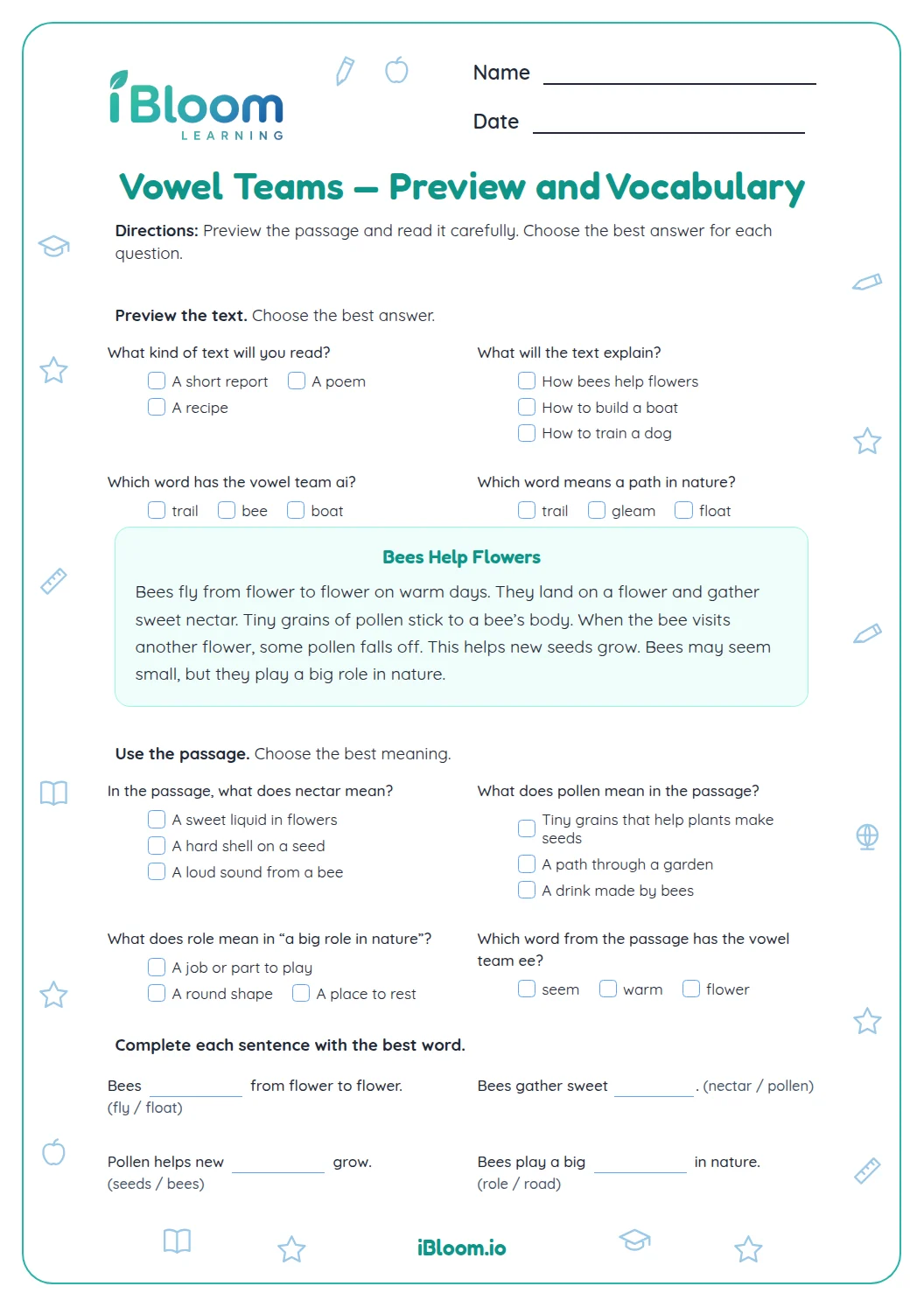
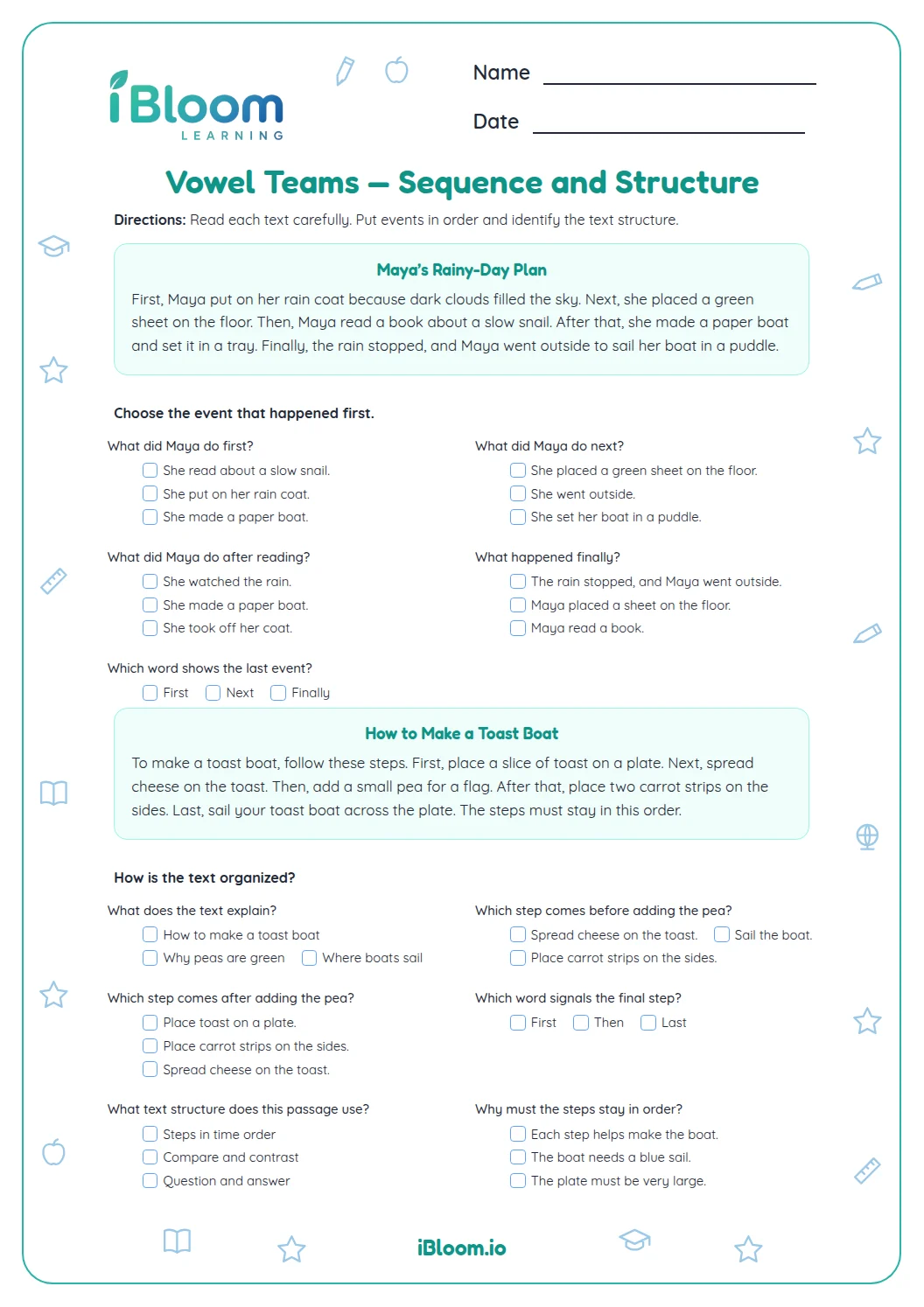
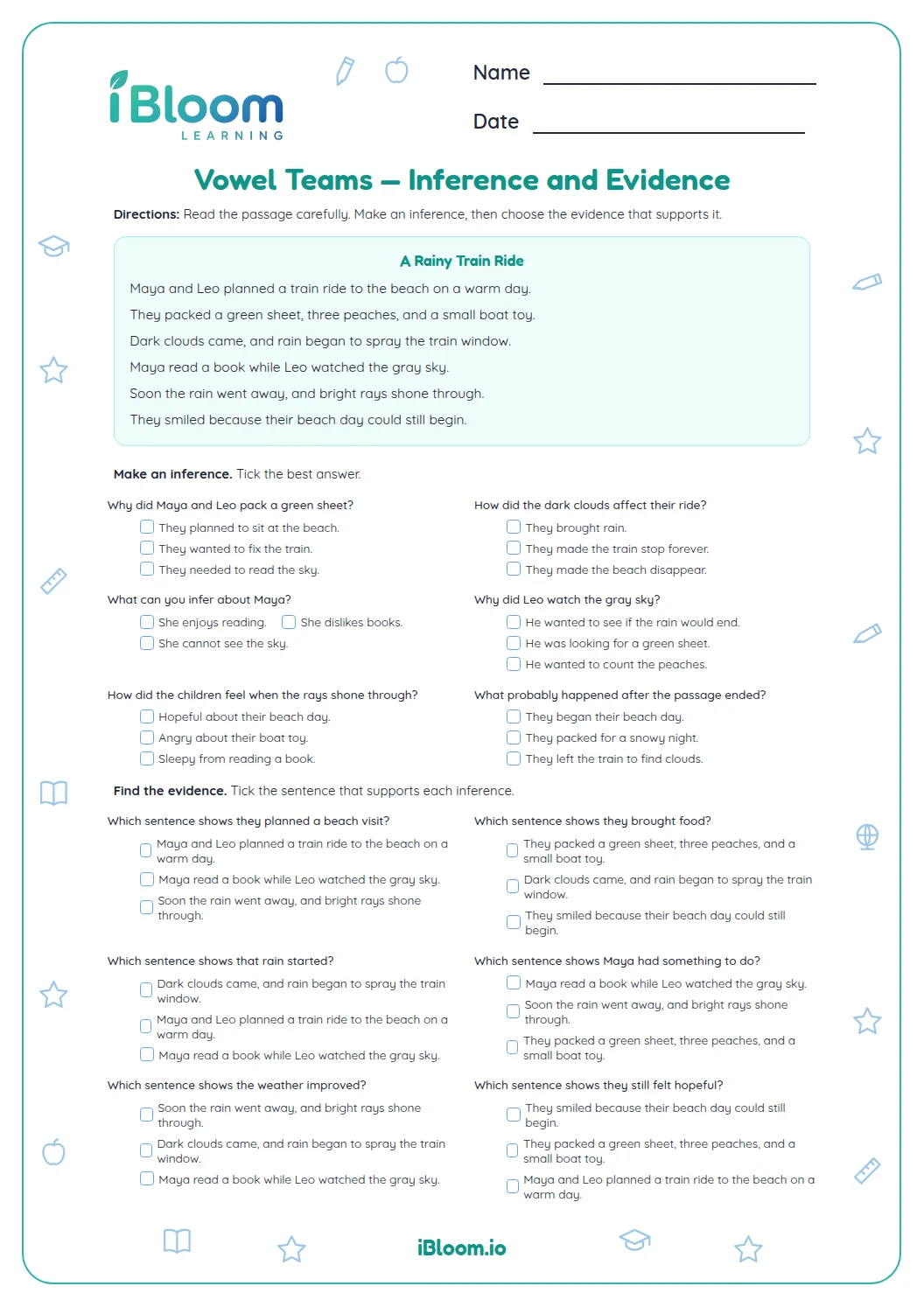
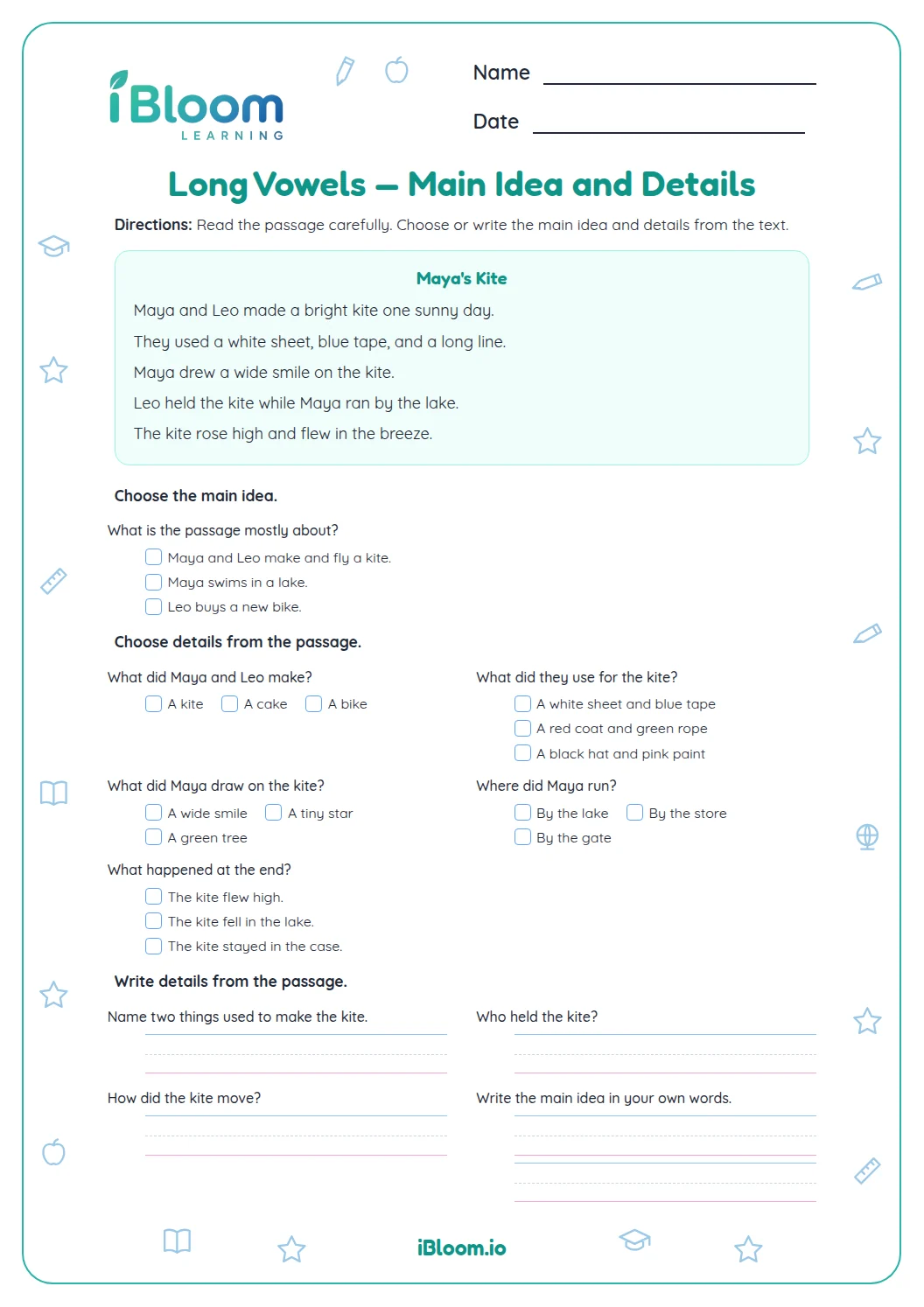
This Grade 2 printable pairs an original rainy-day train story with 14 questions. Students choose words with ai and ay, answer a question about the sound ai spells, respond to story details, and write sentences using target words. The passage gives spelling-sound practice a clear context, while the answer key provides response models. The page practices common vowel-team correspondences through reading and written response.
Aligned to 2.RF.3.b
How can a reader find ai and ay?
Read the whole word and look for the target two-letter spelling. Part B asks students to select one passage word with ai and one with ay; later questions check the sound ai spells and passage clues.
- 1rain → ai
- 2Jay → ay
How can the story support a written answer?
Questions 3–7 and 10 ask about what happened in the story. Reread the lines around each detail and answer in your own words.
How do spelling and story details work together?
Part D asks students to use a vowel-team word or story detail to answer short questions. One asks for the sound ai spells in train; the others check details such as the day, toy train, and porch.
How to use this worksheet
- 1Read the story once for meaning before looking at the questions.
- 2Circle ai or ay in a word when locating a spelling, then read the full word aloud.
- 3Return to the passage to find details for the written responses.
- 4Say the sound in train, then write one sentence with an ai word and one with an ay word.
- 5Check answers with the key and point to the passage evidence for detail questions.
Vowel-team reading mistakes and fixes
The mistake
Naming a word with the wrong spelling, such as train for ay.
The fix
Look directly at the two letters and match them to the spelling named in the question.
The mistake
Copying a passage detail from memory and changing it.
The fix
Reread the sentence and check the names and actions before writing.
The mistake
Writing a target word without making a complete sentence.
The fix
Add who or what the sentence is about and what happens, then reread it.
Common Core alignment
This sheet gives focused practice with the skill named in the standard.
Use common vowel teams to connect spellings such as ai and ay with their sounds.
On this sheet: Children locate and use ai and ay words in an original passage.
Show the official wordingHide the official wording
Know spelling-sound correspondences for additional common vowel teams.
What to practice next
Make more practice
Further reading
Questions parents and teachers ask
What vowel teams does this story practice?
The passage practices ai in rain, train, and trail, and ay in Saturday and Jay. Children choose words with each spelling, answer what sound ai spells in train, and use vowel-team words in original sentences. The story also supplies details for written responses.
Should children read the passage before answering?
Yes. The questions ask readers to find spellings and retrieve details from the story. Reading it once for meaning and again to locate evidence is a useful approach. Children may refer back to the passage as they write. The key models how to answer in a complete sentence.
What makes a complete written response?
A response should answer the question in a clear phrase or sentence and match a detail in the passage. Questions 8 and 9 ask children to use a vowel-team word in an original sentence that makes sense. Encourage the child to reread the relevant lines before finishing the answer.
Are there multiple possible answers?
Yes. Some detail questions allow equivalent wording, and the sentence prompts are open-ended. The key provides examples and identifies the information a correct response should include. A different answer can be right if it matches the story. The important check is whether the response is supported by the story details.
Is the story included on the worksheet?
Yes. The original passage, The Rainy-Day Train, appears before the questions. Children can refer back to it while finding vowel teams and checking their answers. The answer key is printed separately for review. The key makes it easy to review each response after the reading is complete.