

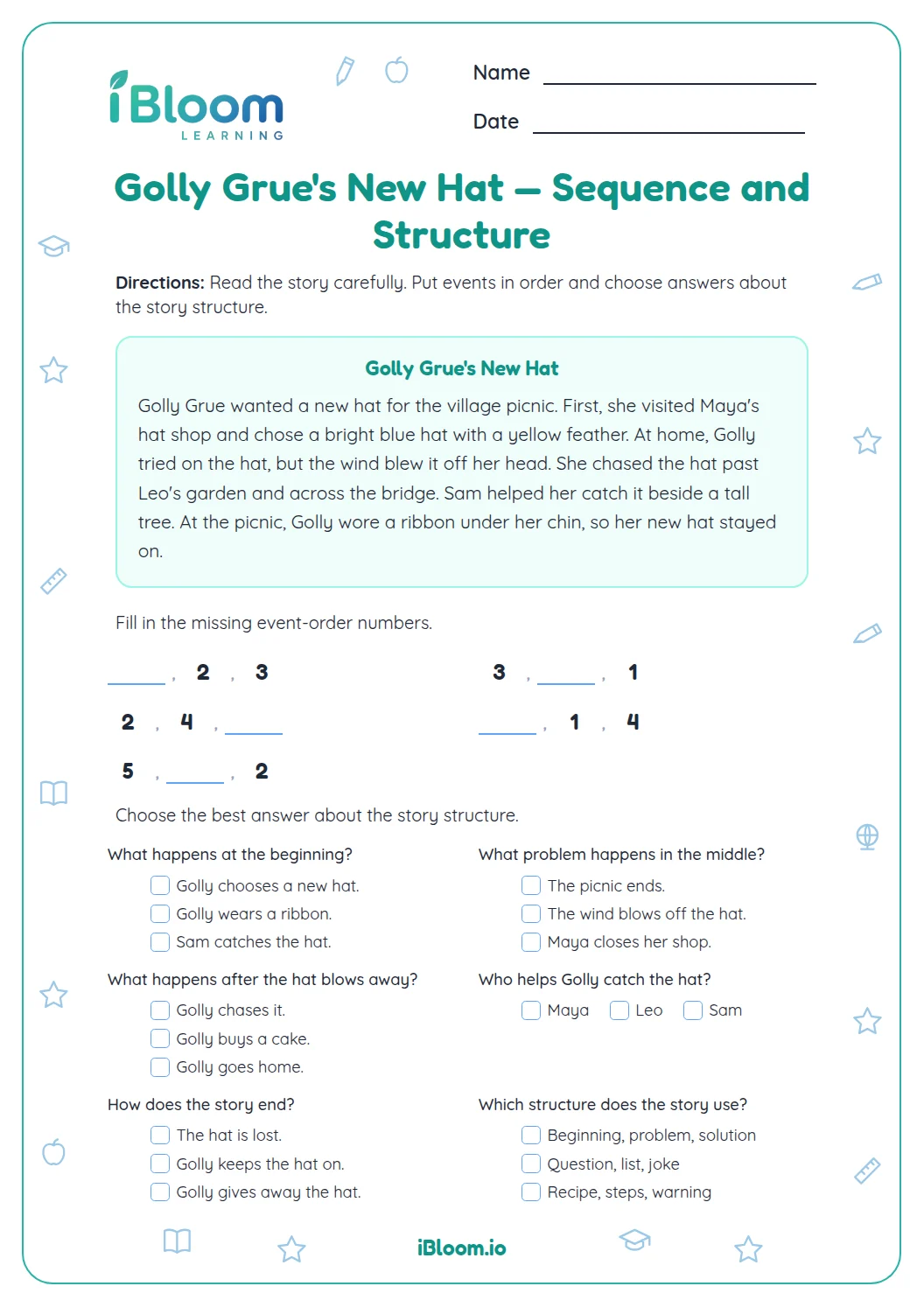
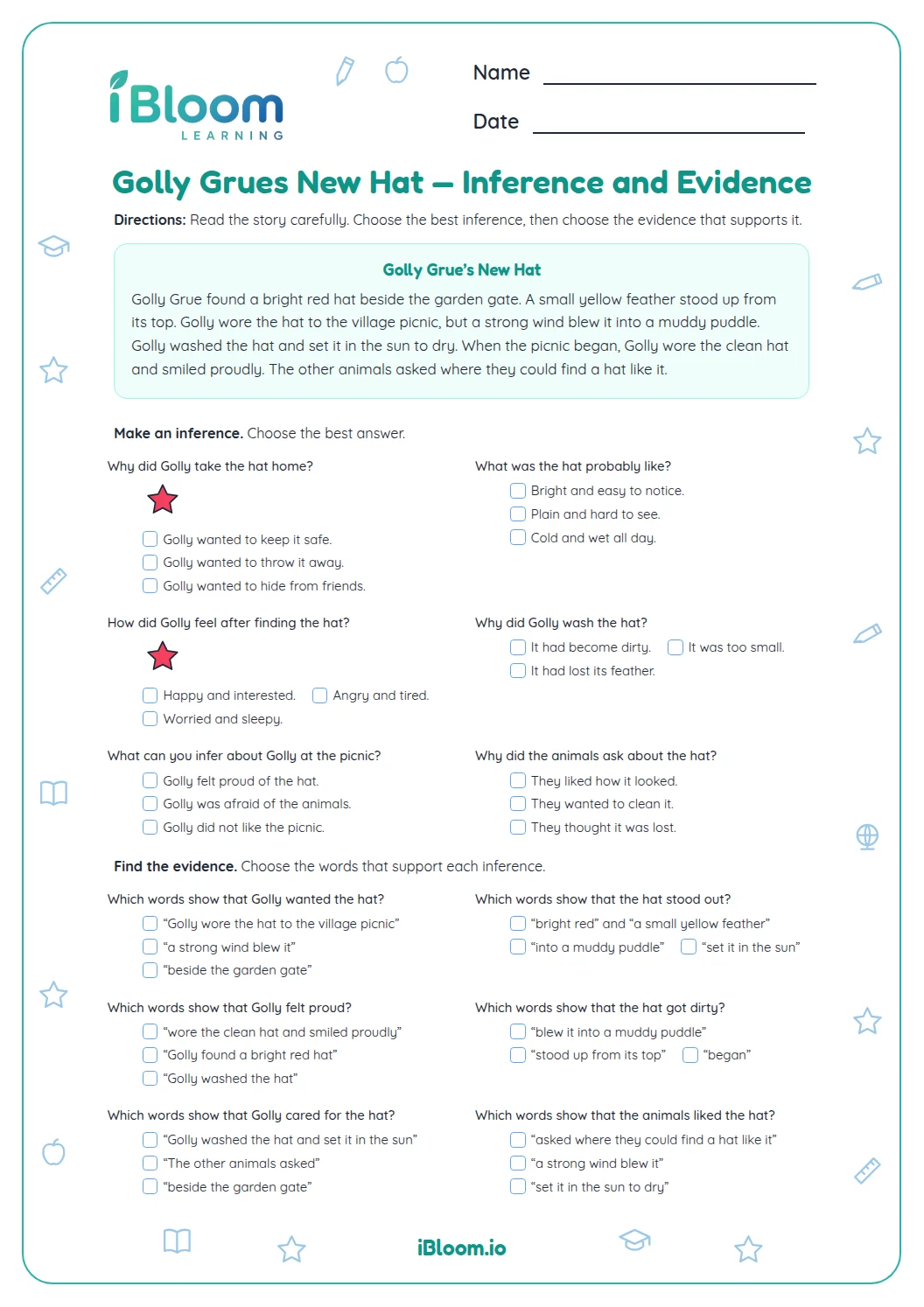
About this worksheet
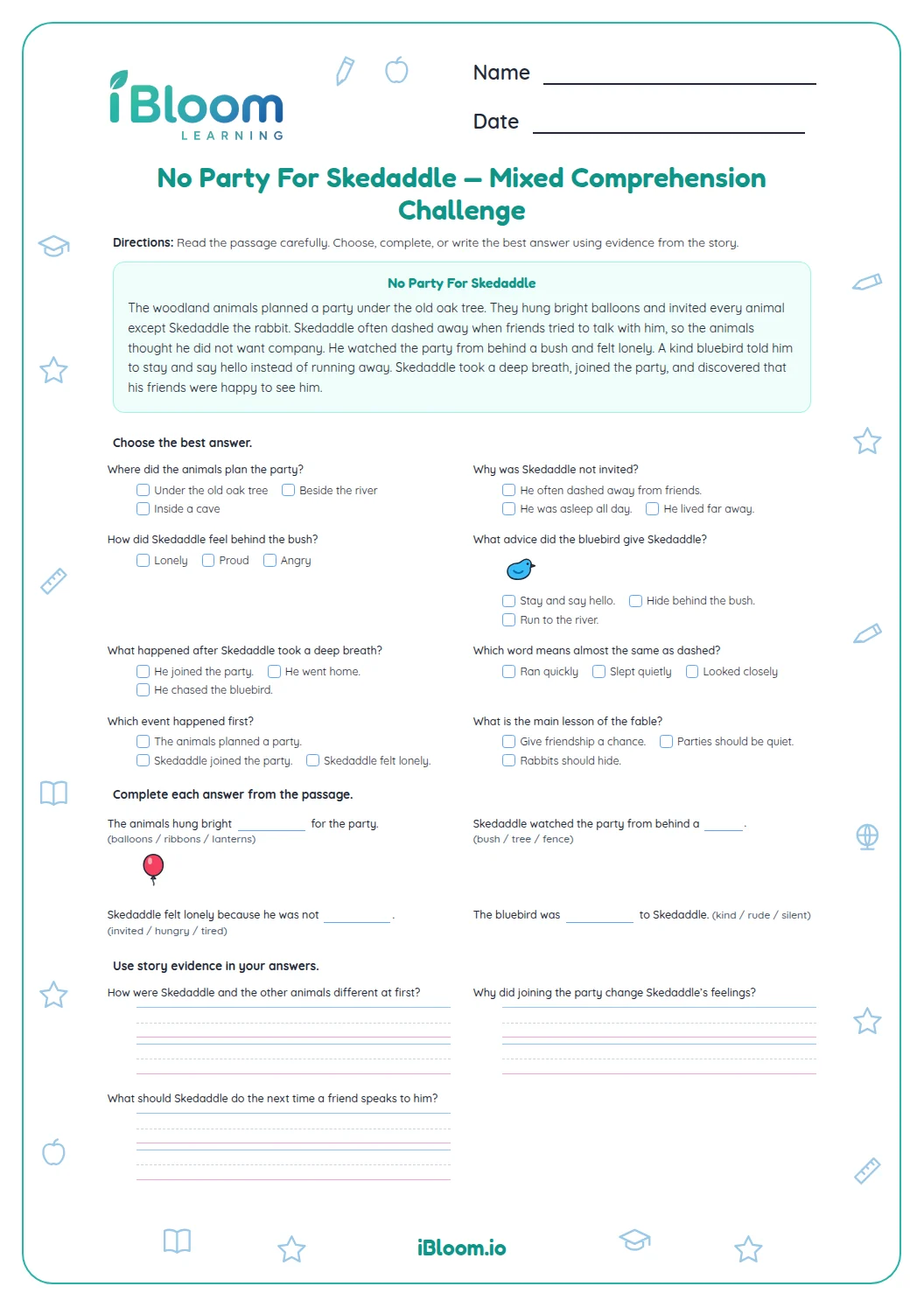
This Grade 2 printable uses a short original retelling of No Party for Skedaddle, about a rabbit who earns a party invitation by bringing carrots and helping clean up. Children answer questions about story details, then write four responses that use events as evidence. It practices CCSS RL.2.1 and includes sample answers on a separate key page.
Aligned to RL.2.1
How does a story detail support an answer?
A response is stronger when it names something that happened. Question 11 asks how Skedaddle showed he was sorry. Children can point to the event: he brought fresh carrots to Squirrel and promised to help.
- 1Question: How did Skedaddle show he was sorry?
- 2Detail: He brought fresh carrots and promised to help.
- 3Answer: He brought fresh carrots and promised to help.
How does Skedaddle’s thinking change?
At first, Squirrel leaves Skedaddle out because he took food and ran without helping. He brings carrots and promises to help, so she lets him join. After the games, he stays to clean up. Children can use these events to explain how he earns trust.
What kind of writing is on the worksheet?
Part B asks for facts and short explanations directly from the fable. Part C asks children to explain how Skedaddle changes, how his actions change Squirrel’s choice, and what the ending teaches. Sample answers show one clear way to respond.
- Part B: ten story-detail questions
- Part C: four responses supported by a story event
- An original short passage and separate answer key
How to use this worksheet at home or in class
- 1Read the fable and notice why Skedaddle was left out.
- 2Mark what Skedaddle brings and what he promises.
- 3Answer who, what, where, and why questions with story details.
- 4For each Part B response, choose an event as evidence.
- 5Reread each answer and check that it answers the whole question.
Common mistakes and quick fixes
The mistake
Giving an opinion without a story event.
The fix
Add one thing Skedaddle or Squirrel did as support.
The mistake
Saying Skedaddle was invited at the beginning.
The fix
Check the first two sentences: Squirrel leaves him out at first.
The mistake
Explaining the ending without mentioning clean-up.
The fix
Use the event after the games: Skedaddle stays and helps clean up.
Common Core alignment
This worksheet practices the standard below through its printed questions.
Answer who, what, where, when, why, and how questions with story details.
On this sheet: Questions ask children to retrieve and explain key events and use a detail in a response.
Show the official wordingHide the official wording
Ask and answer such questions as who, what, where, when, why, and how to demonstrate understanding of key details in a text.
What to practice next
Make more practice
Further reading
Questions parents and teachers ask
Why was Skedaddle left out at first?
Squirrel did not invite Skedaddle because he had grabbed food and left without helping clean up. The passage gives this reason before describing how he feels and what he does next. Children can use those details to explain the invitation rather than guess from the ending.
How does Skedaddle show that he wants to make things right?
He brings fresh carrots to Squirrel and promises to help. Squirrel lets him join after seeing that he is sorry, and he helps clean up after the games. A response can name one or both actions, depending on what the question asks.
How many questions ask for written responses?
Four questions in Part C ask children to explain an event or lesson in their own words. The first ten questions in Part B focus on details and short explanations. The separate three-page key gives sample responses; other wording is fine when it matches the story.
What should a strong written answer include?
A strong answer responds to the whole question and includes a detail from the fable. For example, to explain how Skedaddle shows he is sorry, a child might mention that he brings carrots and promises to help. For the ending, the clean-up detail supports the idea that he becomes more thoughtful.
Can a child use different words from the answer key?
Yes. The key provides sample responses for questions where answers can vary. A child may use shorter or different wording if it answers the prompt and matches the passage. For a factual detail, check that the answer names the right character, action, or place.