


About this worksheet
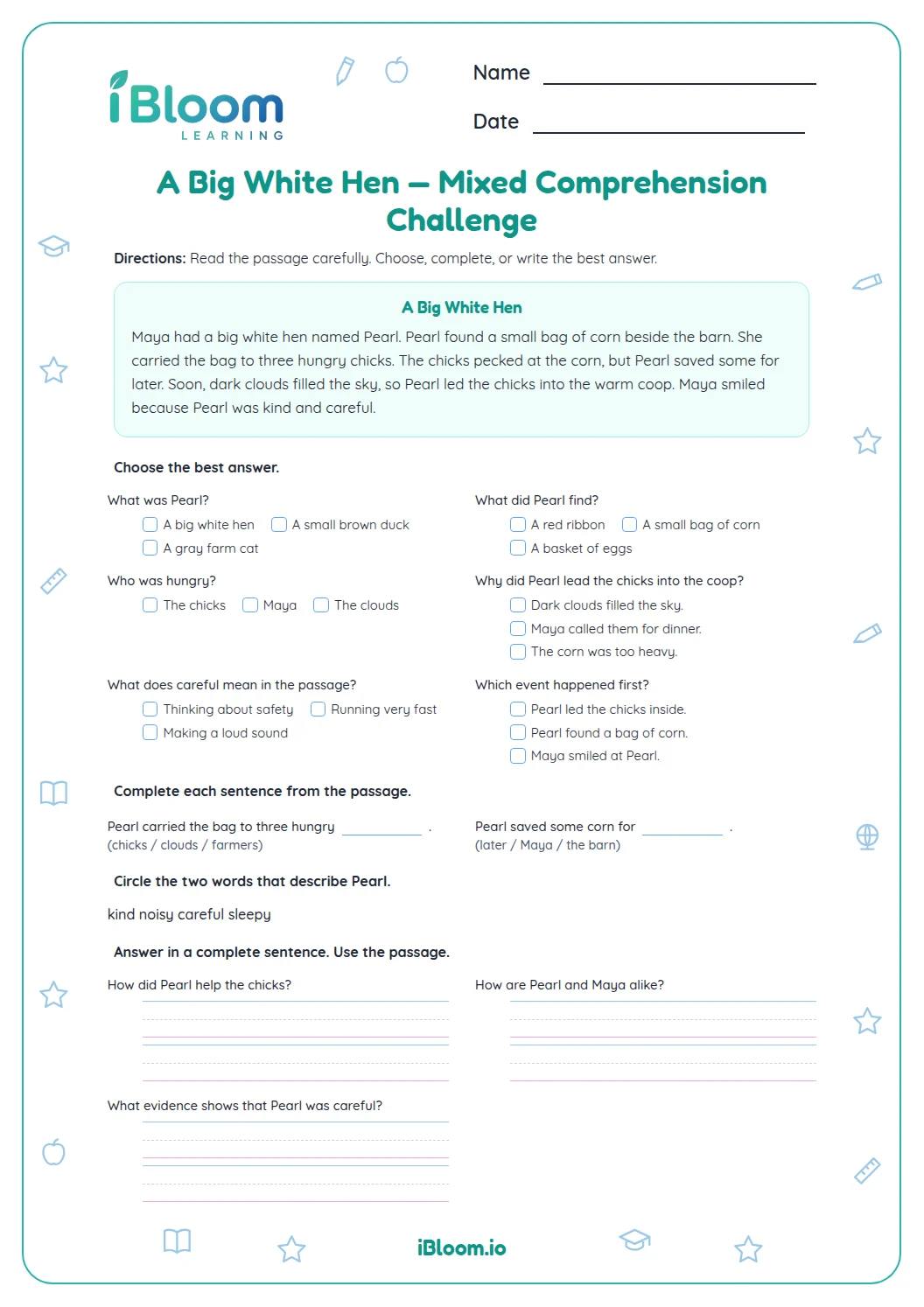
This free Grade 2 reading worksheet follows Pearl, a big white hen, as she finds seeds, shelters from rain, eats corn, and returns to her coop. The short passage prints as Part A. Students answer four inference questions in Part B, match four ideas to evidence in Part C, and explain two answers in Part D. The work supports CCSS RL.2.1 and RL.2.3 through questions about story details and Pearl’s responses to events. The separate answer key includes choices and sample written explanations.
Aligned to RL.2.1 and RL.2.3
What can readers infer about Pearl?
Readers can infer that Pearl searches for food, seeks shelter, and is ready to rest at sunset. The passage gives the actions that support those ideas, even when it does not state her reason directly.
Keep the distinction simple: “She hurried under the porch roof” is a detail readers can find. “She wanted to stay dry” is an explanation they infer from the rain and her movement.
How do the evidence questions build on the inferences?
Part C returns to four ideas from Part B. Students choose the detail that supports each one. All choices should be checked for relevance: Pearl’s white feathers describe her appearance, but they do not explain why she scratches the dirt.
- 1Question 2: Why does Pearl go under a roof?
- 2Inference: To stay dry.
- 3Story clue: Rain begins, and Pearl hurries under the porch roof.
- 4Question 6 asks students to recognize that shelter-seeking action as evidence.
What should the two written answers include?
Question 9 asks students to predict Pearl’s response to another rainy day and support it with her earlier action. A response such as “Go under the roof because she went there when it rained” connects a reasonable prediction to evidence.
Question 10 asks why Pearl returns to the coop at sunset and requests two clues that make it a good resting place. Its warmth and Pearl’s nest support the answer. Students may use their own words; the key supplies a short model.
How to use this worksheet
- 1Read Part A once to follow Pearl through her day.
- 2Reread the rain and sunset sentences, naming what Pearl does.
- 3Answer Part B and point to a clue for each inference.
- 4Choose the supporting details in Part C, checking that each one matches the idea.
- 5Write Part D answers with an idea and the requested evidence, then compare with the key.
Mistakes to notice and fix
The mistake
Choosing a guess about Pearl that has no supporting detail.
The fix
Return to what she actually does: scratches, shelters, eats, and settles.
The mistake
Using her white feathers as evidence that she looks for food.
The fix
Use the action connected to food: scratching the dirt and finding seeds.
The mistake
Writing only “Yes” about the coop.
The fix
Add both supporting details: warmth and a nest.
Common Core alignment
Answer questions about Pearl and use key story details to support each answer.
On this sheet: Students answer why questions and select or write details that support their ideas.
Show the official wordingHide the official wording
Ask and answer such questions as who, what, where, when, why, and how to demonstrate understanding of key details in a text.
Describe how Pearl responds to rain and the end of the day.
On this sheet: Students connect rain to seeking shelter and sunset to returning to the nest.
Show the official wordingHide the official wording
Describe how characters in a story respond to major events and challenges.
What to practice next
Make more practice
Further reading
Questions parents and teachers ask
Does this worksheet include the story?
Yes, the complete short story about Pearl prints as Part A. Children can refer back to it while answering every question. The passage follows one day, from leaving the coop in the morning to settling on a nest at sunset, so its details are easy to locate.
What is the difference between an inference and a detail?
An inference is an idea a reader works out from clues, while a detail is information the text gives directly. Pearl’s move under the roof is a detail. Wanting to stay dry is an inference supported by that move and the fact that rain has started.
Can I read the passage aloud to my child?
Yes, you can read the passage aloud and let your child follow the print. Pause after each paragraph to retell Pearl’s actions. Keep the text available during the questions, and ask your child to point to the words that support an answer before explaining the idea aloud.
Are different written answers acceptable?
Yes, accept different wording when it answers the question and uses a relevant story detail. For the rainy-day prediction, returning under the porch roof is supported by Pearl’s earlier action. For the coop question, look for both warmth and the nest. The key provides models for these responses.
Why are some ideas asked about twice?
The sheet separates making an inference from identifying its evidence. Part B asks about Pearl’s needs and feelings and what the farmer’s action suggests. Part C asks which detail supports those ideas. This paired practice prepares children to explain their own answers in Part D.