

About this worksheet
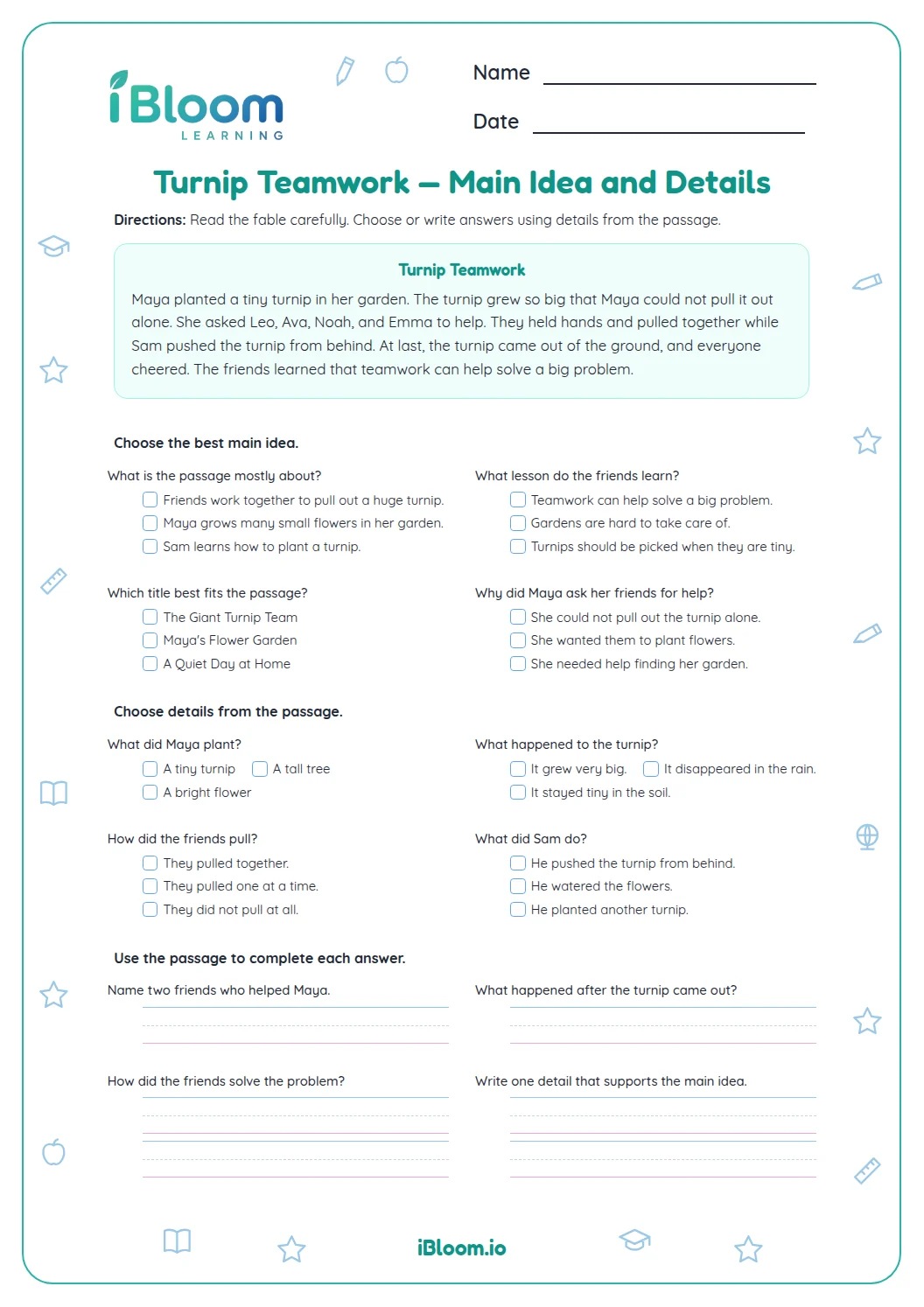
This free printable Grade 2 reading worksheet pairs an original short fable, “The Turnip Team,” with 14 comprehension questions. Children follow Maya’s turnip and the helpers who join her, then examine event order and how the beginning and ending shape the story. It practices Common Core RL.2.5. A separate answer key is included.
Aligned to RL.2.5
How do you follow the events in a fable?
Sequence means the order in which events happen. Keep track of what starts the story, what changes, and what the characters do next. This passage begins when Maya finds a giant turnip, then follows Leo, Ava, Noah, Emma, and Sam as they join her effort to pull it free.
Questions 1–7 check details and character actions. Questions 8–11 ask readers to put events in order.
How does the beginning set up the ending?
A story’s beginning introduces its characters and situation. The middle develops a problem, and the ending shows how the action concludes. In this fable, the giant turnip will not move; the friends’ shared effort solves the problem, and carrying it home for dinner closes the story.
- 1Maya pulled first; Leo joined before Ava and Noah.
- 2The friends carried the turnip home after it came free.
- 3Order: Maya pulls; friends join; they carry it home.
Which details support the lesson?
A fable’s lesson grows from what the characters do and what changes. Look for the moment the problem is solved, then connect that event to the final words. Here, the friends pull together and the turnip comes free, supporting Maya’s idea that friends make a hard job easier.
How to use this worksheet
- 1Read the fable once to learn who is in it and what problem appears.
- 2Reread when a question asks for a detail or action.
- 3For sequence questions, name what happened first, next, and last.
- 4For structure, compare how the beginning introduces the problem with how the ending closes it.
- 5Choose the answer supported by the passage, not by a guess.
- 6Check the answer key and point to a sentence that supports each choice.
Common mistakes and quick fixes
The mistake
Mixing up the order in which helpers arrive.
The fix
Retell the pulling scene one character at a time: Maya, Leo, Ava and Noah, then Emma and Sam.
The mistake
Choosing a detail that is true but does not answer the question.
The fix
Match the question word, such as first, just before, or last, to the event.
The mistake
Treating the lesson as an event.
The fix
Name what happened, then ask what the characters’ actions show.
Common Core alignment
This fable practice follows story events and examines how the beginning and ending shape the action.
Describe how the opening introduces the story and the ending brings its action to a close.
On this sheet: Questions ask how the seed-and-turnip problem begins and how the carry-it-home ending concludes it.
Show the official wordingHide the official wording
Describe the overall structure of a story, including describing how the beginning introduces the story and the ending concludes the action.
What to practice next
Make more practice
Further reading
Questions parents and teachers ask
What is the fable The Turnip Team about?
Maya finds a giant turnip and cannot pull it out alone. Leo joins her first, then Ava and Noah, followed by Emma and Sam. Their combined effort frees the turnip, and the friends carry it home for dinner.
How does the worksheet practice sequence?
Questions ask what happened first, which event came just before the turnip came free, and what happened last. Students also choose a correctly ordered list. Rereading the pulling scene helps keep Maya, Leo, Ava, Noah, Emma, and Sam in the right order.
What does story structure mean here?
Story structure describes how a story is arranged. The beginning introduces Maya and the stuck turnip; the ending shows the friends carrying it home after solving the problem. Several questions ask students to connect those parts to the whole action.
What lesson does Maya learn?
Maya learns that a hard job feels easier when friends work together. The friends’ actions support this idea: Maya cannot pull the giant turnip alone, but the group succeeds when each person joins the line. Their teamwork changes the outcome.
Should a student answer from memory or reread?
Rereading is useful, especially for questions about order. Ask the student to find the sentence that names an event and compare it with the words first, just before, or last in the question. This keeps answers grounded in the fable.
How long does this reading worksheet take?
Plan for about 20 minutes for the 14 questions, including one careful reading and a quick reread of the pulling scene. The answer key is separate and gives a straightforward way to check each choice against the passage.