

About this worksheet
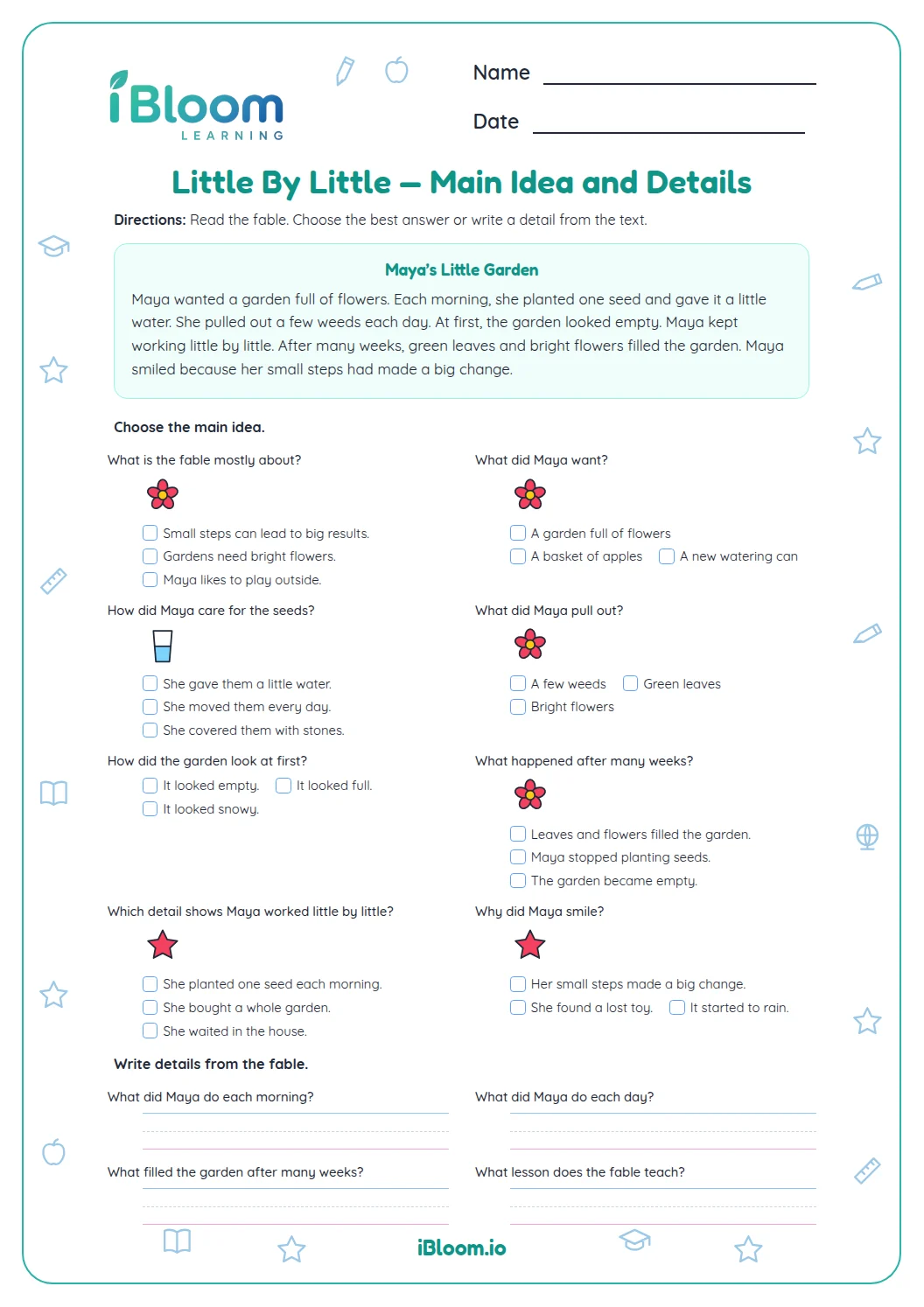
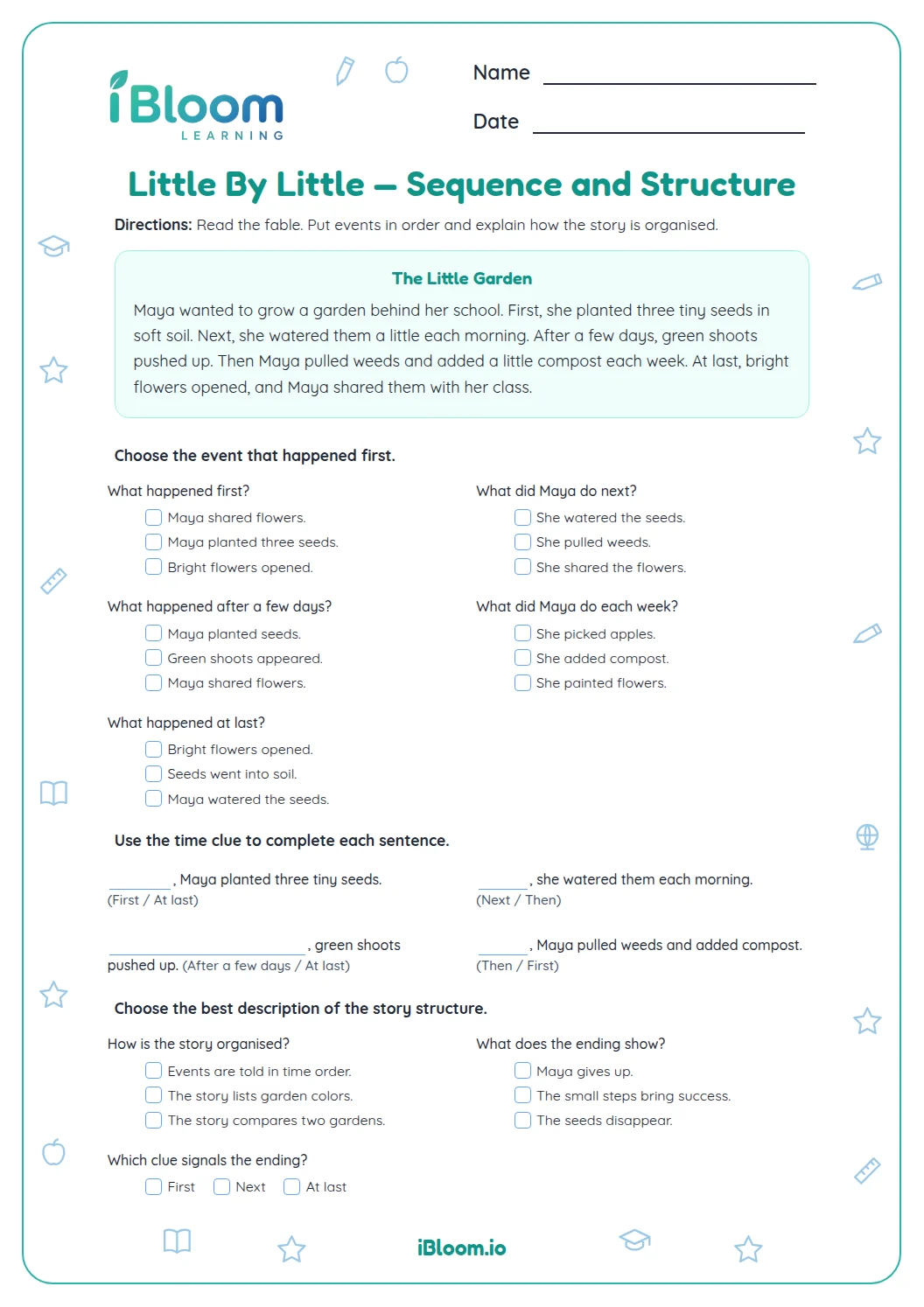
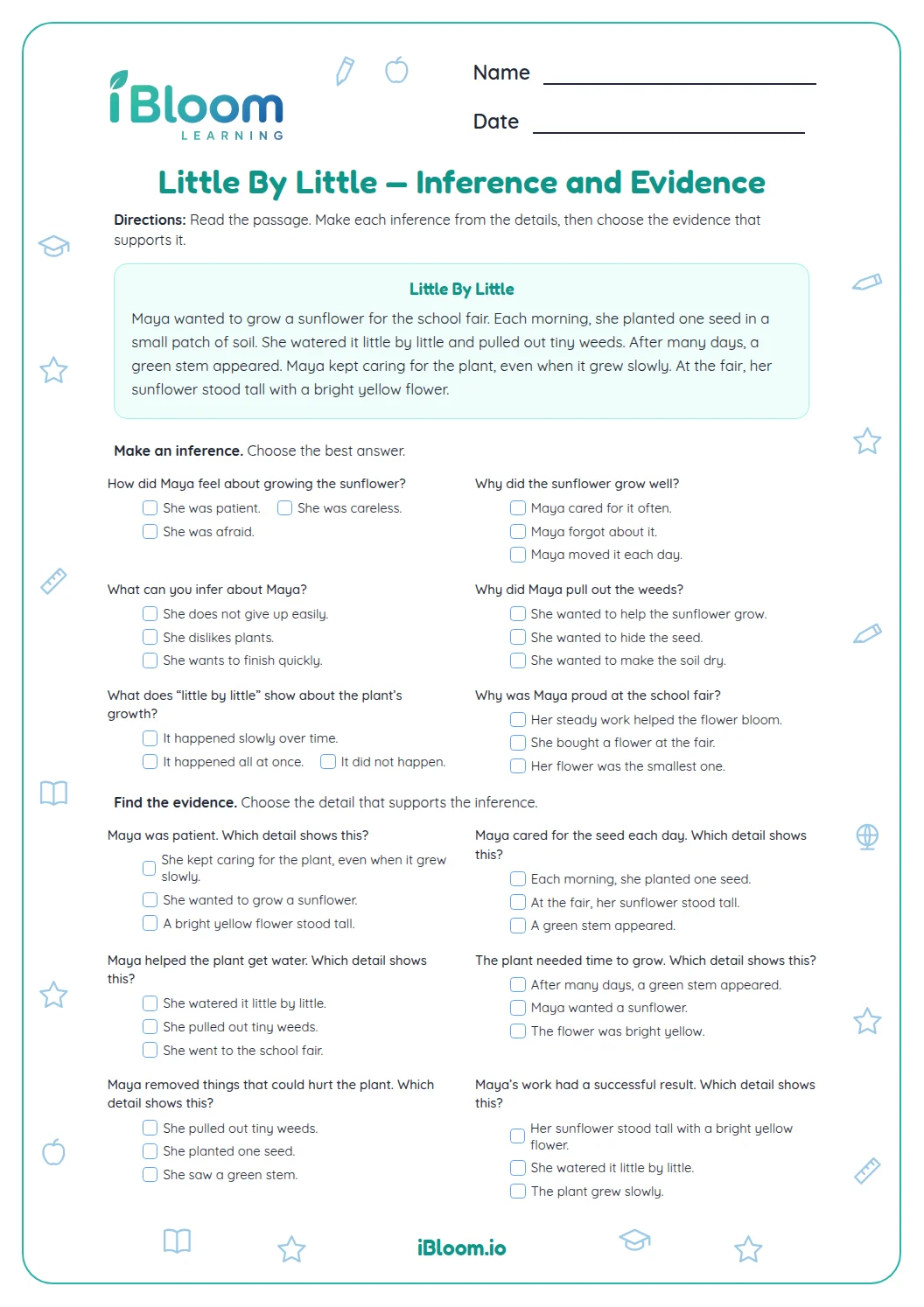
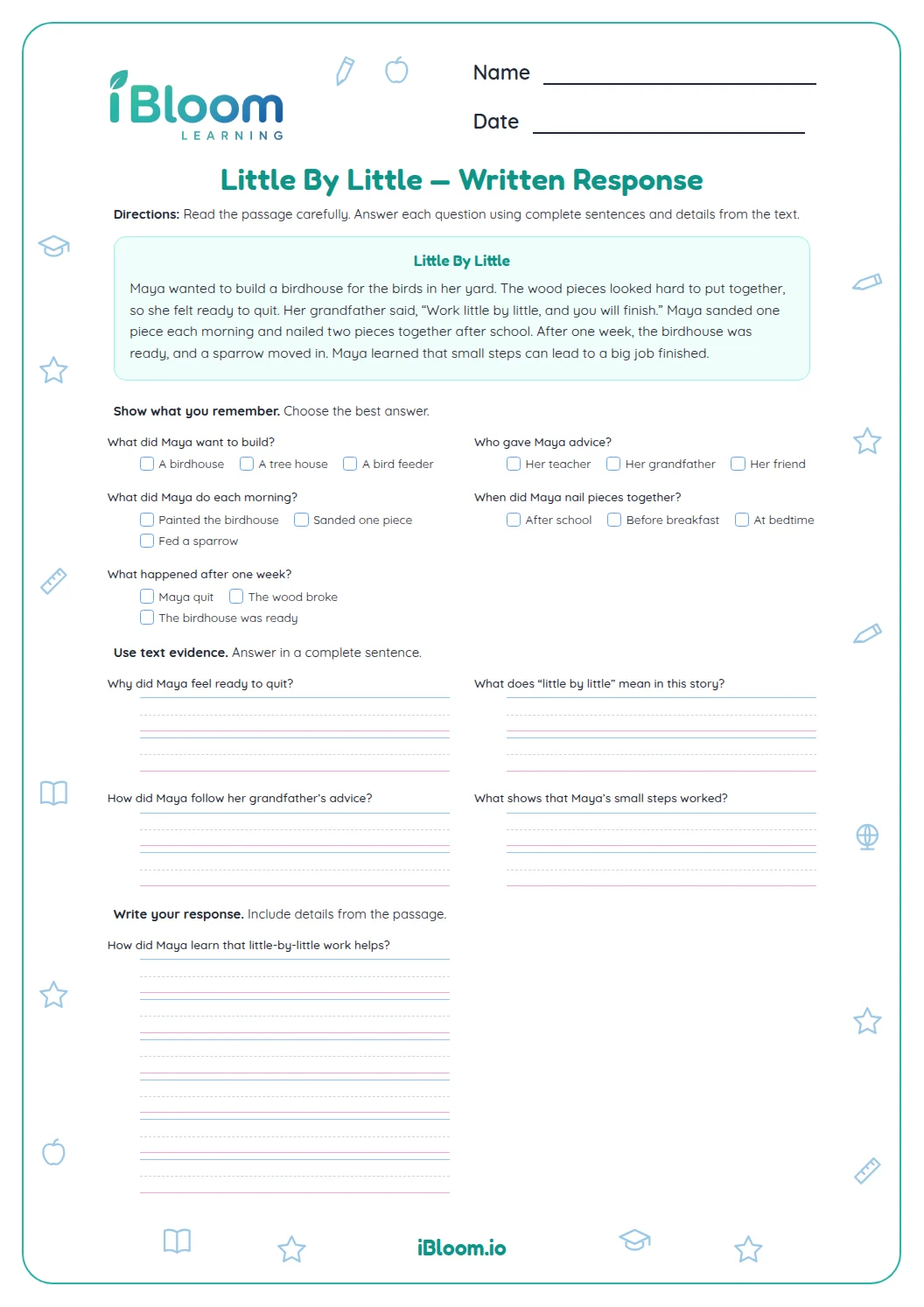
This free Grade 2 printable pairs “The Water Jar,” a short fable about Maya filling a jar one cup at a time, with 16 questions. Children preview the fable, use sentence clues for vocabulary, recall details, and complete lines from the story. Two final written responses ask them to explain the lesson and cite an action. The answer key includes sample responses. The story questions practice answering about key details in a literary text (CCSS RL.2.1).
Aligned to RL.2.1
How does the fable preview prepare readers?
The opening questions ask children to think about the fable form, the title phrase, context clues, and a possible lesson. These prompts help them notice what they can learn from the story before answering detail questions.
How can children use story words as clues?
Read the whole sentence and consider what happens around an unfamiliar word. Maya carries water, and “the water rose,” so rose means went up. The next word-completion questions use key details from the same passage.
- 1What does “rose” mean in the fable?
- 2Maya is carrying water into a jar.
- 3The water level went up, so rose means went up.
What makes a strong written response?
Answer the question directly and point to an action in the story. For example, Maya keeps carrying one small cup at a time, which shows that she keeps trying. The key gives a sample answer, but children may use their own wording.
How to use the worksheet
- 1Preview the fable by thinking about its title, text type, and possible lesson.
- 2Read the passage and follow Maya’s actions.
- 3Use nearby words to choose the meaning of rose and patient.
- 4Complete the four sentences with words from the fable.
- 5Answer the two final questions with a story detail.
- 6Check the choices and sample responses with the key.
Fable-reading mistakes and quick fixes
The mistake
Guessing a word meaning without rereading its sentence.
The fix
Look at the action around the word; Maya’s water rises in the jar.
The mistake
Choosing a lesson that does not match the events.
The fix
Connect the lesson to Maya’s repeated small trips and the full jar.
The mistake
Giving a written answer without evidence.
The fix
Name an action from the story, such as carrying one cup at a time.
Common Core alignment
The questions ask readers to use details from a short literary text.
Answer questions about the fable using details from the story.
On this sheet: Children answer questions about Maya’s actions and the lesson using details from the fable.
Show the official wordingHide the official wording
Ask and answer such questions as who, what, where, when, why , and how to demonstrate understanding of key details in a text.
What to practice next
Make more practice
Further reading
Questions parents and teachers ask
What is the fable “The Water Jar” about?
Maya wants to fill a large jar for her garden, so she carries one small cup of water at a time. At first the jar does not look full, but she keeps going until the water rises to the top. The story shows how steady effort can finish a big job.
How many questions are included?
There are 16 questions: four preview prompts, six story and vocabulary questions, four sentence completions, and two written responses. The key gives the correct choices and missing words, plus sample answers for the final questions. Have the child point to the matching detail in the fable.
How can children work out what “rose” means?
Read the full sentence and use the nearby action as a clue. Maya carries cups of water to a jar, and the water rises little by little. In that context, rose means went up. Ask the child to explain which story detail helped.
Can children use different wording in the written responses?
Yes. The two written questions allow children to explain the lesson and name an action in their own words. Check that the answer responds to the prompt and uses a detail from the fable; the key gives sample wording, not the only acceptable sentence.
What does “patient” mean in the story?
Patient describes Maya’s willingness to keep trying even though filling the jar takes many small trips. The story contrasts her steady effort with the slow progress she first sees. The vocabulary question asks children to choose the meaning that fits those actions.