

About this worksheet
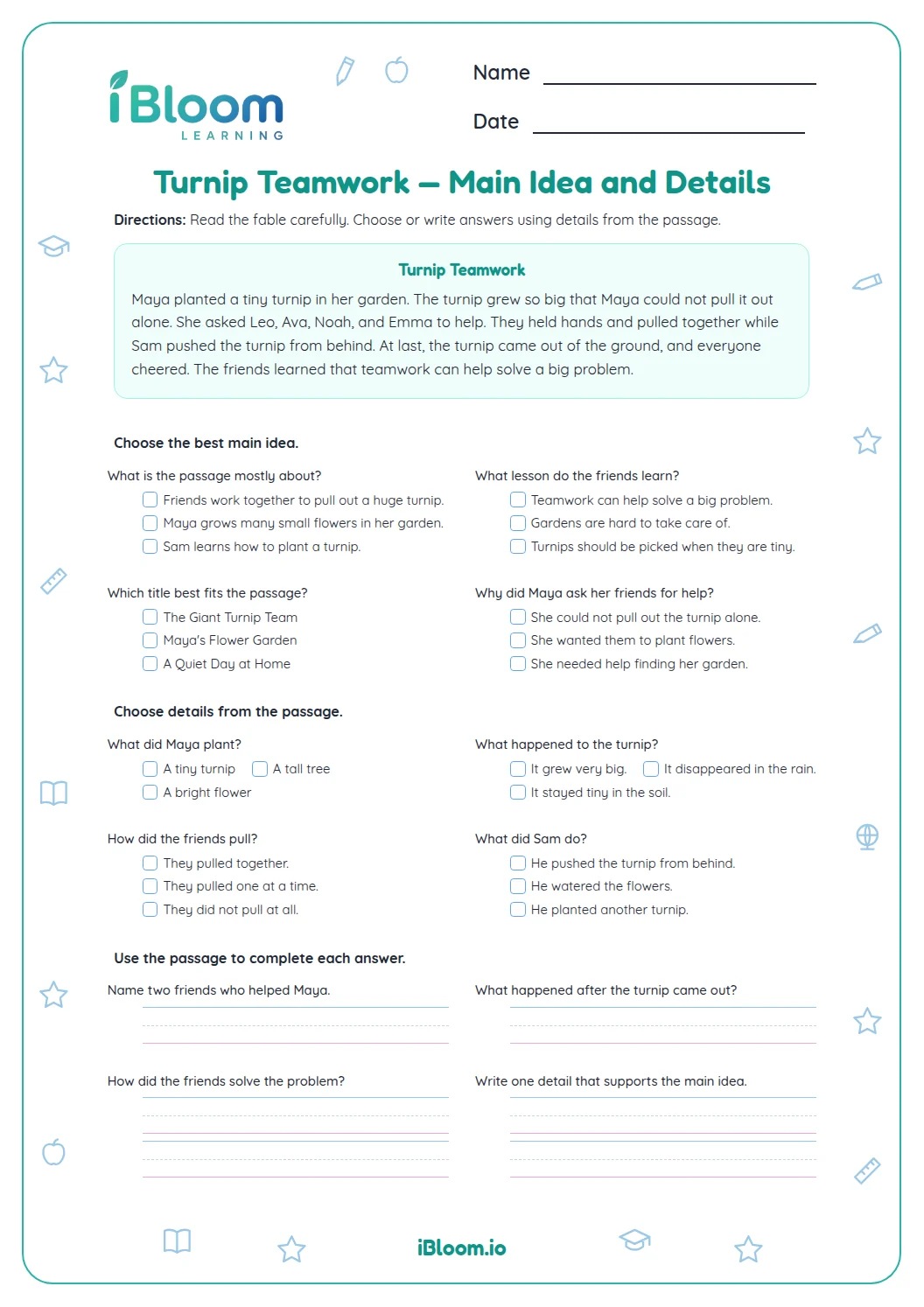
This free Grade 2 reading worksheet uses the Turnip Teamwork story to practice drawing an inference and finding a detail that supports an answer. Children read about Grandpa, Maya, Leo, Ava, and Noah working together to pull a giant turnip. Part B asks what readers can infer from the events; Part C asks them to find details stated in the passage. The answer key follows the 14 multiple-choice questions. This practice supports CCSS RL.2.1.
Aligned to RL.2.1
How can readers infer why Grandpa asks for help?
Part B asks readers to connect what Grandpa does with the problem in the story. He pulls, but the turnip does not move; then he calls the children. Those actions support the inference that the turnip is too hard to pull alone.
- 1Clue: Grandpa pulls, but the turnip does not move.
- 2Inference: He calls the children because he needs help.
Which details count as story evidence?
Part C asks for details the passage states directly, such as who Grandpa called or what happened after he pulled. Look back at the passage and match the question to the exact event or character.
How does the ending support the lesson?
The children join the pulling line, and the turnip finally comes out. The sequence supports the idea that working together helped solve the problem.
How to use this worksheet
- 1Read the question and decide whether it asks for an inference or a stated detail.
- 2For an inference, connect two or more clues from the story.
- 3For evidence, return to the passage and find the matching event or character.
- 4Read every choice and eliminate details that are not in the story.
- 5Check the answer key after finishing both question parts.
Common mistakes and quick fixes
The mistake
Choosing a detail that is true but does not answer the question.
The fix
Match the choice to the exact person, event, or reason asked about.
The mistake
Treating an inference as a sentence copied from the story.
The fix
Combine a story clue with what it suggests.
The mistake
Using the lesson as evidence for every question.
The fix
Find the specific event that supports each answer.
Reading standards alignment
This worksheet practices making inferences and citing story evidence at the stated grade level.
making inferences and citing story evidence.
On this sheet: making inferences and citing story evidence.
Show the official wordingHide the official wording
Ask and answer such questions as who, what, where, when, why, and how to demonstrate understanding of key details in a text.
What to practice next
Make more practice
Further reading
Questions parents and teachers ask
What is the Turnip Teamwork story about?
Grandpa cannot pull a giant turnip out by himself, so he calls Maya, Leo, Ava, and Noah. They join the pulling line and work together until the turnip comes out. The story gives readers clues for inferring why Grandpa needs help and details they can locate directly.
What is the difference between an inference and evidence?
An inference is an idea readers figure out by combining clues. Evidence is a detail the passage states. For example, Grandpa pulls without moving the turnip, which is evidence; readers infer that he needs help because the turnip is difficult to pull.
Does the worksheet include the story?
Yes. The Turnip Teamwork passage appears before the questions, so children can reread it while working. It features Grandpa, Maya, Leo, Ava, and Noah, and the events lead to a teamwork lesson. The answer key lets readers check the passage clue they chose.
How many questions are on the worksheet?
There are 14 multiple-choice questions in two parts. Five ask readers to infer a reason, trait, or lesson, and nine ask for an event or detail stated in the passage. A separate answer key follows the three worksheet pages. The answer key lets readers check the passage clue they chose.
How can I help a child find evidence?
Ask the child to point to the sentence or event that supports a choice. For an inference question, help connect that clue to the conclusion. The questions move from understanding character actions to finding direct details in the passage. The answer key lets readers check the passage clue they chose.