



About this worksheet
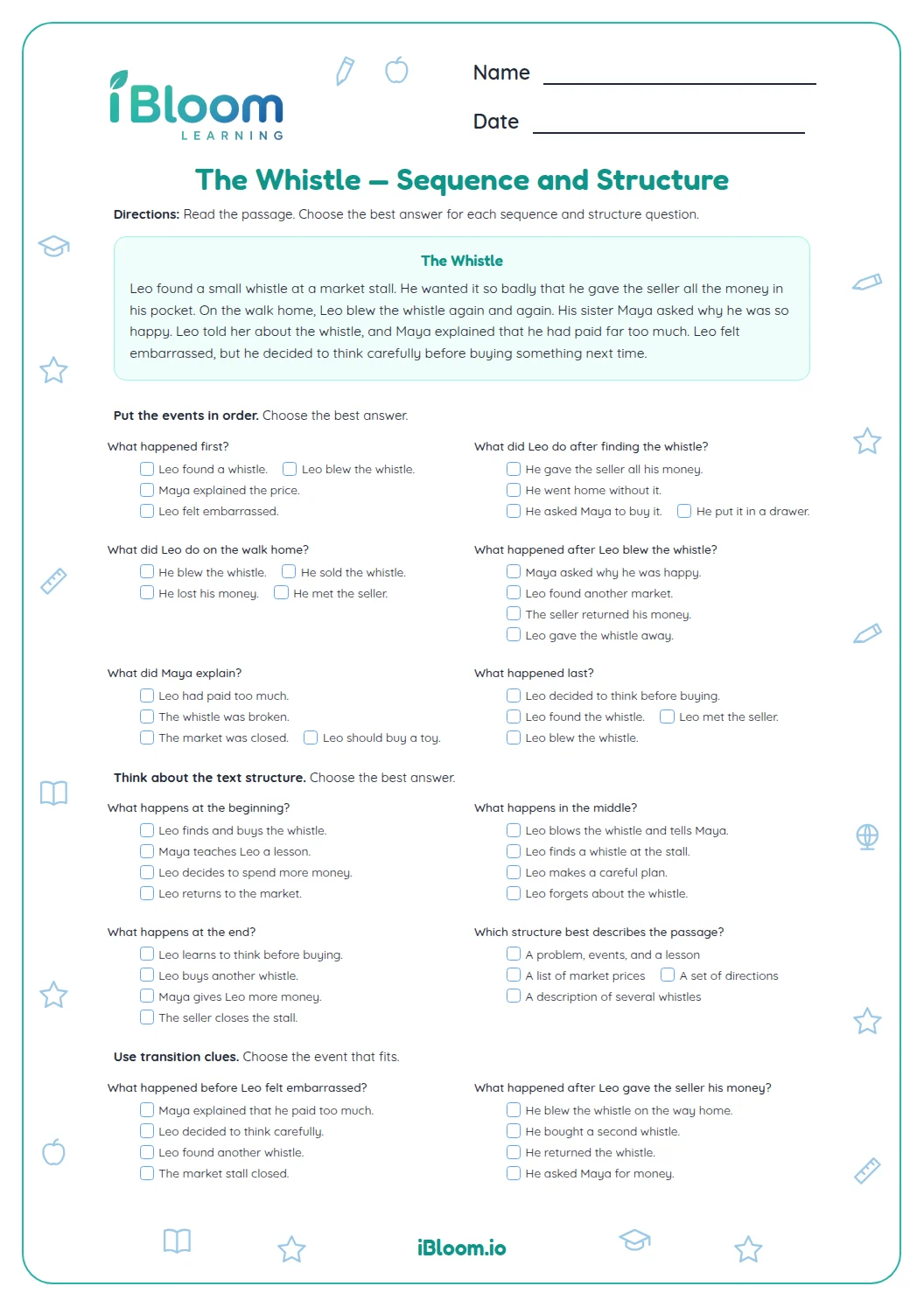
This free Grade 3 reading worksheet pairs The Whistle with ten questions about Leo’s market purchase. Leo spends every dollar he has on a small silver whistle. His sister Maya’s question and the whistle’s unpleasant sound make him reconsider his choice. Part A is the passage. Part B checks six details about the purchase and his first feelings. Part C asks for explanations, a retelling a lesson and a judgment supported by story details. The practice supports Common Core RL.3.1 and RL.3.2. A separate answer key includes four sample written responses.
Aligned to RL.3.1 and RL.3.2
Where can a child find the details?
The first paragraph describes Leo’s savings and purchase. The second introduces Maya’s question and his empty pocket. The third explains why he regrets buying the whistle, and the fourth tells what he plans to do differently.
Part B asks for short answers. In Part C, students use those same facts to explain a change or a lesson. Their wording can differ from the passage while preserving its meaning.
Why does Leo change his mind about the whistle?
Leo first imagines enjoying the whistle and proudly plays it. Later, he listens carefully and notices its sharp, unpleasant sound. Maya’s question also draws his attention to spending all his money on one toy.
- 1Purchase: Leo pays every dollar he has.
- 2Discovery: The whistle sounds sharp and unpleasant.
- 3Sample: No. He spent all his money on a whistle, then regretted its unpleasant sound.
How does the purchase teach a lesson?
Question 9 asks students to judge the purchase and retell it with two details. Question 10 then asks what Leo learns. These prompts connect a specific event to advice the reader could use.
A useful lesson is to think before spending. Support it with Leo handing over every dollar without trying the whistle or considering its price. “Be careful” alone leaves that connection unexplained.
How to use this worksheet
- 1Read the passage once and identify Leo and his sister Maya.
- 2Reread the first three paragraphs to complete Part B.
- 3For question 7, connect Leo’s excitement to his quick purchase.
- 4Track his feelings from proud to regretful before answering question 8.
- 5Use two details to retell and judge the purchase, then explain its lesson.
- 6Compare the written responses with the sample key, accepting supported wording.
Mistakes to notice and fix
The mistake
Saying Maya bought the whistle.
The fix
Maya questions the purchase; Leo saves the money and pays the seller.
The mistake
Saying the whistle broke.
The fix
The passage says its sound was sharp and unpleasant. Leo regrets the purchase even though it still works.
The mistake
Giving the lesson without a story detail.
The fix
Connect thinking before spending to Leo paying every dollar before trying the whistle.
Common Core alignment
Answer questions about Leo’s purchase using details from The Whistle.
On this sheet: Students support factual answers and explanations with Leo’s actions, feelings and Maya’s question.
Show the official wordingHide the official wording
Ask and answer questions to demonstrate understanding of a text, referring explicitly to the text as the basis for the answers.
Retell Leo’s purchase and explain the lesson about thinking before spending.
On this sheet: Students recount the purchase and regret, then connect those events to the lesson.
Show the official wordingHide the official wording
Recount stories, including fables, folktales, and myths from diverse cultures; determine the central message, lesson, or moral and explain how it is conveyed through key details in the text.
What to practice next
Make more practice
Further reading
Questions parents and teachers ask
Is the story printed on the worksheet?
Yes; Part A contains the complete passage about Leo, Maya and the whistle bought at the market. Every question can be answered from that text. Parts B and C move from finding facts to explaining Leo’s feelings, recounting the purchase and identifying the lesson he learns.
How much should students write?
Questions 1 through 6 accept a word or short phrase, while questions 7 through 10 call for a complete sentence. One well-chosen sentence can answer each longer prompt. Ask for a useful story detail, such as Leo’s empty pocket or the whistle’s unpleasant sound, rather than extra length.
Does my child have to quote the passage?
No; students can explain the story in their own words. For question 8, they might say Leo was proud at first but later regretted the purchase because the sound disappointed him. Check that the response names the change and supports it with an event from the passage.
What lesson does Leo learn?
Leo learns to think before spending instead of letting excitement make the choice. He pays every dollar without trying the whistle or considering the price, then regrets its unpleasant sound. A strong answer to question 10 connects that mistake to his plan to pause before another purchase.
How should I use the answer key?
Use the key to check facts and reasoning, while accepting different wording that fits the passage. For question 9, look for a judgment and two details from the purchase and its outcome. The sample names his spending and the unpleasant sound as reasons the purchase was unwise.