Free PDF download
Preview every page of the Survival Written Response worksheet, then download the printable PDF free for homework, tutoring, homeschool, or classroom practice.
Answer with complete evidence-based sentences
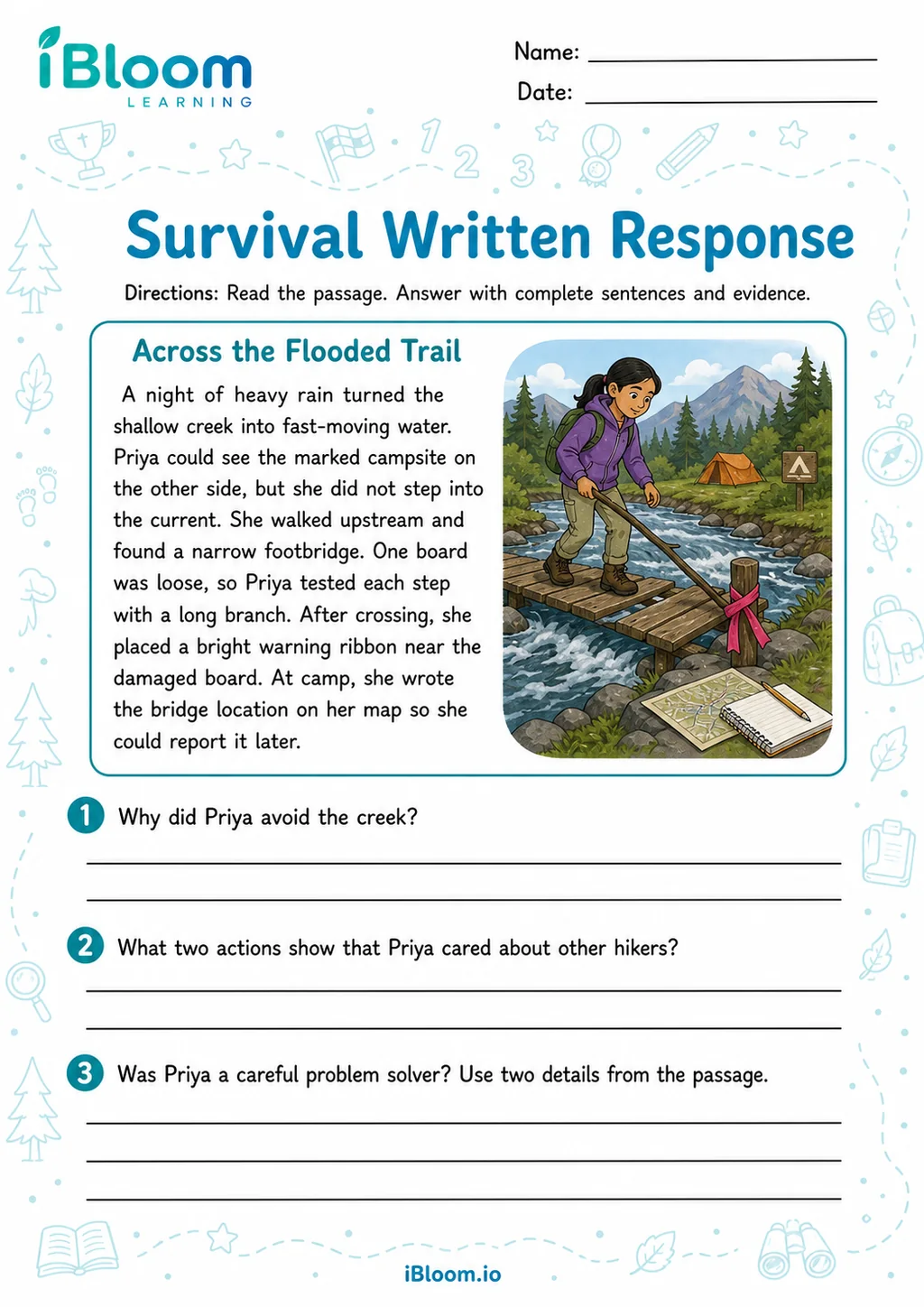
Read Across the Flooded Trail and write three responses about Priya's careful decisions.
Download and curriculum guide
Preview every page of the Survival Written Response worksheet, then download the printable PDF free for homework, tutoring, homeschool, or classroom practice.
Skill codes: CCSS RI.4.1, CCSS W.4.9. Use these codes with the learning objective above when comparing this worksheet with your school or district scope and sequence.
This free worksheet PDF can be downloaded in all 50 states and Washington, DC. State learning standards differ, so teachers should verify the exact local benchmark before assigning it.
Curriculum codes identify useful skill references; they do not mean that every state, district, or board has formally approved this worksheet.
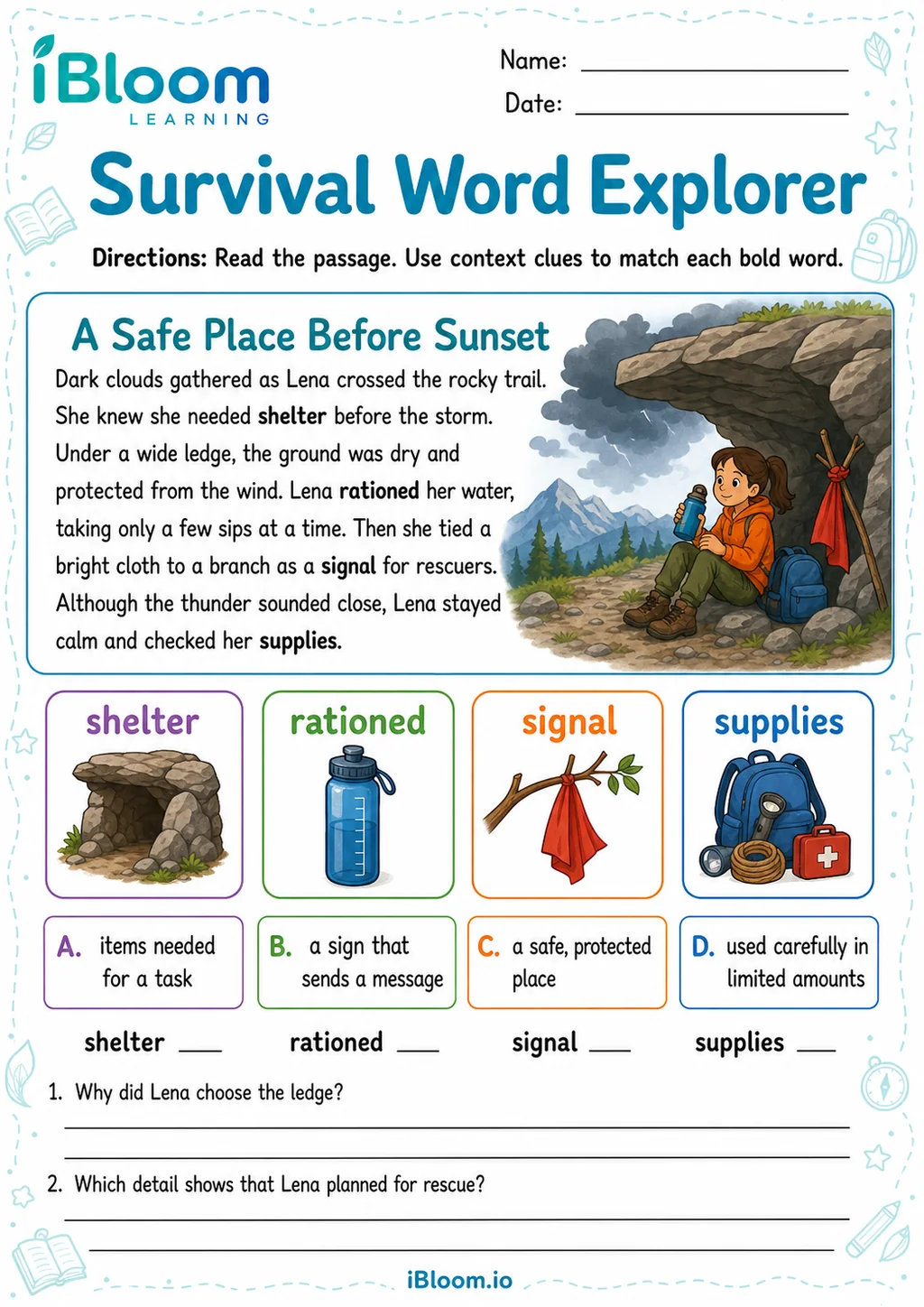
Read about Lena preparing for a storm, match four vocabulary words, and answer two evidence questions.
Preview free PDF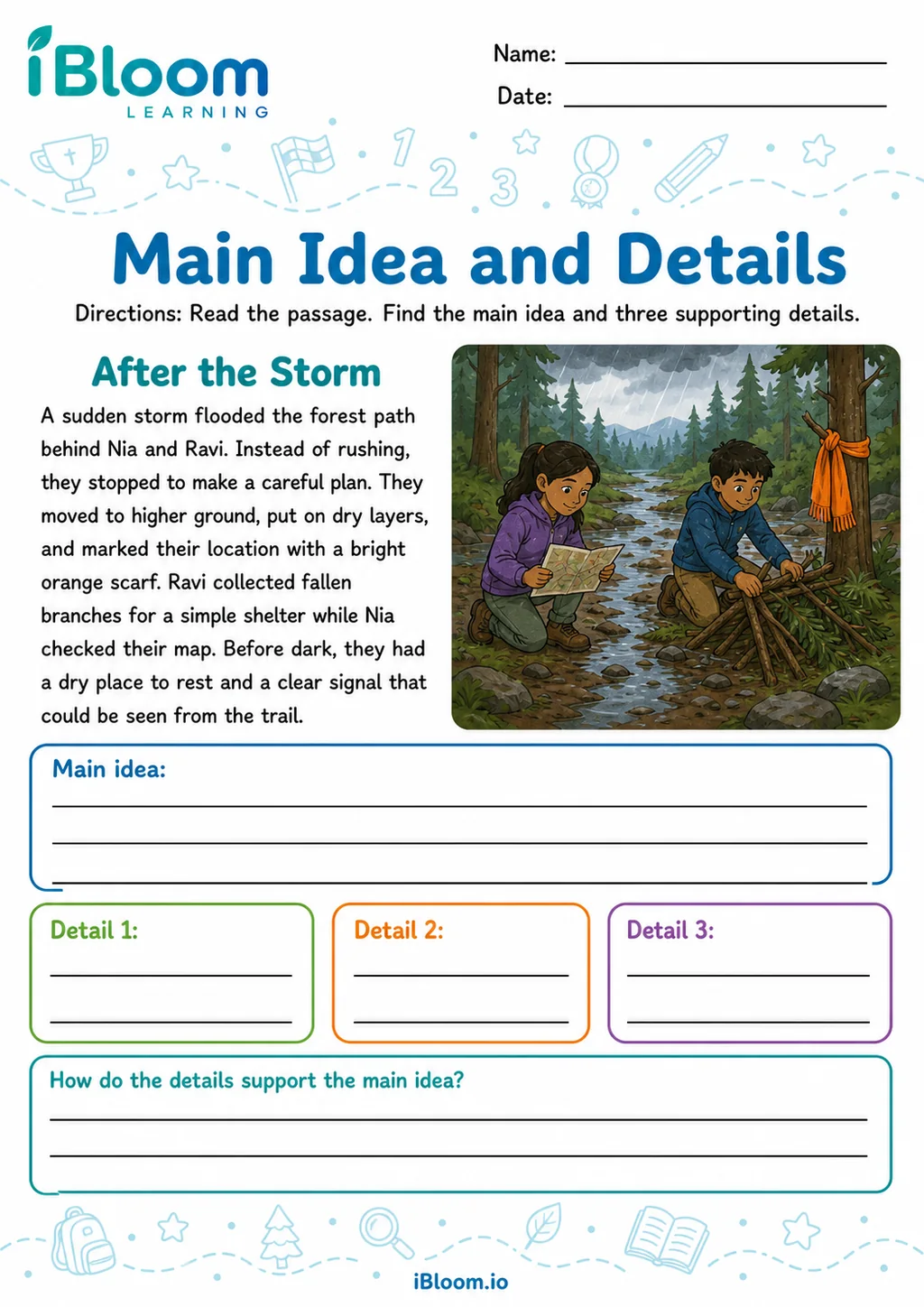
Read how Nia and Ravi respond after a storm, then record the main idea and three supporting details.
Preview free PDF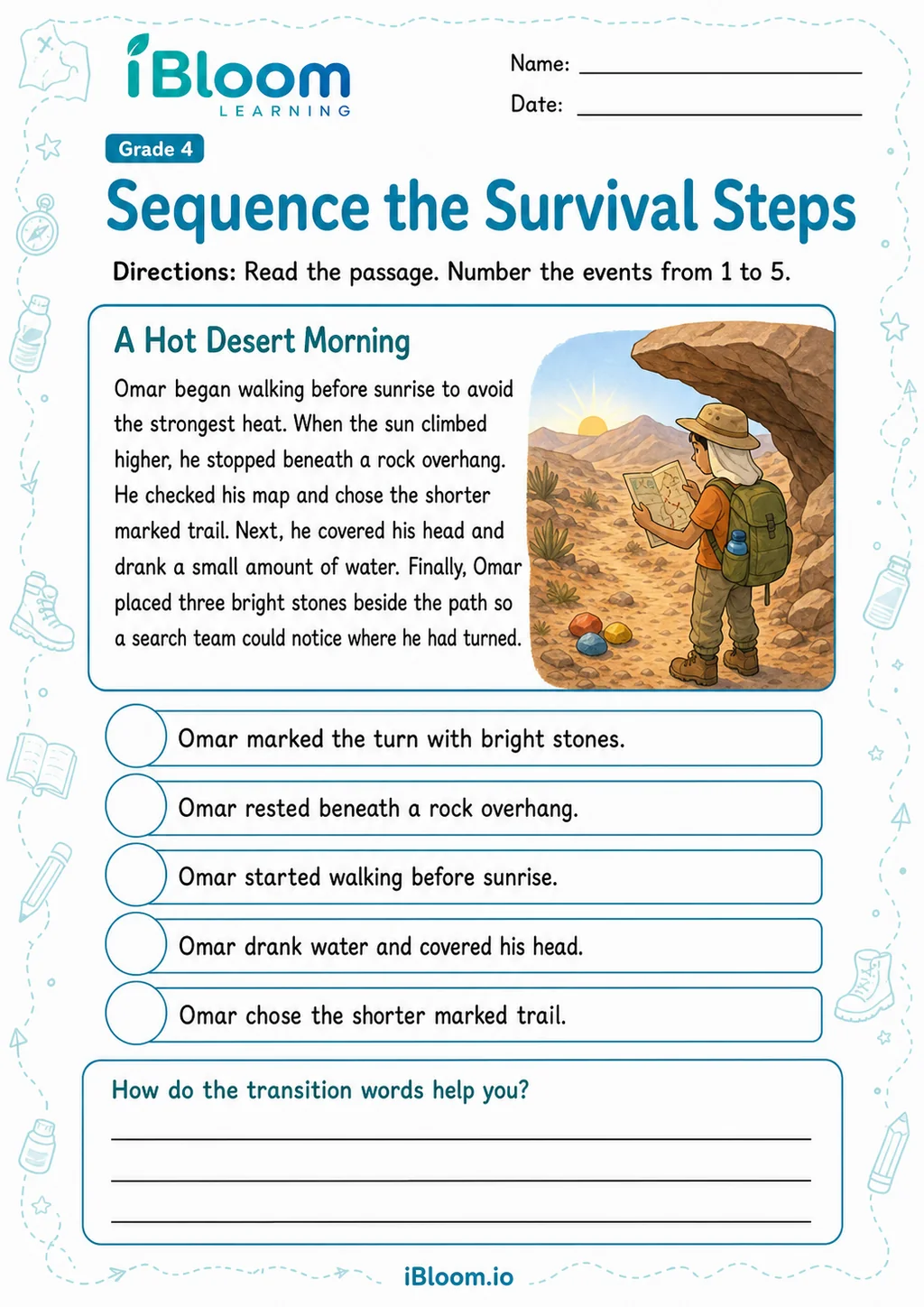
Read A Hot Desert Morning and number five mixed events in the correct order.
Preview free PDF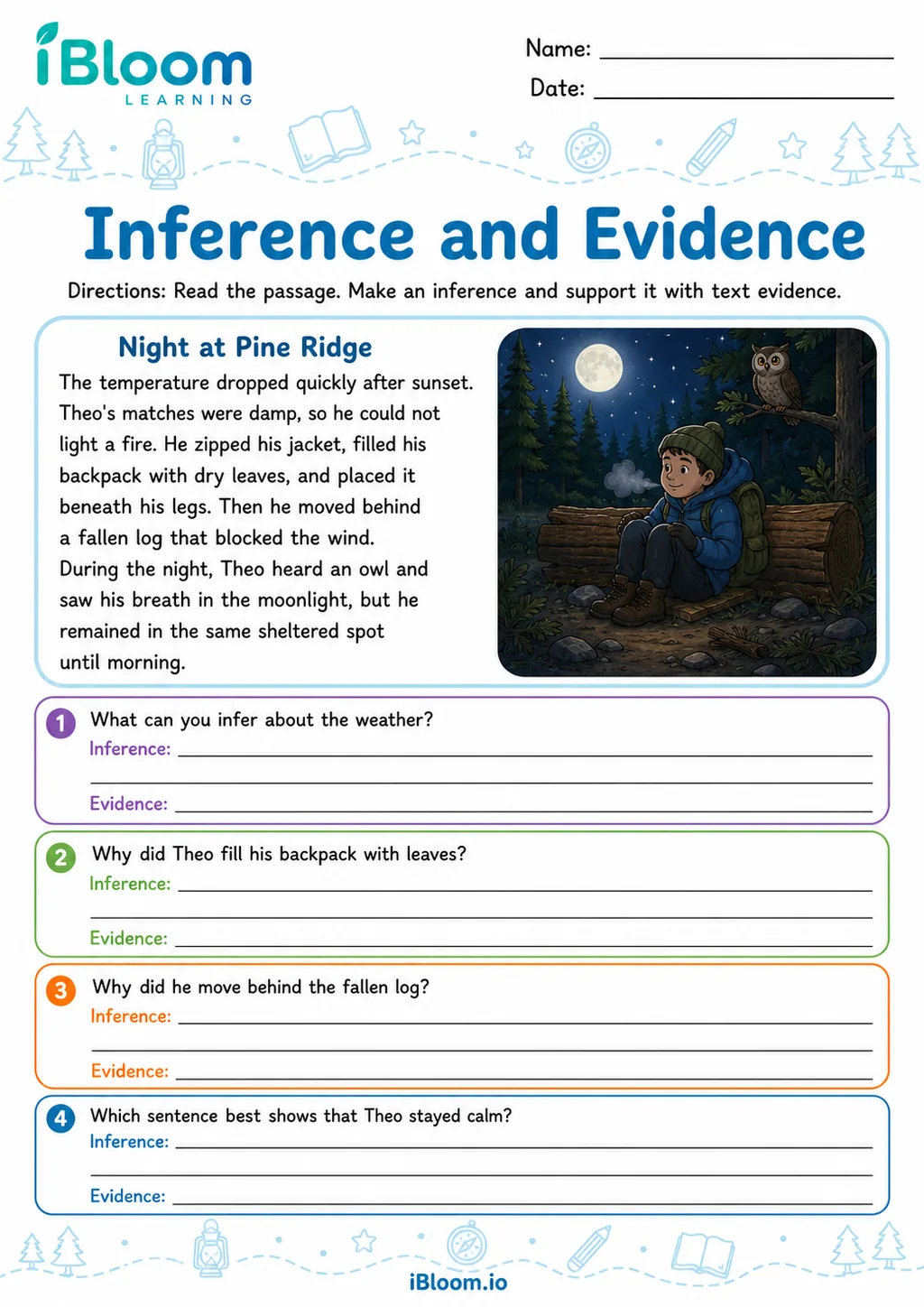
Read Night at Pine Ridge and support four inferences with evidence from the text.
Preview free PDF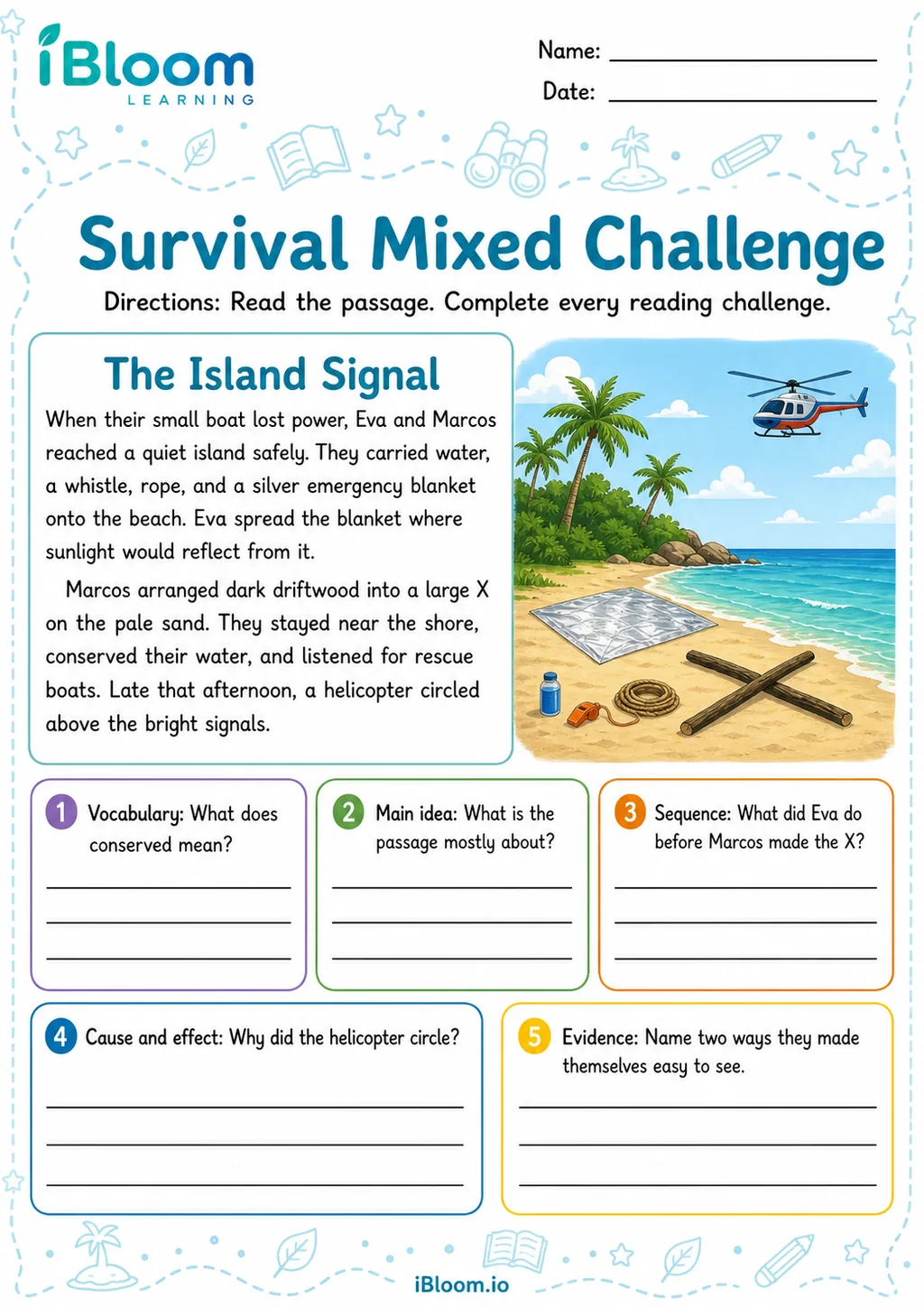
Read The Island Signal and answer vocabulary, main idea, sequence, cause-and-effect, and evidence questions.
Preview free PDFPractice that builds confidence
Write evidence-based answers about Across the Flooded Trail.
Questions move from a literal reason to analysis supported by two details.

A printable worksheet is most useful when it follows a clear explanation and gives a child a manageable chance to apply one skill.
Begin by previewing the page yourself.
Check the directions, vocabulary, number range, amount of writing, and expected level of independence.
Tell the child the purpose in simple language, such as, “Today we are practicing how to compare two groups,” rather than presenting the page as a test.

Short, regular sessions are usually more effective than completing several pages at once. Younger children may work for five to ten minutes; older elementary learners may stay engaged for fifteen to twenty minutes when the task is appropriate. Break a page into sections when handwriting, attention, language, or working memory makes the full activity feel heavy.

Use a worksheet after explicit instruction as guided practice, a learning center, partner work, independent application, intervention, homework, or a quick formative check. Model the first item and clarify unfamiliar language before students begin. During work time, notice the strategies students choose, the errors that repeat, and the prompts that help them restart. These observations are often more useful than a total score.
Differentiate without changing the learning goal. Offer counters, a number line, an alphabet strip, a word bank, sentence starters, read-aloud support, or fewer questions when a learner needs access. For additional challenge, ask students to explain a second method, create an example, justify a choice, write a related problem, or teach the idea to a partner.
After the activity, group students by the next instructional need rather than by a permanent label. One group may need another concrete model, another may need vocabulary support, and another may be ready to apply the same skill in a less familiar context. Keep completed pages as one small piece of evidence alongside conversation, observation, reading, writing, and hands-on work.

iBloom Learning organizes printable practice by subject, grade, and specific skill so families and educators can choose a focused activity instead of searching through a mixed packet. Each library page explains what children are practicing, what adults should notice, and how the activity can fit into a real lesson or home routine. Clear previews help you check the full page before printing, including its directions, visual density, and expected writing.
The worksheets are designed to support teaching, not replace it. Children still need conversation, books, manipulatives, demonstrations, play, investigation, and feedback. iBloom pages work as the practice step within that larger learning experience. A focused layout reduces unnecessary switching between unrelated skills and gives adults a clearer view of how a child approaches the target idea.
For parents, this means less time guessing what to print and more time listening to a child's thinking. For teachers, it means flexible material that can support whole-class modeling, small groups, centers, intervention, review, and independent application. Regional grade labels and examples help the library feel familiar to the learners using it, while topic pages make it easier to move from foundational practice toward greater independence.
Use the worksheet that fits today's need, adapt the amount of work, and revisit the topic through another format when necessary. Progress is not the number of pages completed; it is the child's growing ability to explain, apply, and use the skill with confidence.
Helpful answers
One or two complete sentences per prompt are usually enough when evidence is specific.
Use them when they reinforce a current learning goal. A few short, focused sessions each week are generally more useful than completing many unrelated pages at once.
Pause first and ask the child to explain the method. Then use an object, drawing, example, or clue to help the child notice and revise the response.
Adjust the number of questions and provide supports such as counters, number lines, word banks, sentence starters, read-aloud help, or partner discussion. Extend learning through explanation, creation, and comparison tasks.
Stop before frustration grows, identify the prerequisite skill, model a simpler example, and return to the page later. Choosing an earlier related topic is productive support, not a setback.
Ask the child to explain an answer, show the idea with another representation, create an example, or apply the skill in a new context. Use the completed page together with observation and conversation.
No. They are focused practice resources designed to work alongside instruction, discussion, reading, manipulatives, investigation, feedback, and other learning experiences.