
About this worksheet
This Grade 4 worksheet pairs the original passage “The Island Signal” with 14 multiple-choice questions. Readers track Eva and Marcos’s rescue signals, use context for vocabulary, identify the main idea, sequence events, and draw inferences from details. The answer key identifies the correct choice for each question.
Aligned to RL.4.1 and RL.4.2
How does context clarify a word?
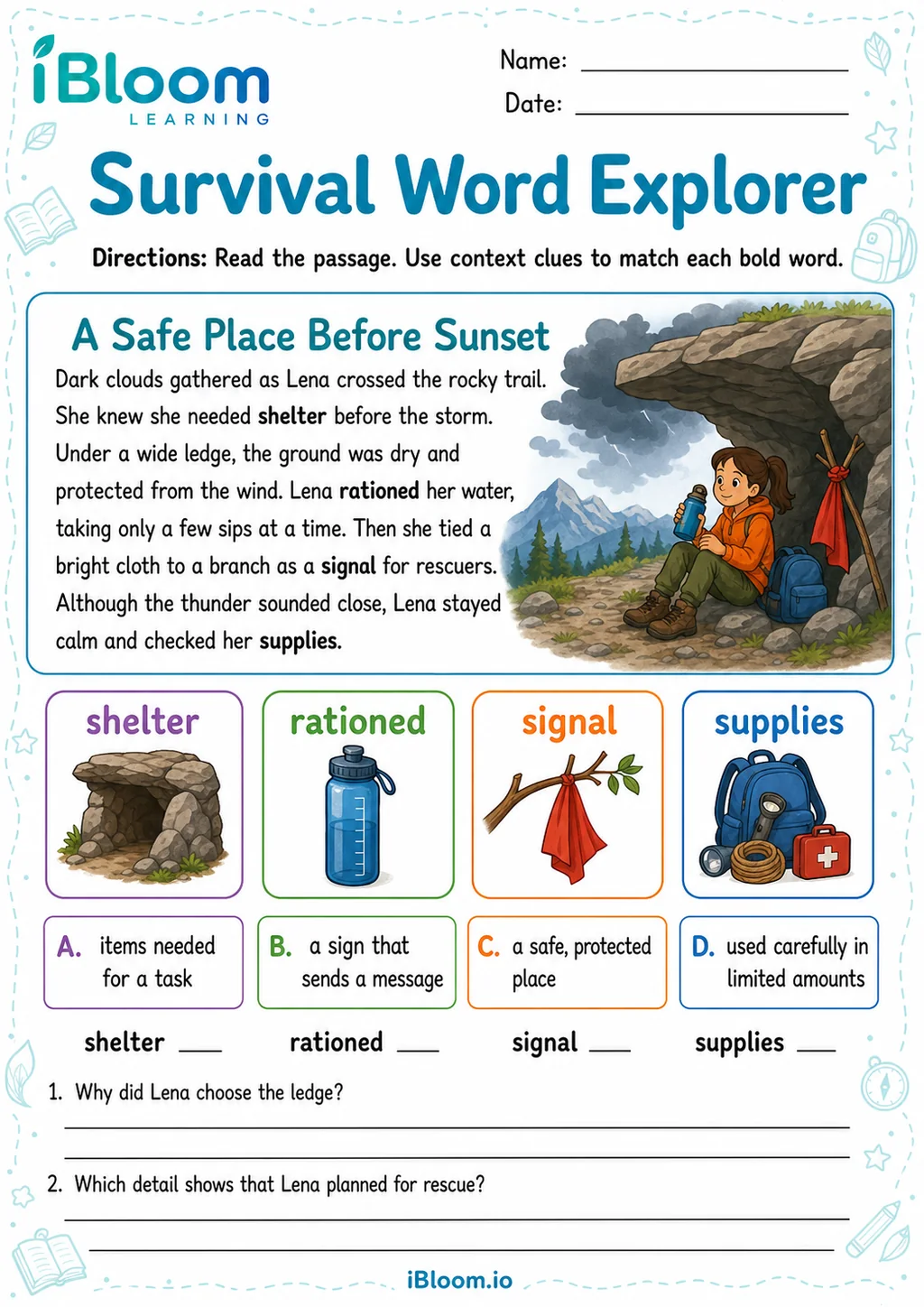
Question 1 asks what conserved means. In the passage, Eva and Marcos save water and take care with the amount they use. That context supports “used carefully.” Questions 2–6 check the main idea and story details.
- Return to the sentence around an unfamiliar word.
How do story events fit together?
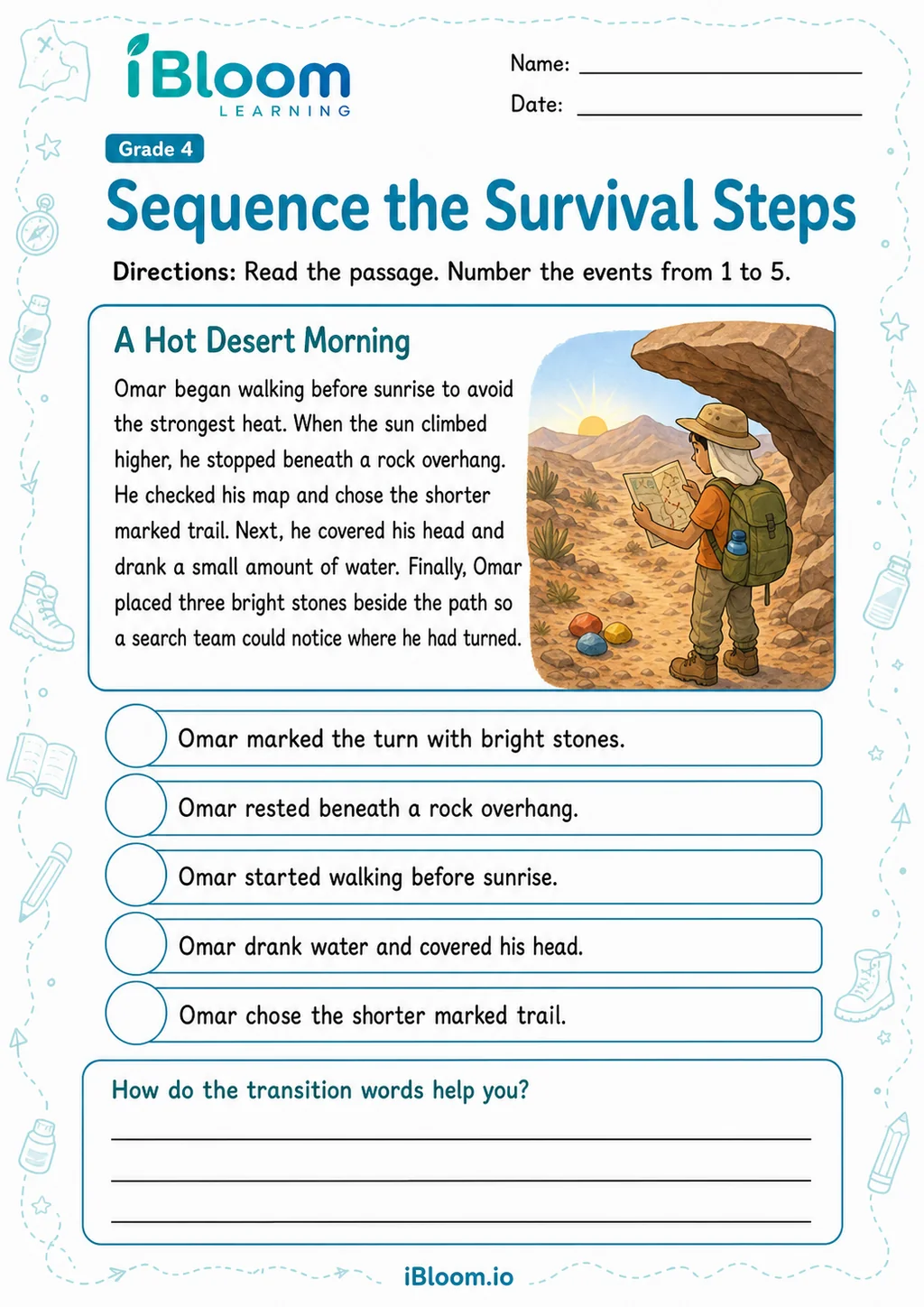
Questions 7–8 ask about event order and the children’s limited water. They reach shore before the helicopter returns, and they save their water while waiting.
- Notice time words and actions that show what happened first.
Which details support an inference?
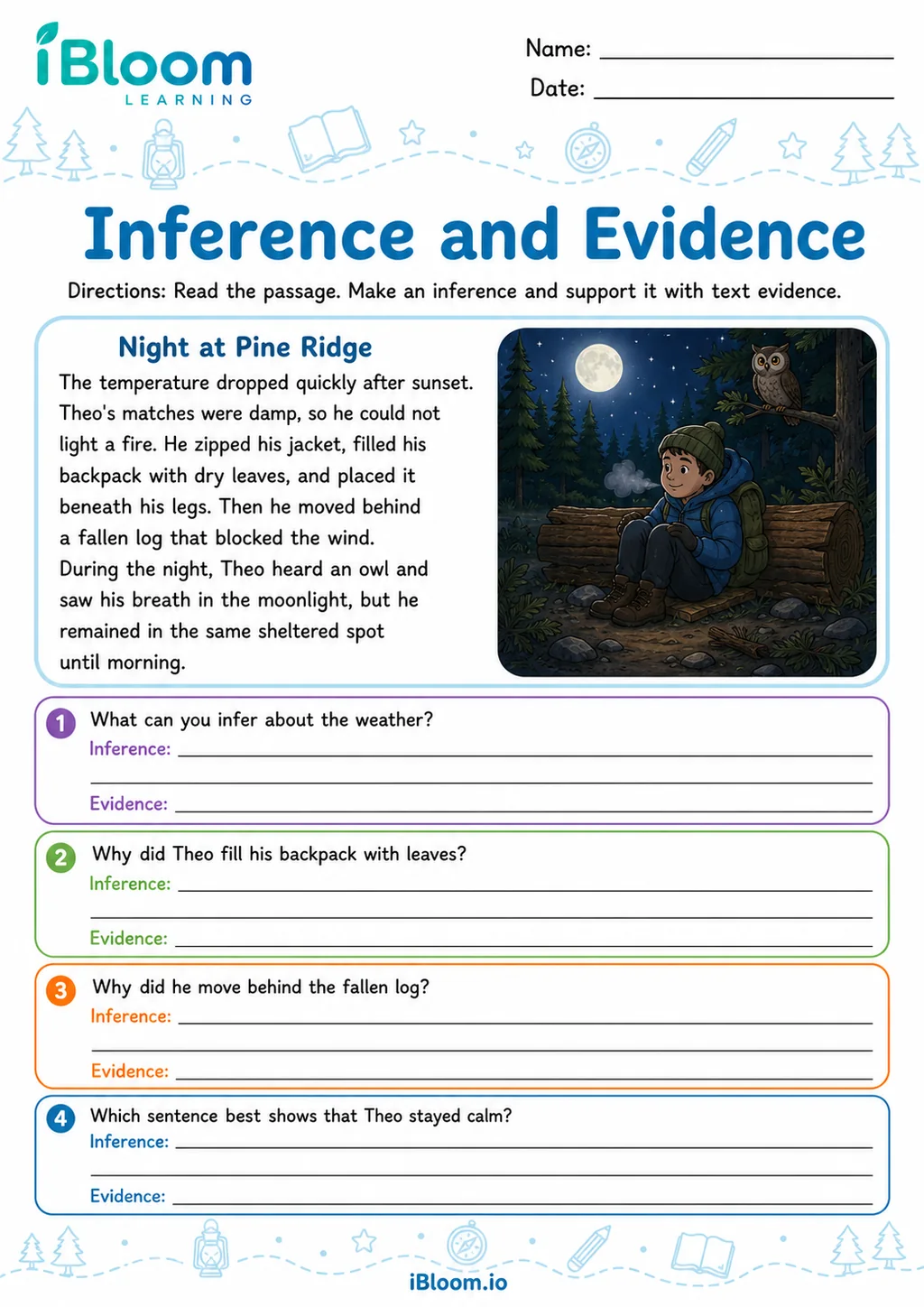
Questions 9–14 connect the children’s choices to what a reader can infer. Their signals, decision to stay together, and calm waiting show that they use their safety training.
- Choose the answer supported by details in the story.
How to use this worksheet
- 1Read “The Island Signal” once for the events.
- 2Reread the relevant part when a question names a detail or word.
- 3For sequence, identify what happened before and after.
- 4For an inference, connect story evidence to a reasonable idea.
- 5Choose the option that best matches the passage.
Common mistakes and quick fixes
The mistake
Selecting an answer that sounds possible but is absent from the passage.
The fix
Find a sentence or event that supports the choice.
The mistake
Confusing the signal with the rescue itself.
The fix
Track the blanket, driftwood X, whistle, helicopter, and rescue boat separately.
The mistake
Treating an inference as a guess.
The fix
Combine a specific story detail with what it suggests.
Curriculum alignment
Readers use story details to explain events, make inferences, and identify a central idea.
Refer to details and examples when explaining and inferring.
On this sheet: Questions ask learners to identify explicit details and infer how the children responded to the emergency.
Show the official wordingHide the official wording
Refer to details and examples in a text when explaining what the text says explicitly and when drawing inferences from the text.
Determine a story’s theme from details and summarize it.
On this sheet: Learners identify the main idea and summarize how the children signal for help.
Show the official wordingHide the official wording
Determine a theme of a story, drama, or poem from details in the text; summarize the text.
What to practice next
Make more practice
Further reading
Questions parents and teachers ask
What does conserved mean in the passage?
Conserved means used carefully so a supply lasts. Eva and Marcos have limited water, so they save it while waiting for rescue. The surrounding details help readers choose “used carefully” rather than an answer that suggests wasting or giving away the water.
What is the main idea of “The Island Signal”?
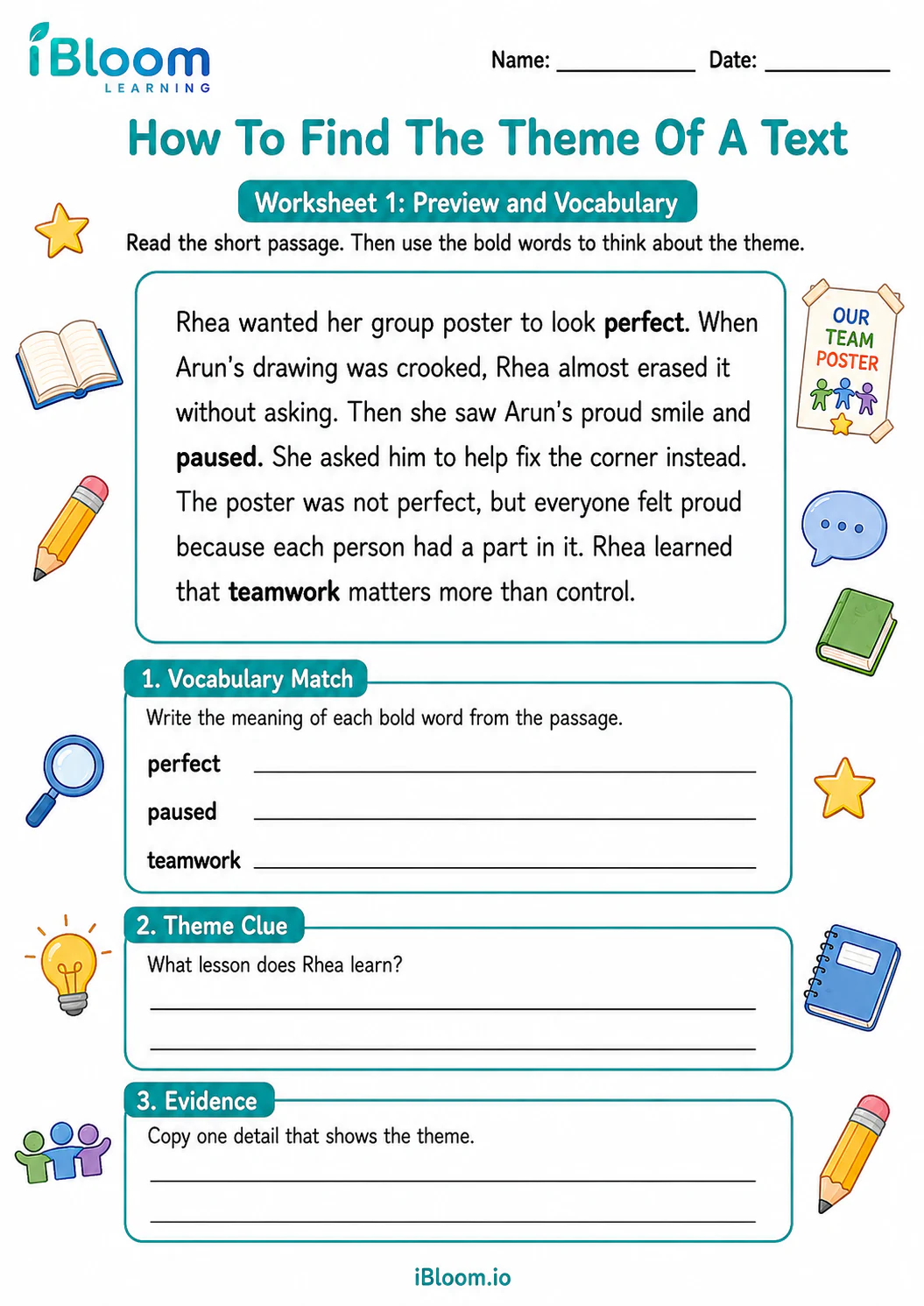
The story is mainly about Eva and Marcos using visible signals and waiting safely until rescuers find them. Details such as the silver blanket, driftwood X, and their decision to stay together support this central idea. Each correct choice matches an event or clue stated in the passage.
How can a reader answer sequence questions?
Look for actions and time clues, then place them in order. Eva and Marcos reach the shore before a helicopter circles the island and before a rescue boat brings them aboard. The question asks which event came first. Each correct choice matches an event or clue stated in the passage.
How do students support an inference?
An inference connects a story detail with a reasonable conclusion. The children remember safety guidance, create signals, and wait together. Those actions support the idea that they remember and follow their training. Each correct choice matches an event or clue stated in the passage.
Why is the old story setting retained?
The source page’s question set refers to Eva, Marcos, the island, and rescue signals. The replacement keeps those characters and the rescue situation so the questions and passage describe the same story. Each correct choice matches an event or clue stated in the passage.
Should students reread the passage for every answer?
Rereading is useful when a question asks about a particular word, event, or clue. Students can first read the story for its overall events, then return to the relevant sentence to confirm a detail or support an inference before choosing an answer.