


About this worksheet
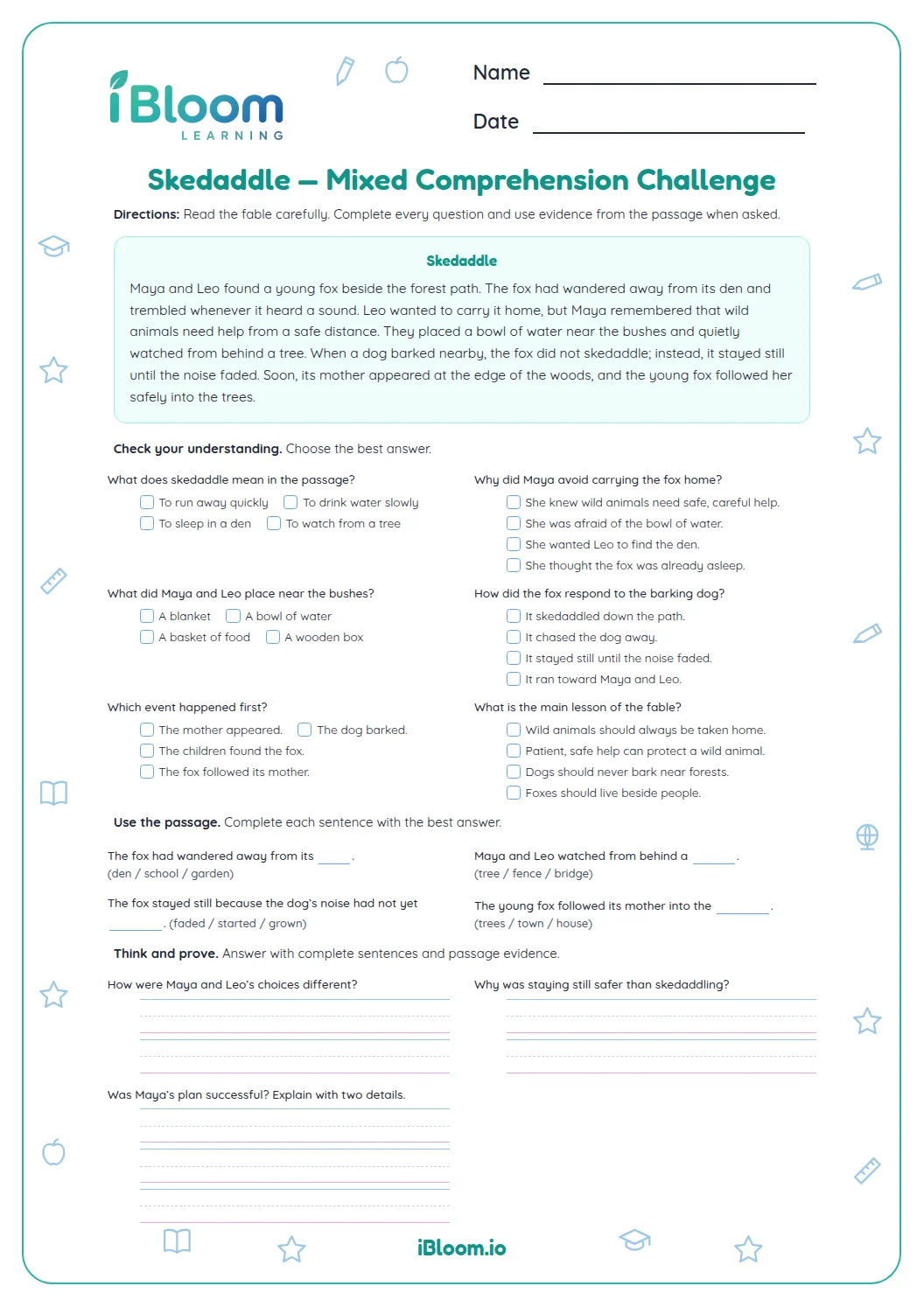
This free Grade 4 reading worksheet uses Skedaddle to practice written answers supported by evidence. Maya and Leo notice a fox near a henhouse, frighten it away and secure the loose gate that let it enter. Part A contains the passage. Part B gathers six details, including the meaning of skedaddle in context. Part C asks students to explain the danger, Maya’s reason for fixing the gate and how the children’s actions work together. The ten questions practice Common Core RL.4.1 and RL.4.3. A separate answer key provides factual answers and four sample responses.
Aligned to RL.4.1 and RL.4.3
Which details show that the chickens are in danger?
The fox has entered through a loose gate and is creeping toward the chickens. These details support question 7: students explain the danger by using the fox’s actions in this scene.
Part B collects facts before Part C asks students to explain them. Question 6 also asks what skedaddle means; the fox dashing away gives a clear context clue.
Why does Maya repair the gate after the fox leaves?
Leo’s shout and arm movements deal with the immediate danger. Maya notices that the opening remains, so the fox could return. Her repair addresses the cause of the problem.
- 1Problem: The loose gate let the fox enter.
- 2Action: Maya secures it with a sturdy piece of wood.
- 3Sample: The loose gate would let the fox return, so she secured it.
How can students explain both children’s contributions?
Question 9 asks how Leo and Maya help in different ways. A complete answer names an action by each child: Leo frightens the fox away, and Maya fixes the gate.
Question 10 asks how those actions work together. Students should explain the connection between removing the immediate danger and preventing the fox from entering again. Two details are needed because the response must account for both children.
How to use this worksheet
- 1Read the passage and identify Maya, Leo and the danger they notice.
- 2Complete Part B, using the fox’s dash into the woods to explain skedaddle.
- 3Find the detail that shows why the chickens are in danger.
- 4Explain why Maya acts even after Leo has driven the fox away.
- 5For the final two questions, include an action by each child and its purpose.
- 6Use the sample key to check support, accepting other wording that the passage justifies.
Mistakes to notice and fix
The mistake
Saying skedaddle means to approach quietly.
The fix
The fox skedaddles away after Leo shouts. Its quick escape shows that the word means run away quickly.
The mistake
Saying the fox can never return because Leo shouted.
The fix
Maya notices the loose gate still allows entry. Explain why her repair is needed.
The mistake
Describing only Leo in a response about both children.
The fix
Add Maya’s gate repair and explain how it helps prevent another entry.
Common Core alignment
Use details from Skedaddle to explain the danger and the children’s responses.
On this sheet: Students support explanations with the fox’s approach, Leo’s response and Maya’s gate repair.
Show the official wordingHide the official wording
Refer to details and examples in a text when explaining what the text says explicitly and when drawing inferences from the text.
Describe Maya’s and Leo’s actions and how they work together to protect the chickens.
On this sheet: Written responses explain each child’s actions, motives and contribution to the outcome.
Show the official wordingHide the official wording
Describe in depth a character, setting, or event in a story or drama, drawing on specific details in the text (e.g., a character’s thoughts, words, or actions).
What to practice next
Make more practice
Further reading
Questions parents and teachers ask
What is Skedaddle about?
Skedaddle tells how Maya and Leo help chickens escape danger from a fox. Leo shouts and waves his arms to drive it away, and Maya secures the loose gate. The passage is printed on the sheet, so students can reread it while supporting all ten answers.
What does skedaddle mean in this passage?
Skedaddle means to run away quickly. Leo shouts the word, and the fox dashes back through the gate into the woods. Students can connect the word with that action instead of guessing from its sound. Question 6 accepts a short explanation such as “leave in a hurry.”
Why does Maya fix the gate after the danger seems over?
Maya fixes the gate because the fox could return through the same opening. Leo has removed the immediate danger, but the loose gate remains a problem. In question 8, students connect her action to that reason, using the third paragraph as support for their explanation.
What does question 9 need for a complete comparison?
It needs an action by each child and a clear difference between their contributions. Leo frightens the fox away with shouting and movement, while Maya secures the gate. Students can express this in one sentence, as long as they explain both roles rather than naming only one child.
How much should students write for question 10?
One complete sentence can answer it if it includes both required details and explains their connection. Students should link Leo driving the fox away with Maya preventing another entry through the gate. The key supplies a sample; a longer response is also acceptable when every detail helps explain the outcome.