
About this worksheet
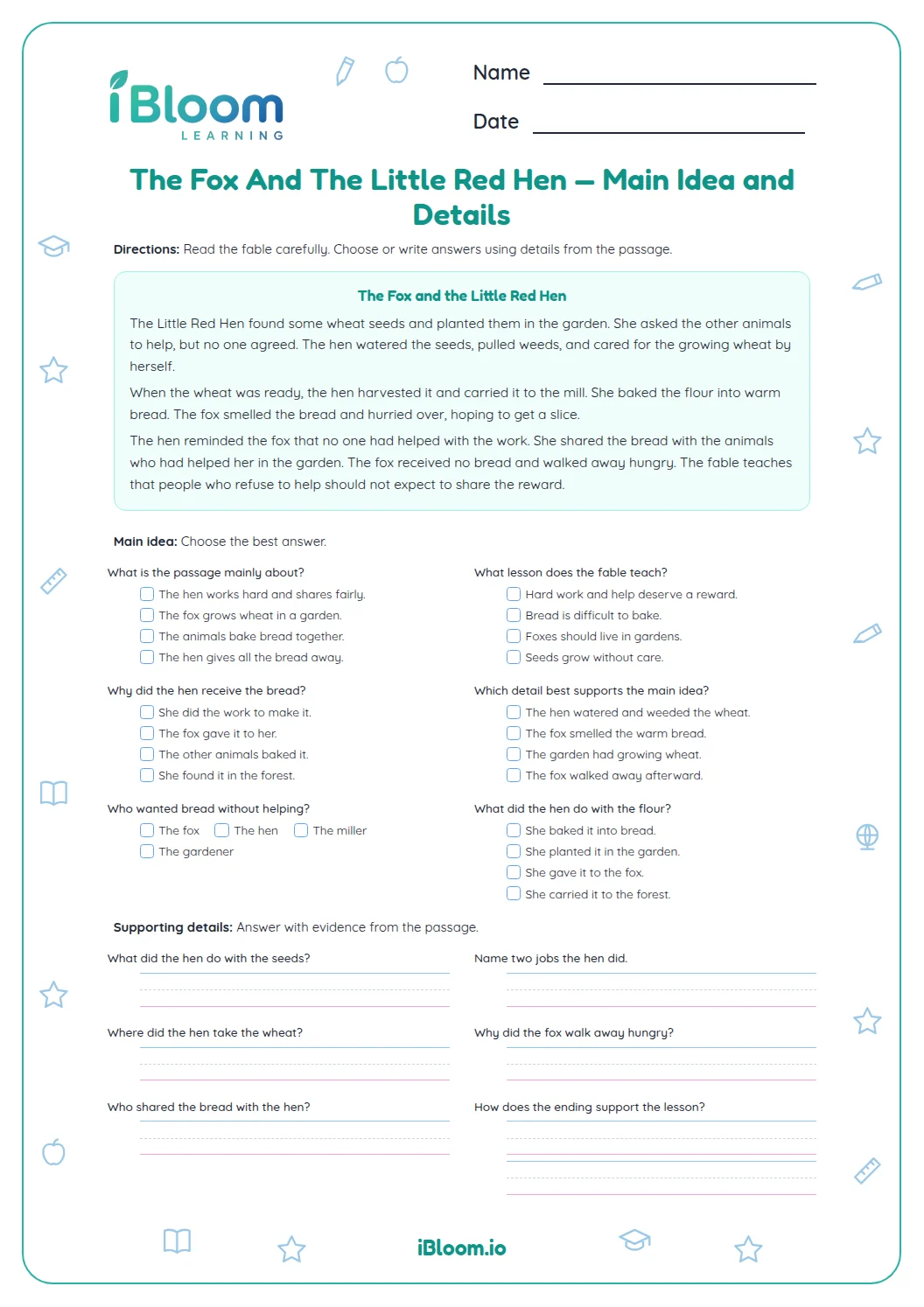
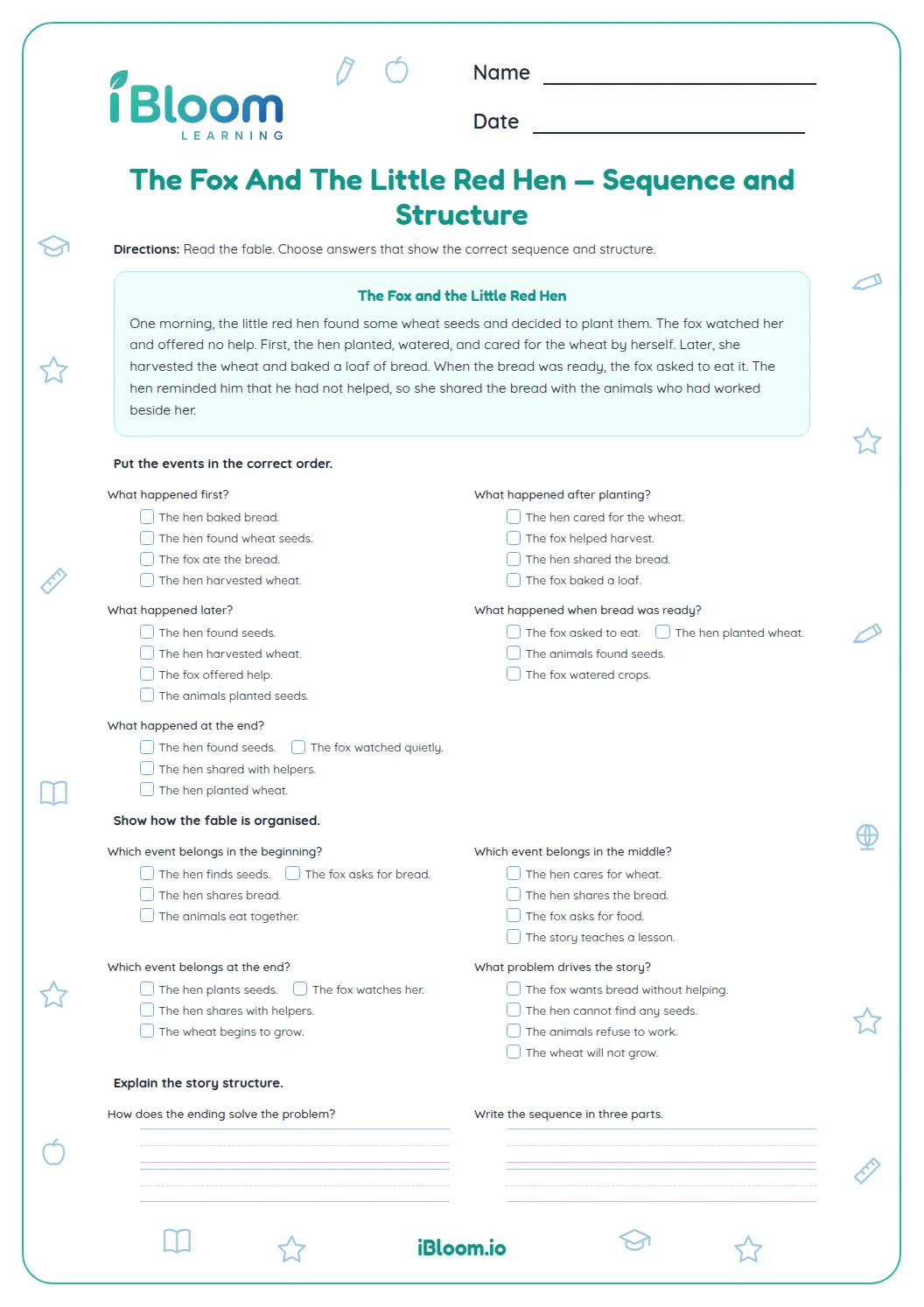
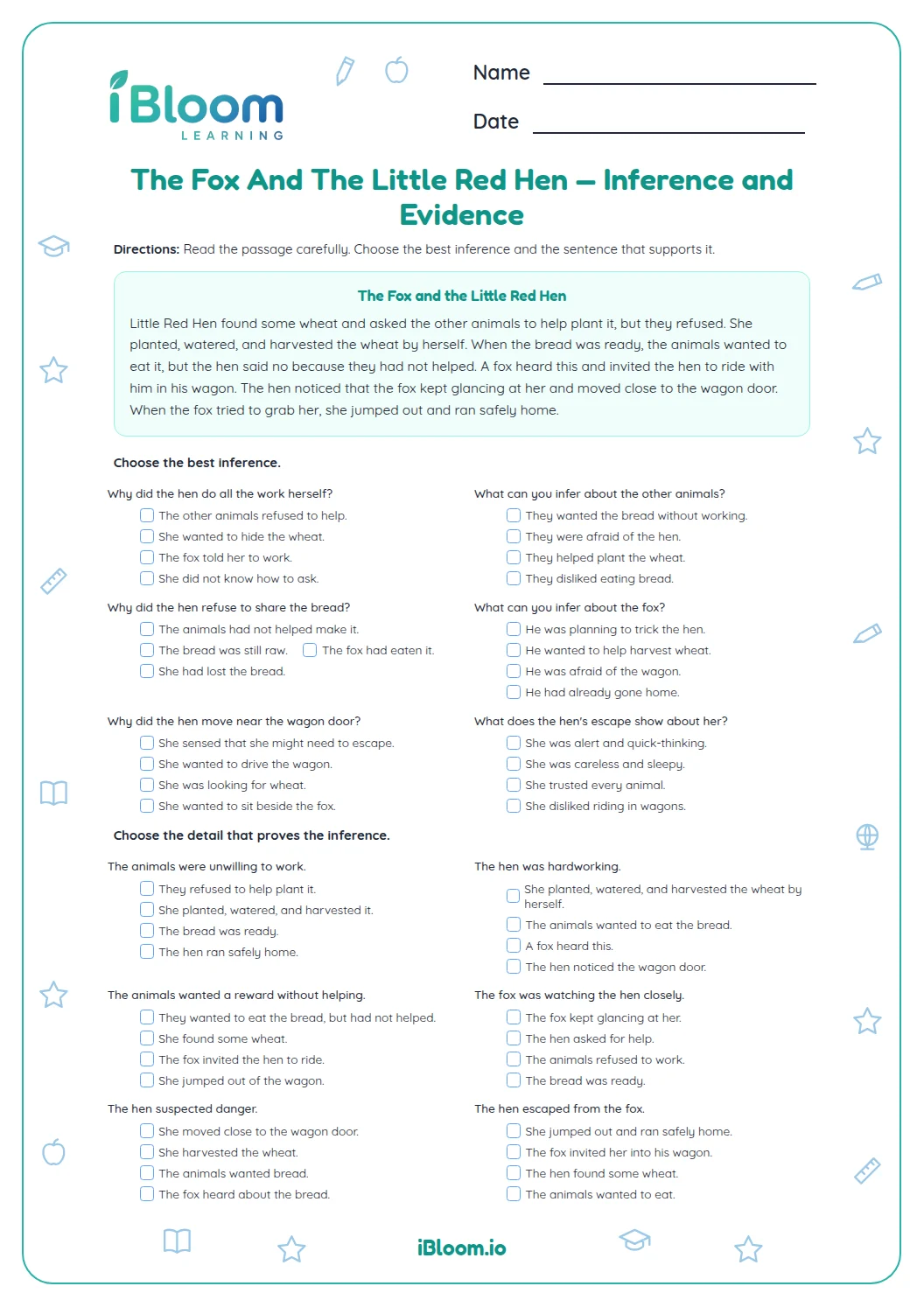
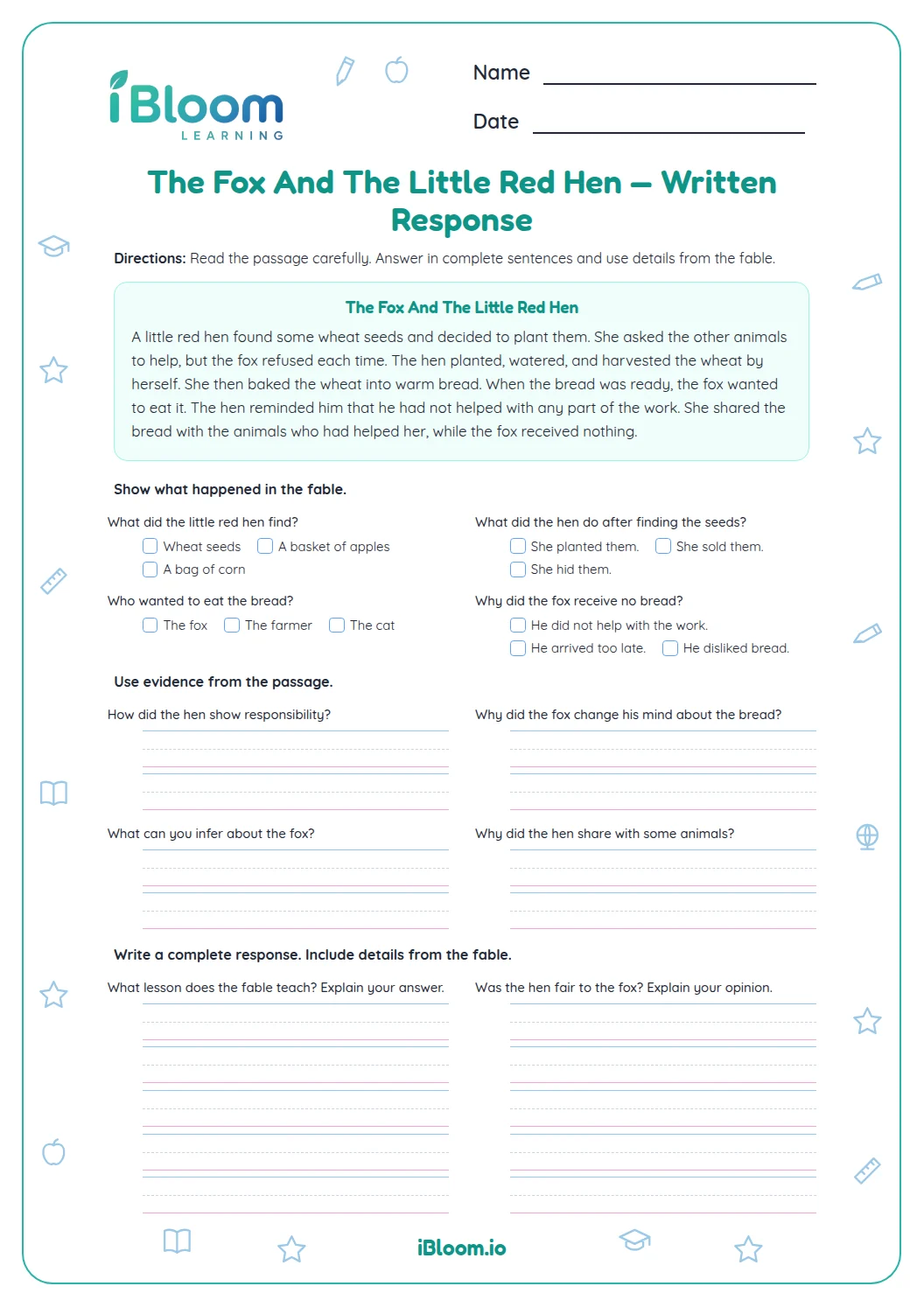
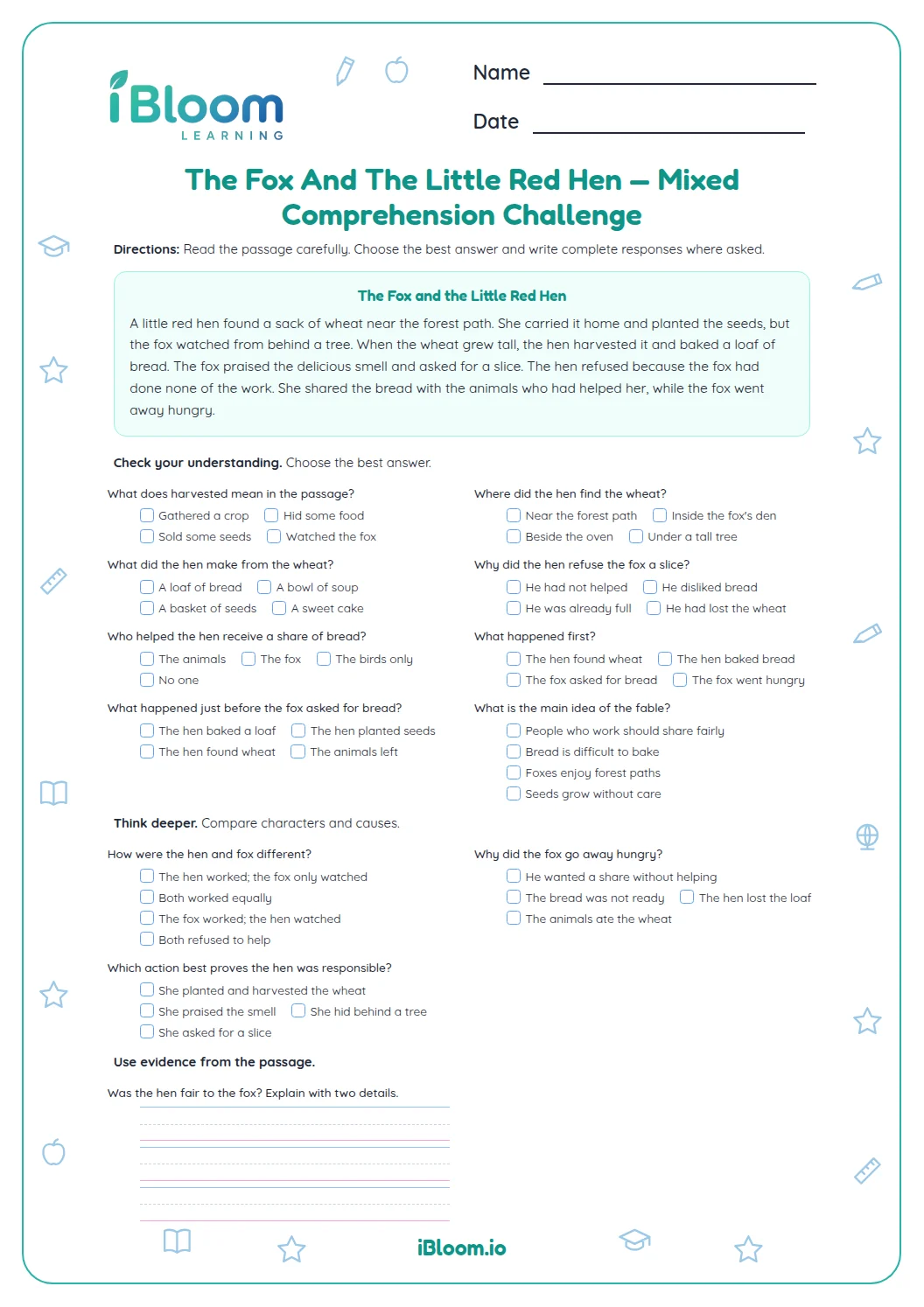
This free Grade 4 printable includes an original fable about a little red hen who guards a basket of grain, followed by 16 questions on details, inference, lesson and vocabulary. The three-page worksheet has a separate answer key and sample written responses. It practices CCSS RL.4.1 and L.4.4.a.
Aligned to RL.4.1 and L.4.4.a
Which details matter most in the fable?
Read the passage closely, then return to it when a question asks for a detail. The hen finds grain near the farm gate, refuses the fox’s invitation, and calls the farmer when the fox follows.
- 1Question 1: the hen “planted the kernels herself” directly shows who did the planting.
How can context explain a new word?
Read the whole sentence and the sentences around it. “Steadily” describes the hen continuing through planting, watering and baking, so it means she works without giving up.
- 1Question 5: “without giving up” matches the actions that follow.
How can readers support an inference?
An inference joins a clue from the story with what the reader understands. The fox’s final choice to climb down and help supports the inference that he has changed.
How do actions reveal a lesson?
Compare the fox’s choices at the beginning and end. His refusal makes the work harder for the hen; his later help shows what he has learned about sharing work.
How to use this worksheet
- 1Read the whole passage once before answering.
- 2Return to the story and underline a detail for each answer.
- 3Use nearby words and actions to infer vocabulary.
- 4For an inference, connect a story clue to what it suggests.
- 5Write a short response that answers the question and names evidence.
Common mistakes and quick fixes
The mistake
Choosing a detail that is true but does not answer the question.
The fix
Match the detail to the question’s exact focus, such as what the hen did.
The mistake
Guessing a word meaning from only its first syllable.
The fix
Read the sentence and nearby actions for a context clue.
The mistake
Stating a lesson without linking it to the characters.
The fix
Name an action from the fox or hen that shows the lesson.
Common Core alignment
The questions connect story details and context clues to two Grade 4 reading standards.
Refer to details and examples when explaining what a story says and when drawing inferences.
On this sheet: Refer to details and examples when explaining what a story says and when drawing inferences.
Show the official wordingHide the official wording
Refer to details and examples in a text when explaining what the text says explicitly and when drawing inferences from the text.
Use context in a sentence or paragraph to figure out an unfamiliar word.
On this sheet: Use context in a sentence or paragraph to figure out an unfamiliar word.
Show the official wordingHide the official wording
Use context (e.g., definitions, examples, or restatements in text) as a clue to the meaning of a word or phrase.
What to practice next
Make more practice
Further reading
Questions parents and teachers ask
How long is the passage?
The original fable is about 150 words, followed by 16 questions across three worksheet pages. It tells how a hen finds grain, spots a warning sign in a fox’s invitation, and gets help when he follows her. The key has three pages.
What skills does this worksheet practice?
The 16 questions ask readers to recall story details, infer why the hen is cautious, identify the lesson, and use context to understand words such as “suspicious” and “politely.” Three written responses ask students to explain an idea using the passage.
Does the answer key allow different written answers?
Yes. The key gives sample responses for the final three questions. A different response can also be correct if it answers the prompt and agrees with the story. For the evidence question, look for a detail such as the fox’s hungry look or his following the hen.
What does “suspicious” mean in this story?
“Suspicious” means thinking that something may be wrong. The hen feels suspicious because the fox looks hungry while inviting her to his den. Readers can use this nearby detail and the hen’s cautious response to work out what the word means in this story.
What lesson does the hen learn?
The hen learns to pay attention when an invitation feels unsafe. She notices the fox’s hungry look, refuses to go to his den, and calls the farmer when he follows. The fable connects her careful choices with getting home safely.
Is this the familiar folktale version?
This worksheet uses an original passage written for its questions. It keeps the fox, the little red hen, the grain, the den, and the farmer from the old sheet’s story setup. In this version, the central decision is how the hen responds to a suspicious invitation.