
About this worksheet
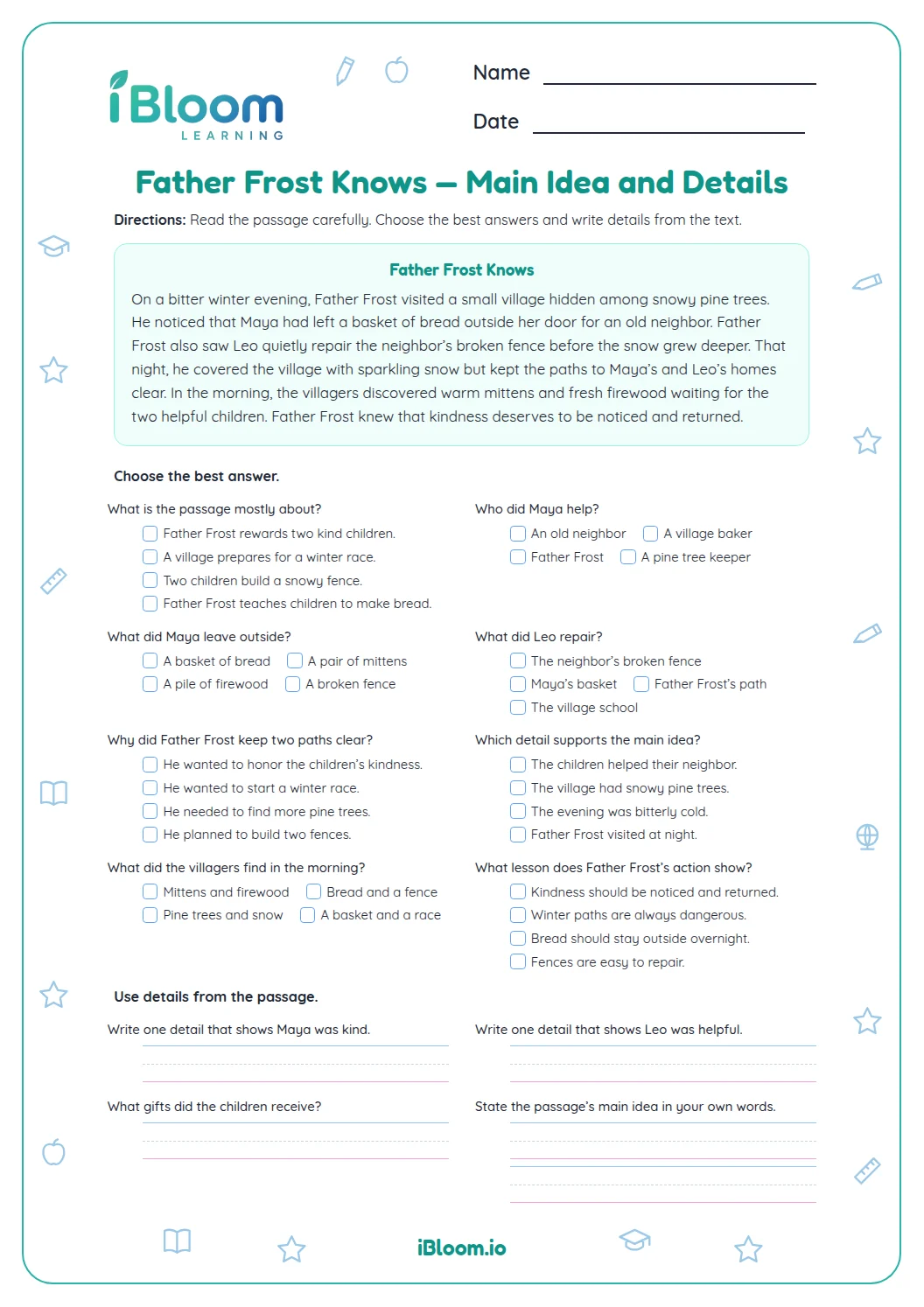
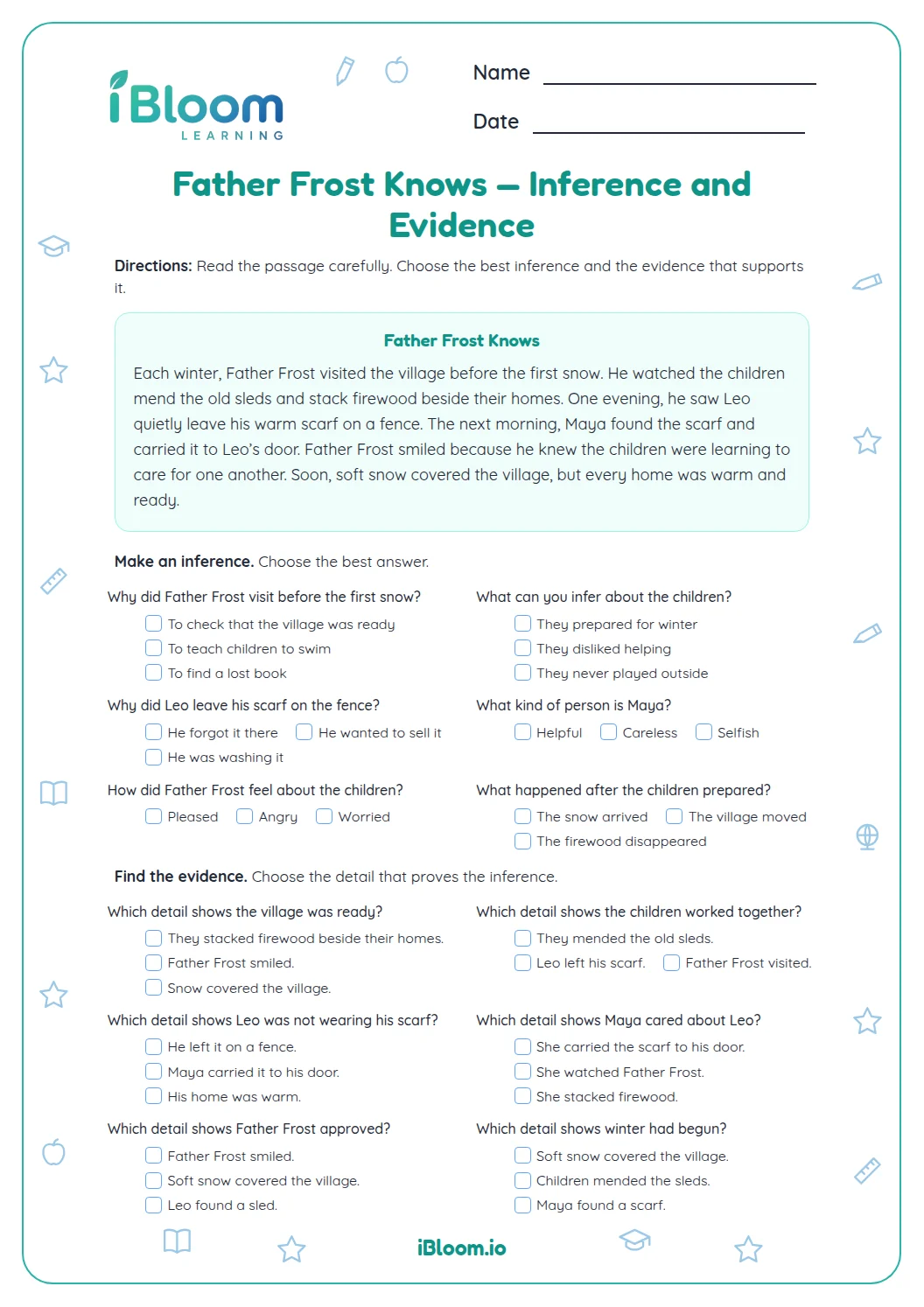
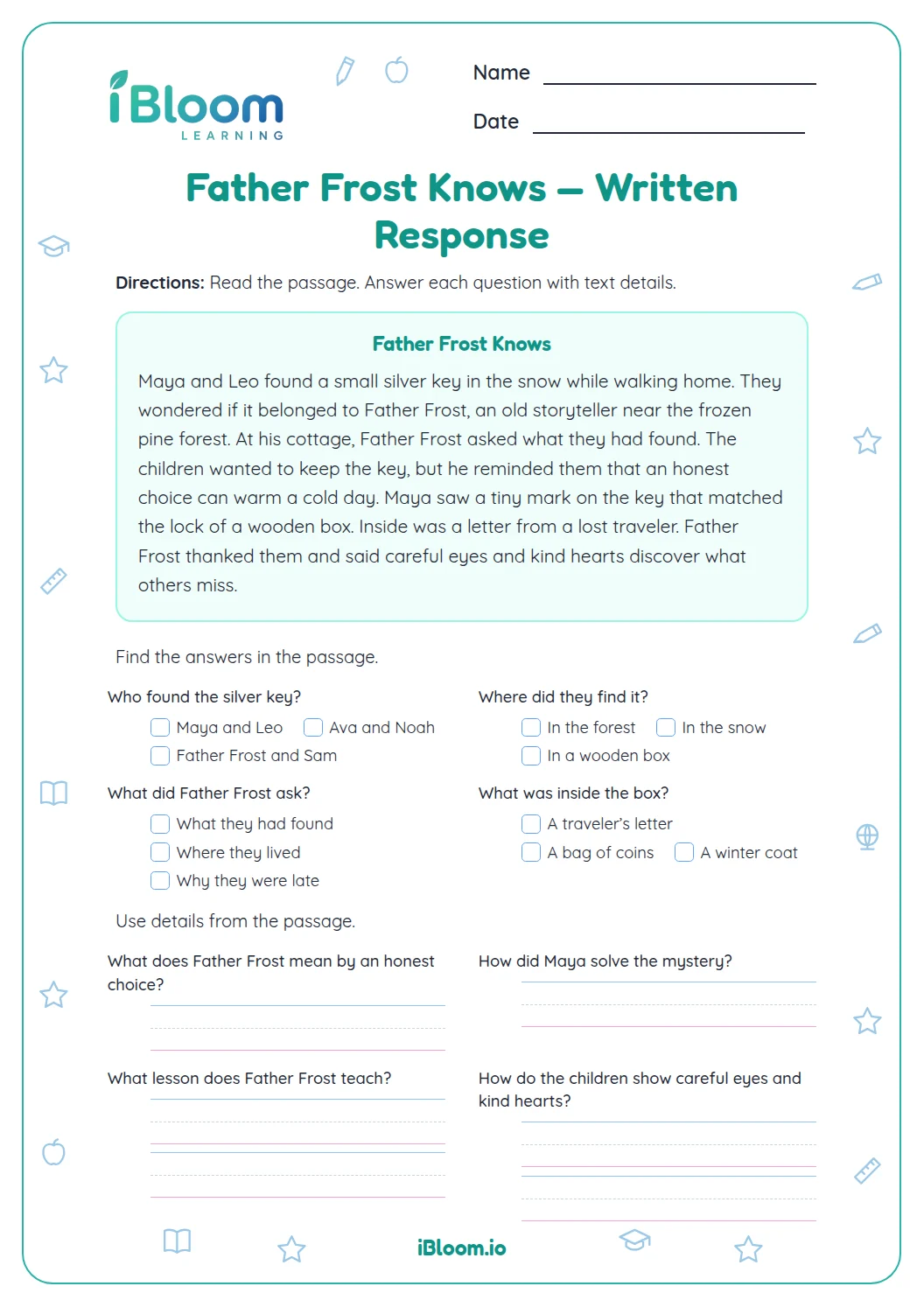
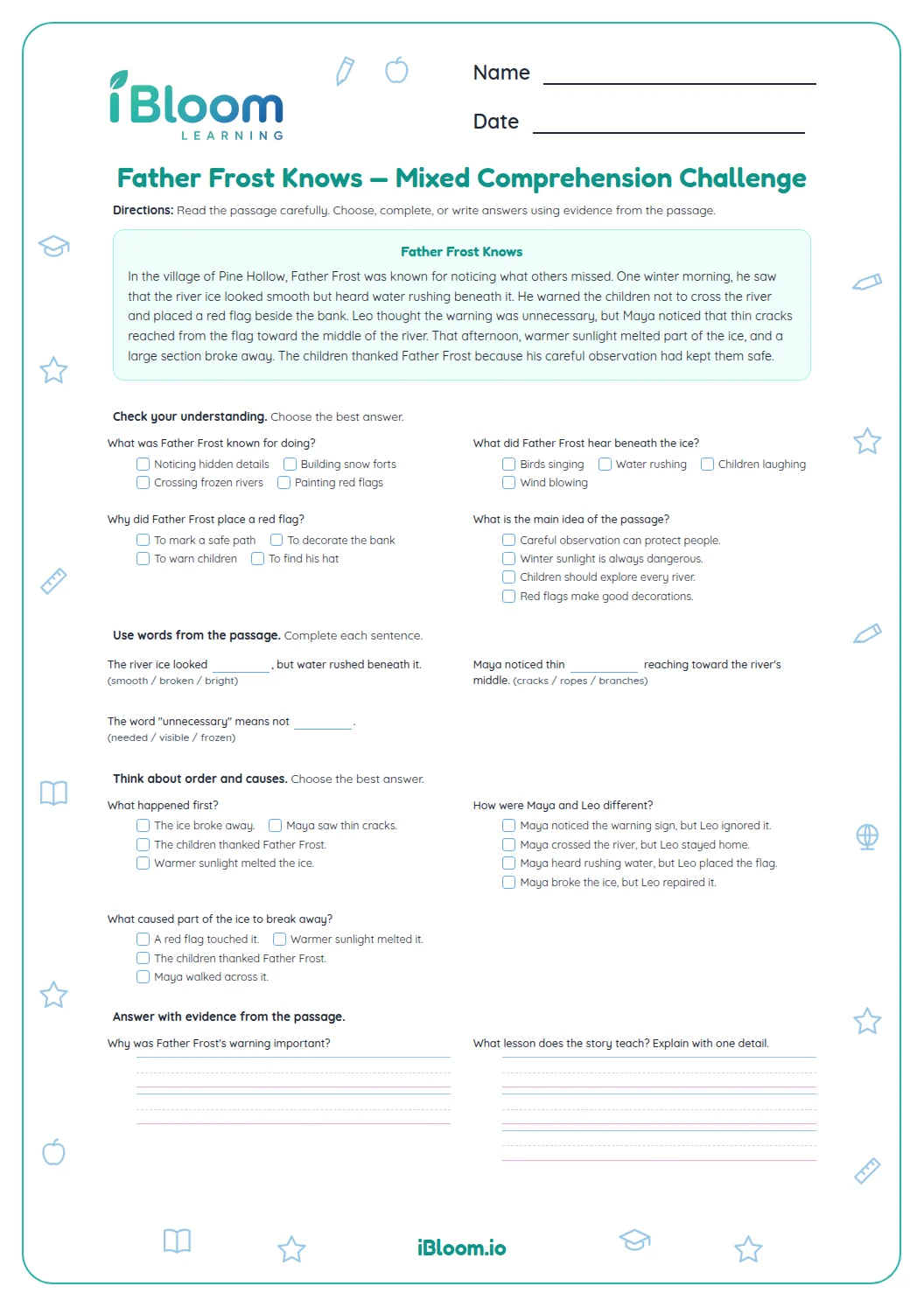
This Grade 4 worksheet uses the Father Frost Knows passage to practice event order, cause and effect, and character choices. Its 14 questions ask readers to track Maya’s care for a shivering fox, Father Frost’s snow-covered shed, and the tracks that appear in the morning. Children also describe the problem, result, and ending in their own words. A separate answer key follows the three worksheet pages. This work aligns with Common Core RL.4.3, describing characters and events with details from a story.
Aligned to RL.4.3
What problem starts the story?
Maya finds a fox shivering near the forest path. That problem gives her a reason to act and begins the sequence.
Part B asks readers to identify the fox’s need and the help Maya provides.
- 1Maya wraps the fox in her scarf, carries it to the warm shed, and leaves milk and bread.
How do the events build on one another?
Maya’s actions give the fox shelter and food. During the night, Father Frost covers the roof; by morning, tracks lead from the shed into the woods.
In Part C, explain what happens before and after a named event. Use the passage order rather than a general guess.
What does the ending show?
The fresh tracks show that the fox left the shed and returned toward the woods. This result connects the opening problem to the ending.
Part D asks readers to name that result and describe the story structure using passage evidence.
How to use this worksheet
- 1Read the passage and mark the opening problem.
- 2List Maya’s actions in the order they happen.
- 3Notice what happens during the night and the next morning.
- 4Connect a choice to the result that follows.
- 5Use a specific event when describing the ending or structure.
Common mistakes and quick fixes
The mistake
Putting the tracks before the night event
The fix
Follow the time words: during the night, then in the morning.
The mistake
Saying the fox stays in the shed
The fix
The tracks lead from the shed into the woods.
The mistake
Naming an event without explaining its effect
The fix
State what happened and what changed as a result.
Common Core alignment
This worksheet practices trace how Maya’s choices help a shivering fox and shape the story’s ending.
Trace how Maya’s choices help a shivering fox and shape the story’s ending.
On this sheet: Trace how Maya’s choices help a shivering fox and shape the story’s ending.
Show the official wordingHide the official wording
Describe in depth a character, setting, or event in a story or drama, drawing on specific details in the text (e.g., a character’s thoughts, words, or actions).
What to practice next
Make more practice
Further reading
Questions parents and teachers ask
What is the story in this worksheet about?
Maya finds a shivering fox, brings it to a warm shed, and leaves food nearby. During the night Father Frost covers the roof with snow. In the morning, tracks lead from the shed into the woods, showing the fox has left safely.
How many questions and pages are included?
There are 14 questions in four parts: the passage, following events, sequencing, and explaining the ending. The printable includes three worksheet pages and three matching answer-key pages. Keep the key aside until the child has tried the passage questions.
How does the worksheet practice sequence?
Children answer questions about what happens first, what follows Maya’s actions, and what she sees in the morning. The passage’s time markers help keep events in order, while the final questions ask them to describe the story’s beginning, middle, and end.
What evidence shows that the fox leaves safely?
Maya sees fresh fox tracks leading from the shed into the woods. That detail supports the conclusion that the fox moved away after resting safely. Children can cite what Maya sees instead of guessing based only on what she hopes happened.
What might a child write for the story structure question?
A concise response can name the problem, Maya’s helpful choice, and the safe result. For example: “A fox is cold; Maya shelters it; it leaves in the morning.” The answer key gives a model, and equivalent text-based wording can work.