



About this worksheet
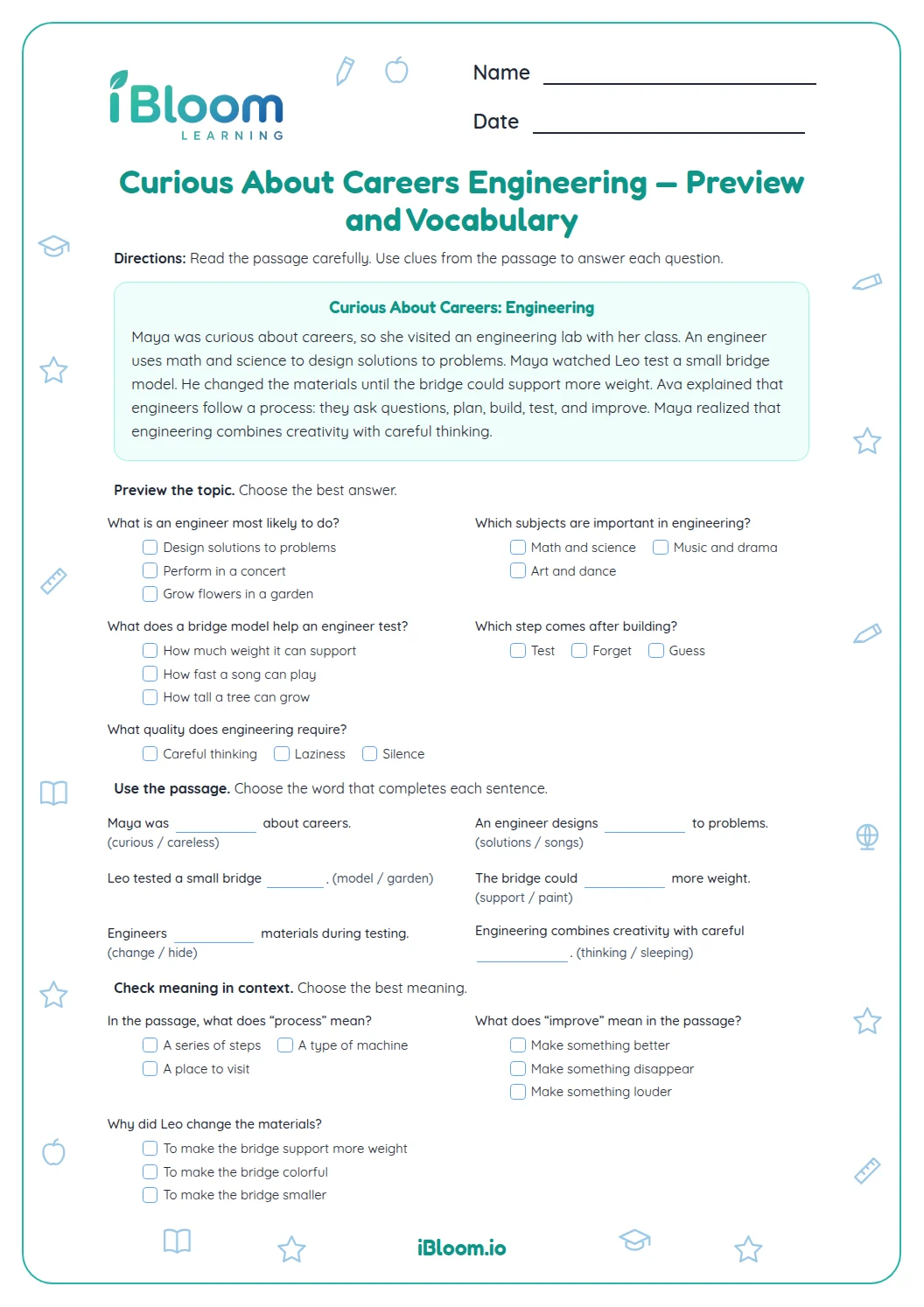
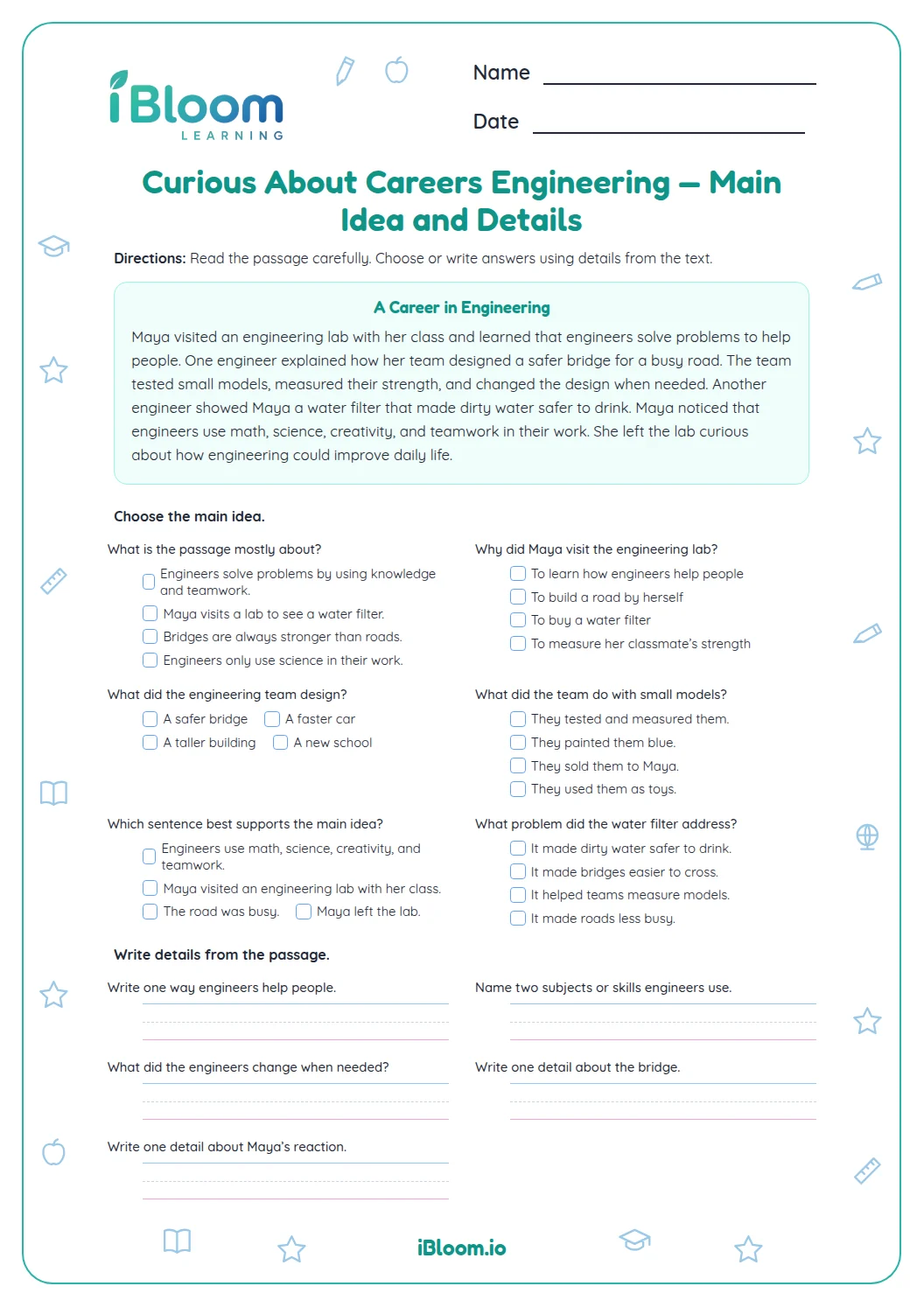
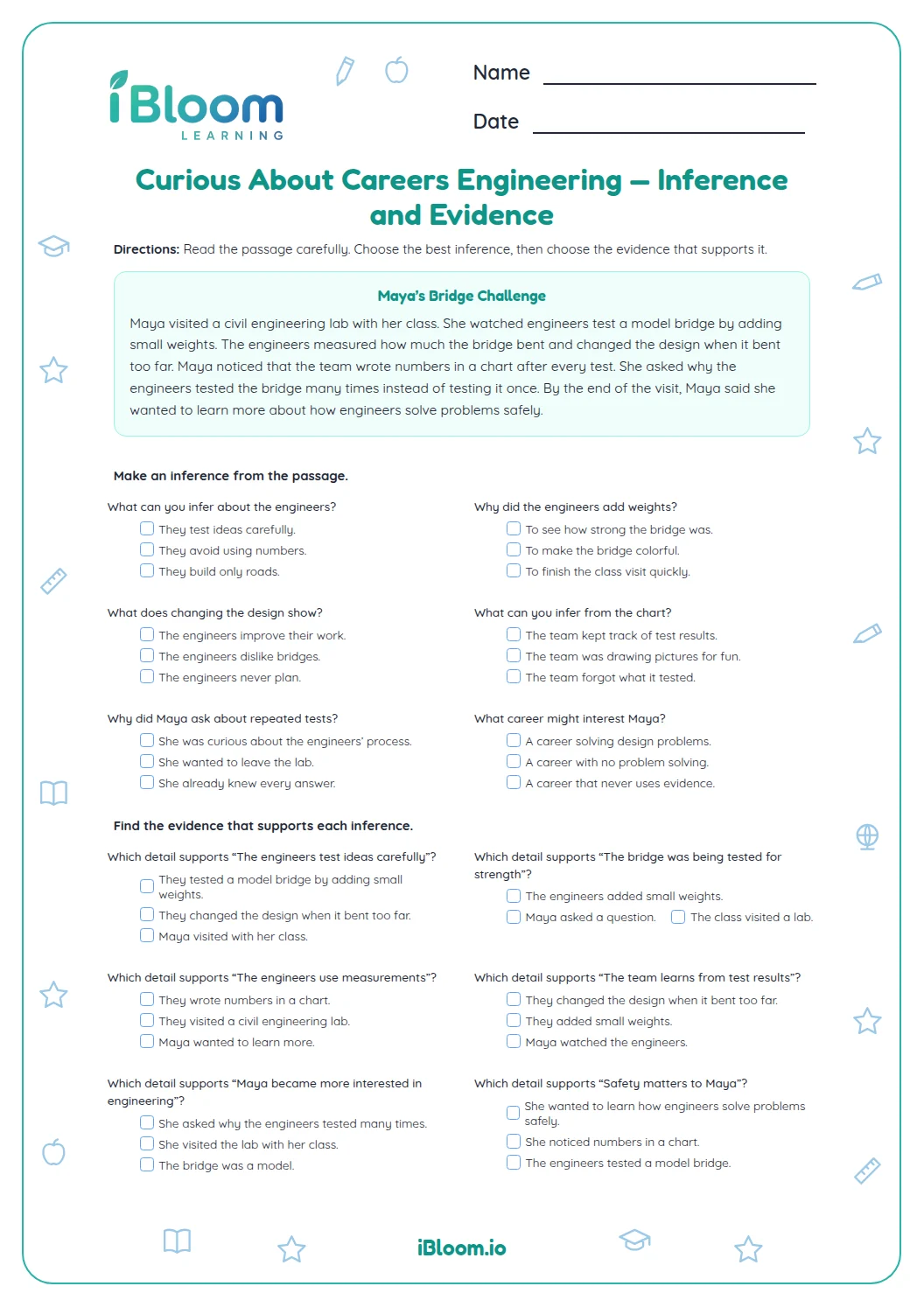
This Grade 5 mixed comprehension worksheet keeps the Curious About Careers Engineering passage and adds a complete set of questions. Students check explicit details, interpret a word in context, identify the main idea, and explain how evidence supports inferences about engineering. The story follows Maya and Leo as a science club tests and strengthens a model bridge. The questions practice Common Core RL.5.1 and RL.5.2. A separate answer key includes selected answers and sample written responses.
Aligned to RL.5.1 and RL.5.2
How can readers find details in a passage?
Reread the sentence that describes the visit, materials, test, or result. A detail answer should match what the passage says, not just what seems likely in real life.
Question 2 asks what Ava’s model bridge was made from; the passage names wooden sticks.
How do events develop the passage’s main idea?
Notice how the team moves from testing the bridge to seeing it bend and strengthening its supports. Those connected events show how testing can guide improvement.
The main idea includes the process, not only the topic of bridges.
- 1Question: What is a main idea?
- 2The team tests a bridge and improves its supports.
- 3The passage also says engineers study results and revise plans.
- 4Answer: Engineers improve designs by testing and revising.
How can students support an inference with evidence?
An inference combines details with a reasonable conclusion. Ava explains that designs may not work immediately, and the team changes the supports after testing. Those details support the idea that a first attempt can be improved.
Part C asks students to explain improvements and draw an inference. The answer key provides sample responses; other answers work when they use accurate evidence.
How to use this worksheet at home or in class
- 1Read the whole passage once before answering.
- 2Underline names, materials, actions, and results as you read.
- 3For main-idea questions, connect several related details.
- 4For written answers, state the idea and cite a specific event.
- 5Reread your answer to make sure the detail supports it.
- 6Check each response against the answer key’s sample.
Common mistakes and quick fixes
The mistake
Choosing an answer that sounds true in general but is not in the passage.
The fix
Find a sentence that directly supports the choice.
The mistake
Naming only the topic, such as bridges, as the main idea.
The fix
Explain what the passage teaches about testing and improving designs.
The mistake
Writing an inference without a story detail.
The fix
Pair the conclusion with an action or statement from the passage.
Common Core alignment
This printable gives students focused practice with the listed English language arts skill.
Use accurate details from a text to explain explicit information and inferences.
On this sheet: Students identify details, infer character thinking, and support explanations with information from the passage.
Show the official wordingHide the official wording
Quote accurately from a text when explaining what the text says explicitly and when drawing inferences from the text.
Determine a story’s lesson from details and summarize the text.
On this sheet: Students identify the central idea about engineering and connect it to events in the passage.
Show the official wordingHide the official wording
Determine a theme of a story, drama, or poem from details in the text, including how characters in a story or drama respond to challenges or how the speaker in a poem reflects upon a topic; summarize the text.
What to practice next
Make more practice
Questions parents and teachers ask
What does this mixed comprehension page include?
It has 12 multiple-choice questions on details, vocabulary, events, and main idea, followed by four written responses using evidence. The answer key includes the selected answers and sample written responses. Ask the student to point to the exact word or event that supports the response, then explain the connection in their own words.
Is the passage about a real engineering career?
The story describes a fictional science-club visit where students observe an engineer testing and improving a model bridge. It introduces actions engineers may take as they study a design. Ask the student to point to the exact word or event that supports the response, then explain the connection in their own words.
How should students answer the written questions?
They should state a complete idea and include a detail from the passage. The answer key provides sample responses, and another response is suitable when it is supported by an accurate passage detail. Ask the student to point to the exact word or event that supports the response, then explain the connection in their own words.
What is the central idea students can take from the story?
The events show that engineers can test a design, study the results, and make changes to improve it. Students can use the bridge test and stronger supports as details when explaining this idea. Ask the student to point to the exact word or event that supports the response, then explain the connection in their own words.