






About this worksheet
This Grade 5 reading worksheet follows Nia and Mateo as they design, test and revise a small bridge. Students answer 12 questions about the order of events, the passage structure and how test results inform a redesign. The original passage and question set come with a separate answer key.
How does the passage sequence the bridge work?
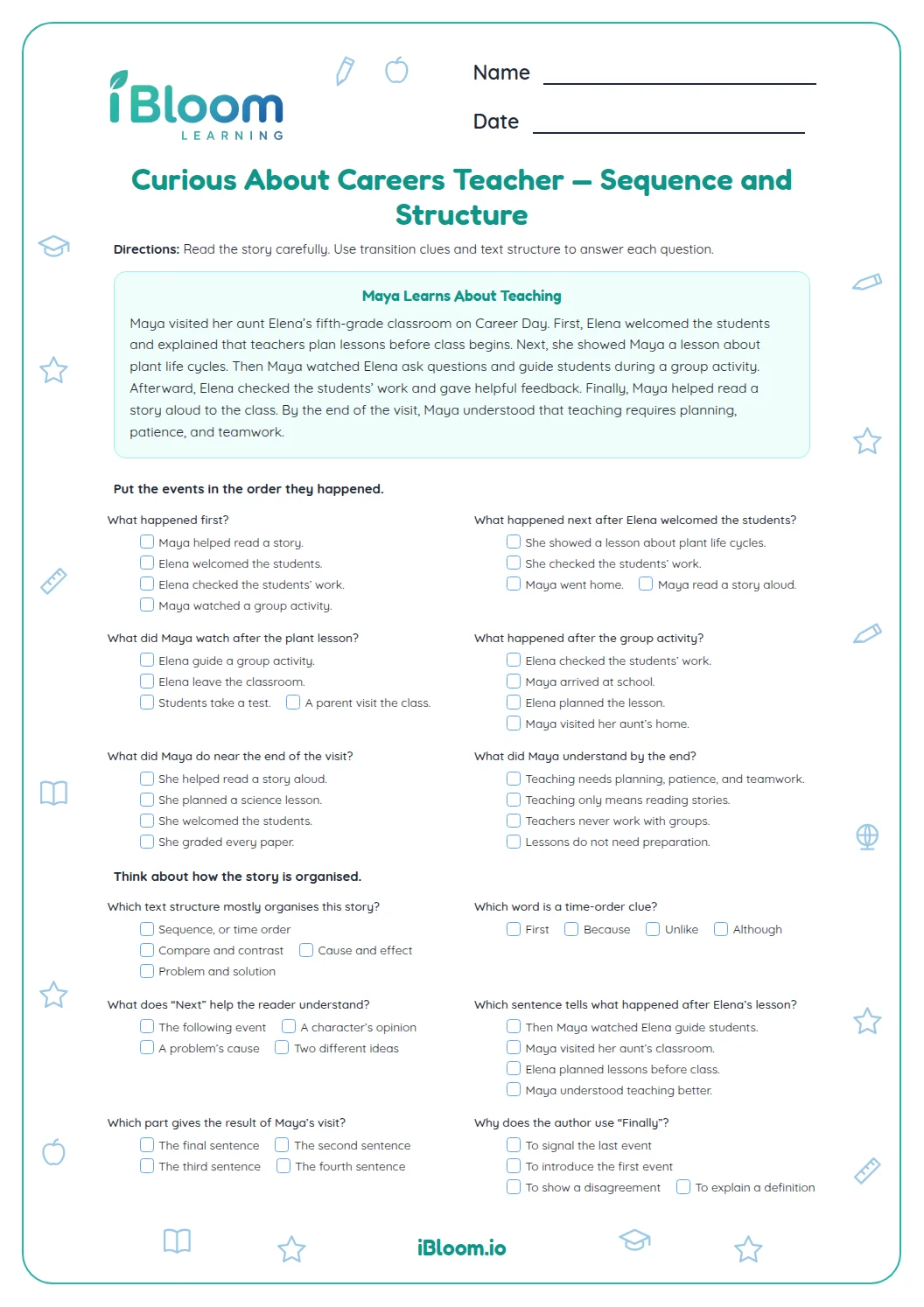
The passage presents the project in time order: sketch, measure, build frames, join them, test, revise and test again. Following the sequence helps readers see how each action contributes to the result.
- 1Build frames → join the sides → test
- 2Study the bend → add braces → test again
- 3The sequence links the first result to a revision.
What text structure does the passage use?
The account follows events in time order and connects the first test result to a later design change. The bridge bends, the team studies the result, and the added braces change what happens during the second test.
Which details support an answer?
Specific details such as twelve washers, two added braces and twenty washers help readers support an inference. Answers should connect a claim to what the passage says.
How to use this worksheet
- 1Read once to understand the project and its outcome.
- 2On a second read, note the order of actions and test results.
- 3For a structure question, ask how the passage groups its details.
- 4For a cause question, connect the change to the evidence that prompted it.
- 5Return to the passage to confirm each choice.
Common mistakes and fixes
The mistake
Mixing up the two bridge tests
The fix
Track the first result and second result separately: twelve, then twenty washers.
The mistake
Calling every passage a list of steps
The fix
Look at how events connect; here the first test causes a design revision.
The mistake
Choosing an inference without evidence
The fix
Point to a detail, such as adding diagonal braces after noticing a bend.
What to practice next
Make more practice
Questions parents and teachers ask
What is the passage mainly about?
The passage follows Nia and Mateo as they design, test and improve a bridge. They use what they observe in the first test to decide what to change before testing again. The questions ask readers to track the order of events and connect the test evidence with the redesign.
What happened in the first bridge test?
The first bridge bent after twelve washers. Nia and Mateo studied the bend and added two diagonal braces near the center before the second test. The passage then reports that the revised bridge held twenty washers before one joint slipped, giving readers evidence to compare.
How is the passage organized?
The account follows events in time order, from planning and building to testing and revision. It also links cause and effect because the first test result influences the next design. Questions ask students to notice both the sequence and the relationship between the bend and the braces.
Why did the second bridge hold more washers?
The team added two diagonal braces after studying where the first bridge bent. In the second test, it held twenty washers before a joint slipped, an improvement over the first result of twelve washers. The passage gives the measurements so readers can support the comparison with evidence.
What does the question about changing one feature mean?
Changing one feature helps Nia and Mateo compare test results and see which change may have mattered. The passage says they plan to compare brace patterns while changing only one feature at a time. That detail supports an inference about how they would make a fair comparison.
Is there an answer key for the reading questions?
Yes. The separate answer key lists the correct choice for all 12 questions. Students can return to the passage to find the sequence, test results and details that support each answer. The worksheet has four reading pages, with the key provided separately.