


About this worksheet
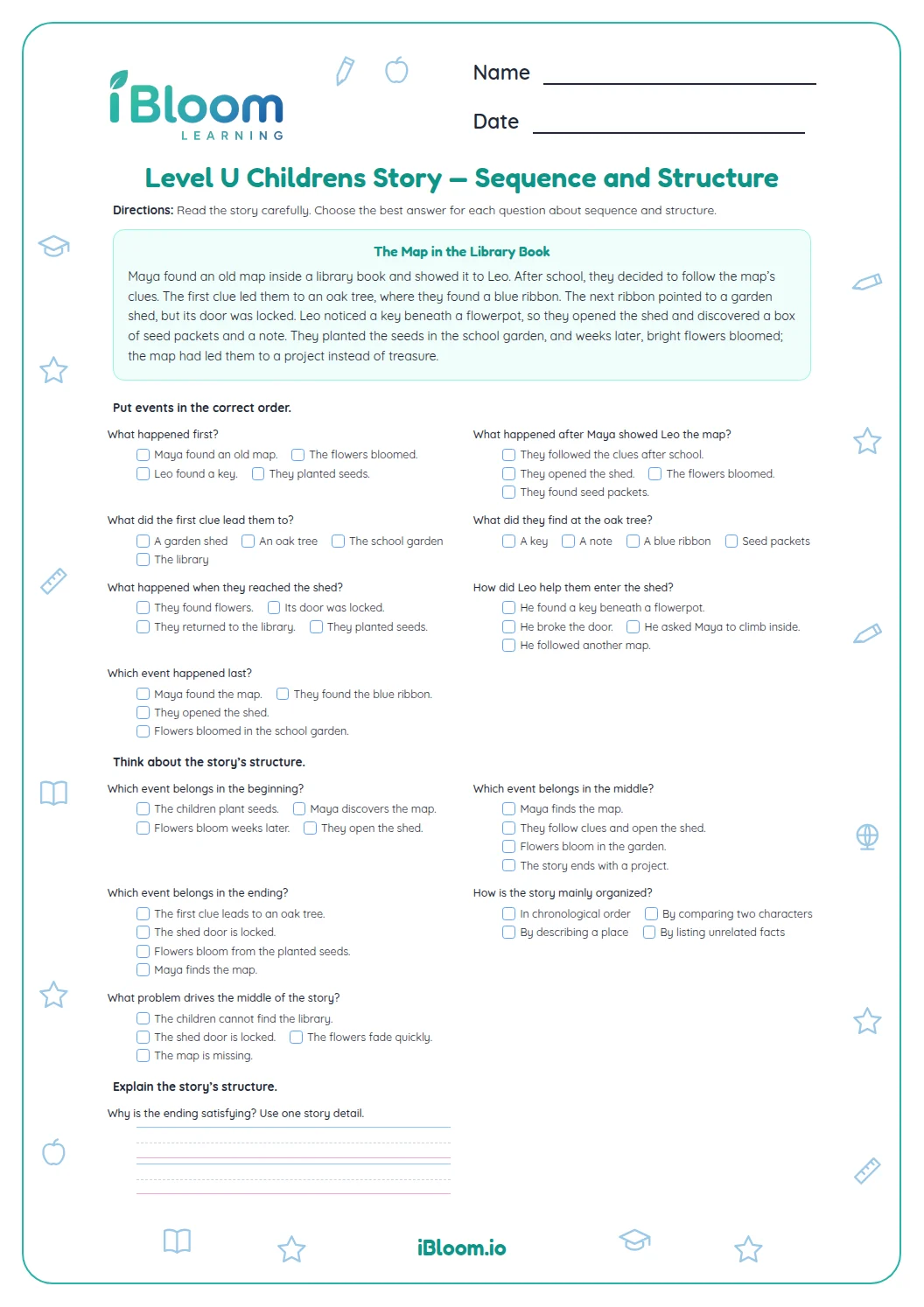
This Grade 5 reading worksheet pairs an original story with 14 questions about event order, causes, and story details. Students follow Nia’s response to a damaged plan and explain how silver stars connect the beginning and ending, quoting details in two written responses. The separate key includes sample answers. It practices CCSS RL.5.1 by asking students to quote accurately when explaining the passage and drawing an inference.
Aligned to RL.5.1
How do readers track a story’s sequence?
Readers follow what happens and notice how one event leads to another. A simple retelling can name the beginning, the problem, the response, and the outcome. Look for time words and actions that connect each step.
- 1Nia gathers the pages while Leo holds the door shut.
- 2The sentence directly states Leo’s action.
- 3Answer: He held the door shut.
How do details contribute to the story?
A repeated detail can connect the beginning to the ending. Here, the silver stars appear first as a discovery and later as part of the mural. The damaged plan creates a problem, and Nia’s response turns it into a new design idea.
Part B asks students to explain how details support a whole-story idea, not only to recall an isolated fact.
What is on the worksheet?
The passage is followed by 14 questions. Part B asks about the order, causes, and outcomes of events. Part C asks students to explain how details connect across the story.
Students may return to the story to confirm an answer. The key gives a sample for each open response.
How to use this worksheet
- 1Read the whole passage once for the main events.
- 2Reread the paragraph named in a question.
- 3Mark time clues such as first, then, and after lunch.
- 4For an explanation, include the problem and the event that responds to it.
- 5Check written answers against the story, not memory alone.
Common mistakes and quick fixes
The mistake
Mixing up when an event happens.
The fix
Retell the events with first, next, and finally before answering.
The mistake
Choosing a detail that is true but does not answer why.
The fix
Match the question word to the needed evidence: what, when, or why.
The mistake
Giving an explanation without a story detail.
The fix
Name one specific event and explain how it supports the answer.
Common Core alignment
Students refer to story details when they explain events and connections.
Quote story details to explain events and draw an inference.
On this sheet: Questions 13–14 ask students to quote story details while explaining how events and repeated images connect.
Show the official wordingHide the official wording
Quote accurately from a text when explaining what the text says explicitly and when drawing inferences from the text.
What to practice next
Make more practice
Further reading
Questions parents and teachers ask
Is the story original?
Yes. The worksheet includes an original story about Nia, Leo, and a class mural project. Its events and details were written to support sequence and structure questions, with a beginning, a problem, a response, and an ending students can trace.
How many questions are on the worksheet?
There are 14 questions: twelve short-answer items and two longer written responses. They move from locating events and causes to explaining how story details connect, so students practice careful recall and whole-story thinking. These totals include every item on the page.
Can students look back at the passage?
Yes. Returning to the passage is part of careful reading. Encourage students to reread the paragraph containing the event or detail named in a question; this helps them confirm order and choose evidence instead of relying only on memory as they work.
What should a strong written answer include?
A strong response names a relevant story detail and connects it to the question. The answer key gives sample wording, but another response is correct when it is supported by the passage and explains the relationship clearly using details from the passage.
How does this practice story structure?
Students consider how the damaged plan creates a problem, how Nia responds, and how the silver stars link the beginning to the ending. They can use those events and details to explain how the story holds together while rereading the text.