



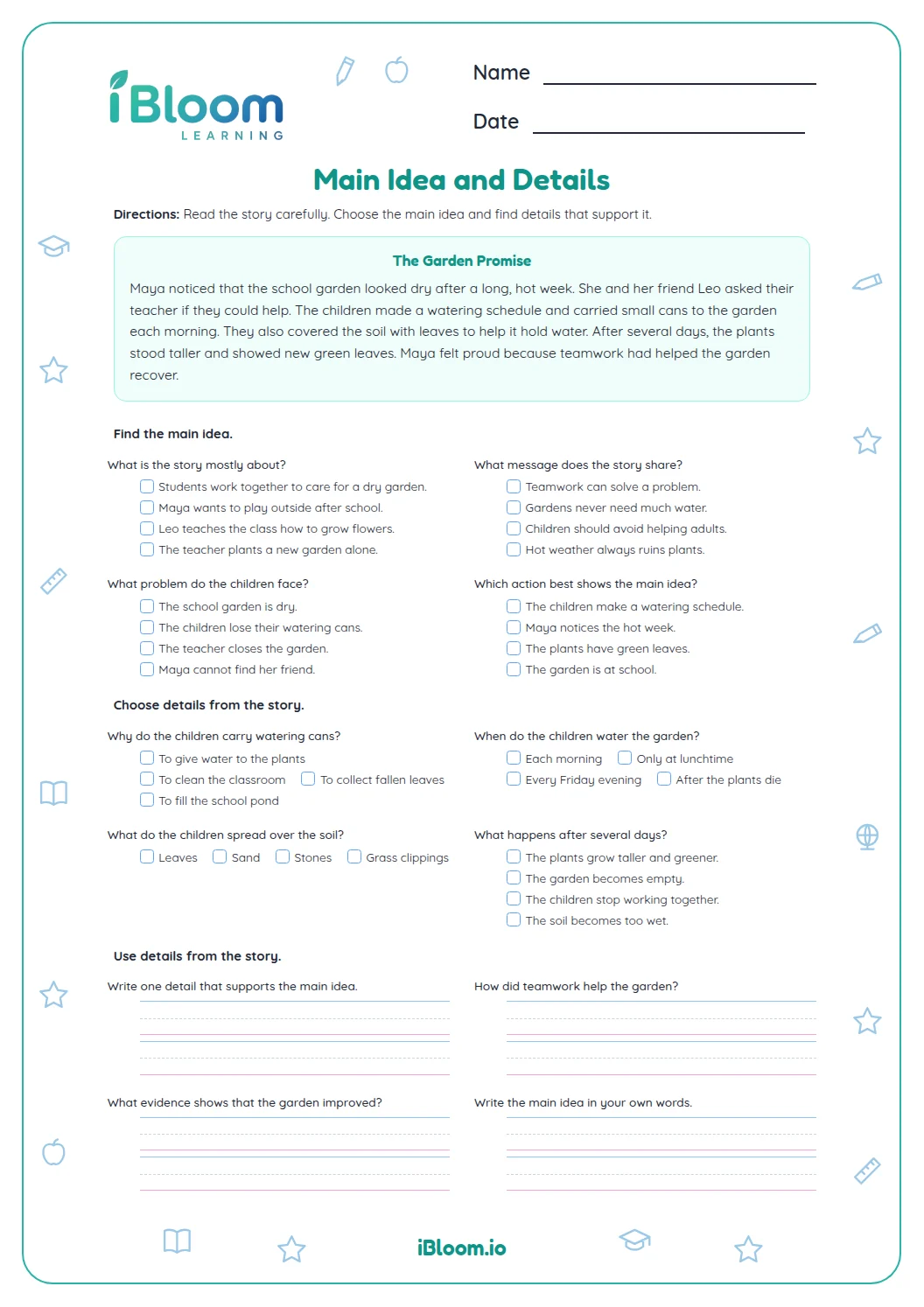
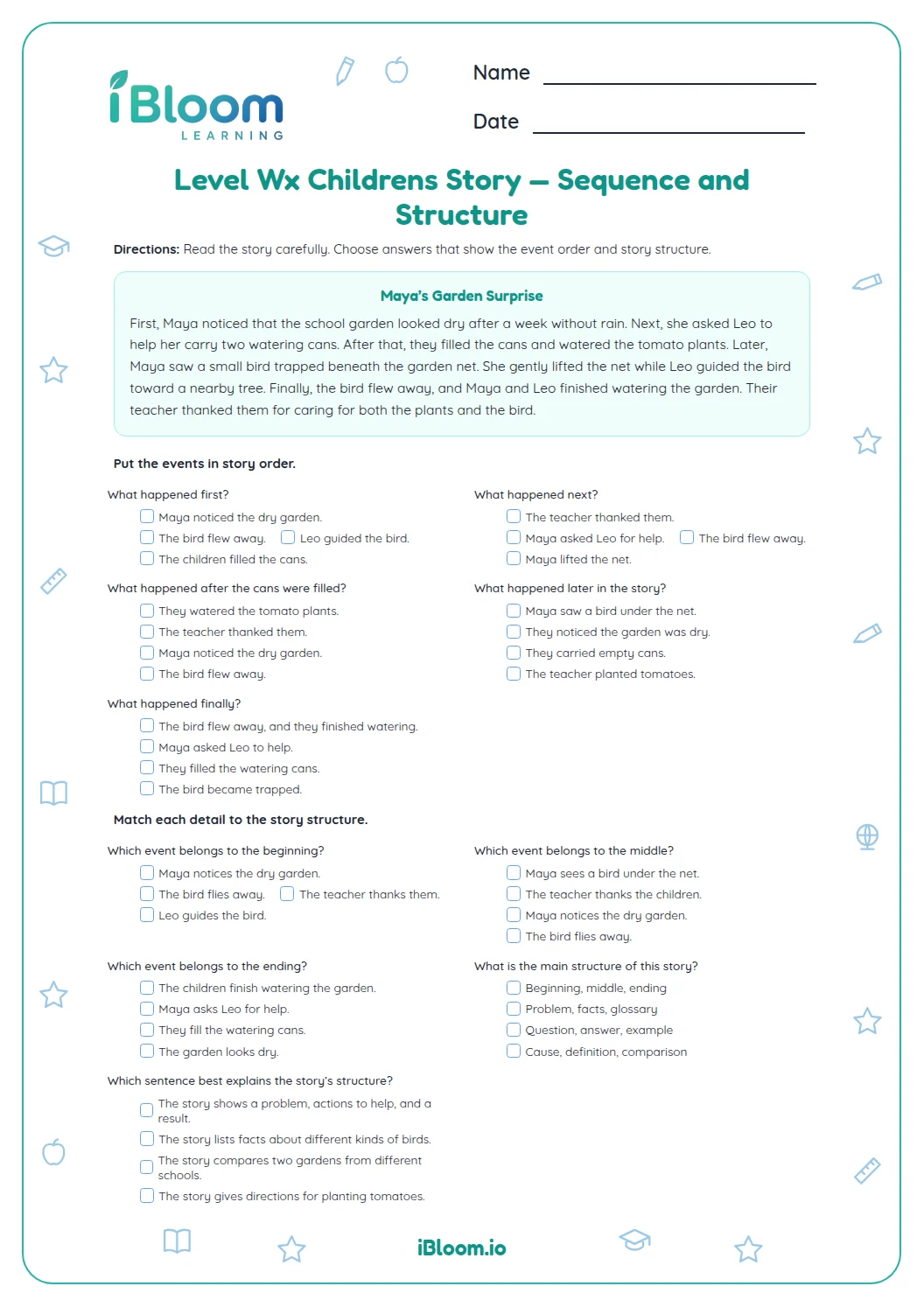
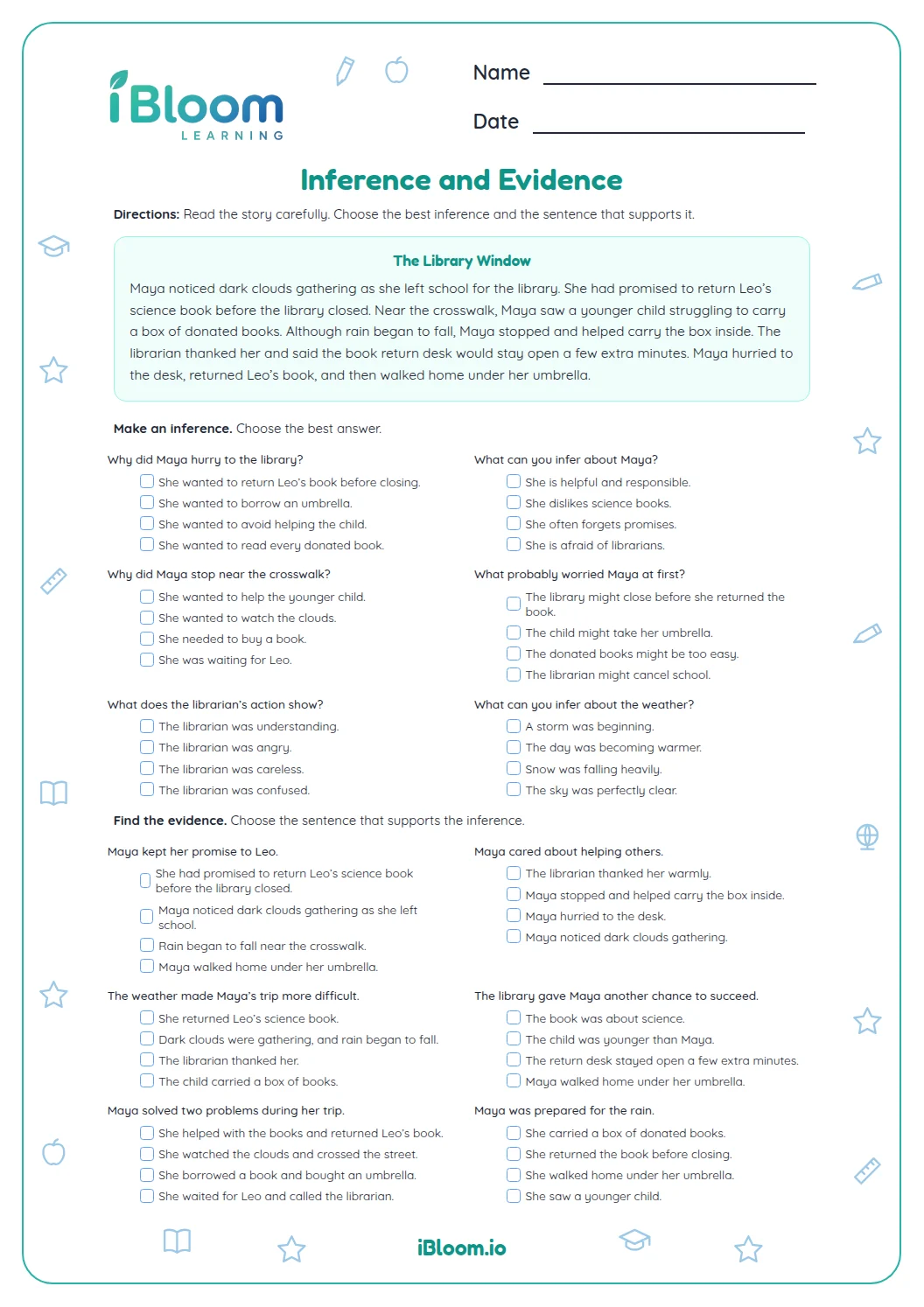
About this worksheet
This free printable worksheet gives Grade 5 readers an original 216-word story, "Tomás and the Lumpy Kite," and asks them to read between the lines. In the first set of questions, they make five inferences about what Tomás feels and why people act as they do. In the second set, they pick the story detail that best proves a claim. Last, they explain one inference in writing, with a detail to back it up. It practices Common Core RL.5.1, drawing inferences from a text and supporting them with details. A separate answer key is included.
Aligned to RL.5.1
What is the difference between an inference and evidence?
An inference is a conclusion a reader draws from clues because the writer never states it. The story never says that Tomás is upset after the crash. It says he did not speak, pushed his hands into his pockets, and his shoulders dropped, and a reader puts those clues together.
Evidence is the clue itself: the exact detail in the text that supports the conclusion. Good readers say both parts, "He was upset, because his shoulders dropped," so a claim never stands alone.
How do students find the best evidence for an inference?
Ask them to state the inference in their own words, scan the story for details that connect to it, and test each one: does it prove the claim, or is it only true in the story? In Part C, "The field was crowded" is a true detail, but it says nothing about Priya's kindness.
The answer choices on this sheet are short details from the story so students can find each one, underline it, and compare it with the claim.
- 1Inference: Tomás takes care with his work.
- 2Look for a detail about how he worked.
- 3"He cut the paper twice because the first edges were crooked."
- 4Test it: cutting again to fix crooked edges shows care.
- 5Evidence: He cut the paper twice.
What is on this worksheet?
A 216-word story about a boy whose kite breaks and a classmate who helps, on its own page, followed by ten questions on two more pages. The sheet labels the story Part A and the questions Parts B to D, and the questions follow the story in order so students can track back to each detail.
Question 5 asks for an idea the whole story supports, and the written question at the end asks students to name an inference and the detail that proves it, which uses the same habit in their own words.
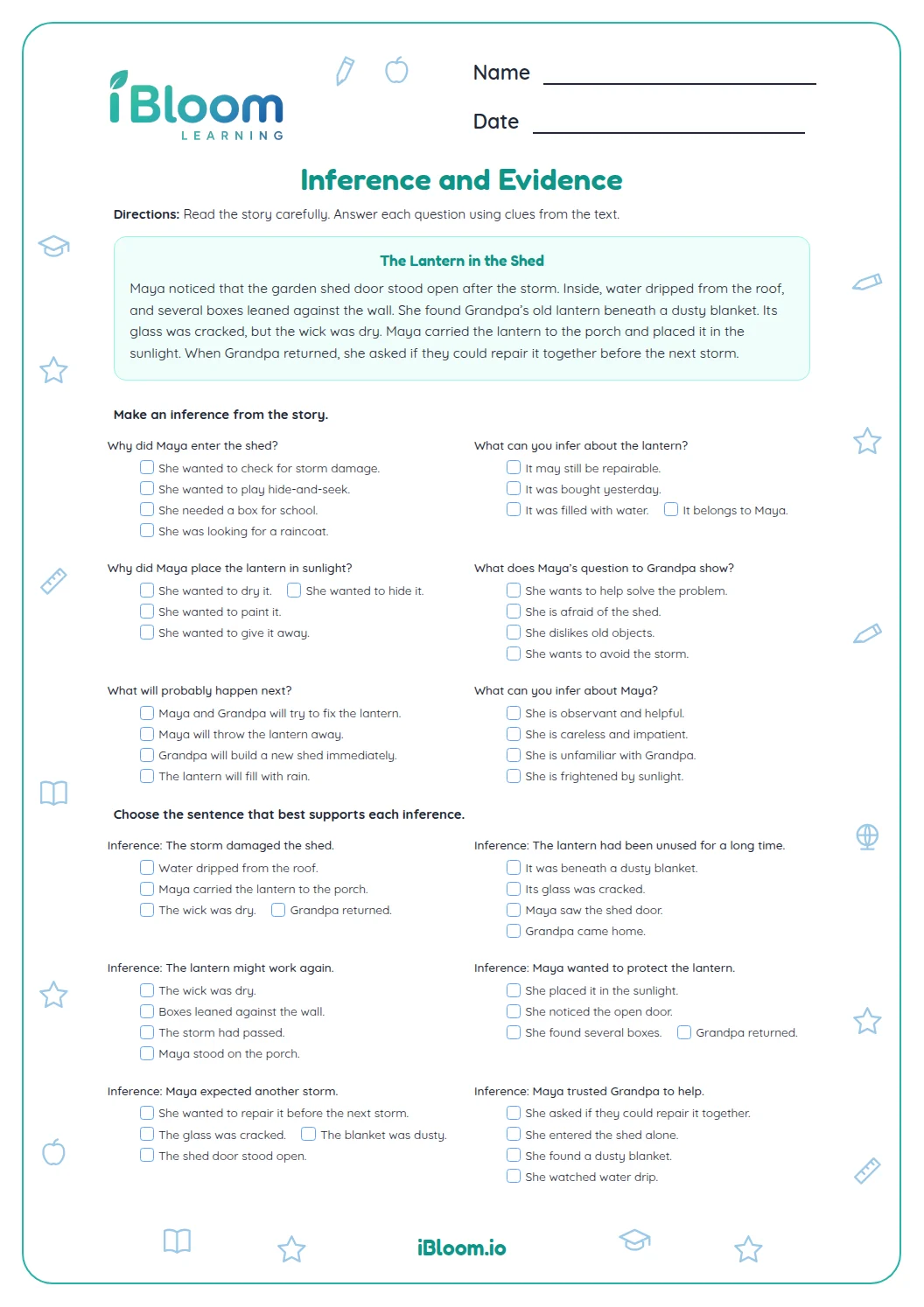
- Part A, Read: the story, "Tomás and the Lumpy Kite," 216 words
- Part B, Make an inference: 5 multiple-choice questions about feelings, character, motive and the whole story
- Part C, Find the evidence: 4 questions on the detail that best supports each claim
- Part D, Explain your thinking: 1 written answer, with a sample in the key
- Answer key on separate pages
How to use this worksheet at home or in class
- 1Read the story aloud once, or have your child read it twice, once for the story and once to notice clues.
- 2Talk through question 1. Ask, "What does the story say Tomás did after the crash?" before looking at the choices.
- 3Let your child finish Part B, then have them tell you the clue behind each answer.
- 4In Part C, have your child underline the matching detail in the story before choosing an answer.
- 5In Part D, ask for the written answer in a sentence with a "because." Cover both the inference and the detail.
- 6Check with the answer key. For a miss, find the sentence that supports the answer and the one that does not.
Common mistakes and quick fixes
The mistake
Choosing a detail that is true but does not prove the claim, such as "The field was crowded" for Priya being kind.
The fix
Ask, "If I only had this detail, would I know Priya is kind?" If the answer is no, look for a detail about what she did.
The mistake
Retelling the story instead of inferring, such as writing "He did not win the ribbon" for question 10.
The fix
Say, "That is what happened. What does it tell us about Tomás?" Then ask your child to finish the sentence "This shows he..."
The mistake
Picking an inference the story does not support, such as "Angry at Priya" in question 1.
The fix
Check each choice against the text. Priya helps him, and nothing in the story shows he is angry at her.
Common Core alignment
Most US states use the Common Core standards or a close state version. This sheet practices the Grade 5 reading literature standard on inferences and evidence.
Draw inferences from a story and pick the details from the text that support them.
On this sheet: Every question asks students to draw an inference or choose the text detail that supports one.
Show the official wordingHide the official wording
Quote accurately from a text when explaining what the text says explicitly and when drawing inferences from the text.
What to practice next
Make more practice
Further reading
Questions parents and teachers ask
What is the difference between an inference and evidence?
An inference is a conclusion you reach from clues, such as "Tomás is upset." Evidence is the exact detail in the text that supports it, such as "his shoulders dropped." Part B asks for inferences, and Part C asks students to pick the detail that proves a claim.
What are the answers to Parts B and C?
Part B: let down and upset; he takes care with work; she likes to be prepared; to remember the day; Priya's help mattered. Part C: he cut the paper twice; his shoulders dropped; she helped fix the kite; it flew above most kites. The key also gives a sample answer for question 10.
What does Level Y mean?
Level Y is a letter from the A to Z guided reading levels used by many schools, where letters late in the alphabet are harder texts. iBloom uses it to group leveled stories. This story was written for Grade 5 and has not been formally leveled, so treat Level Y as a label, not a measurement.
Why are the answer choices only a few words long?
Short choices let students find each detail in the story, underline it, and compare it with the claim, instead of working from a long paragraph. The choices are details or short conclusions taken from the text. Only question 10 needs full sentences from the student.
My child chose a true detail but missed the point. What now?
Ask what the detail proves. "The field was crowded" is true, but it tells nothing about Priya. Have your child read each choice and finish the sentence "This shows that Priya..." The one that makes sense is the evidence. Repeat the check on any other missed question.
What makes a good written answer to question 10?
A good answer names the inference and one detail, for example: "He cares more about flying than winning, because his cheeks hurt from grinning." Accept different wording if the claim fits the story and the detail is real. The sample in the key is one of many acceptable answers.