Free printable practice
Space Travel Practice Activities
Grade 2 science worksheets help children explore space travel, from rockets and astronauts to safe missions beyond Earth.
Free printable worksheet PDFs
Preview every available page, then download the free worksheet PDF for home, homeschool, tutoring, or classroom practice.
Preview the exact activity before downloading it.
 Space Travel — Sort and ClassifyGrade 2 science worksheets help children explore space travel, from rockets and astronauts to safe missions beyond Earth. This sort and classify worksheet provides a distinct, age-appropriate way to practise the same lesson.Grade 2Free PDF preview
 Space Travel — Label and ModelGrade 2 science worksheets help children explore space travel, from rockets and astronauts to safe missions beyond Earth. This label and model worksheet provides a distinct, age-appropriate way to practise the same lesson.Grade 2Free PDF preview
 Space Travel — Explain Cause and EffectGrade 2 science worksheets help children explore space travel, from rockets and astronauts to safe missions beyond Earth. This explain cause and effect worksheet provides a distinct, age-appropriate way to practise the same lesson.Grade 2Free PDF preview
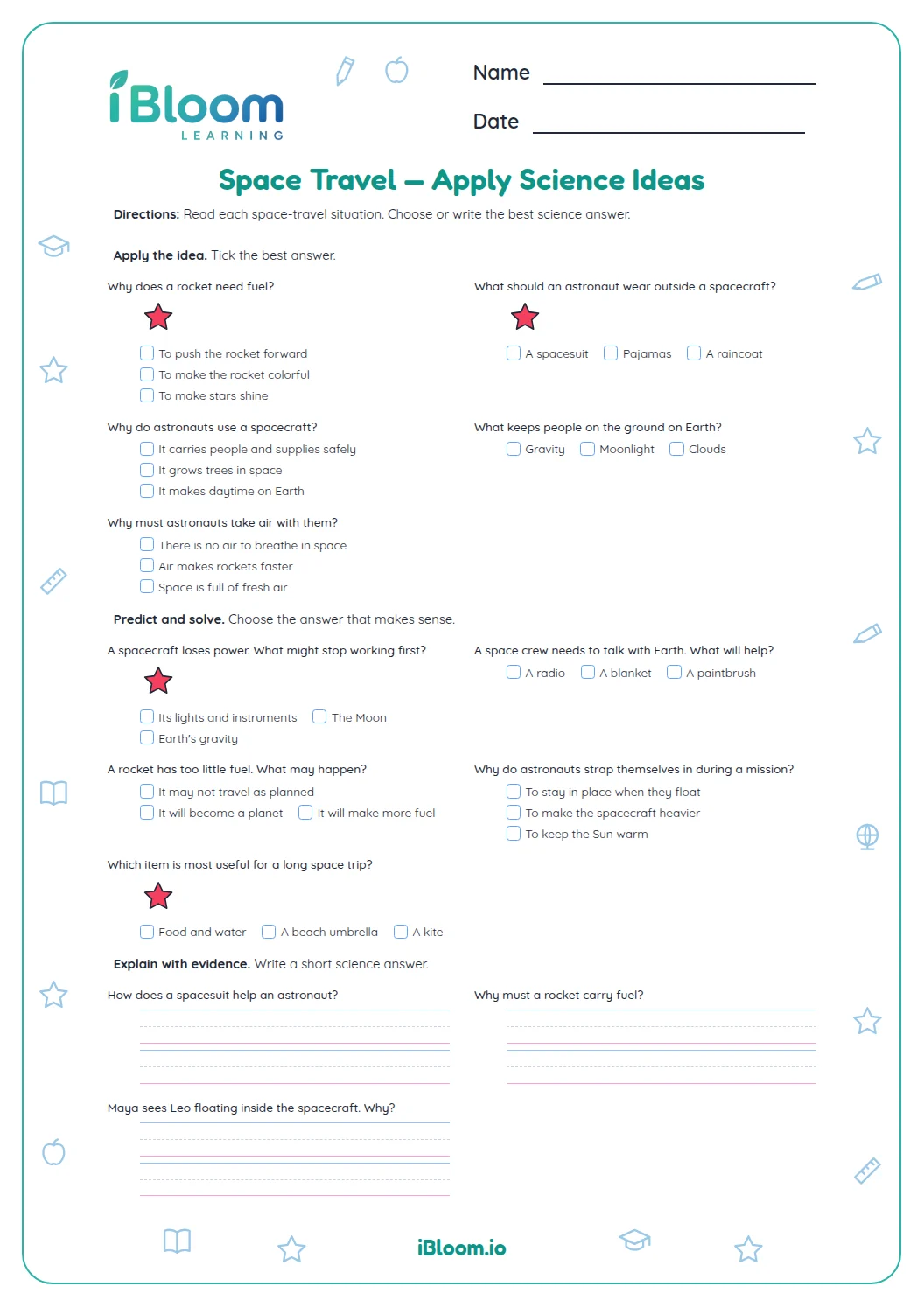 Space Travel — Apply Science IdeasGrade 2 science worksheets help children explore space travel, from rockets and astronauts to safe missions beyond Earth. This apply science ideas worksheet provides a distinct, age-appropriate way to practise the same lesson.Grade 2Free PDF preview
 Space Travel — Science Reasoning ReviewGrade 2 science worksheets help children explore space travel, from rockets and astronauts to safe missions beyond Earth. This science reasoning review worksheet provides a distinct, age-appropriate way to practise the same lesson.Grade 2Free PDF preview
Practice that builds confidence
What children learn about space travel
These Grade 2 space travel practice activities help children connect the idea of the solar system with the tools people use to explore it. Students practise reading and thinking about rockets, astronauts, spacecraft, launch, orbit, and the purpose of space missions.
The printable worksheets include clear science vocabulary, simple diagrams, labeling tasks, matching activities, short reading prompts, and question sets that build understanding step by step. They are designed for young learners who are ready to explain how humans travel into space in age-appropriate ways.
Space travel can feel exciting but abstract for second graders, so these worksheets focus on concrete ideas: rockets help spacecraft leave Earth, astronauts train for missions, and space vehicles carry people or equipment to learn more about space. Children meet useful words such as launch, orbit, mission, spacecraft, telescope, astronaut, and space station, then use those words in simple explanations.

Building from pictures to explanations
The activities move from recognizing objects to explaining their jobs. A child may first match a rocket to its function, label parts of a space scene, or decide whether an item belongs on Earth or in space. Later questions encourage complete science thinking, such as why astronauts wear special suits or how a spacecraft is different from an airplane.
A simple parent routine
At home, start by looking at one picture together and asking, “What do you notice?” Next, read the directions aloud and let your child circle or label independently. After each page, ask for one spoken sentence using a new word: “A rocket launches into space,” or “An astronaut works on a mission.” Keep a small word list on the fridge and add a quick sketch beside each term to strengthen memory.

Classroom uses for Grade 2 science
Teachers can use these pages during a solar system unit, as science centers, early-finisher work, small-group vocabulary support, or a quick check after reading a space book. The worksheets also work well before a class discussion about how people explore places they cannot easily visit. Students can compare answers with a partner and point to evidence in the picture or text.

Common mix-ups to watch for
Children may think rockets “fly like airplanes,” confuse planets with stars, or assume astronauts can breathe normally in space. Gently guide them back to the science idea: rockets need powerful engines to leave Earth, space is not like the air around us, and astronauts use equipment to stay safe. Encourage precise language instead of one-word answers.
Free printable PDF download
Use this grade 2 space travel worksheet page to preview the activity, print it, or download it as a PDF for quick practice. It works well for homework, homeschool lessons, tutoring, morning work, revision, and classroom centers.
Answers and answer key support
After the child completes the worksheet independently, parents and teachers can use the answer support or answer key information to check the work, review mistakes, and choose the next practice step.
Why iBloom worksheets help
The pages combine visuals, short text, and repeated vocabulary so children do more than memorize space facts. A helpful child-friendly strategy is: look, name, tell. Look closely at the picture, name the object, then tell what it helps people do in space travel.
Helpful answers
Frequently asked questions
What space travel ideas are covered in these Grade 2 worksheets?
Children practise basic ideas about rockets, astronauts, spacecraft, launch, missions, and how people use special equipment to explore space safely.
Are these worksheets only about the solar system planets?
No. They fit within a solar system unit, but the focus is space travel: how humans and spacecraft go beyond Earth to study space.
How can I help my child use new space vocabulary correctly?
Ask your child to point to a picture, say the word, and use it in a sentence, such as “The astronaut wears a space suit” or “The rocket launches from Earth.”
Can teachers use these activities in science centers?
Yes. The pages are suitable for centers, small groups, partner review, early finishers, or follow-up work after a read-aloud about space exploration.
What common misunderstandings do these worksheets address?
They help children separate rockets from airplanes, understand that astronauts need equipment in space, and describe spacecraft as tools for exploration.
Is this grade 2 space travel worksheet free?
Yes. You can preview it for free and use the printable worksheet for home or classroom practice.
Can I download this grade 2 space travel worksheet as a PDF?
Yes. Use the worksheet download option to save a printable PDF, or print the worksheet directly from the page.
Does this grade 2 space travel worksheet include answers or an answer key?
When the activity has fixed answers, iBloom includes answer support so parents and teachers can check the completed worksheet.