





About this worksheet
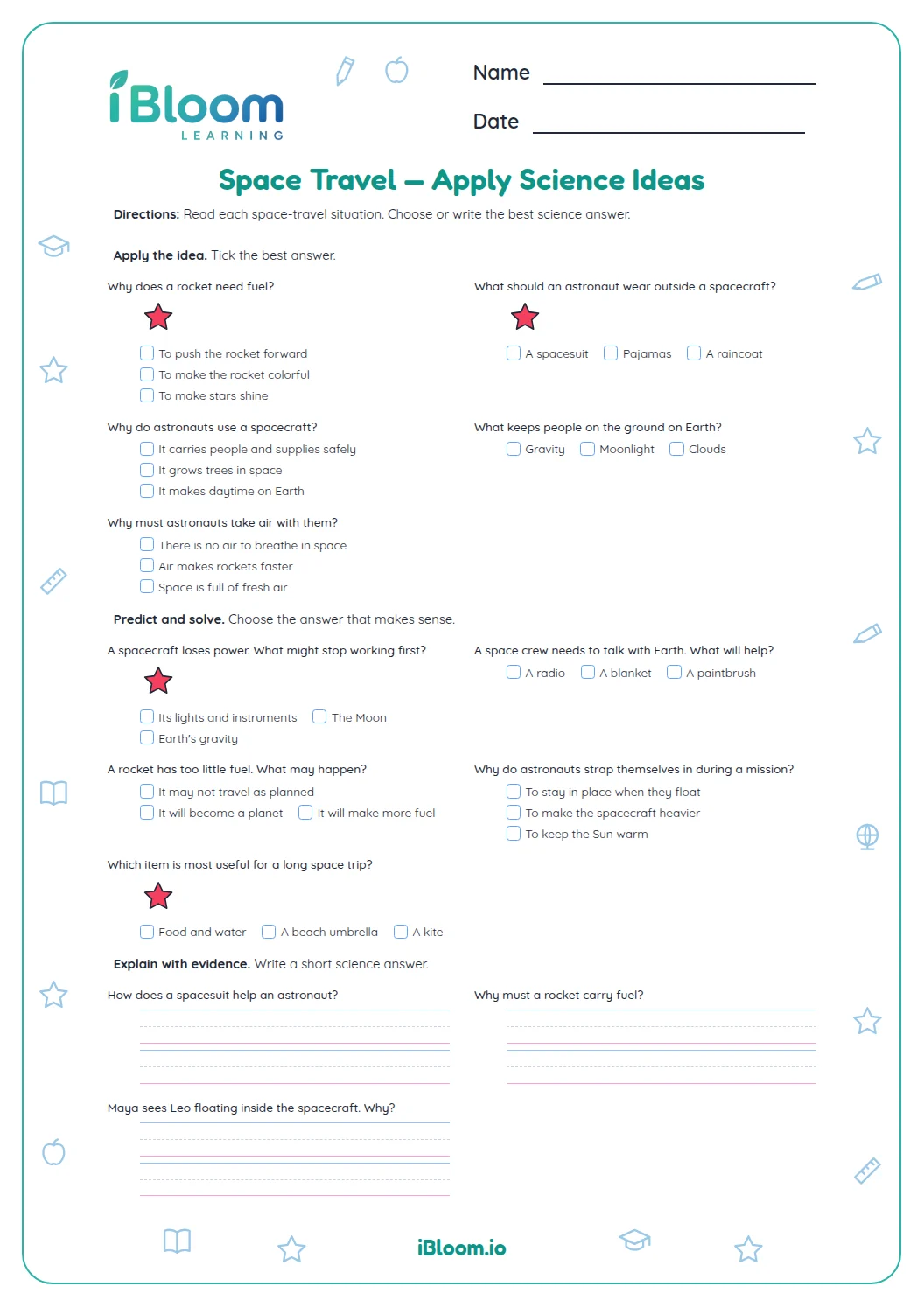
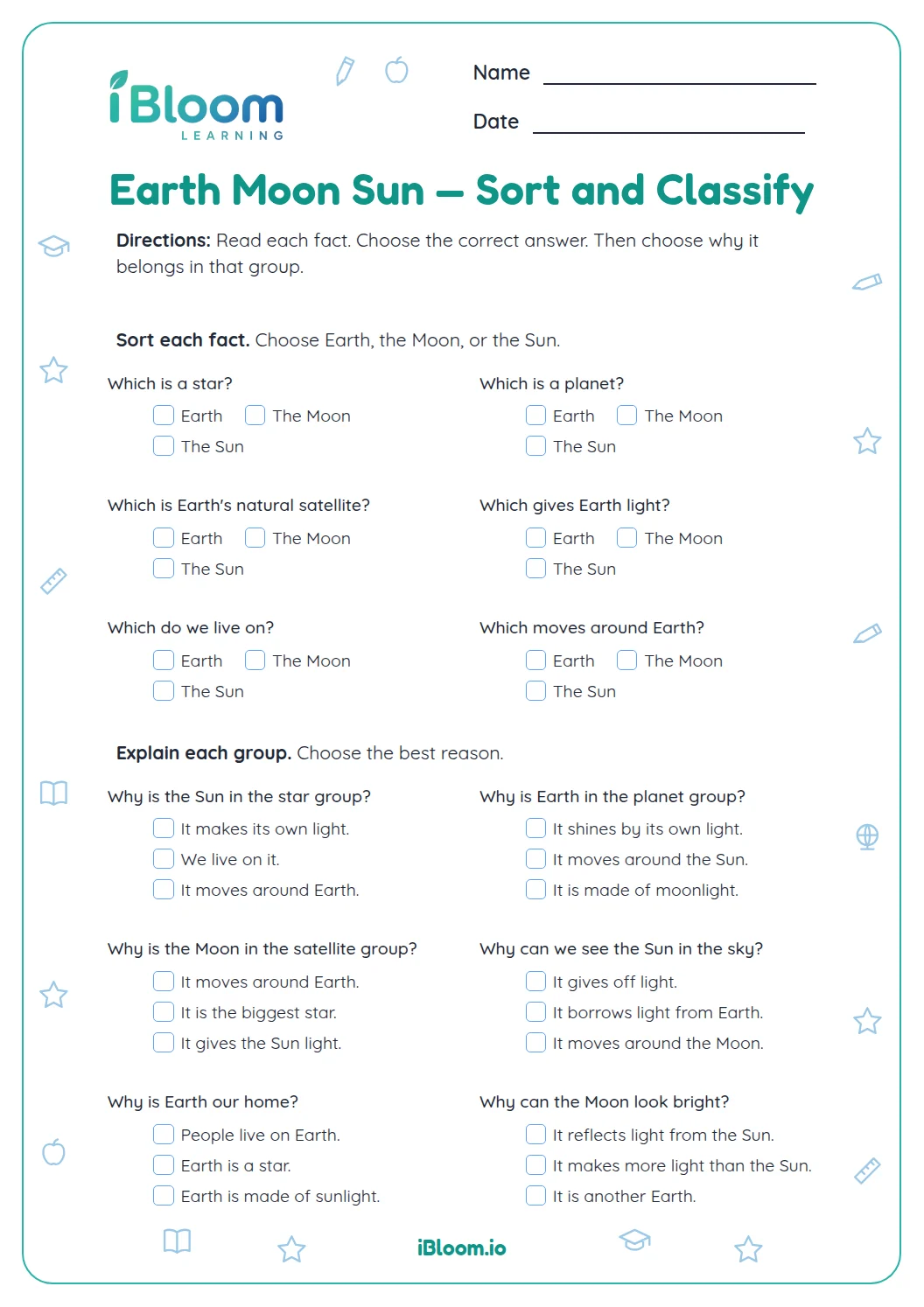
This free printable Grade 2 science worksheet gives learners 16 questions on solar system objects and space travel tools. It moves from naming familiar objects to sorting natural objects and human-made tools, with a separate answer key. The examples include planets, moons, the Sun, comets, rockets, spacesuits, telescopes, and satellites.
How can you sort space-travel examples?
The worksheet uses one rule throughout: decide whether each example travels into space or stays on Earth. A rocket, astronaut, spacecraft, and probe travel; a launch pad and mission control stay on Earth.
- 1Rocket
- 2People design and build it.
- 3Category: human-made object
Which tools travel, and which stay on Earth?
A space probe travels to gather information, while a telescope at an observatory stays on Earth and helps people observe distant objects. Think about where the example goes during a mission.
What does the worksheet ask learners to sort?
Sixteen questions ask learners to name space objects and tools, explain their jobs, and classify examples using the travel-or-stay rule. The answer key shows each choice.
How can I use this worksheet?
- 1Read whether the clue names something found in nature or built by people.
- 2Use the object’s job to identify the tool.
- 3Choose the category that fits the whole object.
- 4For group questions, look for what all items have in common.
Common mistakes and quick fixes
The mistake
Sorting a launch pad as something that travels because it is part of a mission.
The fix
Ask where the example goes during the mission: into space or stays on Earth.
The mistake
Sorting mission control with spacecraft instead of people and tools that stay on Earth.
The fix
Ask where the example goes during the mission: into space or stays on Earth.
The mistake
Assuming every object used to explore space must leave Earth.
The fix
Ask where the example goes during the mission: into space or stays on Earth.
What to practice next
Make more practice
Questions parents and teachers ask
What does this worksheet ask learners to sort?
Learners decide whether each example travels into space or stays on Earth. A rocket and spacecraft travel, while a launch pad and mission control stay on Earth. The answer key gives the classification for each example, following the same rule used on the worksheet.
Does a space probe travel into space?
Yes. A space probe travels away from Earth to study objects or places in space. The worksheet groups a probe with examples that travel, rather than with ground equipment such as a launch pad. Learners can explain what the probe does as they sort it.
Why does a launch pad stay on Earth?
A launch pad is the place where a rocket begins its trip. The rocket travels into space, but the pad remains on Earth. This contrast helps learners sort mission tools by where they go during a space trip.
How many questions are on the worksheet?
There are 16 questions. The first eight ask learners to identify space objects and tools or describe their jobs; the next eight ask them to sort examples by whether they travel into space or stay on Earth. The answer key covers both groups.
Does the worksheet include an answer key?
Yes. The separate key gives the expected object, tool, or travel classification for all 16 questions. Learners can explain their reason first, then use the key to check each response. It has the same three-page length as the worksheet.
What does “travels into space” mean on this page?
It means the example leaves Earth as part of a space mission. A rocket, astronaut, spacecraft, and probe travel; mission control and a launch pad stay on Earth. The worksheet uses these examples to practice one clear sorting rule and discuss where each item goes.