






About this worksheet
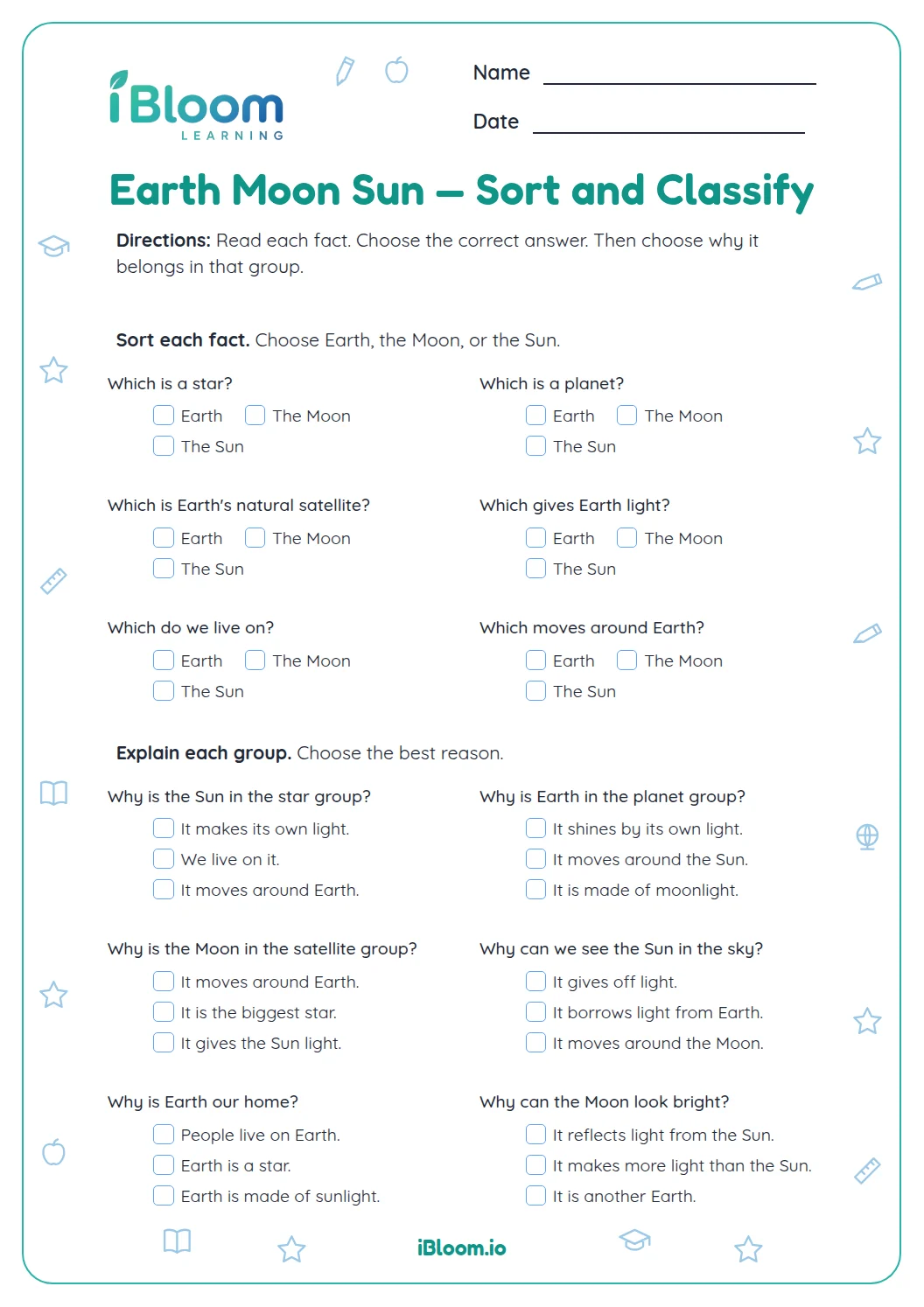
This free printable Grade 2 science worksheet asks children to use what they know about the Earth, Moon and Sun in everyday situations: a ball in sunlight, the Moon at night, the Sun coming up tomorrow. They choose answers, one of them with pictures of the Sun, the Moon and a cloud, complete four science sentences, and explain night and shadows in a sentence each. There are 11 questions in three parts on two pages, with a separate answer key.
Why do we have day and night?
Earth spins like a top, once every day. The side facing the Sun has daytime, and the side turned away has night. The Sun does not go anywhere; Earth’s spin makes it look as if the Sun rises in the morning and sets in the evening.
Because Earth keeps spinning the same way, the pattern repeats. Question 5 asks what the Sun will do tomorrow morning. Predicting that it will come up again is a first example of using a pattern to predict.
- 1Why is it dark at night where you live?
- 2Earth spins, and our side turns away from the Sun.
- 3No sunlight reaches us, so it is dark.
- 4Model answer: Our side of Earth turns away from the Sun, so it is dark.
Where does the Moon’s light come from, and how do shadows form?
The Moon does not make light. It looks bright because sunlight bounces off it, which is what question 3 asks. The Moon also travels around Earth, which is question 2.
A shadow forms when an object blocks light. A ball in sunlight, a tree and a hat all block sunlight, and the dark shape behind each is a shadow. Question 4 asks what forms behind a ball in sunlight, and Part C asks children to explain shadows in writing.
What is on this worksheet?
Eleven questions in three parts, from choosing answers to explaining in writing.
- Part A, Choose the best answer: five questions, one with pictures of the Sun, Moon and a cloud
- Part B, Complete the science sentence: four fill-in sentences with two choices each
- Part C, Explain it: two one-sentence written answers about night and shadows
- Answer key on separate pages
How can children test these ideas themselves?
On a sunny day, put a ball or a toy on the ground and look for its shadow. Move the object and see how the shadow moves. Indoors, use a flashlight in a dark room, and a globe or a ball to show how Earth turns one side toward the light.
How to use this worksheet at home or in class
- 1Start with a flashlight and a ball in a dim room. Shine the light on the ball and show the lit side and the dark side.
- 2Turn the ball slowly and say: “This is Earth spinning. Where it is lit, it is day.”
- 3In Part A, have your child say their answer aloud before filling the bubble, using a full sentence.
- 4In Part B, read each sentence with the missing word to hear whether it makes sense.
- 5For Part C, say the answer first, then write it. Check with the answer key.
Common mistakes and quick fixes
The mistake
Thinking the Moon makes its own light.
The fix
Shine a flashlight on a ball in a dark room. The ball glows only because of the light. The Moon is like the ball and the Sun is like the flashlight.
The mistake
Thinking the Sun moves around Earth to make day and night.
The fix
Use a ball and flashlight. Keep the flashlight still and turn the ball, and the lit side changes. Earth turns; the Sun stays where it is.
The mistake
Thinking a shadow is an object or that a shadow makes the dark.
The fix
A shadow is where light is blocked. Hold your hand over a paper in sunlight and watch the dark shape appear.
What to practice next
Make more practice
Questions parents and teachers ask
Does the Moon make its own light?
No. The Moon shines by reflecting light from the Sun, which is the answer to question 3. You can show this at home: in a dark room, a ball glows only when a flashlight shines on it. Without the flashlight, the ball is dark, like the Moon without the Sun.
Why does the Sun look like it moves across the sky?
Earth spins, so the Sun appears to rise, cross the sky and set. The Sun is not traveling around us. Where we stand on Earth turns toward the Sun in the morning and away in the evening, which is why Earth’s spin gives us day and night.
What is the answer to question 5 about tomorrow morning?
The Sun will come up again. Day and night repeat in the same pattern because Earth keeps spinning, so children can predict it. Question 5 offers a pattern to rely on and two choices that cannot happen, such as the Sun staying hidden or turning into the Moon.
What should my child know before trying this sheet?
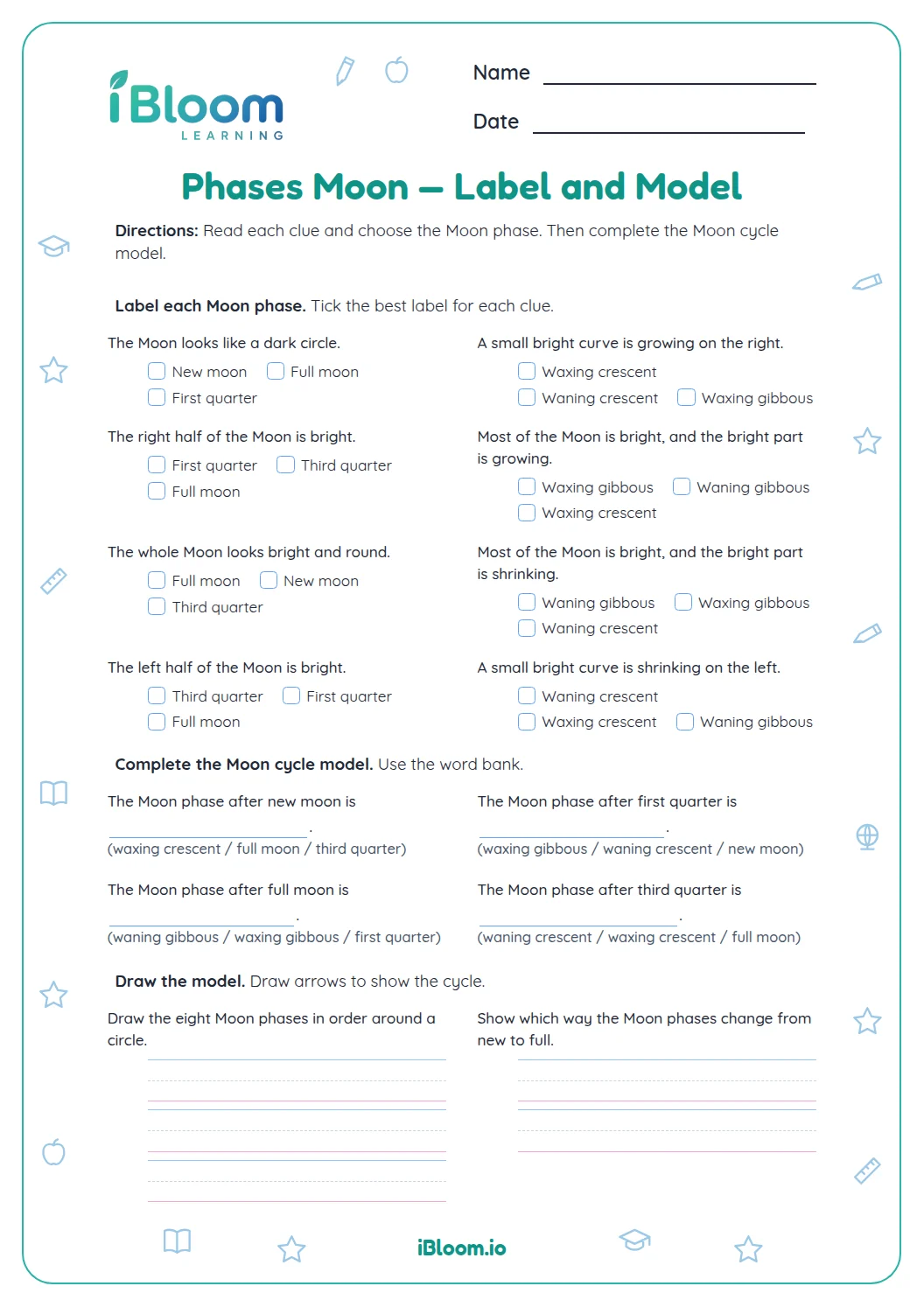
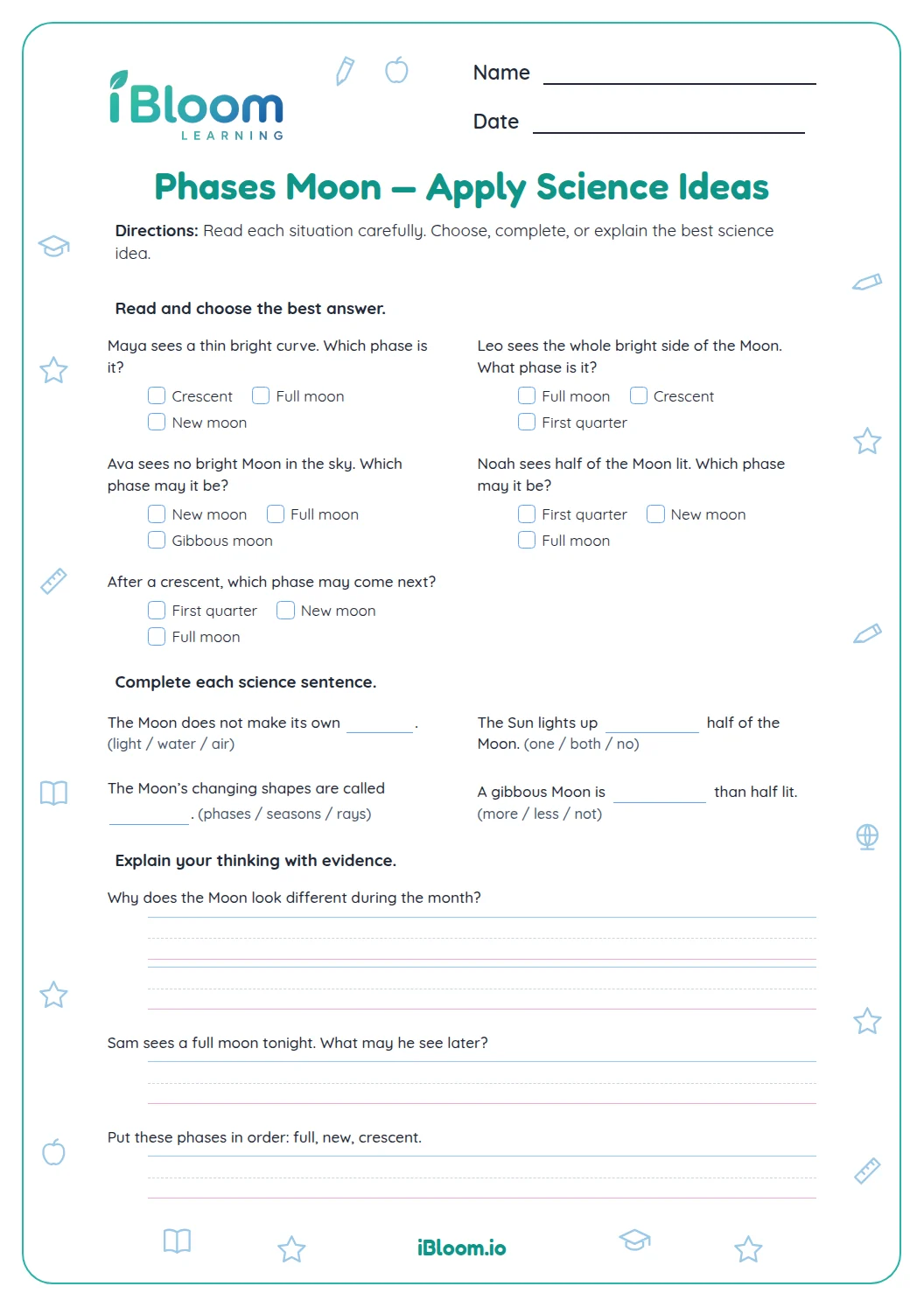
Your child should know the words Sun, Moon and Earth and be able to read short sentences with a two-word choice. Some practice with a flashlight and a ball helps. For more on how the Moon changes shape, try the Phases of the Moon worksheet linked below.
How should my child answer the written questions?
One clear sentence is enough. For question 10, a good answer names Earth and the Sun, such as “Our side of Earth turns away from the Sun.” For question 11, it should say that something blocks the light. Let your child say it aloud first, then write.
Is there an answer key for this worksheet?
Yes. A separate answer key shows the correct bubble for each choice, the missing words in Part B and sample sentences for the two written answers in Part C. Print the worksheet by itself and keep the key for checking, or download the worksheet and key together as a free PDF.