




About this worksheet
This free Grade 2 science worksheet connects changes in the sky with their causes. Six choice questions cover sunlight, moonlight, day and night, shadows, Moon phases and the Sun’s apparent movement. Four sentence completions revisit light and add Earth’s tilt and seasons. Two written explanations ask why a morning shadow is long and why only part of the Moon’s sunlit side may face us. Children choose, complete and explain, using because to link an effect to its cause. A separate answer key includes sample explanations.
How do children explain a cause and an effect?
An effect is what happens; a cause explains why. The last two questions ask children to join the two with because. “The shadow is long because the Sun is low in the sky” explains a cause, while “because it looks long” only repeats the observation.
Part A has six choices, Part B has four sentence completions, and Part C has two written explanations.
What changes when Earth turns?
Earth’s spin causes day and night and makes the Sun appear to move across the sky. A town has daytime while it faces the Sun and nighttime when it faces away. Earth’s turning changes which direction the town faces.
Question 10 concerns a different motion: Earth’s trip around the Sun. Because Earth is tilted, different parts receive more direct sunlight at different times of year. That tilt, together with the yearly trip, causes seasons.
Why is a morning shadow long?
An object makes a shadow by blocking light. When the Sun is low in the sky, light arrives at a low angle and a standing person’s shadow extends farther along level ground. Question 11 asks children to explain that connection.
- 1Maya sees a long shadow on level ground in the morning. Why?
- 2Cause: the Sun is low in the sky.
- 3Effect: her body blocks sunlight at a low angle.
- 4Sample: Her shadow is long because the Sun is low in the sky.
Why does the Moon look bright and change shape?
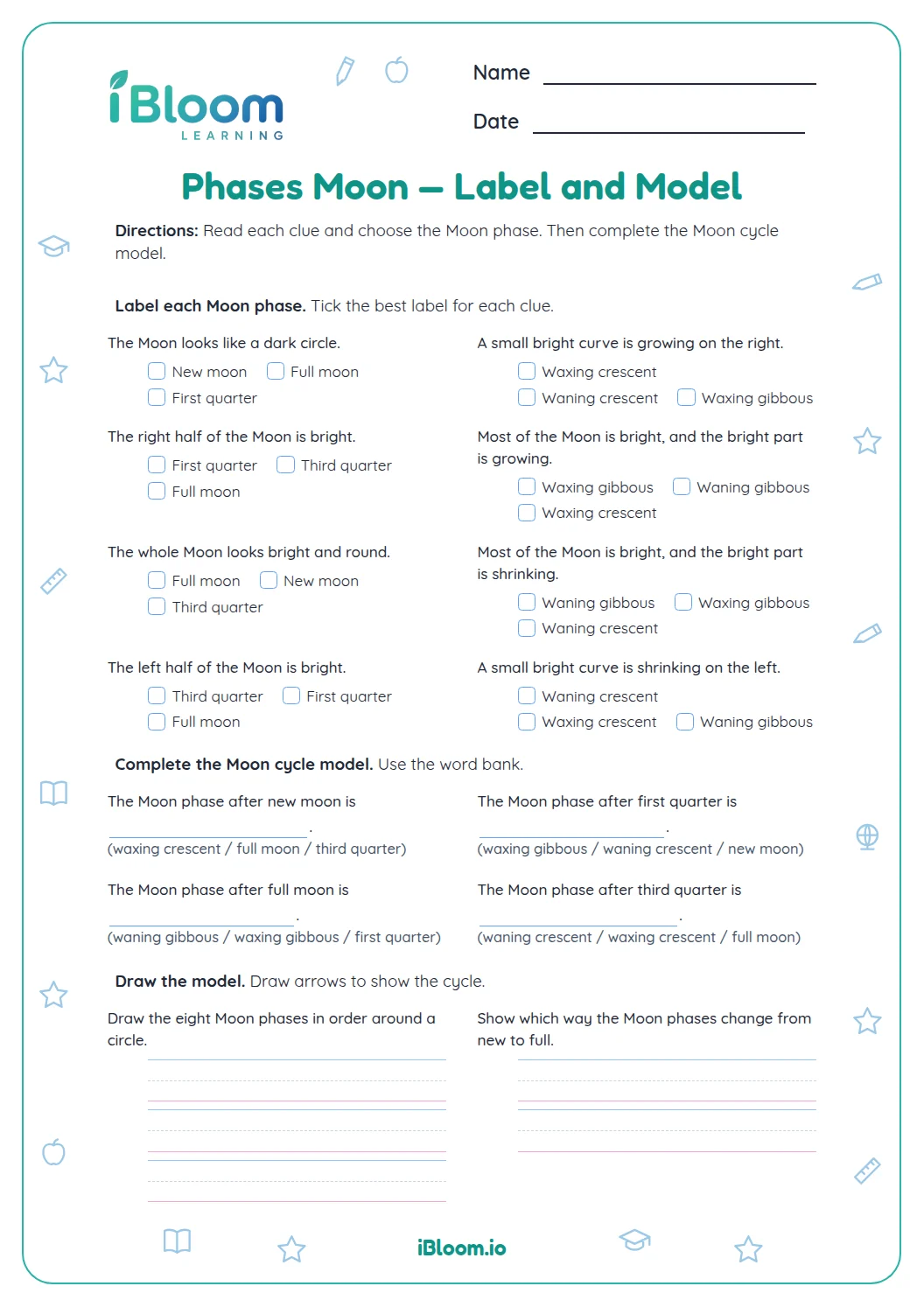
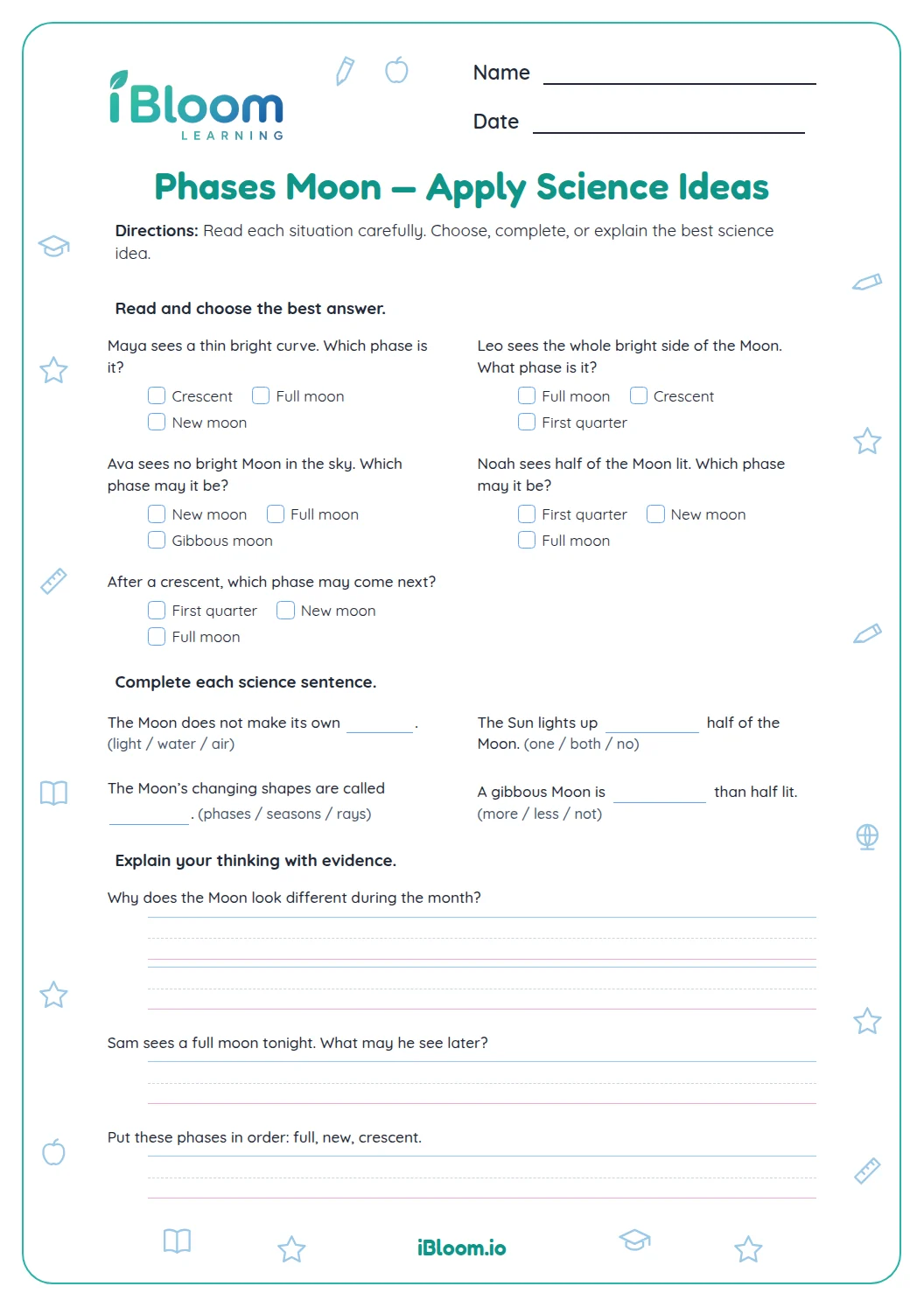
The Moon reflects sunlight. We can sometimes see it during the day too. As the Moon travels around Earth, we see different amounts of its sunlit half, so its visible shape appears to change. The Moon itself stays round.
For question 12, children should connect the visible shape to the part of the sunlit half facing us. Merely saying “the Moon reflects light” explains its brightness but does not explain the phase.
Use the sheet to build a because sentence
- 1Read Part A and ask children to name the cause before choosing an answer.
- 2In Part B, try each word from the pair and reread the completed sentence.
- 3For question 10, distinguish Earth’s daily spin from its yearly trip around the Sun.
- 4Say each Part C explanation aloud using because, then write it.
- 5Check the cause in each written answer against the sample key; accept equivalent wording.
Mistakes to notice and how to fix them
The mistake
Saying the Sun switches off at night.
The fix
Ask what turns: Earth spins so a place faces away from the Sun.
The mistake
Saying the Moon changes its actual shape.
The fix
Explain that we see different amounts of its sunlit half as it travels around Earth.
The mistake
Saying a long shadow means a person has grown taller.
The fix
In question 11, the Sun is low in the sky, so the same person casts a longer shadow.
What to practice next
Make more practice
Questions parents and teachers ask
What causes day and night on this worksheet?
Earth’s spin causes day and night. Question 3 asks children to choose that cause, and question 7 completes the phrase day and night. A place has daytime when it faces the Sun and nighttime when it faces away; the Sun continues giving off light.
Why does the Moon seem to change shape?
We see different amounts of the Moon’s sunlit half as it travels around Earth. The Moon stays round. Question 5 asks children to recognize this idea, and question 12 asks for a because sentence explaining why Leo sees only part of the sunlit half.
What should children write about the morning shadow?
They should explain that the Sun is low in the sky. In question 11, Maya’s body blocks sunlight arriving at a low angle, making a long shadow on level ground. Accept a short explanation with that cause, even if the wording differs from the key.
How does the sheet explain seasons?
Question 10 links seasons to Earth’s tilt as Earth travels around the Sun. Keep the two motions distinct when discussing it: the daily spin causes day and night, while the tilt and yearly trip change how sunlight reaches different places during the year.
Can I read the questions aloud, and is there a key?
Yes, you can read all twelve questions aloud while your child chooses or writes the answers. A separate key gives six choices, four missing words and two sample explanations. For the written questions, let children say their because sentence before putting it on the lines.