




About this worksheet
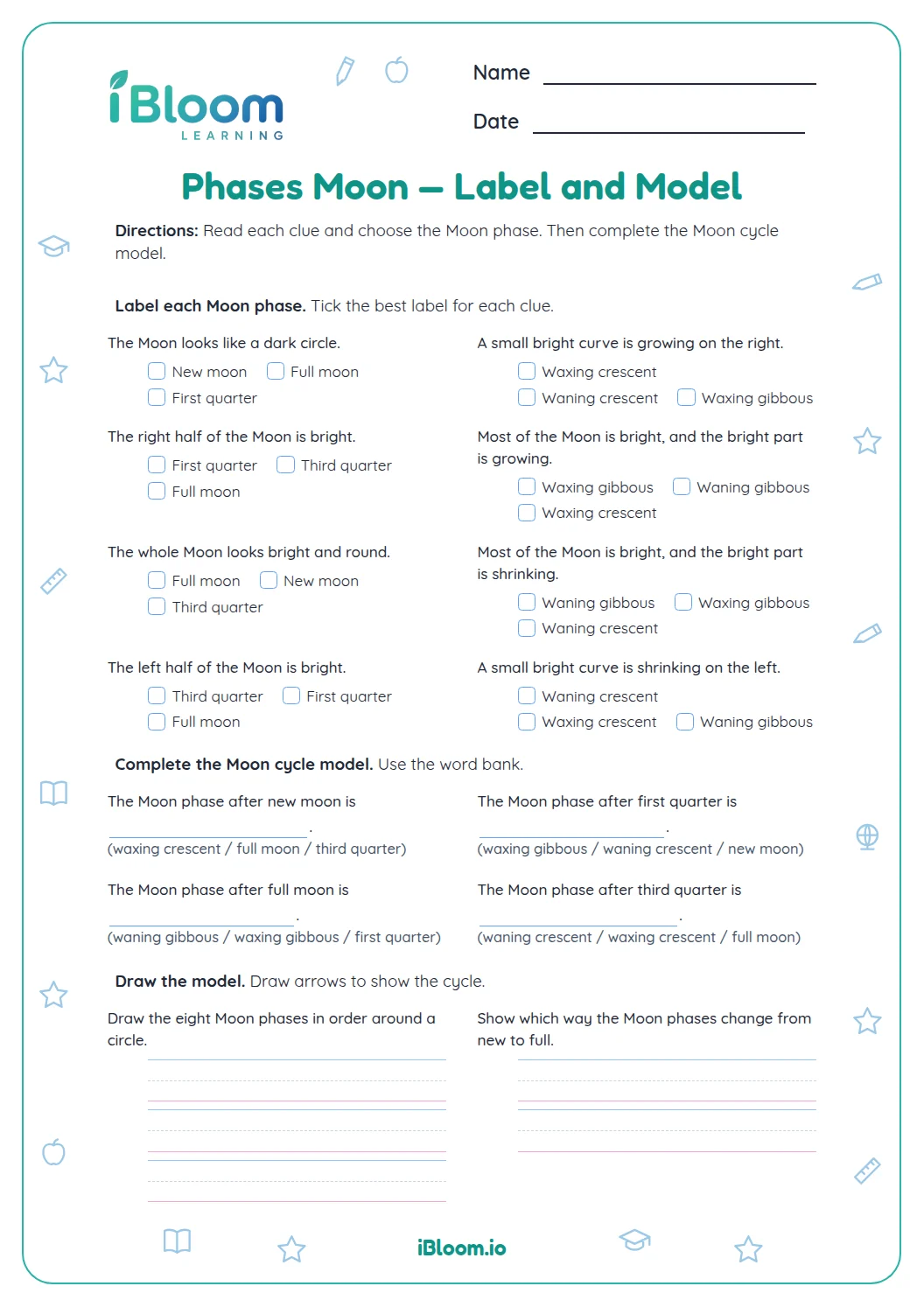
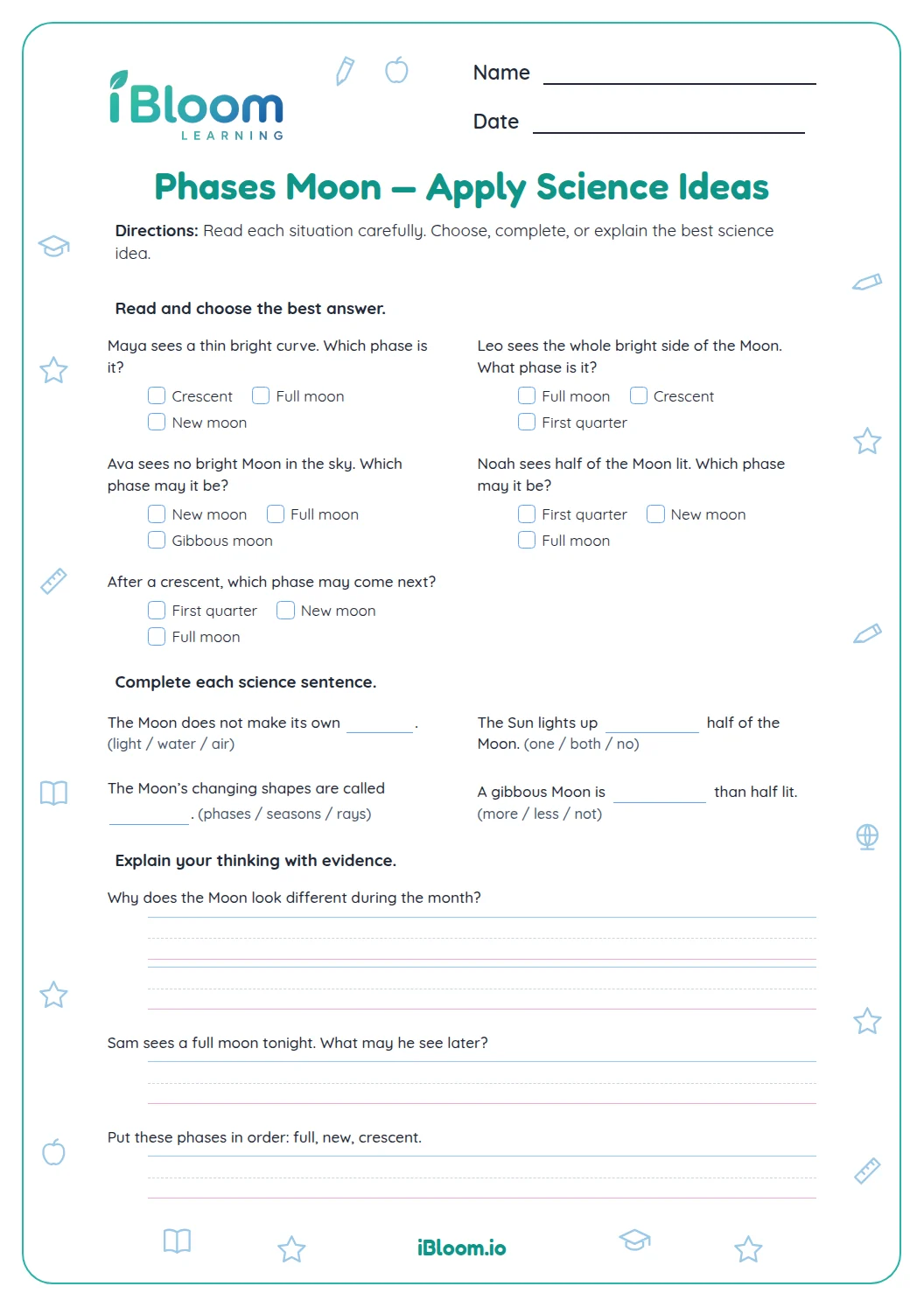
This free printable is for Grade 2 learners studying Moon phases. Across 14 questions, learners identify reflected sunlight, connect the Moon’s orbit to the changing view of its lit half, complete short science statements, and explain why the phase pattern repeats. The separate answer key includes expected answers and sample explanations. The questions connect Moon observations with NGSS 1-ESS1-1, which asks learners to describe predictable patterns in the sky.
Aligned to 1-ESS1-1
Why does the Moon seem to change shape?
The Moon keeps its shape and reflects sunlight. As it travels around Earth, the amount of the sunlit half visible to us changes, creating the phases.
The sheet starts with cause-and-effect choices, then checks key facts and the repeating pattern. Learners use sunlight, orbit, and the visible lit half to select a supported answer.
- 1Question 14 asks why the phases look different as the Moon orbits Earth.
- 2A complete response links the orbit to how much of the sunlit half we see.
What do full moon and new moon mean here?
At full moon, the sunlit half faces mostly toward Earth. At new moon, it faces mostly away, so the side visible from Earth is mostly dark. These descriptions help explain the changing view without suggesting that the Moon itself changes shape.
How can the answer key support a science conversation?
After checking a response, ask the learner to use the words orbit, sunlight, and lit half in a short explanation. The key gives a sample for the two open-response questions.
How to use this worksheet
- 1Read the prompt and identify whether it asks about sunlight, orbit, or a phase.
- 2For a choice, rule out ideas that say the Moon makes its own light or changes shape.
- 3Complete each short statement with the word that fits the science idea.
- 4For the final items, connect the Moon’s orbit to the changing view of its lit half.
- 5Check each response with the answer key and revise the science link if needed.
Common mistakes and quick fixes
The mistake
Saying the Moon makes its own light.
The fix
Explain that sunlight shines on the Moon and the Moon reflects it.
The mistake
Saying Earth’s shadow causes the monthly phases.
The fix
Connect the phases to the Moon’s orbit and our changing view of its sunlit half.
The mistake
Saying the Moon changes shape.
The fix
Describe a changing view of the lit half while the Moon keeps its shape.
Curriculum alignment
This worksheet connects Moon observations to a repeating sky pattern.
Learners describe the repeating order of Moon phases as an observable pattern.
On this sheet: Learners connect the Moon’s repeating visible phases with observations of a predictable pattern.
Show the official wordingHide the official wording
Use observations of the sun, moon, and stars to describe patterns that can be predicted.
What to practice next
Make more practice
Further reading
Questions parents and teachers ask
What does this worksheet teach about Moon phases?
It connects the Moon’s orbit around Earth with the changing view of the Moon’s sunlit half. Learners identify reflected sunlight, match full and new moon to the view from Earth, and finish with a short explanation of why the phase pattern returns in order.
Does the Moon make its own light?
No. Sunlight shines on the Moon, and the Moon reflects it. As the Moon moves around Earth, observers see different amounts of that lit half. That changing view creates the familiar phase pattern without the Moon making its own light.
Why is a new moon hard to see?
At new moon, the Moon’s sunlit half faces mostly away from Earth. The side facing us is mostly dark, which makes the Moon difficult to see in the night sky. The Moon remains present and continues along its orbit.
How many questions are on the printable?
There are 14 questions in two parts: six cause-and-effect choices followed by eight science statements and pattern questions. The separate answer key gives the expected choice or word for each item, so learners can check both facts and the reasoning that links orbit and phases.
How can a learner check an explanation?
Look for the link between the Moon’s orbit and the amount of its sunlit half visible from Earth. An explanation should show that the Moon’s shape does not change and that the phases return in the same order.