Free printable practice
Earth Structure Practice Activities
Grade 3 Earth structure worksheets help students label Earth’s layers, read cross-section diagrams, and explain the planet’s solid surface with clear vocabulary.
Free printable worksheet PDFs
Preview every available page, then download the free worksheet PDF for home, homeschool, tutoring, or classroom practice.
Preview the exact activity before downloading it.
 Earth Structure — Sort and ClassifyGrade 3 Earth structure worksheets help students label Earth’s layers, read cross-section diagrams, and explain the planet’s solid surface with clear vocabulary. This sort and classify worksheet provides a distinct, age-appropriate way to practise the same lesson.Grade 3Free PDF preview
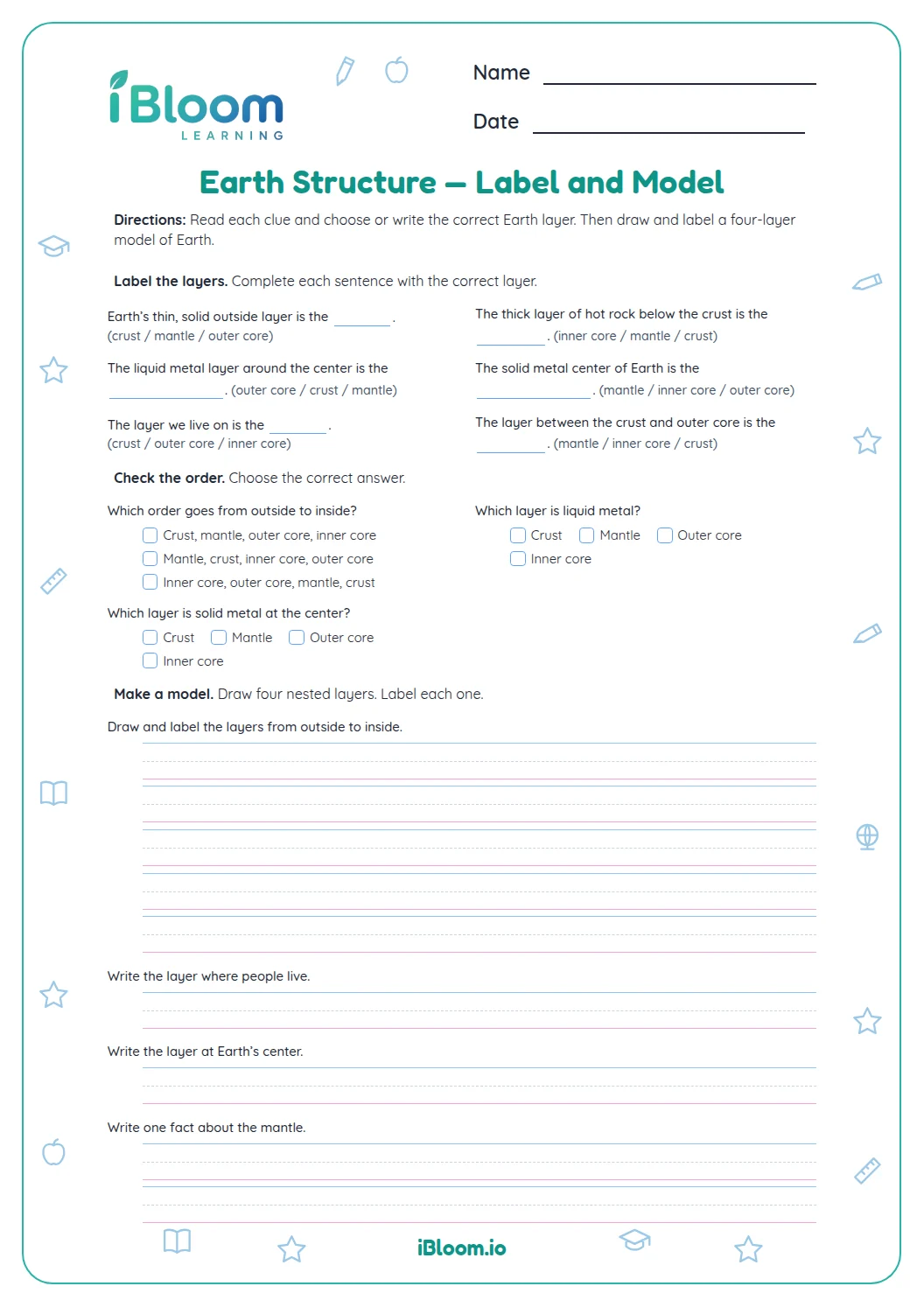 Earth Structure — Label and ModelGrade 3 Earth structure worksheets help students label Earth’s layers, read cross-section diagrams, and explain the planet’s solid surface with clear vocabulary. This label and model worksheet provides a distinct, age-appropriate way to practise the same lesson.Grade 3Free PDF preview
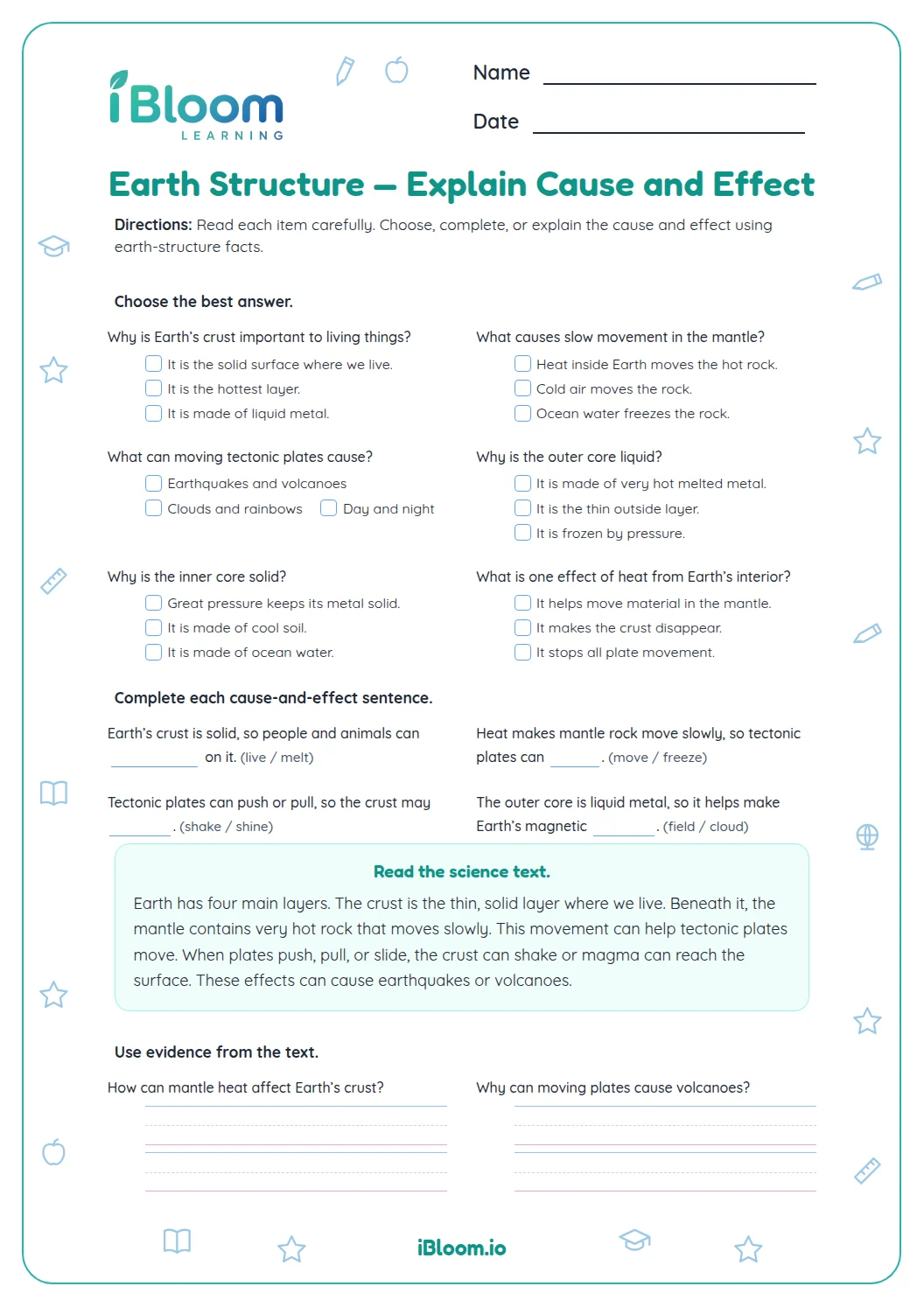 Earth Structure — Explain Cause and EffectGrade 3 Earth structure worksheets help students label Earth’s layers, read cross-section diagrams, and explain the planet’s solid surface with clear vocabulary. This explain cause and effect worksheet provides a distinct, age-appropriate way to practise the same lesson.Grade 3Free PDF preview
 Earth Structure — Apply Science IdeasGrade 3 Earth structure worksheets help students label Earth’s layers, read cross-section diagrams, and explain the planet’s solid surface with clear vocabulary. This apply science ideas worksheet provides a distinct, age-appropriate way to practise the same lesson.Grade 3Free PDF preview
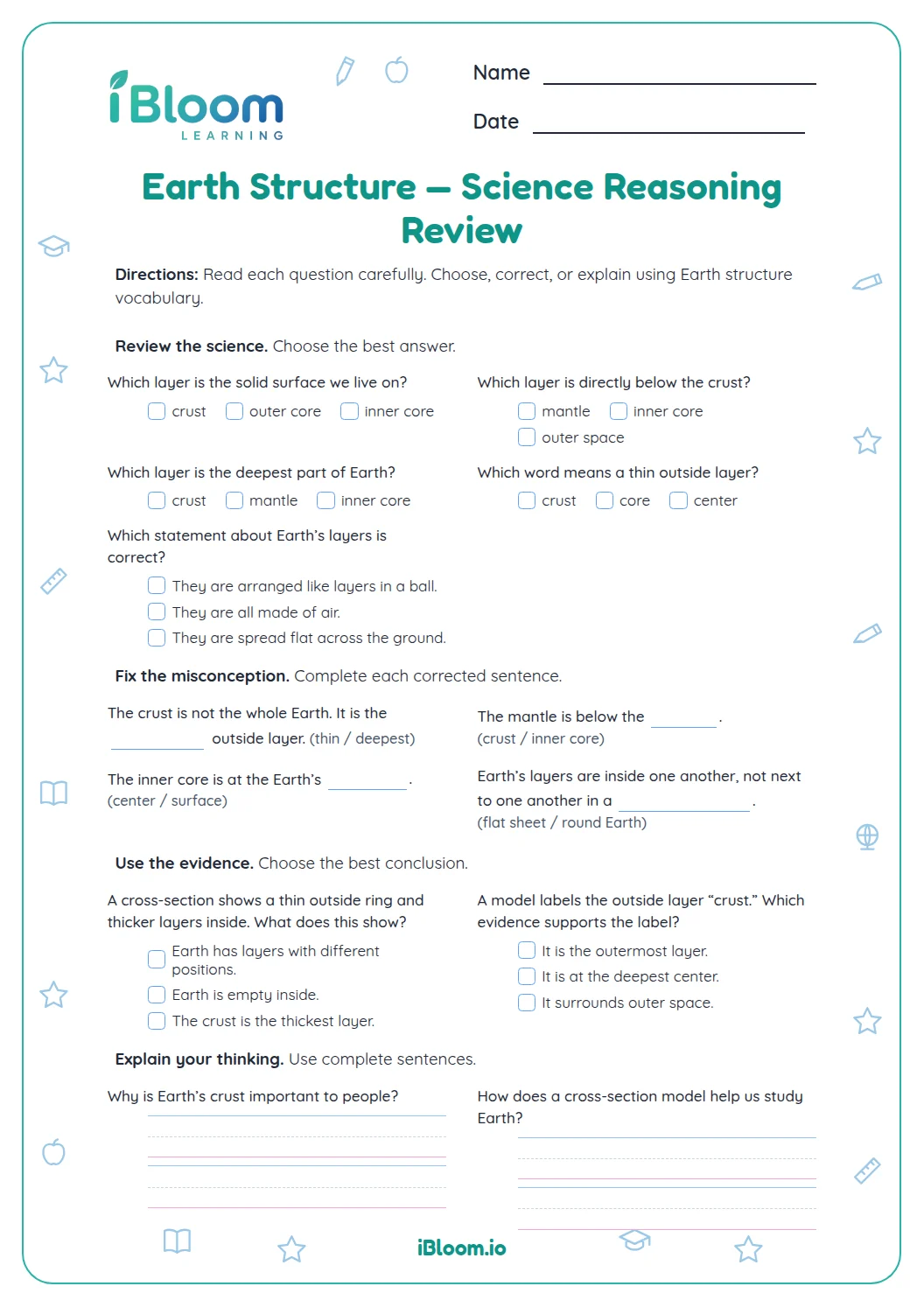 Earth Structure — Science Reasoning ReviewGrade 3 Earth structure worksheets help students label Earth’s layers, read cross-section diagrams, and explain the planet’s solid surface with clear vocabulary. This science reasoning review worksheet provides a distinct, age-appropriate way to practise the same lesson.Grade 3Free PDF preview
Practice that builds confidence
What students learn
These Grade 3 Earth Structure practice activities help children explore how Earth can be described in layers and how the solid surface is represented in simple models. Students work with vocabulary such as crust, mantle, outer core, inner core, surface, landform, and cross-section while building explanations from diagrams.
The printable activities include labeling pages, cut-and-paste layer models, short reading prompts, matching cards, diagram interpretation, and quick-check questions. The work moves from noticing parts of a picture to explaining what each part represents, helping students connect science words with visual evidence.
Earth structure can feel abstract because most of it cannot be seen directly. These worksheets make the idea concrete with cross-section diagrams, simple models, and description tasks. Children identify the crust as the thin outer layer, locate deeper layers, and use the word surface when describing the part of Earth where people, plants, landforms, and oceans are found.

Skill progression
Activities begin with recognition: matching labels to a diagram and sorting Earth words from unrelated terms. Students then move to describing, such as telling how a cross-section is different from a picture of Earth from space. Later pages ask children to use evidence from a diagram or short text to complete sentences, compare layers, or explain why a model is not the same as the real planet.
A simple parent routine
At home, start by asking your child to point to the surface of Earth in a picture, then trace inward through the layers with a finger. After one worksheet, ask three short questions: “Which layer is outside?”, “Which layer is deepest?”, and “How do you know?” If your child struggles, use an everyday comparison, such as a sliced peach or a layered ball of clay, while reminding them that models help us understand but are not exact copies.

Classroom uses
Teachers can use these printables for science centers, vocabulary review, notebook inserts, partner labeling, or exit tickets after an Earth science lesson. A diagram page works well for guided instruction, while matching and explanation pages are useful for independent practice. The variety also supports small-group reteaching for students who need more work with science language.

Common errors to watch for
Some children think the crust is thick because it is drawn large in a diagram. Others mix up mantle and core, or describe every layer as “rock” without noticing that diagrams show different parts for different reasons. Encourage students to say, “In this model…” before making a claim, and to check whether a label belongs on the outside, middle, or center.
Free printable PDF download
Use this grade 3 earth structure worksheet page to preview the activity, print it, or download it as a PDF for quick practice. It works well for homework, homeschool lessons, tutoring, morning work, revision, and classroom centers.
Answers and answer key support
After the child completes the worksheet independently, parents and teachers can use the answer support or answer key information to check the work, review mistakes, and choose the next practice step.
Why iBloom worksheets help
The pages combine vocabulary, visuals, and short written responses so children do more than memorize layer names. A child-friendly strategy is: Look, label, locate, explain. First look at the whole model, then label one part at a time, locate it as outside, middle, or center, and explain it in one sentence. This routine builds confidence and supports accurate science talk.
Helpful answers
Frequently asked questions
What Earth structure vocabulary is practiced in these Grade 3 worksheets?
Students practice words such as crust, mantle, outer core, inner core, surface, layer, model, diagram, and cross-section. Some activities also connect the surface to landforms and oceans.
Are these worksheets mainly about memorizing the layers of Earth?
No. Labeling is included, but students also interpret diagrams, compare parts of models, answer short questions, and explain how a cross-section represents the inside of Earth.
How can I help my child understand Earth’s layers at home?
Use a simple model, such as a sliced fruit or layered clay ball, to show outside, middle, and center. Then have your child label a worksheet diagram and explain one layer in their own words.
What mistakes do third graders often make with Earth structure?
Common mistakes include placing the core near the surface, confusing mantle and crust, and thinking diagrams show exact sizes. Encourage children to use position words like outer, inner, middle, and center.
Can these printables be used in science centers?
Yes. Matching cards, labeling pages, and short diagram tasks work well for centers, partner work, quick reviews, or exit tickets after a lesson on Earth’s structure.
Is this grade 3 earth structure worksheet free?
Yes. You can preview it for free and use the printable worksheet for home or classroom practice.
Can I download this grade 3 earth structure worksheet as a PDF?
Yes. Use the worksheet download option to save a printable PDF, or print the worksheet directly from the page.
Does this grade 3 earth structure worksheet include answers or an answer key?
When the activity has fixed answers, iBloom includes answer support so parents and teachers can check the completed worksheet.