Free printable practice
Electricity Practice Activities
Grade 3 electricity worksheets help children explore circuits, energy sources, conductors, insulators, static electricity, and safe everyday uses.
Free printable worksheet PDFs
Preview every available page, then download the free worksheet PDF for home, homeschool, tutoring, or classroom practice.
Preview the exact activity before downloading it.
 Electricity — Sort and ClassifyGrade 3 electricity worksheets help children explore circuits, energy sources, conductors, insulators, static electricity, and safe everyday uses. This sort and classify worksheet provides a distinct, age-appropriate way to practise the same lesson.Grade 3Free PDF preview
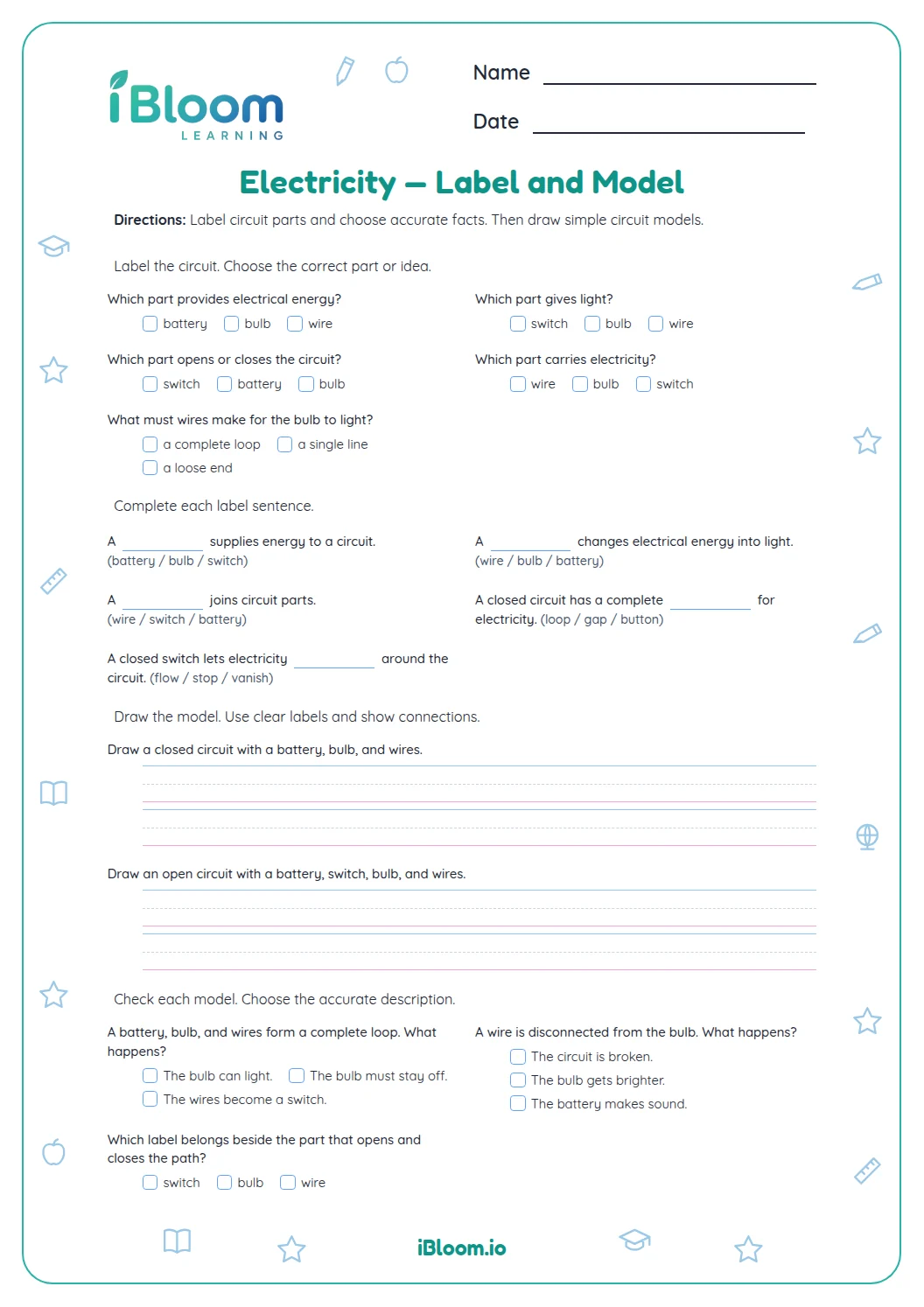 Electricity — Label and ModelGrade 3 electricity worksheets help children explore circuits, energy sources, conductors, insulators, static electricity, and safe everyday uses. This label and model worksheet provides a distinct, age-appropriate way to practise the same lesson.Grade 3Free PDF preview
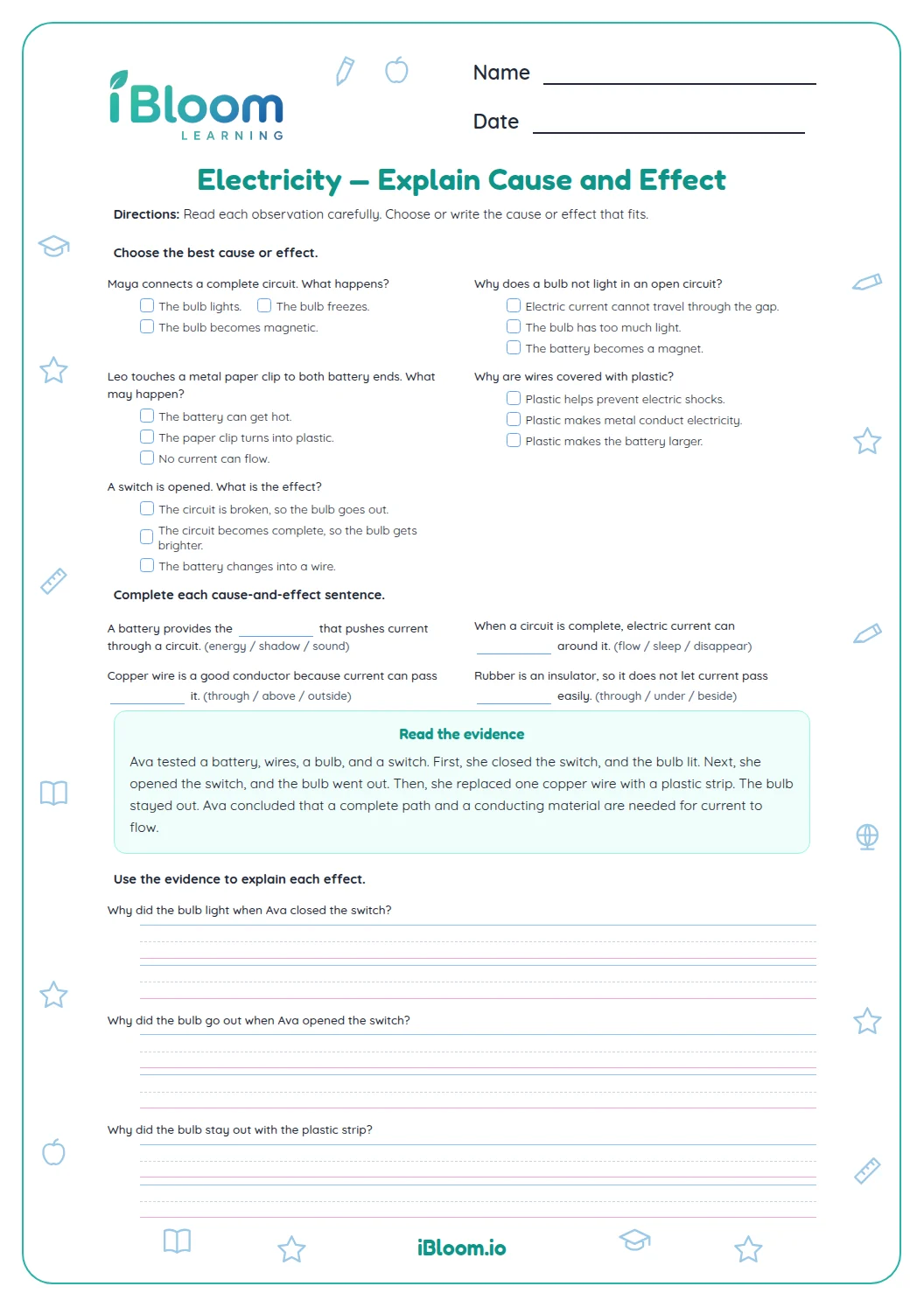 Electricity — Explain Cause and EffectGrade 3 electricity worksheets help children explore circuits, energy sources, conductors, insulators, static electricity, and safe everyday uses. This explain cause and effect worksheet provides a distinct, age-appropriate way to practise the same lesson.Grade 3Free PDF preview
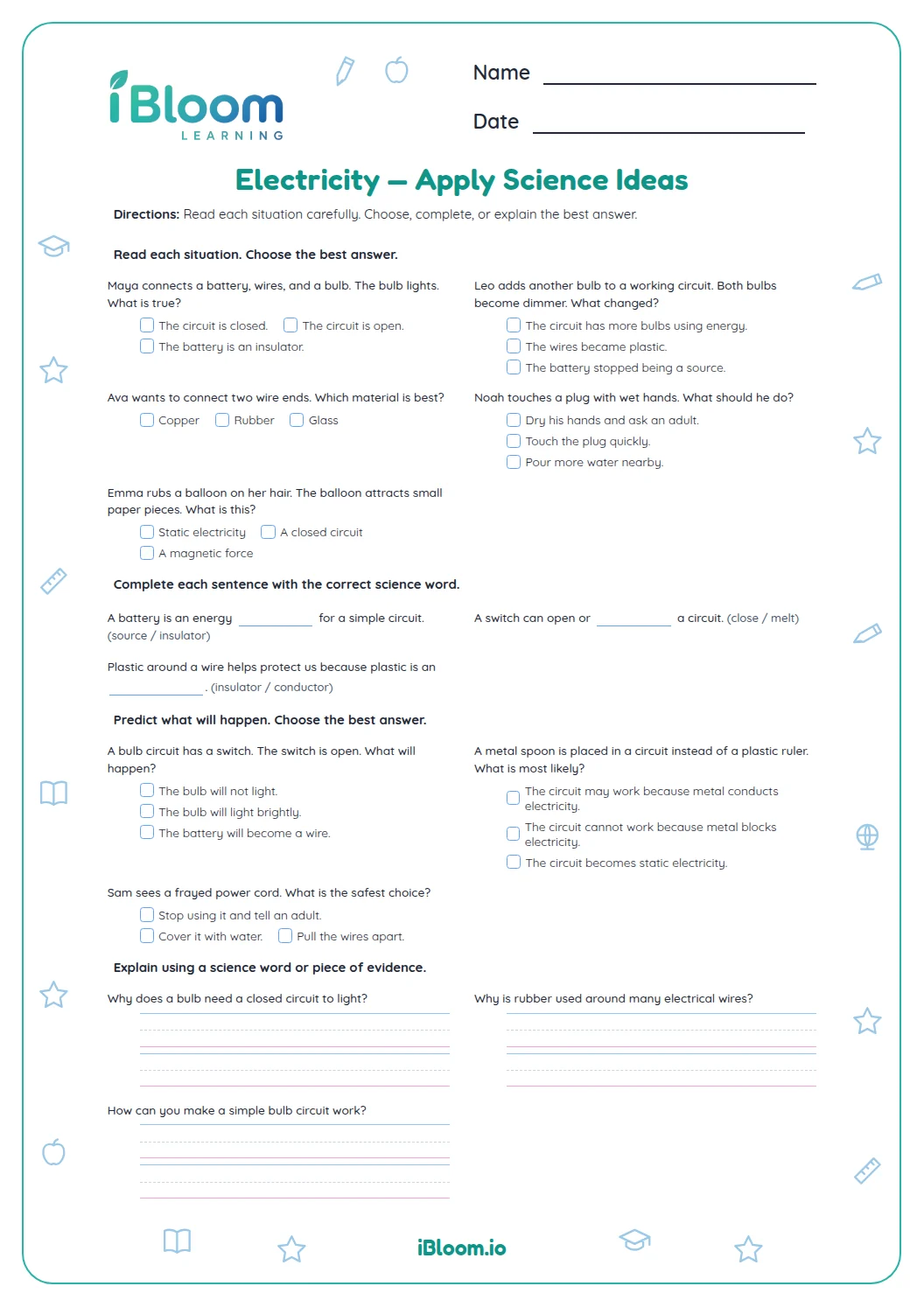 Electricity — Apply Science IdeasGrade 3 electricity worksheets help children explore circuits, energy sources, conductors, insulators, static electricity, and safe everyday uses. This apply science ideas worksheet provides a distinct, age-appropriate way to practise the same lesson.Grade 3Free PDF preview
 Electricity — Science Reasoning ReviewGrade 3 electricity worksheets help children explore circuits, energy sources, conductors, insulators, static electricity, and safe everyday uses. This science reasoning review worksheet provides a distinct, age-appropriate way to practise the same lesson.Grade 3Free PDF preview
Practice that builds confidence
From everyday electricity to science vocabulary
These Grade 3 science worksheets help children build a clear, practical understanding of electricity as a form of energy used in homes, schools, tools, and technology. Students practise identifying electrical sources, reading simple circuit diagrams, and using vocabulary such as battery, bulb, switch, conductor, and insulator.
The printable activities include labeling tasks, picture-based questions, sorting exercises, short explanations, and concept checks. Children connect science ideas to familiar objects while learning to notice whether electricity has a complete path, a power source, and safe conditions for use.
Electricity can feel invisible, so Grade 3 learners need concrete examples: a flashlight turning on, a doorbell ringing, or a lamp needing a plug or battery. These worksheets connect those familiar uses to science words such as electrical energy, current, circuit, source, load, switch, conductor, insulator, and static electricity.

Building concepts in a sensible order
Practice begins with recognizing devices that use electricity and separating battery-powered objects from plug-in objects. It then moves toward simple circuits, where children look for a complete path from the energy source to the device and back. Later questions may ask students to decide whether a bulb will light, compare materials that allow electricity to pass through, or explain why plastic coating on wires improves safety.
A simple parent routine
At home, choose one worksheet and one safe object, such as a flashlight or battery-powered toy. Ask your child to point to the energy source, the part that does the work, and any switch. After the page, invite them to say one sentence: “The circuit works because…” or “This material is an insulator because…” Keep the focus on observation and explanation, not taking objects apart.

Classroom uses for teachers
Teachers can use these printables for science centers, early-finisher review, small-group vocabulary practice, or a quick check after a hands-on circuit demonstration. Picture sorting pages work well before an experiment, while short-answer questions help students record what they noticed after testing bulbs, batteries, wires, and safe sample materials.

Common errors to watch for
Many children think electricity is “used up” by the bulb or that any wire touching a battery will make a circuit. Others may confuse static electricity with current electricity. Encourage them to trace the complete loop with a finger and ask, “Can the electricity travel all the way around?”
Free printable PDF download
Use this grade 3 electricity worksheet page to preview the activity, print it, or download it as a PDF for quick practice. It works well for homework, homeschool lessons, tutoring, morning work, revision, and classroom centers.
Answers and answer key support
After the child completes the worksheet independently, parents and teachers can use the answer support or answer key information to check the work, review mistakes, and choose the next practice step.
Why iBloom worksheets help
The activities use clear visuals, familiar examples, and varied question types so children do more than memorize terms. A child-friendly strategy is: source, path, job, safety. Find the power source, trace the path, name what the electricity does, and check whether the setup is safe.
Helpful answers
Frequently asked questions
What electricity skills do these Grade 3 worksheets practise?
They practise identifying electrical devices and energy sources, reading simple circuit pictures, recognizing conductors and insulators, understanding static electricity, and explaining basic electrical safety.
Do children need to build real circuits to use these worksheets?
No. The pages can be completed with pictures and written prompts. However, they also work well alongside a safe teacher-led circuit demonstration using batteries, bulbs, and wires.
How can I help my child understand why a bulb will or will not light?
Ask your child to trace the path from the battery, through the wire and bulb, and back to the battery. If the path is broken or missing a connection, the bulb will not light.
What is the difference between a conductor and an insulator at this level?
A conductor is a material that lets electricity pass through it, such as metal. An insulator does not let electricity pass through easily, such as plastic or rubber, which is why they are used for safety coverings.
Are these worksheets suitable for science centers?
Yes. Sorting pages, labeling tasks, and short concept checks are easy to use in centers, small groups, review folders, or as follow-up work after an electricity lesson.
Is this grade 3 electricity worksheet free?
Yes. You can preview it for free and use the printable worksheet for home or classroom practice.
Can I download this grade 3 electricity worksheet as a PDF?
Yes. Use the worksheet download option to save a printable PDF, or print the worksheet directly from the page.
Does this grade 3 electricity worksheet include answers or an answer key?
When the activity has fixed answers, iBloom includes answer support so parents and teachers can check the completed worksheet.