Free printable practice
Contact Forces Practice Activities
Grade 3 science worksheets for identifying contact forces such as pushes, pulls, friction, and support in everyday situations.
Free printable worksheet PDFs
Preview every available page, then download the free worksheet PDF for home, homeschool, tutoring, or classroom practice.
Preview the exact activity before downloading it.
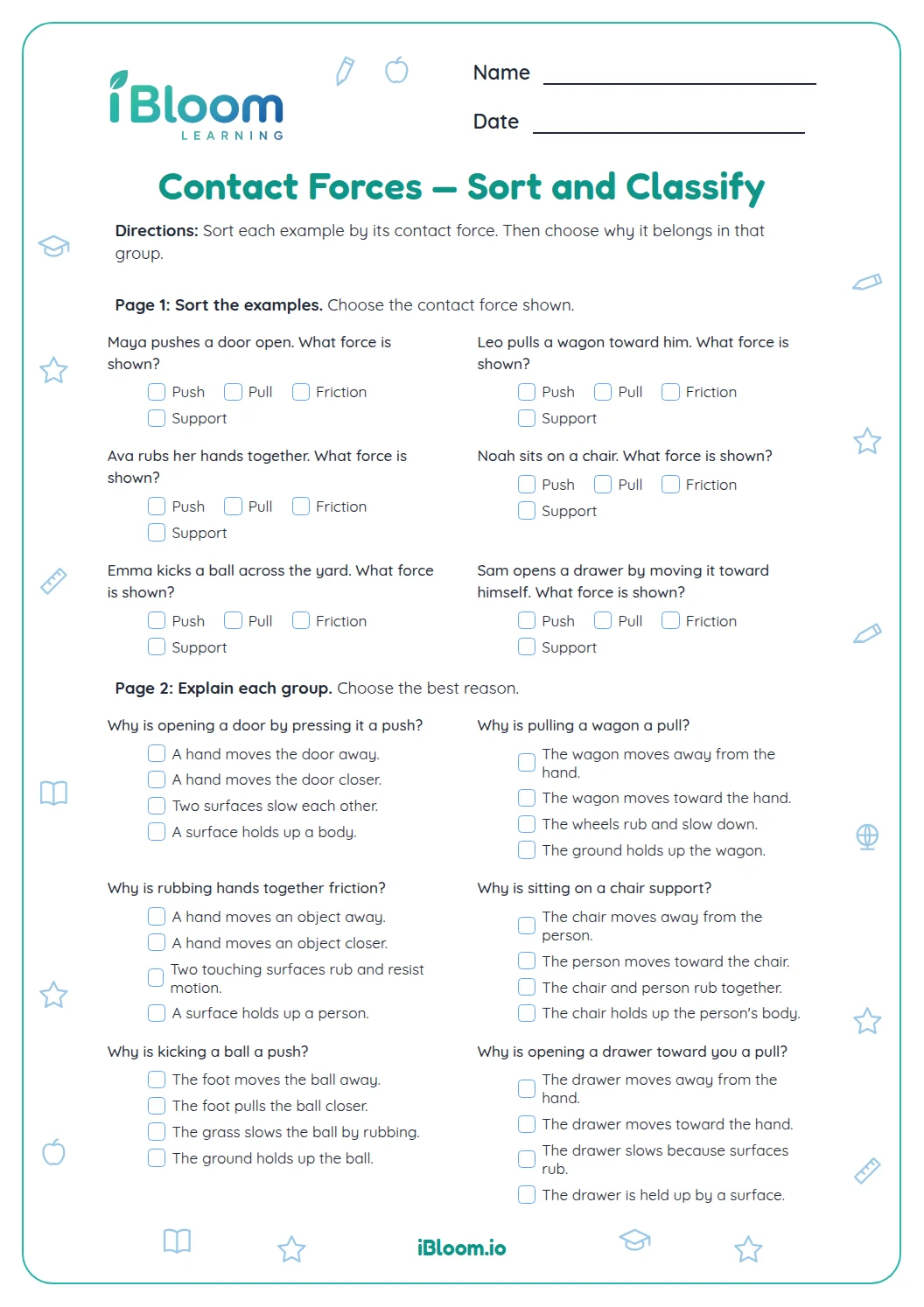 Contact Forces — Sort and ClassifyGrade 3 science worksheets for identifying contact forces such as pushes, pulls, friction, and support in everyday situations. This sort and classify worksheet provides a distinct, age-appropriate way to practise the same lesson.Grade 3Free PDF preview
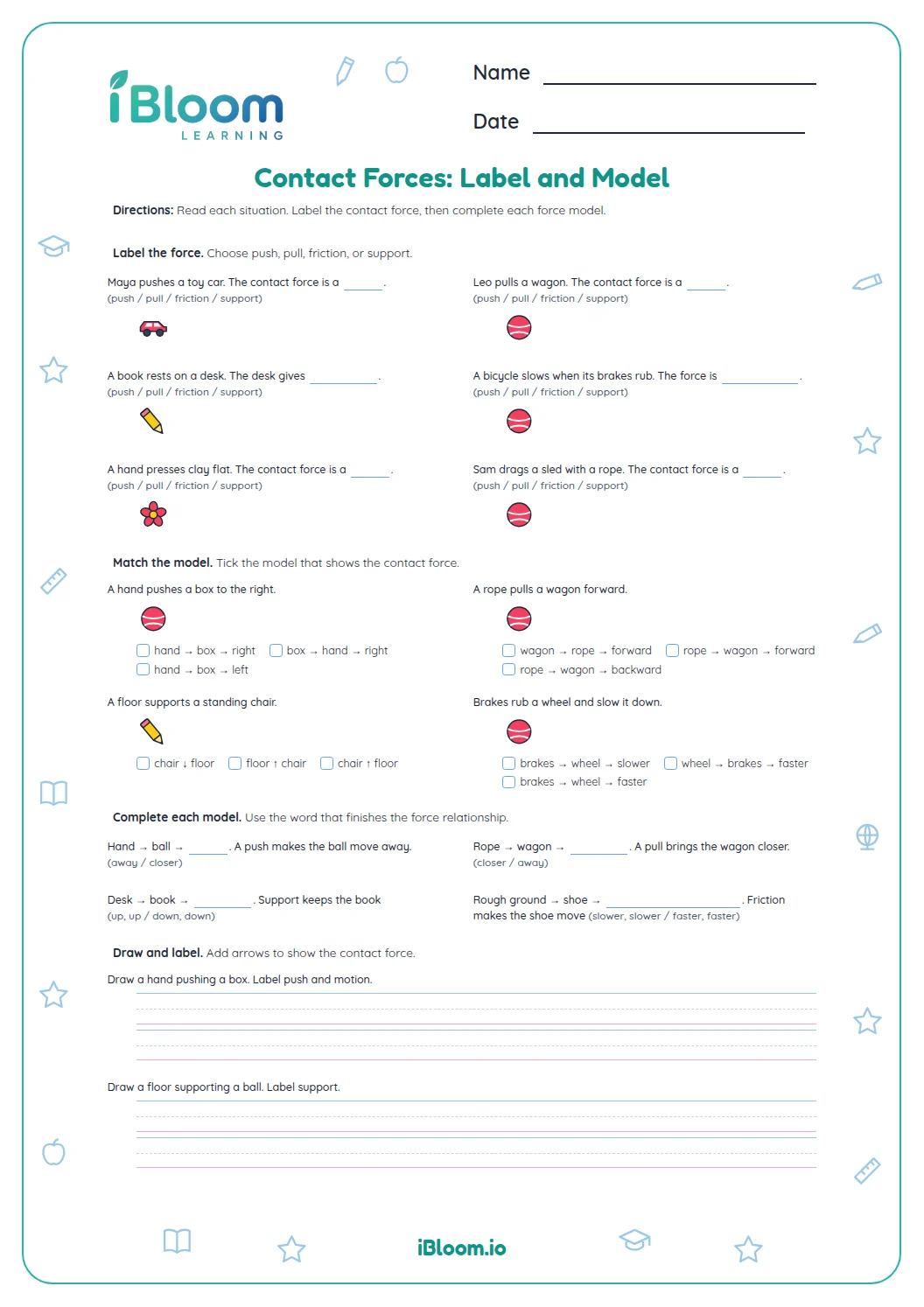 Contact Forces — Label and ModelGrade 3 science worksheets for identifying contact forces such as pushes, pulls, friction, and support in everyday situations. This label and model worksheet provides a distinct, age-appropriate way to practise the same lesson.Grade 3Free PDF preview
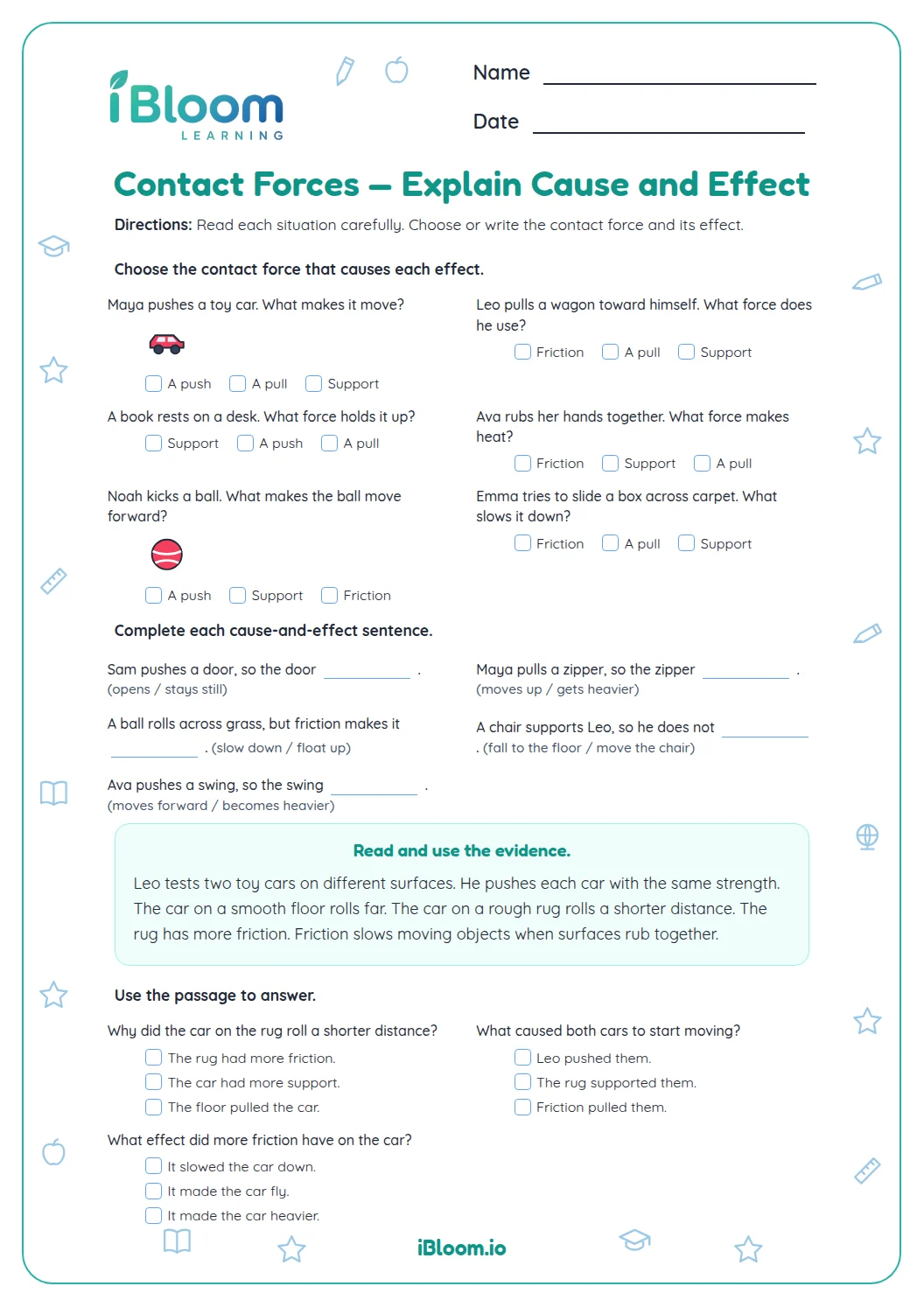 Contact Forces — Explain Cause and EffectGrade 3 science worksheets for identifying contact forces such as pushes, pulls, friction, and support in everyday situations. This explain cause and effect worksheet provides a distinct, age-appropriate way to practise the same lesson.Grade 3Free PDF preview
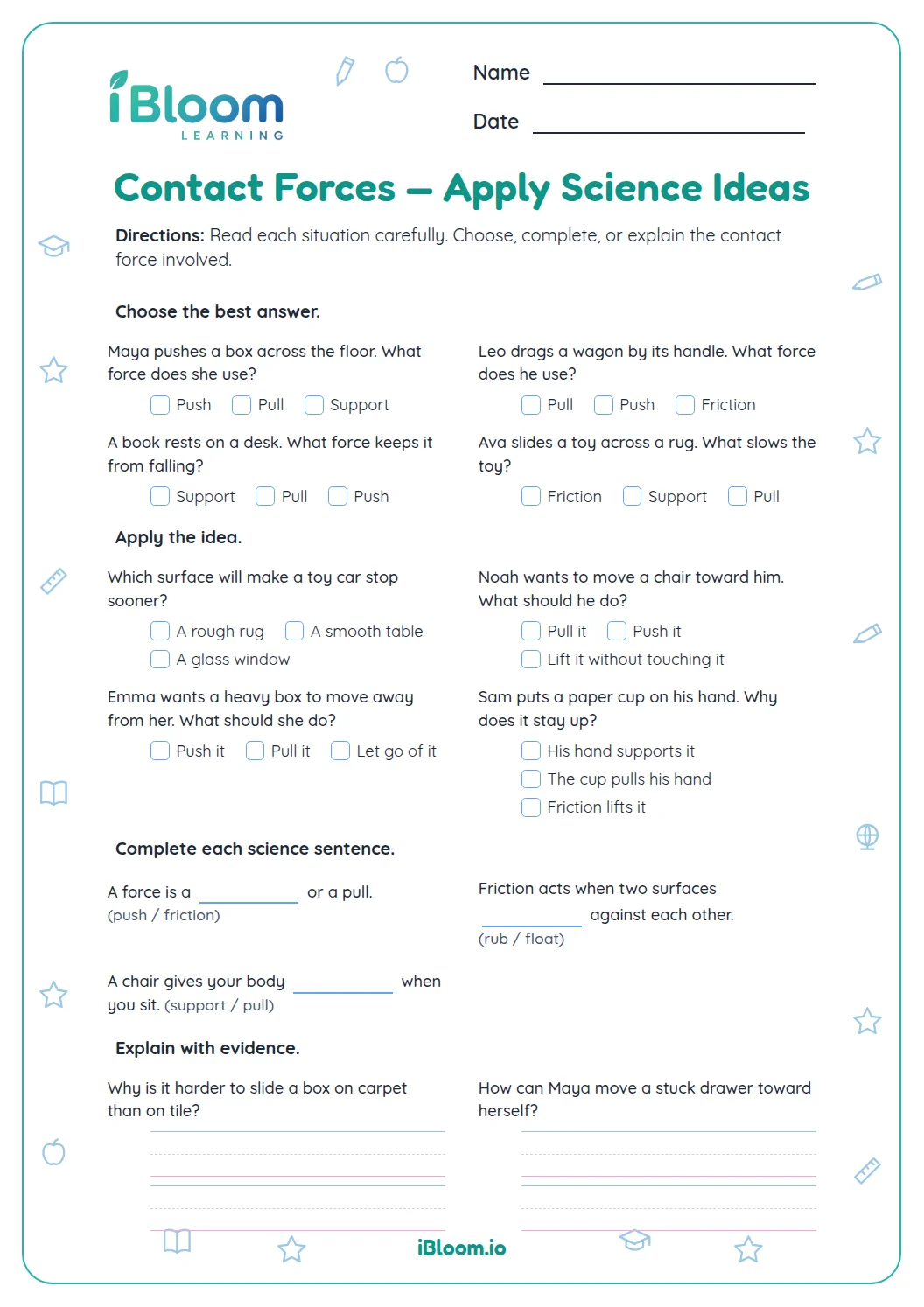 Contact Forces — Apply Science IdeasGrade 3 science worksheets for identifying contact forces such as pushes, pulls, friction, and support in everyday situations. This apply science ideas worksheet provides a distinct, age-appropriate way to practise the same lesson.Grade 3Free PDF preview4 pages
 Contact Forces — Science Reasoning ReviewGrade 3 science worksheets for identifying contact forces such as pushes, pulls, friction, and support in everyday situations. This science reasoning review worksheet provides a distinct, age-appropriate way to practise the same lesson.Grade 3Free PDF preview
Practice that builds confidence
What contact forces mean
These Grade 3 science worksheets help children understand contact forces: forces that act when objects touch. Students practise spotting pushes, pulls, friction, and support forces in familiar actions such as sliding a box, kicking a ball, opening a door, or holding a book on a desk.
The printable activities include picture-based questions, sorting tasks, short explanations, and everyday examples that contrast contact forces with forces that can act without touching, such as magnetism. They are designed to build clear observation, correct vocabulary, and simple cause-and-effect reasoning.
A contact force happens only when two objects are touching. In Grade 3, children do not need formulas; they need to see that a hand can push a cart, a rope can pull a toy, a table can hold up a book, and rough surfaces can slow moving objects through friction. Because this page sits in the electricity and magnetism pathway, the worksheets also help children notice the difference between contact forces and non-contact forces, such as a magnet pulling a paper clip without touching it.

How the practice builds
The collection begins with clear examples: circle the action that shows a push, label a pull, or choose whether touching is needed. It then moves to short scenarios where students explain what changed: an object started moving, stopped, sped up, slowed down, or changed direction. Later questions may ask children to compare surfaces, such as a ball rolling on carpet and on a smooth floor, using words like force, motion, direction, surface, and friction.
A simple parent routine
At home, choose three safe objects: a door, a pencil, and a small toy. Ask your child, “What force are you using?” as they push, pull, slide, or lift each one. Then complete one worksheet section and have them match each answer to something they just tried. This makes the printed question feel connected to real movement.

Classroom uses for teachers
Teachers can use these pages after a hands-on demonstration, in science centers, or as a quick check for vocabulary. Pair students to act out one contact force while another student names it. The worksheets also work well as evidence in notebooks because students must observe, classify, and explain rather than simply memorize a definition.

Common errors to watch for
Children often call every force a push, even when an object is being pulled. They may also think friction is always “bad,” instead of understanding that it can slow motion and also help shoes grip the floor. Another common mix-up is saying magnets use contact force; remind students that if the objects do not touch, it is not a contact force.
Free printable PDF download
Use this grade 3 contact forces worksheet page to preview the activity, print it, or download it as a PDF for quick practice. It works well for homework, homeschool lessons, tutoring, morning work, revision, and classroom centers.
Answers and answer key support
After the child completes the worksheet independently, parents and teachers can use the answer support or answer key information to check the work, review mistakes, and choose the next practice step.
Why iBloom worksheets help
The activities use familiar Grade 3 situations before introducing comparison questions. A child-friendly strategy is: “Touch first, then name the force.” If the objects touch, ask whether the action is pushing, pulling, rubbing, or supporting. That simple check helps children answer with confidence.
Helpful answers
Frequently asked questions
What is a contact force for a Grade 3 student?
A contact force is a push, pull, rub, or support that happens when two objects are touching. For example, a foot kicking a ball and a hand opening a door both use contact forces.
Do these worksheets include friction?
Yes. The activities include friction as a contact force and help children see how surfaces such as carpet, tile, or a desk can slow or affect motion.
How do the worksheets connect to electricity and magnetism?
They help students compare forces that need touch with forces that may act without touch, such as magnetic force. This contrast makes magnetism easier to understand later.
What vocabulary should my child know before starting?
Helpful words include force, push, pull, motion, direction, surface, touch, and friction. The worksheets give practice using these words in everyday examples.
How can I support my child if they confuse push and pull?
Ask them to act it out. If the object moves away from their hand, it is usually a push. If it moves toward them, it is usually a pull.
Is this grade 3 contact forces worksheet free?
Yes. You can preview it for free and use the printable worksheet for home or classroom practice.
Can I download this grade 3 contact forces worksheet as a PDF?
Yes. Use the worksheet download option to save a printable PDF, or print the worksheet directly from the page.
Does this grade 3 contact forces worksheet include answers or an answer key?
When the activity has fixed answers, iBloom includes answer support so parents and teachers can check the completed worksheet.