

About this worksheet
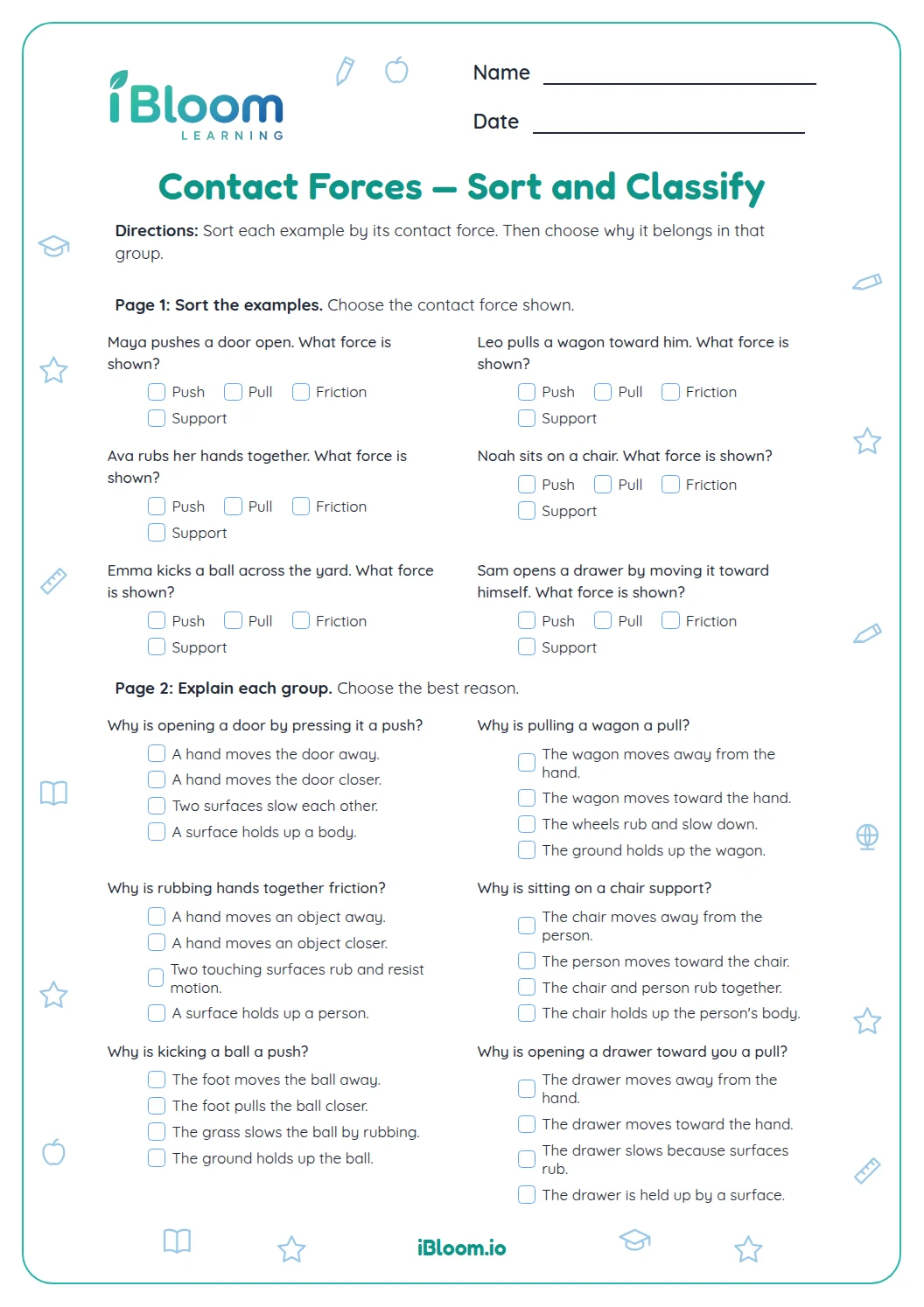
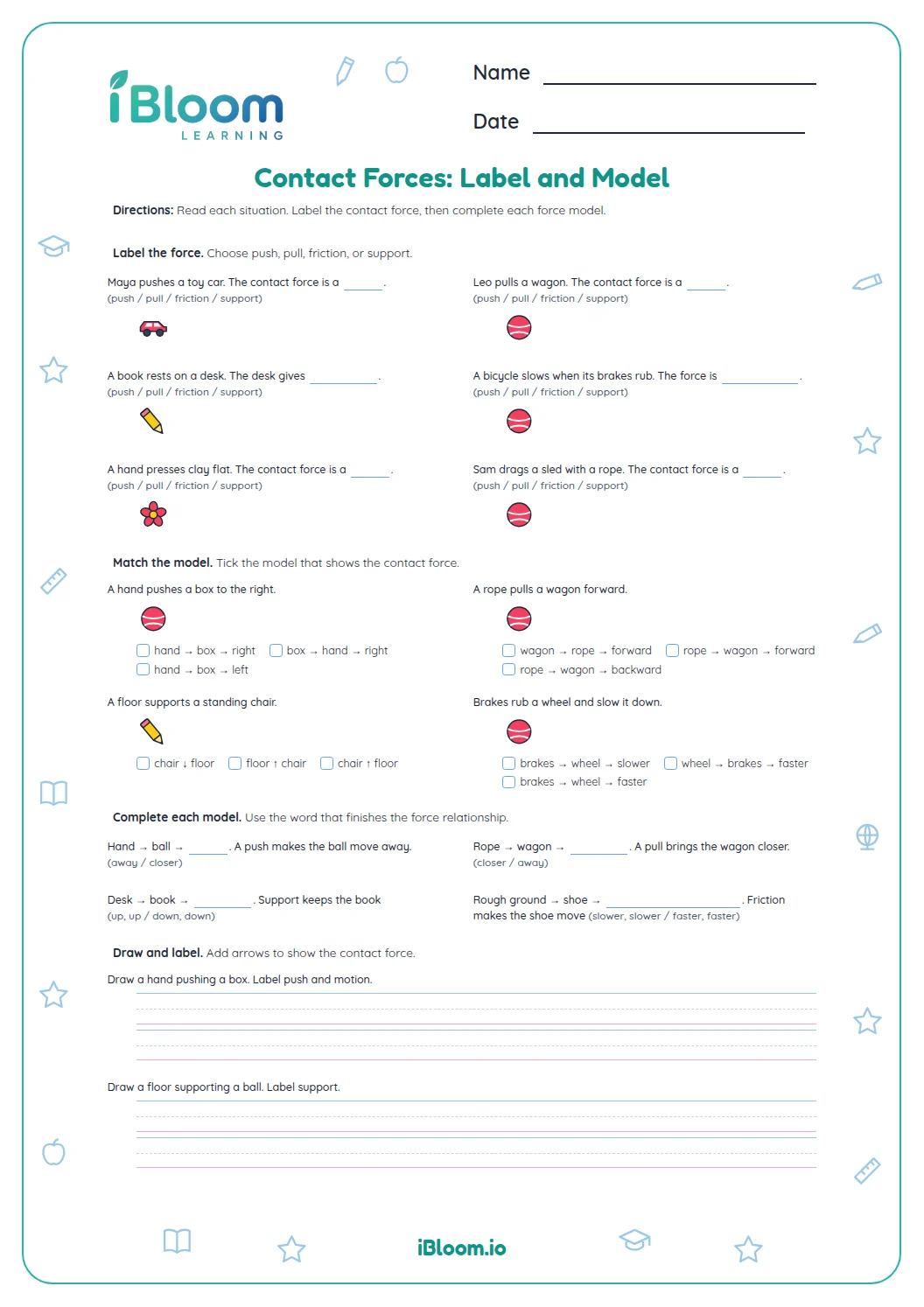
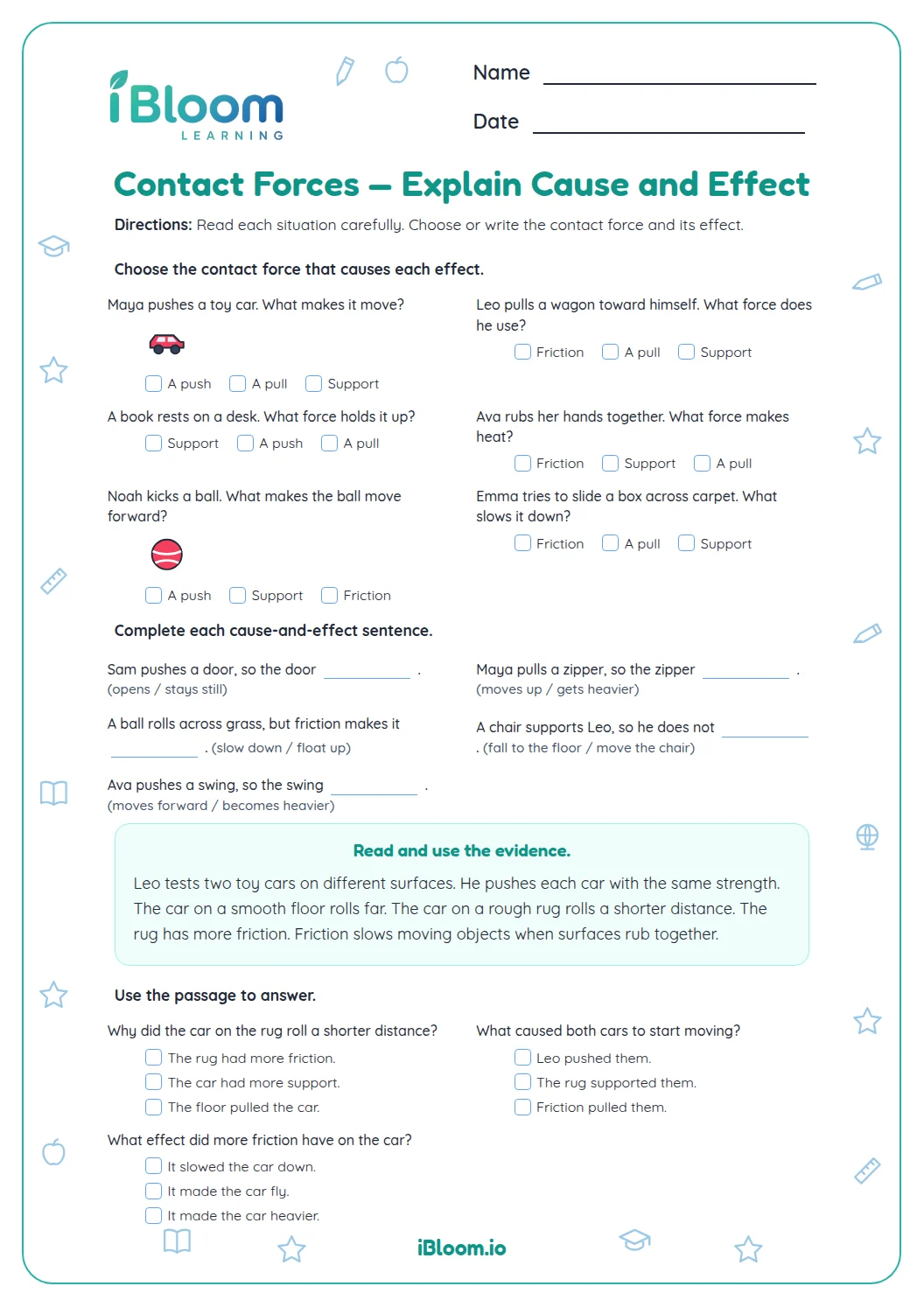
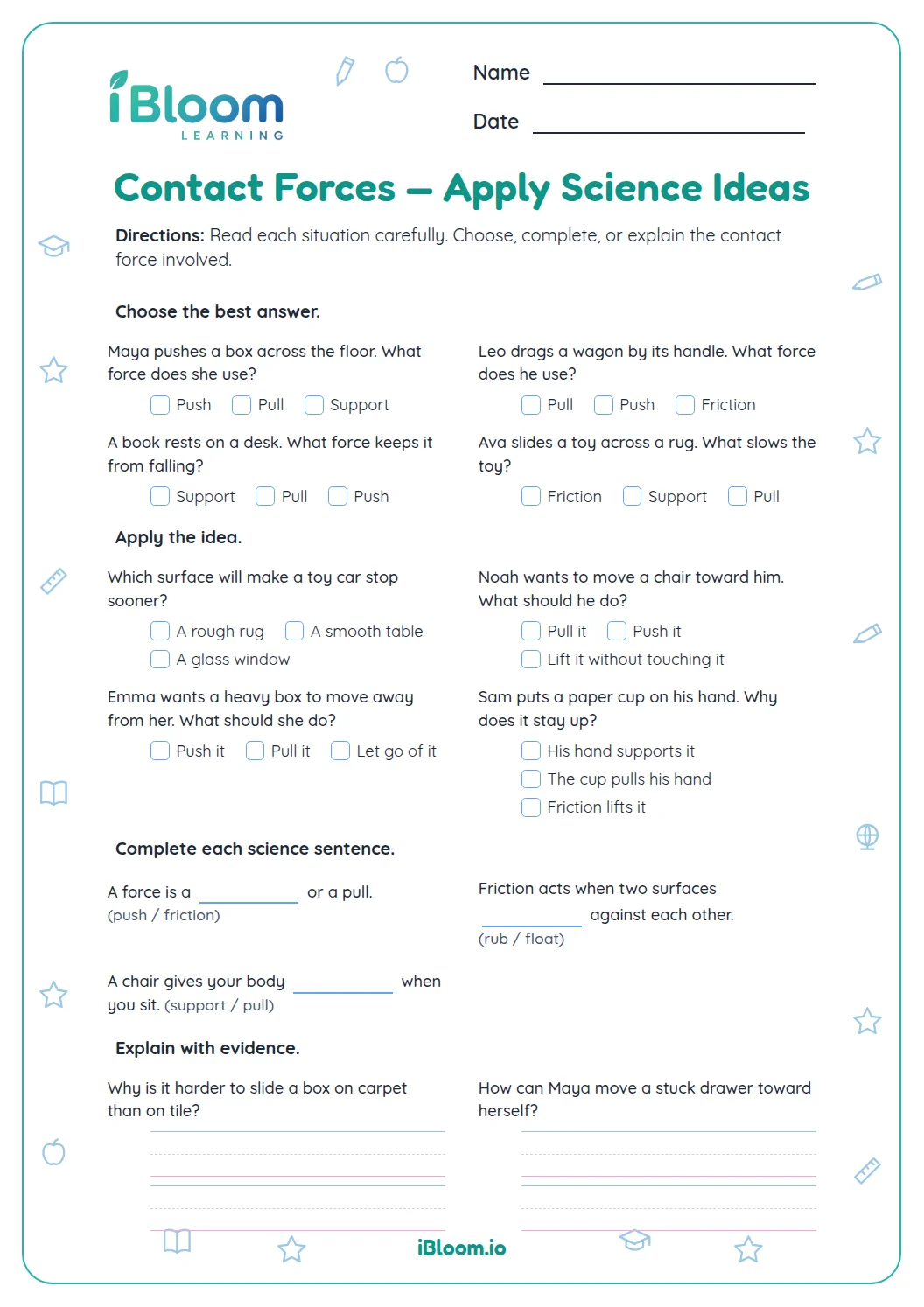
This Grade 3 science reasoning review gives children practice spotting contact forces and connecting pushes or pulls to changes in motion. They classify familiar actions, reason about balanced and unbalanced pushes, identify friction, and identify a fair-test setup. The 14 questions move from recognition to motion reasoning and test planning. The answer key lists the correct choices. It aligns with NGSS 3-PS2-1.
Aligned to 3-PS2-1
How can you spot a contact force?
A contact force occurs when two objects touch and push or pull. A hand tugging a wagon and a table supporting a book are examples. Gravity and magnetism can act without contact.
- 1A book slides on carpet, then slows.
- 2The carpet and book touch.
- 3Friction is the contact force that slows the slide.
How do pushes change motion?
An unbalanced push can start or change motion. Equal pushes from opposite sides can balance, so the object does not speed up in either direction. Compare question 5 with question 7.
What will children practice?
The 14 questions are grouped into three parts: identifying contact forces, reasoning about motion, and planning a fair test.
How to use this worksheet
- 1Read each action and check whether the objects touch.
- 2For balanced forces, compare the pushes and their directions.
- 3Connect an unbalanced push to a likely motion change.
- 4For the fair test, name what changes and what stays the same.
Common mistakes and quick fixes
The mistake
Calling every force a contact force.
The fix
Ask whether the objects are touching where the push or pull occurs.
The mistake
Thinking balanced pushes make an object speed up.
The fix
Compare their directions and strengths; equal opposite pushes balance.
The mistake
Changing several things during a test.
The fix
Hold the toy and surface constant while changing only push strength.
Curriculum alignment
Identify how a push or pull changes an object’s motion.
On this sheet: The questions directly practice this skill.
Show the official wordingHide the official wording
Plan and conduct an investigation to provide evidence of the effects of balanced and unbalanced forces on the motion of an object.
What to practice next
Further reading
Questions parents and teachers ask
Does a push always make an object move?
A push can change motion, but the result depends on the forces acting together. Equal pushes in opposite directions can balance, so the object may stay still. An unbalanced push can start motion, stop motion, or change an object’s direction or speed.
Is gravity a contact force?
No. Gravity pulls objects toward Earth without the objects touching Earth. In this review, gravity is useful to compare with contact examples such as a hand pushing a box or a table supporting a book. Ask the child to point to the touching objects and explain what changed.
What is friction?
Friction is a force between surfaces that touch. It can slow a sliding object, such as a book moving across a carpet. The worksheet asks children to connect this contact force with a change in motion. Ask the child to point to the touching objects and explain what changed.
What makes a fair force test?
Change one thing at a time and keep the other conditions the same. To compare push strength, use the same toy and floor, then measure how far the toy travels after each push. Ask the child to point to the touching objects and explain what changed.
How many questions are on the review?
There are 14 questions in three worksheet parts. Children identify contact forces, reason about motion, and plan a fair test by choosing what to keep constant or measure. The answer key gives the correct choices for every item and supports a quick review.