Free printable practice
Reduce Reuse Recycle Practice Activities
Grade 3 science worksheets help children sort everyday choices into reduce, reuse, and recycle actions for caring for the environment.
Free printable worksheet PDFs
Preview every available page, then download the free worksheet PDF for home, homeschool, tutoring, or classroom practice.
Preview the exact activity before downloading it.
 Reduce Reuse Recycle — Sort and ClassifyGrade 3 science worksheets help children sort everyday choices into reduce, reuse, and recycle actions for caring for the environment. This sort and classify worksheet provides a distinct, age-appropriate way to practise the same lesson.Grade 3Free PDF preview
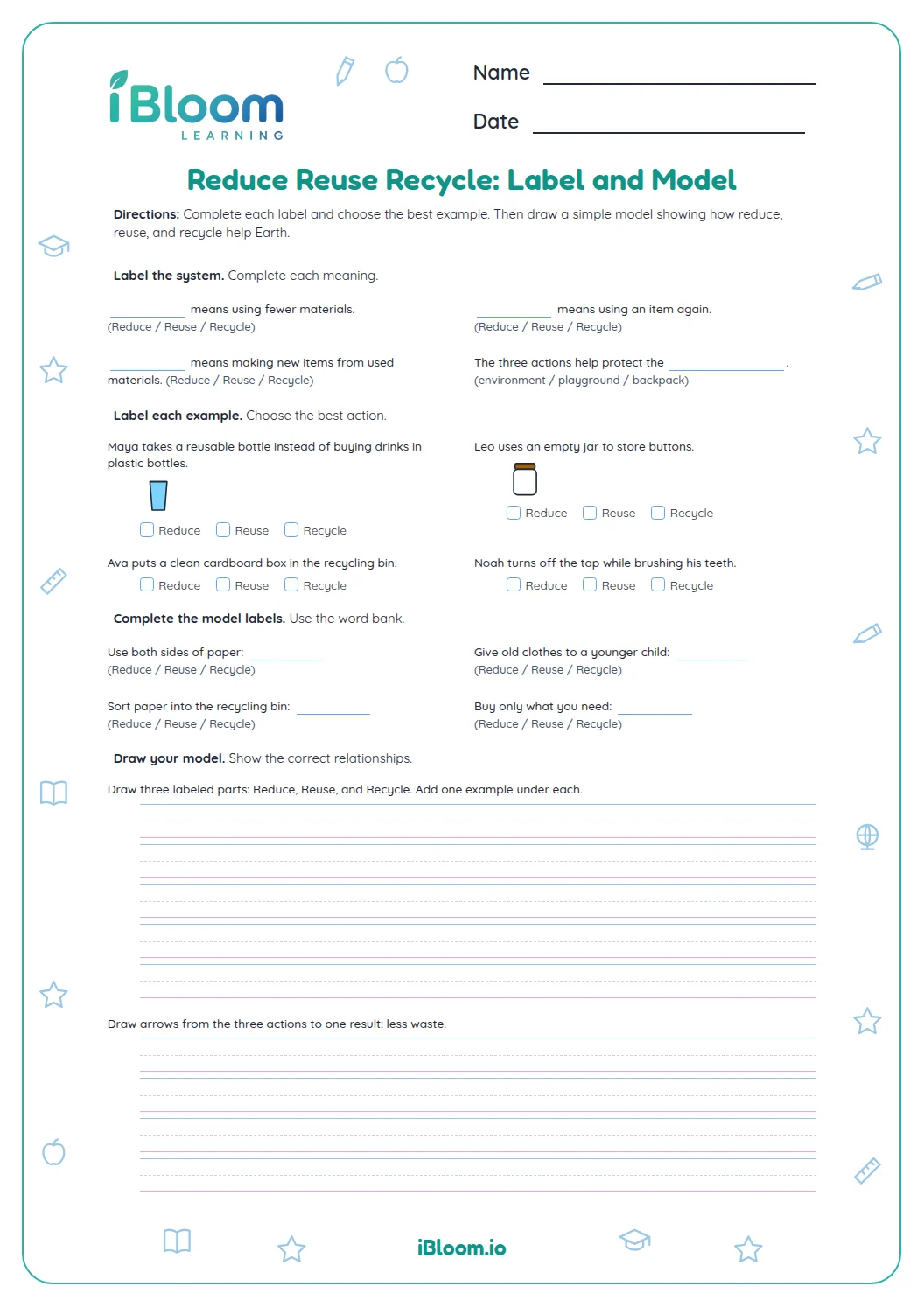 Reduce Reuse Recycle — Label and ModelGrade 3 science worksheets help children sort everyday choices into reduce, reuse, and recycle actions for caring for the environment. This label and model worksheet provides a distinct, age-appropriate way to practise the same lesson.Grade 3Free PDF preview
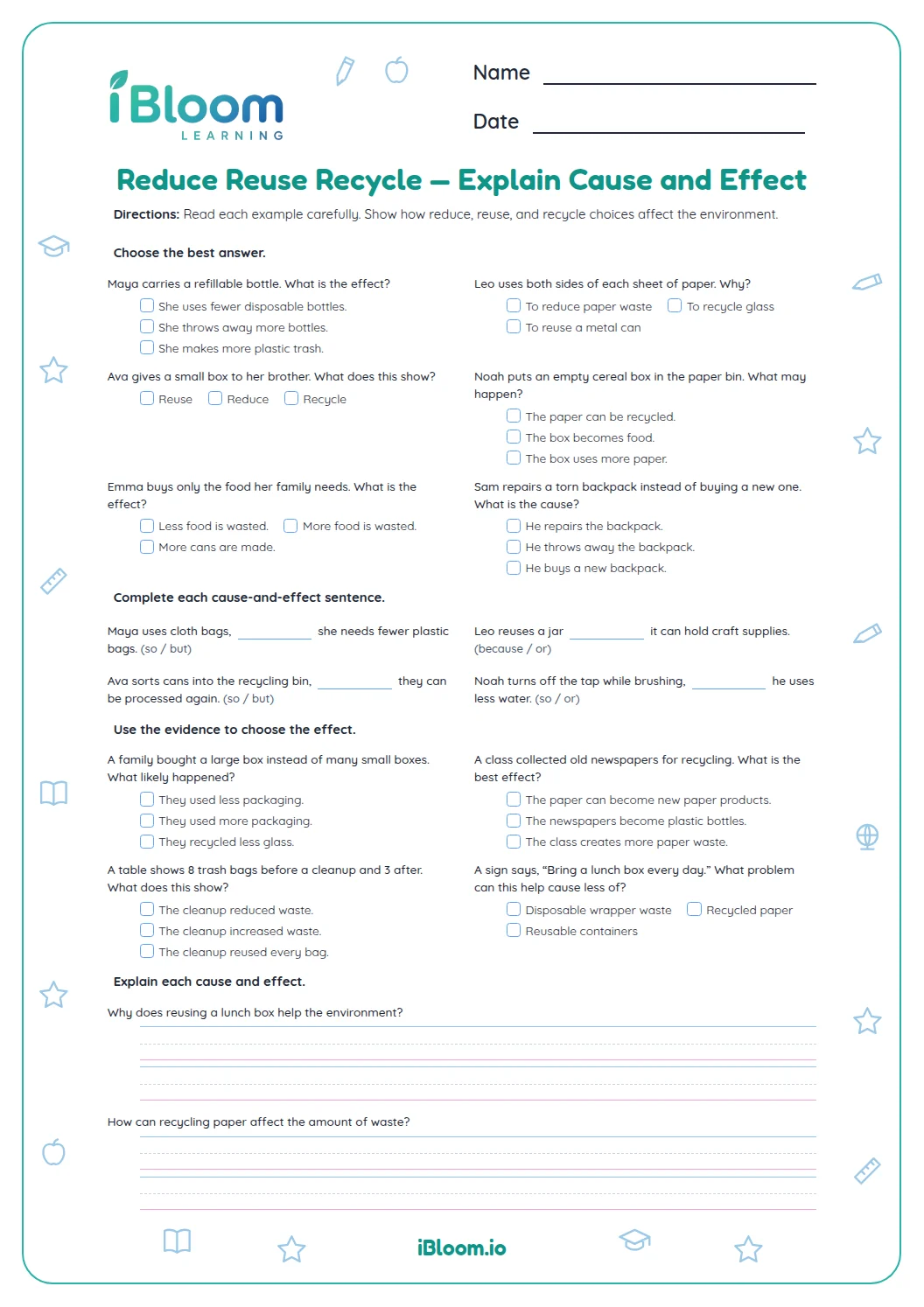 Reduce Reuse Recycle — Explain Cause and EffectGrade 3 science worksheets help children sort everyday choices into reduce, reuse, and recycle actions for caring for the environment. This explain cause and effect worksheet provides a distinct, age-appropriate way to practise the same lesson.Grade 3Free PDF preview
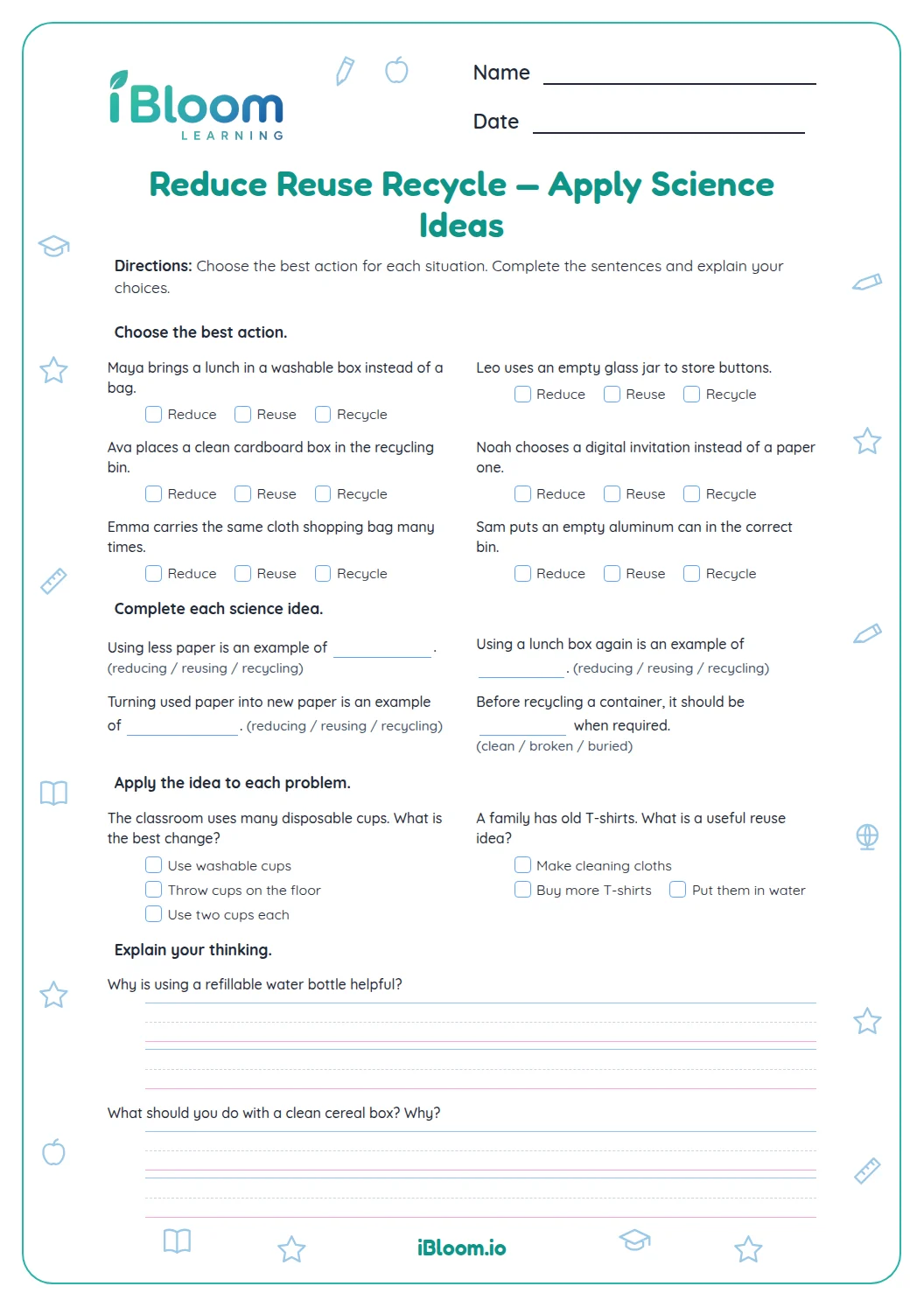 Reduce Reuse Recycle — Apply Science IdeasGrade 3 science worksheets help children sort everyday choices into reduce, reuse, and recycle actions for caring for the environment. This apply science ideas worksheet provides a distinct, age-appropriate way to practise the same lesson.Grade 3Free PDF preview
 Reduce Reuse Recycle — Science Reasoning ReviewGrade 3 science worksheets help children sort everyday choices into reduce, reuse, and recycle actions for caring for the environment. This science reasoning review worksheet provides a distinct, age-appropriate way to practise the same lesson.Grade 3Free PDF preview
Practice that builds confidence
Understanding the three Rs
These Grade 3 science worksheets help children understand how everyday choices can protect the environment. Students practise telling the difference between reducing waste, reusing items, and recycling materials instead of treating all three actions as the same.
The printable activities include sorting tasks, picture-based decisions, short written responses, and real-life scenarios about paper, plastic, cans, food packaging, school supplies, and household items. Children build vocabulary while thinking carefully about what happens before something becomes trash.
Reduce means using less in the first place, such as taking only one napkin or choosing a lunch box instead of disposable bags. Reuse means using an item again, like turning a jar into a pencil holder. Recycle means sending suitable materials to be made into something new. These worksheets guide Grade 3 learners to compare the three ideas, not just memorize the words.

How the practice progresses
Activities begin with clear examples and picture sorts, then move into short scenarios where children choose the best action. A student may decide whether to repair a folder, use both sides of paper, place a clean can in the recycling bin, or avoid extra packaging. This progression helps children explain their reasoning using words such as waste, material, landfill, conserve, resource, and pollution.
A simple parent routine
At home, choose one daily moment, such as packing lunch or cleaning up art supplies. Ask: “Can we use less? Can we use this again? If not, can it be recycled?” Let your child make one decision and explain it. For example, they might reuse a gift bag, choose a refillable water bottle, or rinse a container before recycling if local rules allow it.

Classroom uses for teachers
Teachers can use these printables in an environment unit, Earth Day lesson, science center, morning work, or small-group discussion. The scenario cards and sorting pages work well for partner talk because students must defend choices with evidence. They can also support a class waste audit, a bulletin board of reusable ideas, or a writing prompt about one change the class can make.

Common errors to watch for
Many children think recycling is always the best answer. Help them see that reducing often prevents waste before it starts, while reusing keeps an item useful for longer. Students may also assume every plastic item is recyclable or that dirty containers belong in the recycling bin. Encourage them to check labels, think about local rules, and notice when an item cannot be sorted safely.
Free printable PDF download
Use this grade 3 reduce reuse recycle worksheet page to preview the activity, print it, or download it as a PDF for quick practice. It works well for homework, homeschool lessons, tutoring, morning work, revision, and classroom centers.
Answers and answer key support
After the child completes the worksheet independently, parents and teachers can use the answer support or answer key information to check the work, review mistakes, and choose the next practice step.
Why iBloom worksheets help
The pages connect science vocabulary to familiar Grade 3 situations, so children practise both concept knowledge and responsible decision-making. A child-friendly strategy is: “Need less, use again, sort right.” Saying this before answering helps students slow down, choose the strongest of the three Rs, and explain how their choice helps the environment.
Helpful answers
Frequently asked questions
What do Grade 3 students practise in these reduce, reuse, recycle worksheets?
They practise identifying whether an action reduces waste, reuses an item, or recycles a suitable material. They also explain choices in everyday situations such as school supplies, lunch packaging, paper use, and household containers.
How can I help my child understand the difference between reuse and recycle?
Use a familiar object. If your child turns an empty box into storage, that is reuse because the item is used again. If a clean cardboard box goes to be processed into new material, that is recycling.
Are these worksheets suitable for Earth Day lessons?
Yes. The activities fit naturally into Earth Day discussions because they focus on practical actions children can take, such as using fewer disposable items, reusing materials, and sorting recyclables correctly.
What common misconception should I watch for?
A common misconception is that recycling is always the best choice. Children should learn that reducing waste first and reusing items when possible can often save more resources than recycling after something is used.
Can these worksheets be used in a science center?
Yes. Teachers can place sorting pages, picture prompts, or scenario cards in a science center and ask students to match each example with reduce, reuse, or recycle, then explain their reasoning to a partner.
Is this grade 3 reduce reuse recycle worksheet free?
Yes. You can preview it for free and use the printable worksheet for home or classroom practice.
Can I download this grade 3 reduce reuse recycle worksheet as a PDF?
Yes. Use the worksheet download option to save a printable PDF, or print the worksheet directly from the page.
Does this grade 3 reduce reuse recycle worksheet include answers or an answer key?
When the activity has fixed answers, iBloom includes answer support so parents and teachers can check the completed worksheet.