







About this worksheet
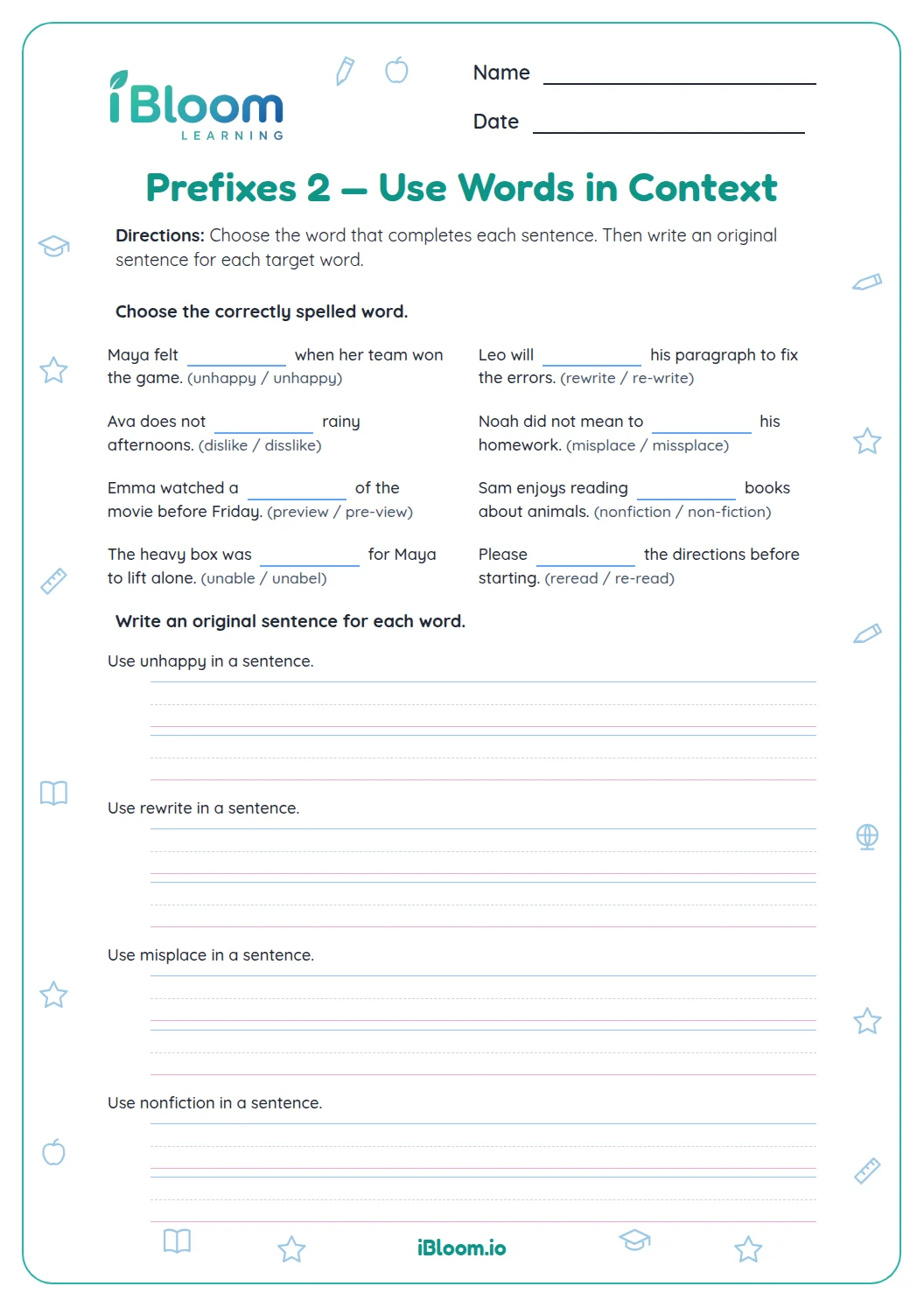
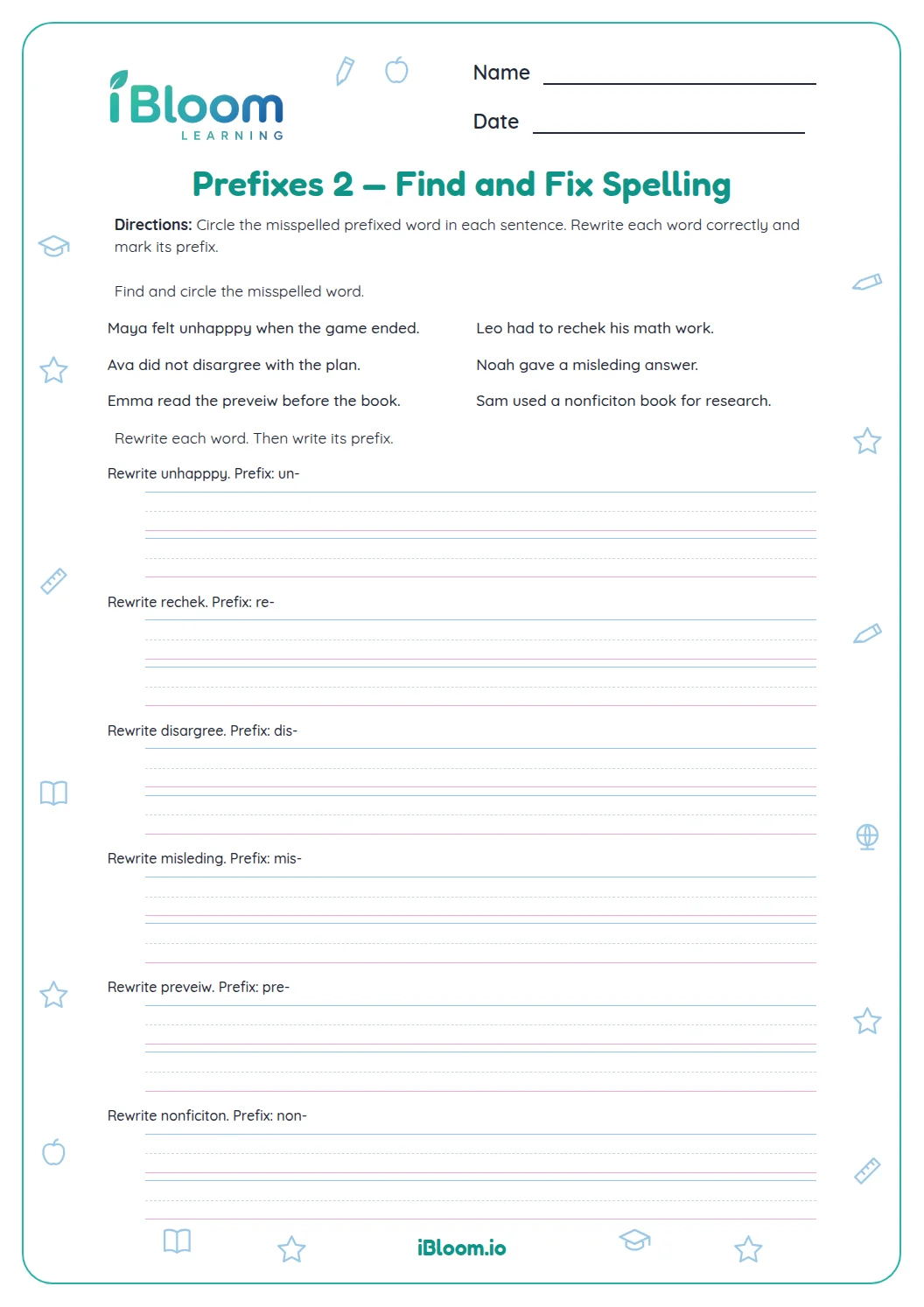
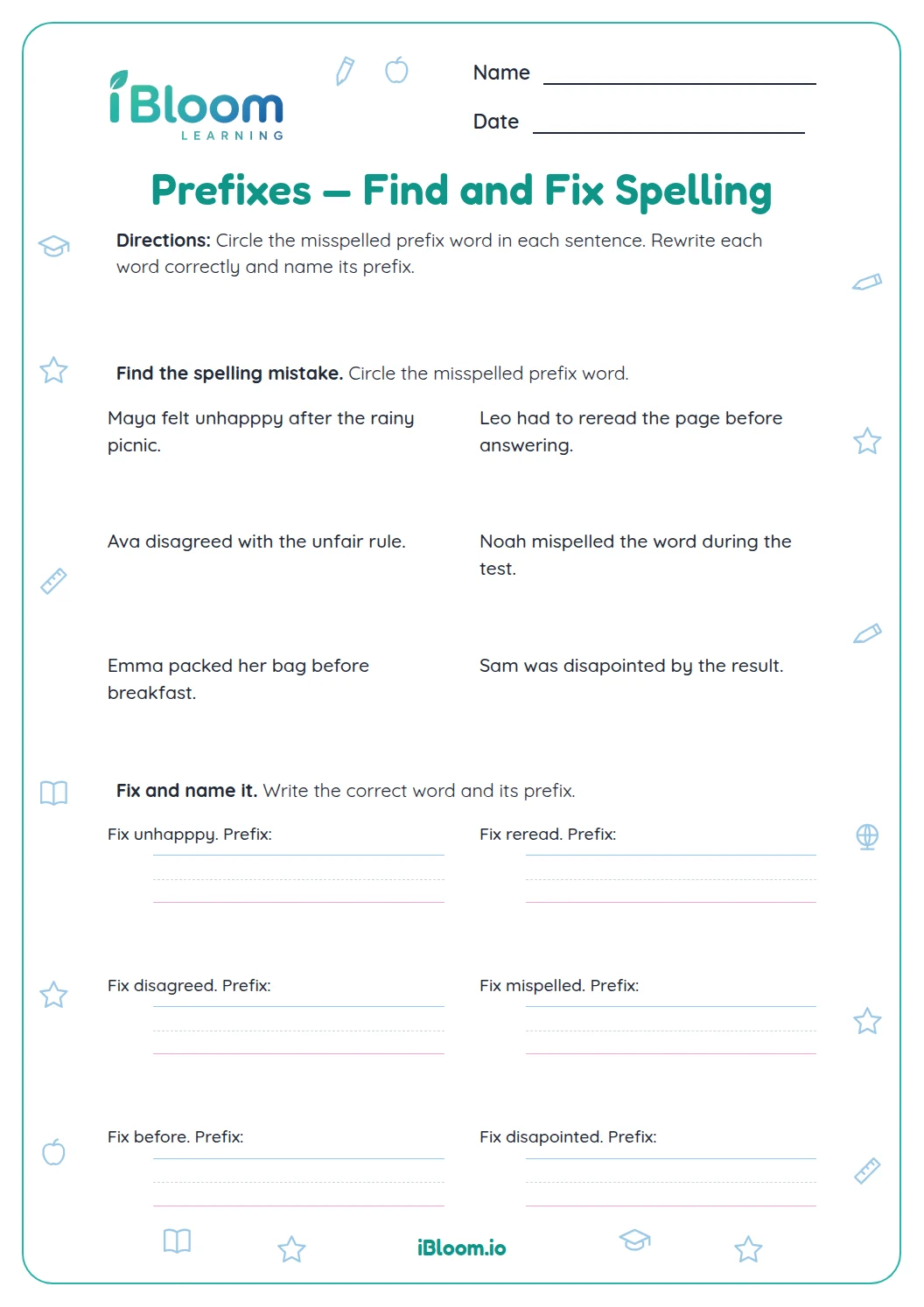
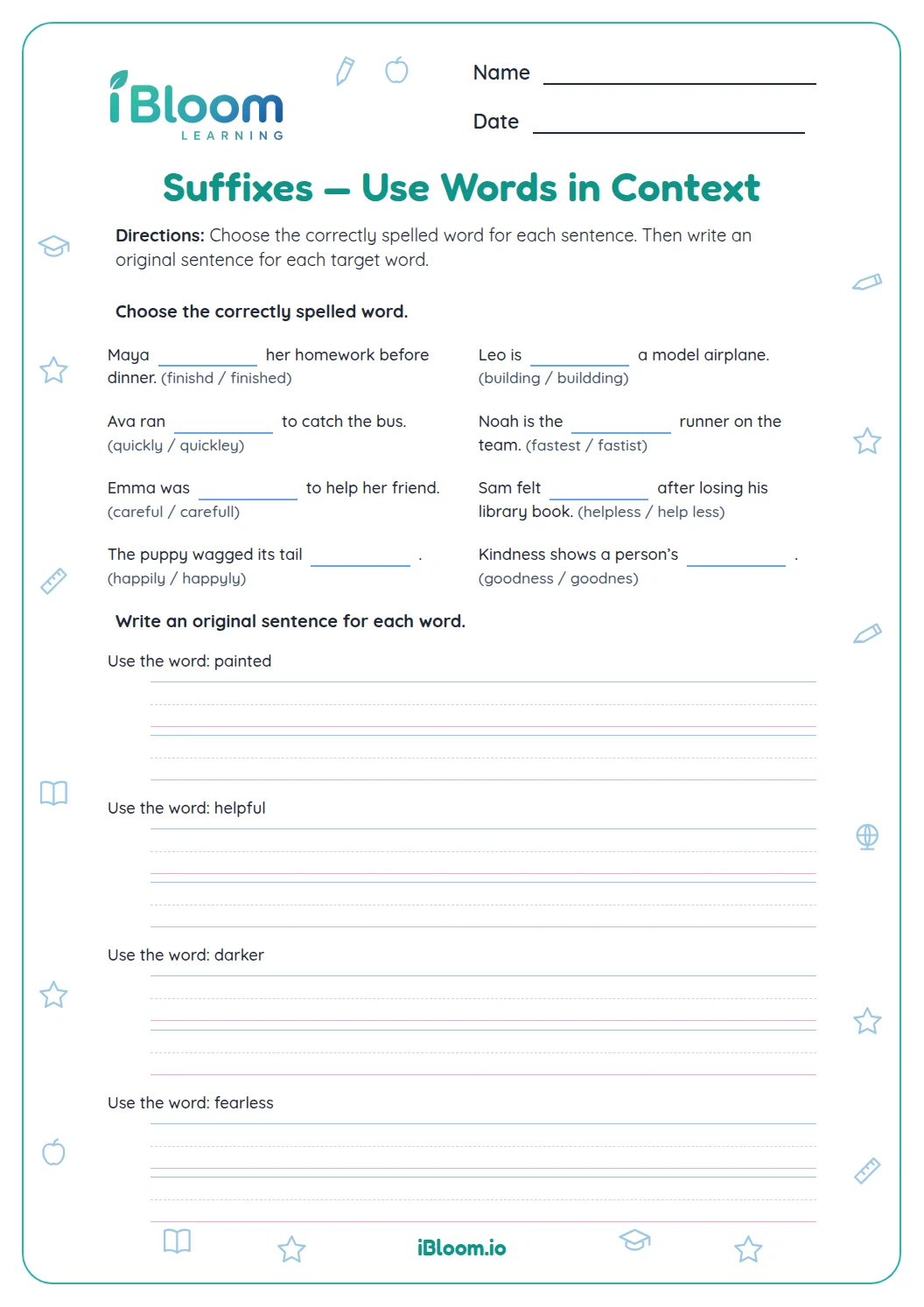
This free Grade 4 spelling worksheet gives students 16 chances to complete words with common prefixes. The first part focuses on spelling the prefix, then sentence clues and meaning clues help students check the whole word. The printable has three short parts and a separate answer key. Students can use the word meaning to check whether the prefix they chose makes sense.
Aligned to L.4.2.d
What kinds of prefix practice are included?
Part A asks students to complete familiar words such as unfair and repack. Part B adds a sentence clue, and Part C gives a meaning clue so the whole word can be checked.
- Part A: six prefix completions
- Part B: five sentence clues
- Part C: five meaning clues
How can a clue help spell the prefix?
Look at “We will ___pack the boxes before the move.” The sentence describes packing again, so re- completes repack. Read the finished word to check its spelling and meaning.
- 1We will ___pack the boxes before the move.
- 2Answer: re- → repack; the clue says the action will happen again.
What should students check after adding a prefix?
Read the entire word and use the clue to check its meaning. For example, a submarine travels under the water, while an underline goes beneath words on a page. The shared prefix is spelled the same, but the base word helps reveal the meaning.
How to use this worksheet
- 1{'step': 'Read the full sentence or meaning clue.', 'detail': 'Look for a signal such as “again,” “not,” or “beneath.”'}
- 2{'step': 'Choose a prefix that matches the clue.', 'detail': 'Say the prefix and base word together.'}
- 3{'step': 'Write the prefix carefully.', 'detail': 'Check its letters before moving on.'}
- 4{'step': 'Read the completed word.', 'detail': 'Make sure it is a real word and fits the clue.'}
Common mistakes and quick fixes
The mistake
Writing re- for a word that means “not.”
The fix
Check whether the clue signals “again” or gives the opposite.
The mistake
Leaving out a letter in a longer prefix.
The fix
Say and write the whole prefix, as in under- or over-.
The mistake
Choosing a prefix without checking the full word.
The fix
Read the completed word in the sentence and test its meaning.
Students practice spelling familiar words and using prefix meanings as clues.
Students spell complete words with common prefixes.
On this sheet:
Show the official wordingHide the official wording
Spell grade-appropriate words correctly, consulting references as needed.
What to practice next
Further reading
Questions parents and teachers ask
What prefixes appear on this worksheet?
The practice uses un-, re-, dis-, mis-, pre-, non-, over-, under-, and sub-. Examples include unfair, reread, mislabel, preview, and submarine. Each clue helps students choose a prefix, spell the completed word, and check that its meaning fits.
How many questions are included?
There are 16 questions in three parts. Part A has six word completions, Part B has five sentence clues, and Part C has five meaning clues. The separate answer key lists the prefix for each blank and makes the practice quick to review together.
Should students write the whole word or just the prefix?
Each prompt asks students to fill the prefix blank, so they write the prefix only. They should still read the finished word and use its sentence or meaning clue to confirm the complete spelling. For example, under- plus line makes underline, a line drawn beneath words.
How can I explain re- and un-?
Re- often means “again,” as in reread, while un- can mean “not” or reverse an action, as in unfair or unlock. Ask the student to use the base word and clue together. The prefix must make sense as part of the complete word, not just match a familiar pattern.
What comes after this worksheet?
Students can move to the broader Prefixes practice, then work on Suffixes and Suffixes 2. This sequence shifts from completing prefix spellings to comparing other word parts attached to a base word. Ask students to point out how each added part changes a word.