




About this worksheet
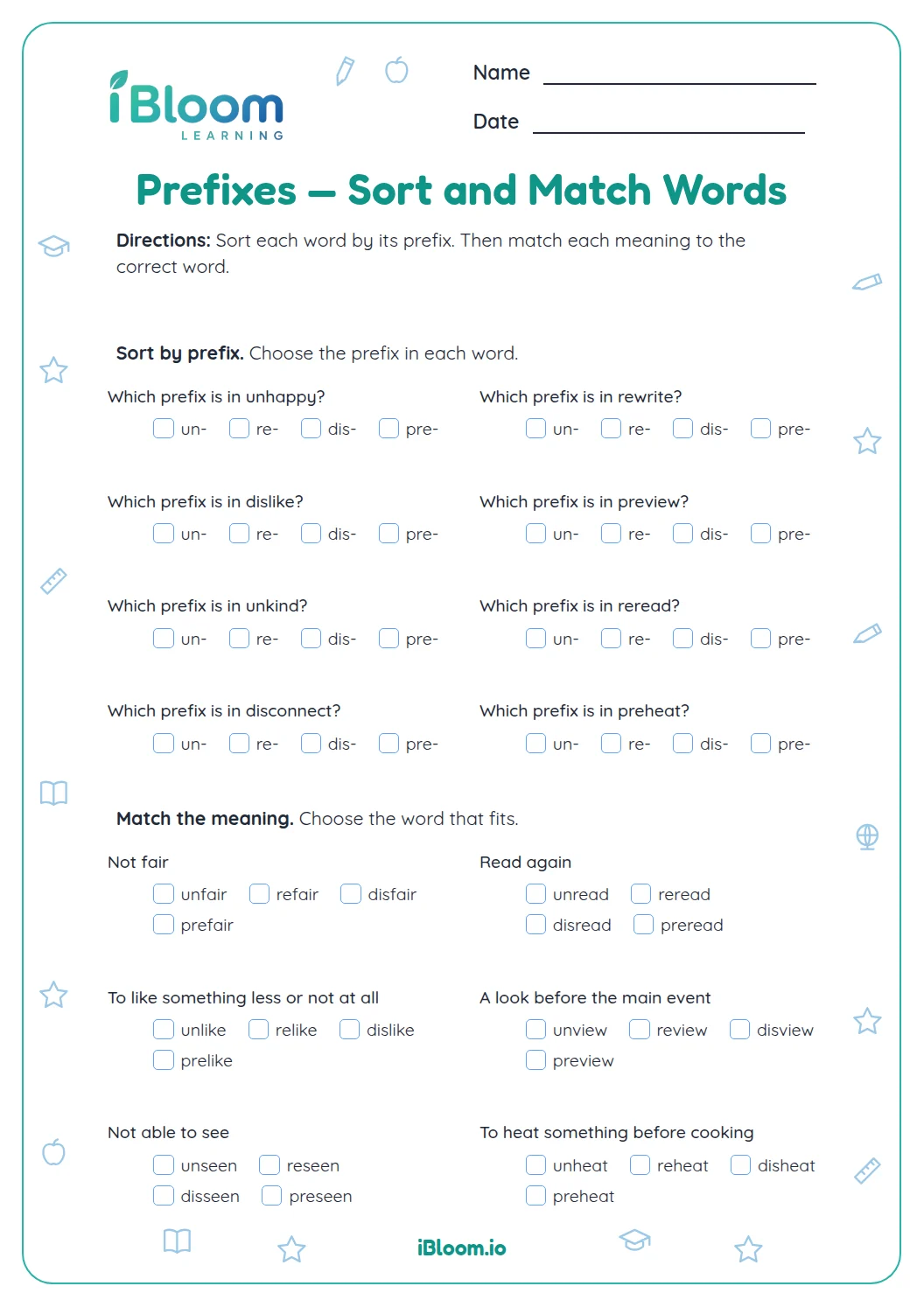
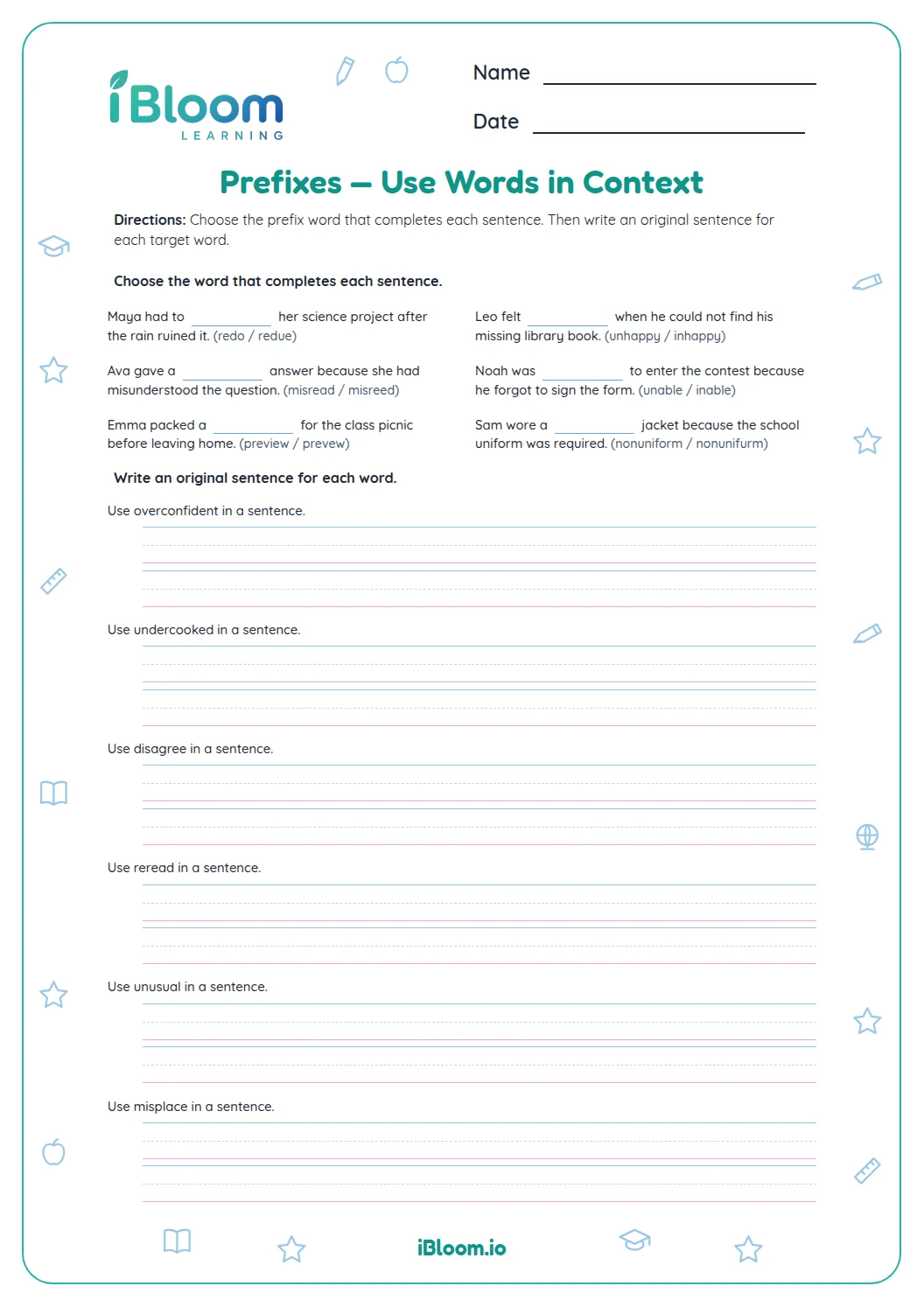
This Grade 5 spelling worksheet practices common prefixes in three ways. Students build words such as rewrite and misplace, select correctly spelled words, and use prefixes to complete meaning clues. The 15 questions have a separate answer key and support accurate spelling of grade-appropriate words, aligned with CCSS L.5.2.e.
Aligned to L.5.2.e
Which prefixes do students practice?
The questions use re-, un-, dis-, pre-, and mis-. Part A joins prefixes to base words, Part B checks spelling in pairs, and Part C uses sentence meanings to complete words.
- Part A: combine a prefix and base word
- Part B: select the correct spelling
- Part C: use a definition or context clue
How can a student check a prefix spelling?
Keep the prefix and base word in view, then read the combined word. In re + write, re- means again, so rewrite means write again. Check the spelling of the full word after joining the parts.
- 1re + write = rewrite
- 2re- means again.
- 3Rewrite means write again.
How do meaning clues help with prefixes?
The prefix contributes meaning: un- can make a word negative, re- can mean again, and mis- can signal something done incorrectly. Read the sentence and base word together before choosing a prefix.
What should students check after finishing?
Compare the whole word with the key, then say how its prefix changes the base word. Pay special attention to spelling patterns in words such as disappear and misspell.
How to use this worksheet
- 1Read the base word and the prefix in each Part A item.
- 2Join them and check the spelling of the complete word.
- 3In Part B, compare every letter in the choices.
- 4For Part C, use the sentence clue to decide which meaning fits.
- 5Check the key and explain what one prefix contributes.
Common mistakes and quick fixes
The mistake
Leaving out or doubling a letter when joining a prefix.
The fix
Read the complete word after combining the prefix and base word.
The mistake
Choosing by sound alone when two spellings look similar.
The fix
Compare the letter sequence with a familiar correct spelling or reference.
The mistake
Ignoring the sentence meaning in a prefix question.
The fix
Use both the base word and context clue to select the prefix word that fits.
Common Core alignment
This worksheet gives focused practice with a Common Core language or writing skill.
Spell prefix words accurately as you build and check each word.
On this sheet: Spell prefix words accurately as you build and check each word.
Show the official wordingHide the official wording
Spell grade-appropriate words correctly, consulting references as needed.
What to practice next
Make more practice
Further reading
Questions parents and teachers ask
Which prefixes are included?
The worksheet practices re-, un-, dis-, pre-, and mis-. Students build words with those prefixes, select correctly spelled words, and complete sentence clues such as doing a job again or reading a word incorrectly. Ask the learner to point to the clue that supports the answer.
How many questions are included?
There are 15 questions across three parts. Part A builds five words, Part B asks students to choose among five spelling pairs, and Part C completes five words from meaning clues. A separate key gives each answer. Ask the learner to point to the clue that supports the answer.
What does re- mean in rewrite?
In rewrite, re- means again and write is the base word. Together they mean to write again. Part A uses this kind of word building so students can connect a prefix’s meaning with the spelling of the whole word. Ask the learner to point to the clue that supports the answer.
Why do students need to check the whole word?
A correct prefix does not guarantee that the complete word is spelled correctly. Students should compare all the letters after joining the prefix and base word. Part B provides spelling pairs for this close check. Ask the learner to point to the clue that supports the answer.
How can I review a missed answer?
Ask the student to read the sentence clue and explain the prefix meaning before checking the spelling. The answer key lists the intended word, and a dictionary can help confirm a spelling when needed. Ask the learner to point to the clue that supports the answer.