





About this worksheet
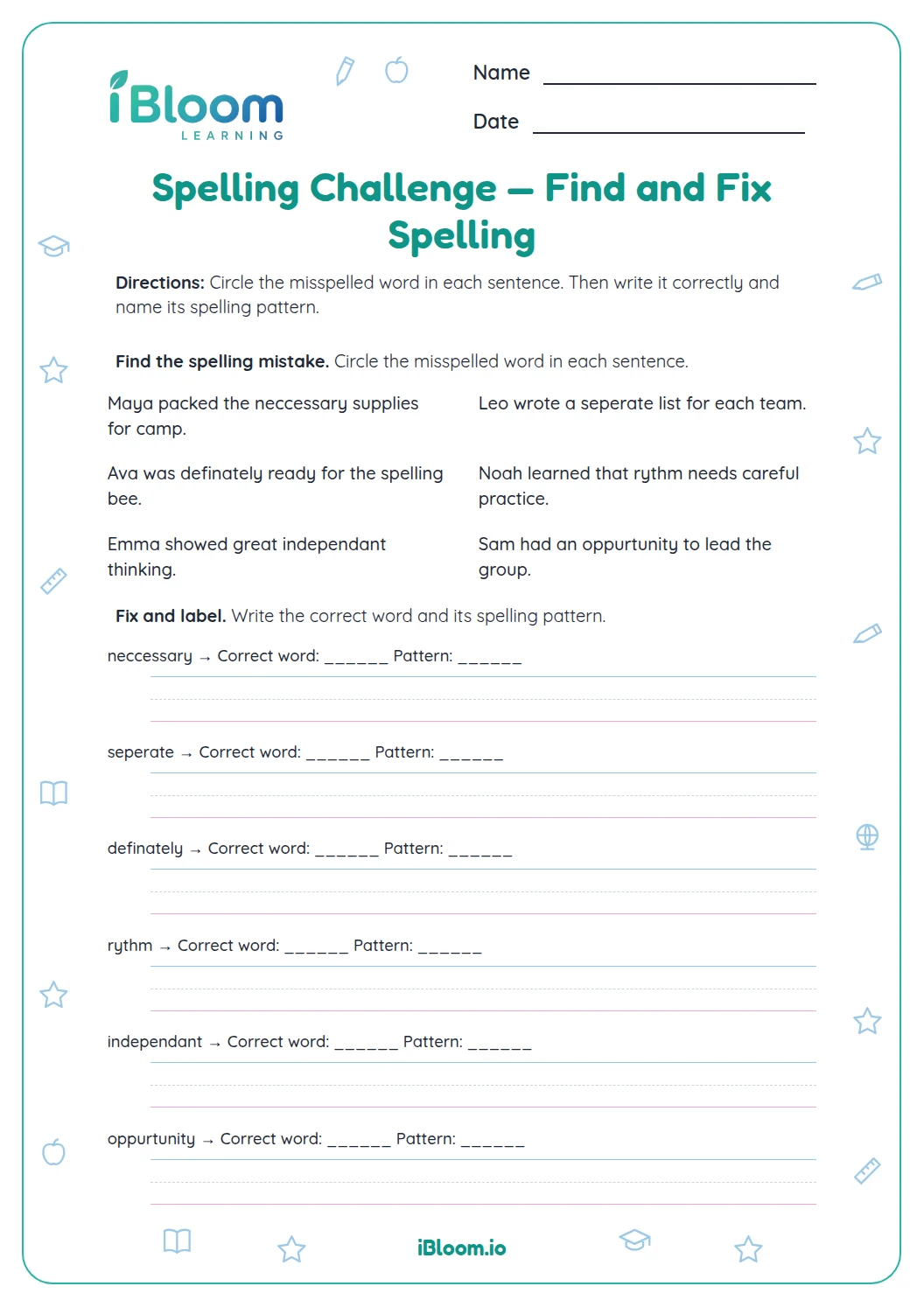
This free Grade 5 spelling worksheet asks students to proofread 14 short sentences, correct one misspelled word in each, and name a spelling clue. The examples cover vowel patterns, endings, doubled letters, and word meaning in context. It practices CCSS L.5.2.e; a separate answer key shows each correction and clue.
Aligned to L.5.2.e
What spelling clues can help during proofreading?
Students look closely at vowel order, doubled consonants, word endings, and the meaning of a sentence. Each item has one intentional spelling error. Context helps distinguish homophones such as “whether” and “weather.”
- 1“Our class will recieve a new dictionary.” → receive; i before e after c.
Why read the whole sentence?
A sentence can reveal which correctly spelled word belongs there. In the storm example, “weather” names conditions outside; “whether” introduces a choice. Reading for meaning makes the correction more reliable than checking letter patterns alone.
How can students remember a correction?
Naming the clue turns a correction into a spelling decision students can explain. A useful clue might be a familiar vowel pattern, a doubled consonant, or a suffix ending. Students can compare their clue with the answer key after finishing each part.
- 1“A curious visitor asked an embarassing question.” → embarrassing; double r and double s.
How to use this worksheet
- 1Read the full sentence to understand its meaning.
- 2Find the word that looks incorrect and write its standard spelling.
- 3Name a short clue, such as a vowel pattern, doubled letter, or ending.
- 4For homophones, ask which meaning fits the sentence.
- 5Use the key to check both the correction and the clue.
Common mistakes and quick fixes
The mistake
Choosing “whether” when the sentence is about a storm.
The fix
Use “weather” for conditions outside; “whether” introduces a choice.
The mistake
Writing “usefull” with two l’s at the end.
The fix
The adjective “useful” ends in one l.
The mistake
Remembering a correction but not the spelling pattern.
The fix
Say the clue aloud, such as “i before e after c” for receive.
Curriculum alignment
This worksheet practices the following Common Core skill.
Use spelling patterns and generalizations when writing words.
On this sheet: Every item asks students to notice and correct a grade-appropriate spelling error.
Show the official wordingHide the official wording
Spell grade-appropriate words correctly, consulting references as needed.
What to practice next
Make more practice
Further reading
Questions parents and teachers ask
What does find and fix spelling practice?
Students proofread each sentence, find one misspelled word, write its correct form, and name a clue for the correction. The items practice vowel patterns, endings, doubled letters, and using sentence meaning to choose a homophone correctly in context in writing.
How many errors are on the worksheet?
There are 14 sentences, each with one intended spelling error. Students write the corrected word and a short clue for each item. The separate answer key lists the target word and an example clue for every sentence on the worksheet.
Why is “weather” correct in the storm sentence?
Weather means the conditions outside, which a storm can change. Whether means “if” or introduces a choice, as in “I do not know whether it will rain.” The sentence meaning points to weather, the spelling students should use here instead.
What counts as a spelling clue?
A clue briefly names the pattern or meaning that supports the correction. Examples include i before e after c for receive, double r and s for embarrassing, or using weather because the sentence is about a storm outside that day.
Should the student copy the entire corrected sentence?
No. Write the corrected word and the clue, as the directions request. This keeps attention on the spelling decision. After checking the key, the student can read the sentence again with the corrected spelling in place before moving to the next item.
How can the answer key be used?
Complete the page first, then compare each correction and clue with the key. The clue can be phrased differently if it explains the spelling accurately. Discuss any mismatch by returning to the word pattern or the sentence meaning in context.