

About this worksheet
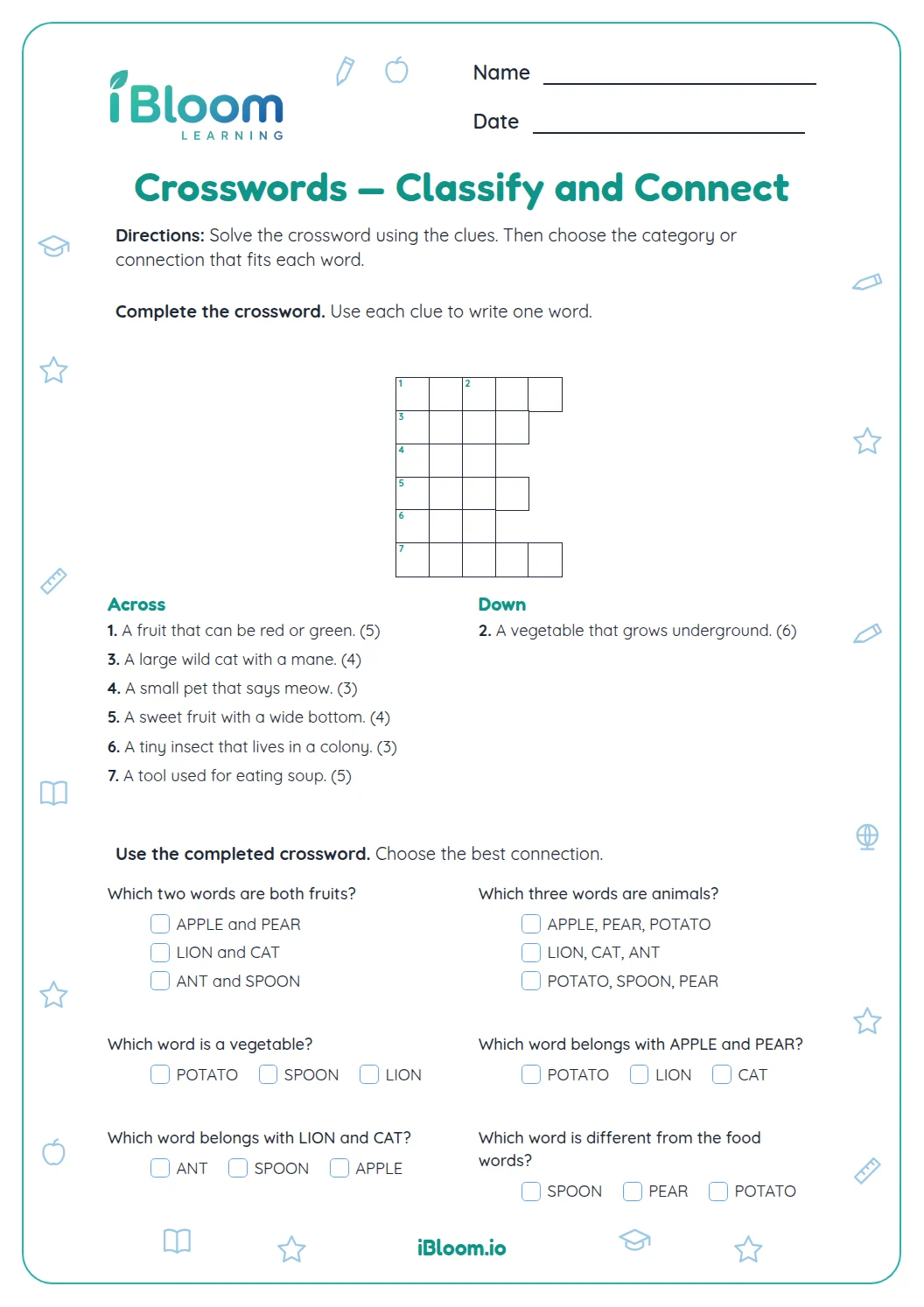
This printable combines a six-word crossword with four questions about the clues that make each answer fit. It is for elementary learners in Grades 1–5 who can read short sentences, with adult reading support as needed. Part A asks children to infer words such as tiny, silent and brave from everyday situations. Part B checks word meanings and the evidence in the clues. The work practices Common Core L.2.4a: using sentence context to work out meaning. A separate answer key supplies the completed grid and the four correct choices.
Aligned to L.2.4a
What makes these clues context clues?
Each crossword clue is a sentence with a missing word. The surrounding details describe the missing meaning: an empty plate has no food, and a wet towel drips water. Children use those details before checking the boxes.
The six answers are tiny, silent, brave, tired, empty and wet. Read unfamiliar clue words aloud so decoding does not prevent a child from reasoning about meaning.
How can a child check a likely answer?
Check both meaning and spelling. A word might make sense in a sentence but have the wrong number of letters. A crossing letter is another check, not a substitute for reading the clue.
- 1The ___ bug fit in a spoon.
- 2Fitting in a spoon suggests a very small size.
- 3Tiny means very small and has four letters.
- 4Write TINY, then check its crossing letters.
What do the follow-up questions add?
The four choice questions ask children to notice evidence and meanings instead of only completing a grid. Two questions identify clue words for empty and wet, while two ask for the meanings of tiny and silent.
Parts A and B move from solving the crossword to checking the clues. After choosing an answer, children can explain aloud how the sentence detail helped. Keep the crossword available during this discussion.
How to use this worksheet
- 1Read the six clues aloud once without filling any boxes.
- 2Start with a clue whose meaning your child can explain.
- 3Count the boxes and write one capital letter in each.
- 4Use crossing letters to check the remaining words.
- 5Complete the four follow-up questions and explain each choice aloud before checking the key.
Mistakes to notice and how to help
The mistake
Writing small for the bug clue.
The fix
Small fits the meaning but has five letters; the four-letter entry is tiny.
The mistake
Choosing a word only because one letter crosses.
The fix
Reread the whole clue and explain why the word fits the situation.
The mistake
Saying the towel is wet because wet fits the boxes.
The fix
Ask which sentence detail gives evidence: the towel drips water.
Common Core alignment
Use sentence clues to infer crossword words and explain their meanings.
On this sheet: The crossword clues and follow-up questions require meaning to be inferred from sentences.
Show the official wordingHide the official wording
Use sentence-level context as a clue to the meaning of a word or phrase.
What to practice next
Make more practice
Further reading
Questions parents and teachers ask
How many words are in the crossword?
There are six crossword words: tiny, silent, brave, tired, empty and wet. Each has a sentence clue with a missing word. After the puzzle, children answer four multiple-choice questions about meanings and evidence, making ten questions across the complete worksheet, with a separate answer key.
Can I read the clues aloud?
Yes, you can read every clue aloud while your child studies the grid. Pause before the missing word and ask which detail suggests its meaning. Let the child supply the word, count the boxes and write the letters, so the reasoning remains their own.
What if a different word seems to fit a clue?
Check the meaning, number of boxes and crossing letters together. For the bug clue, small makes sense, but the entry needs four letters, so tiny fits. Talk through that comparison before erasing anything; it shows how the sentence and the grid work together.
Is a word bank provided?
No word bank is printed; sentence clues and crossing letters guide the answers. If a child needs extra support, offer two possible words for one clue. Ask the child to explain the choice, then check its spelling and length against the grid.
How can I check that my child used the clues?
Ask your child to explain one chosen answer aloud. For wet, the useful clue is that the towel dripped water. A child who can link that detail to the word’s meaning has used the sentence evidence. Use the completed grid and marked choices to check the written work.