

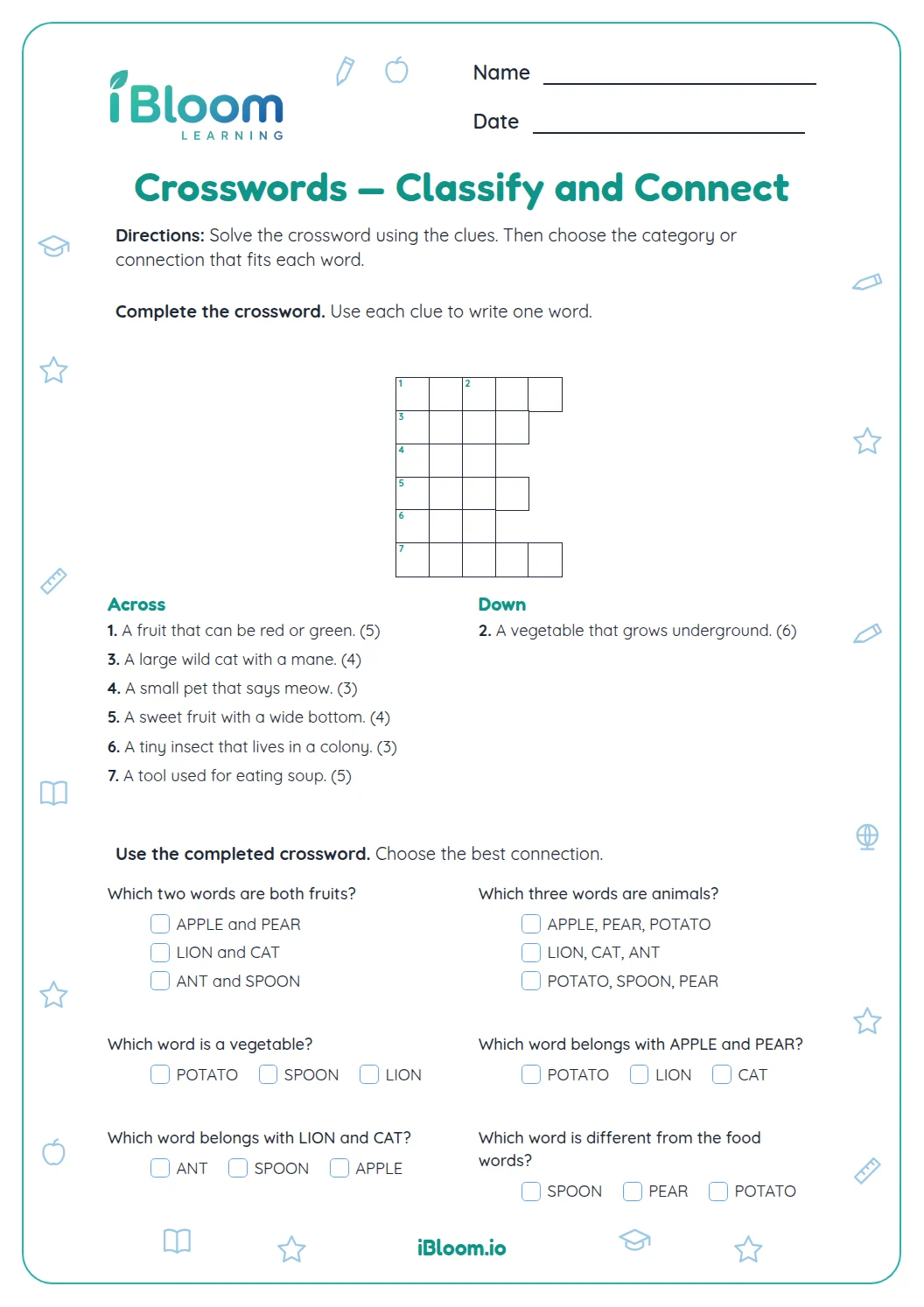
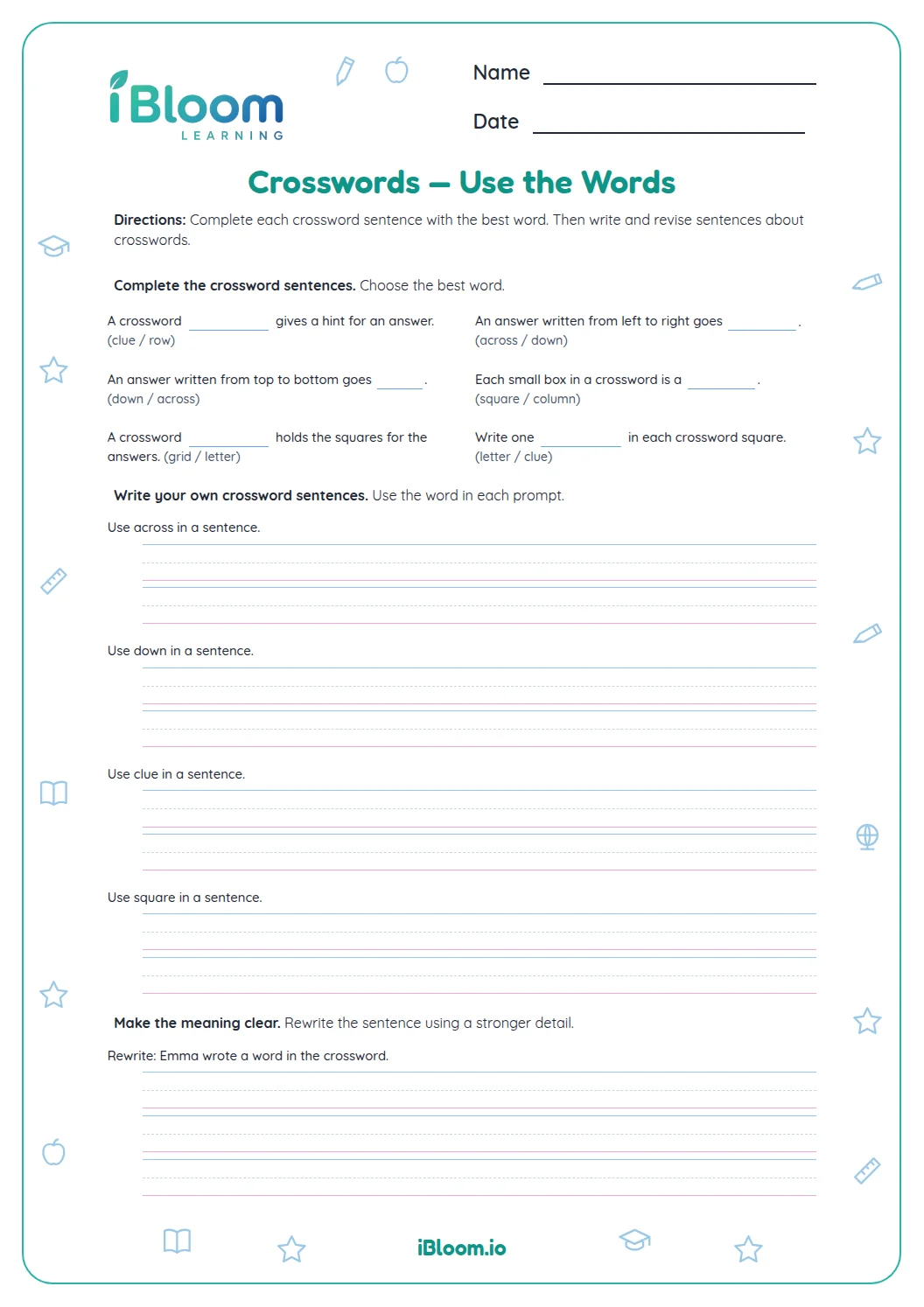
About this worksheet
This free printable vocabulary worksheet asks Grade 1 to Grade 5 students to think about how words relate, not only to recall them. Children warm up with five word questions (an opposite, an odd one out, a synonym, a category and an analogy), solve an eight-clue crossword whose clues are opposites, synonyms, definitions and a sentence, and then use the crossword words in three more questions. It practices CCSS L.4.5.c and L.3.4.a: relating words to opposites and similar words, and using a sentence as a clue. A separate answer key shows the filled grid and every answer.
Aligned to L.4.5.c and L.3.4.a
What is on this vocabulary crossword worksheet?
The worksheet has three parts. Part A, on page 1, is a warm-up with five choose-the-answer questions: the opposite of hot, the word that does not belong with red, blue and green, a word that means almost the same as happy, a fruit that goes with apple, pear and peach, and the analogy “tiny is to small as huge is to big.”
Part B, on page 2, is the crossword, with eight clues and one letter per box. Part C comes back to the words with three more choose-the-answer questions that use bold, empty and ancient in a synonym question and two sentences.
- Part A: five warm-up questions on opposites, categories, synonyms and an analogy (questions 1 to 5)
- Part B: an eight-word crossword, with the number of letters after each clue
- Part C: three questions that use crossword words (questions 14 to 16)
What kinds of clues are in the crossword?
The eight clues use different ways of defining a word, which is what a vocabulary review should do. HUGE is a synonym clue (another word for very, very big). QUIET and EMPTY are opposite clues (the opposite of loud, the opposite of full). BRAVE is a sentence clue, so children read the whole sentence to work out the missing word.
EARTH and CLOUD are definition clues that describe something children know. GENTLE has a meaning and a contrast (soft and kind, not rough), and ANCIENT gives a meaning and an example (very, very old, like a pyramid).
- 1Clue: Soft and kind, not rough. (6) → GENTLE (six boxes, and "soft and kind" fits)
- 2Clue: Very, very old, like a pyramid. (7) → ANCIENT (seven boxes)
- 3GENTLE and ANCIENT cross on N: the third letter of GENTLE is the second letter of ANCIENT.
How do crossing letters help check an answer?
When two words cross, they share a letter, so a wrong answer shows itself. A child who writes SOFT for “The opposite of loud” finds it is one letter short of the five boxes, which points to QUIET. A child who spells ANCIENT as ANSHENT finds the letters no longer match the words that cross it.
Encourage children to start with the clue they are most sure of, such as EARTH or CLOUD. Each word they place gives a letter to a neighbor: BRAVE crosses EARTH at the R, and CLOUD crosses GENTLE at the L.
Why does the sheet ask children to reason about words?
Knowing that a word exists is not the same as knowing how it relates to other words. Question 2 asks a child to see that red, blue and green are colors and happy is not. Question 5 asks them to see that huge is a bigger way of saying big, just as tiny is a smaller way of saying small.
The crossword then puts the same kinds of thinking into clues: an opposite, another word for, a definition, a sentence with a gap. Part C asks whether bold or afraid means almost the same as brave, so children use one crossword word to judge another.
How to use this worksheet at home or in class
- 1Read the Part A directions aloud and let your child answer questions 1 to 5, saying why each answer is right.
- 2Look at the crossword together and point out the number in parentheses after each clue: it is how many letters the word has.
- 3Ask your child to start with the clues they are sure of, such as the planet where we live.
- 4Have your child use the crossing letters to check each word and to find ones they are not sure about.
- 5Do Part C, and ask your child to say each sentence aloud with their answer in it.
- 6Check the page with the answer key and talk about any word your child did not know.
Common mistakes and quick fixes
The mistake
Writing SOFT for “The opposite of loud,” a fair opposite that has only four letters.
The fix
Count the boxes together. There are five, so the word must have five letters. Ask for another word that means not loud: QUIET fits, and its E also starts EMPTY.
The mistake
Choosing "sad" in question 3 because happy and sad are an opposite pair that children often learn together.
The fix
Read the question aloud: almost the same as happy. Sad is the opposite, so glad is the answer. Ask your child to say a sentence with each word.
The mistake
Spelling a long word by sound, such as ANSHENT for ancient, so the crossing letters do not match.
The fix
Treat the crossing letters as a spelling check. If the letter from GENTLE or EMPTY does not fit, sound the word out again and compare it to the boxes.
Common Core alignment
Most US states use the Common Core standards or a close state version. These two vocabulary standards describe the thinking this page asks for.
Relate words to their opposites and to similar words.
On this sheet: Questions 1, 3 and 5, the QUIET, EMPTY and HUGE clues, and question 14 ask for opposites and words with similar meanings.
Show the official wordingHide the official wording
Demonstrate understanding of words by relating them to their opposites (antonyms) and to words with similar but not identical meanings (synonyms).
Use a sentence as a clue to a word's meaning.
On this sheet: The BRAVE clue and questions 15 and 16 ask children to use the rest of a sentence to find the missing word.
Show the official wordingHide the official wording
Use sentence-level context as a clue to the meaning of a word or phrase.
What to practice next
Make more practice
Further reading
Questions parents and teachers ask
Can a Grade 1 student do this crossword?
With some help, yes. The words run from short ones such as HUGE and QUIET to longer ones such as ANCIENT. Younger children can start with Part A and the clues they know, such as the planet where we live, and fill in what they can, while older children can solve the whole grid on their own.
Is there a word bank?
No, children work out each word from its clue. The number in parentheses after each clue gives the number of letters, and the crossing letters narrow the choices further. If your child is stuck, start with the clue they know best and use its letters to help with the words that cross it.
What if my child cannot solve a clue?
Skip it and come back later. Each word your child places gives letters to the words that cross it, so a hard clue often becomes easier. Reading the clue aloud, counting the boxes and thinking about a word with that many letters also helps. The answer key shows every word.
What is the difference between a synonym and an opposite?
A synonym means almost the same thing as another word, and an opposite means the reverse. On this sheet, HUGE is a synonym of very, very big, while QUIET is the opposite of loud. Question 3 mixes them on purpose, so children must choose glad, not sad, for happy.
Why does Part C use the crossword words again?
Meeting a word a second time, in a new kind of question, gives children another look at what it means. Part C uses bold, empty and ancient in a synonym question and two sentences. A child who worked out EMPTY and ANCIENT in the crossword can now check that each one makes sense in a real sentence.
What should we do after this worksheet?
Ask your child to make up a clue for a word of their own, then swap clues with a friend. After that, Picture Crosswords gives easier practice, and the Grade 3, Grade 4 and Grade 5 vocabulary worksheets build on synonyms and opposites. The crossword generator makes new puzzles from any word list.