



About this worksheet
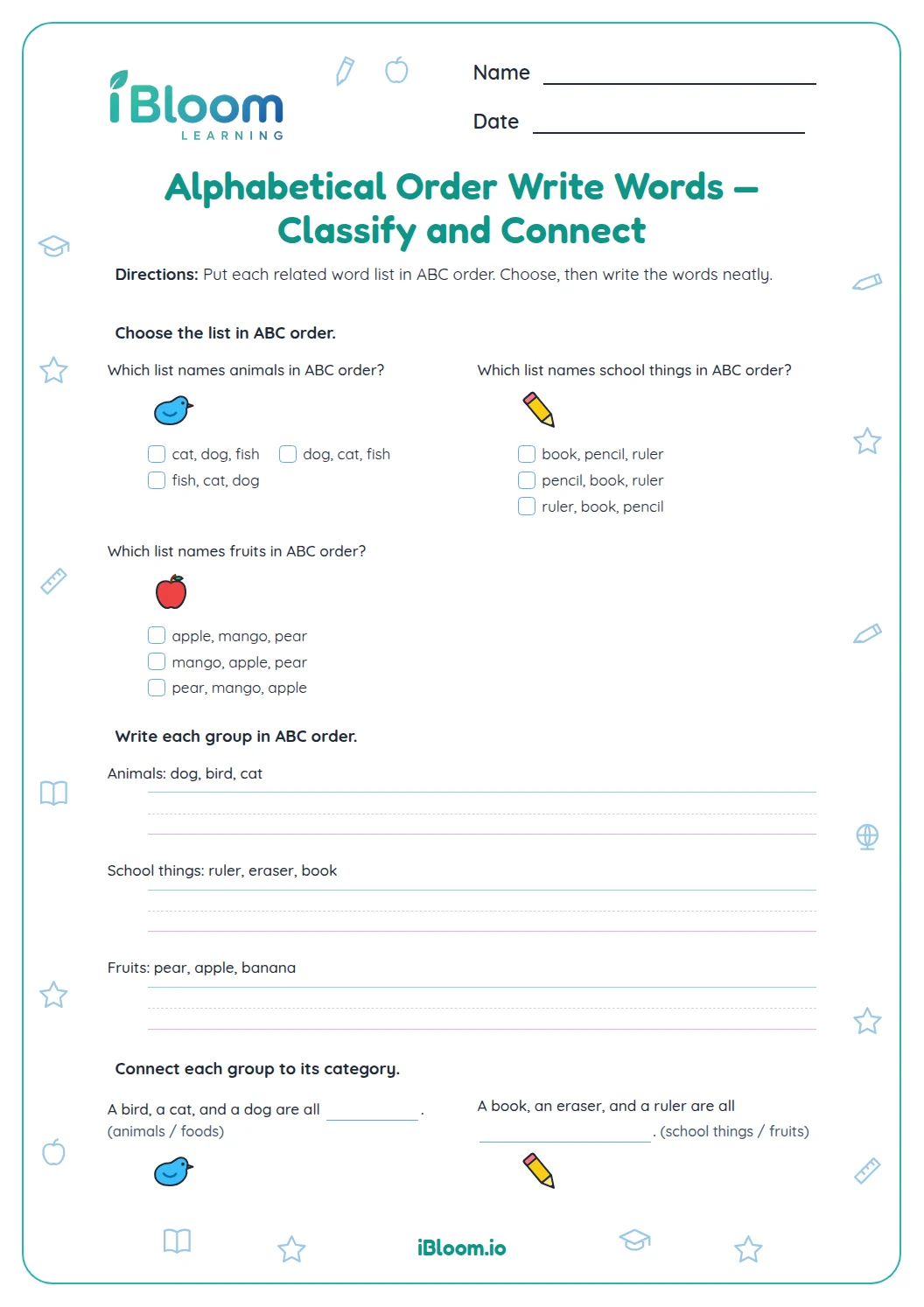
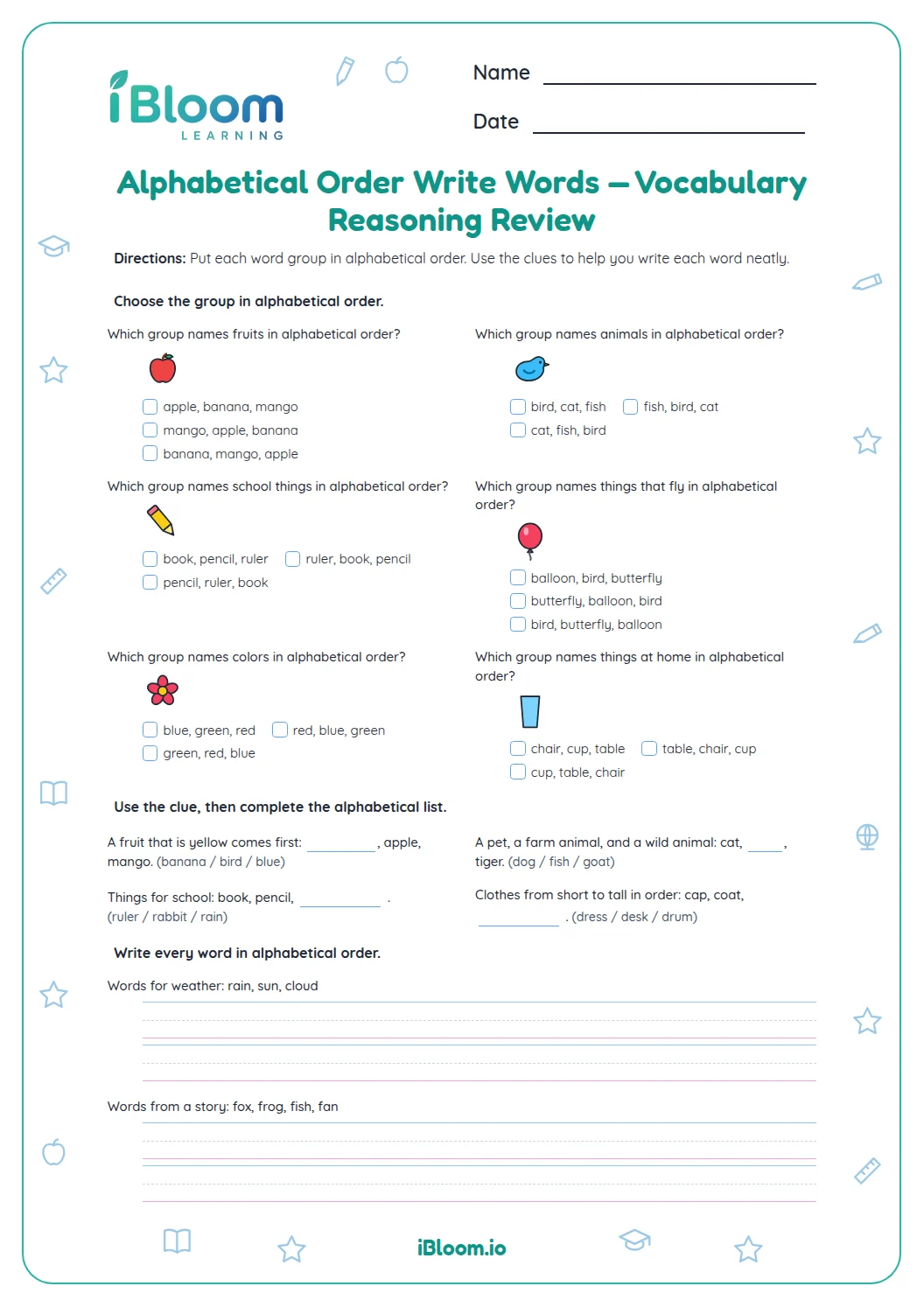
This Grade 1 worksheet gives children practice putting familiar words in alphabetical order. Most sets have three words with different first letters; two sets ask children to compare words that begin with the same letter. The final part asks for a sentence using each target word, connecting careful word reading to writing. The answer key gives the word order and sample sentences.
How does alphabetical order work?
Alphabetical order means putting words in the order of the alphabet. Look at the first letter in each word. A comes before B, and B comes before C, so a word that starts with A goes before a word that starts with B.
When two words share a first letter, compare the next letter. In the set cap, can, cat, all three begin with c. The second letters are a, a, and a, so compare the third letters: n comes before p, and p comes before t.
What does this worksheet practice?
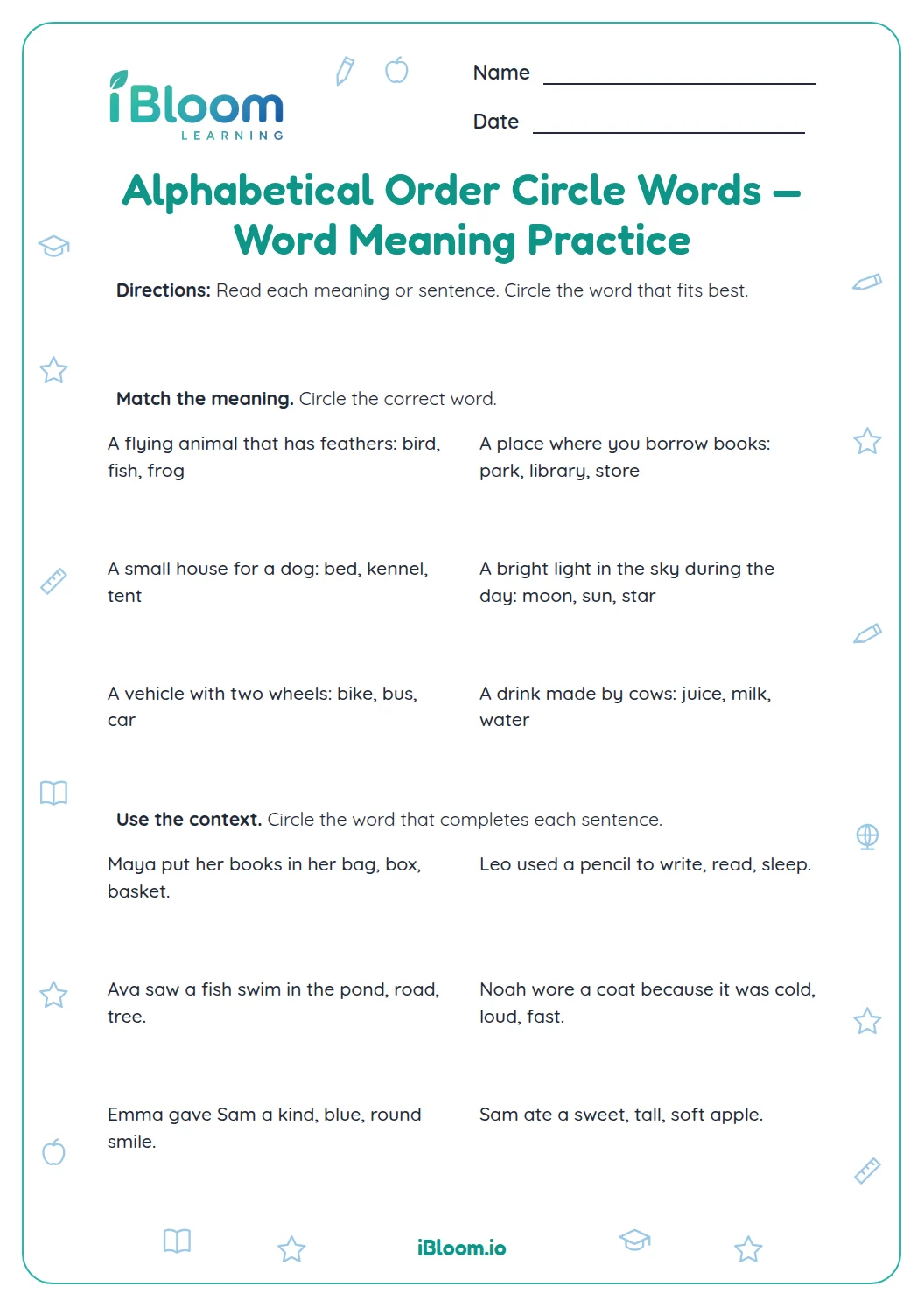
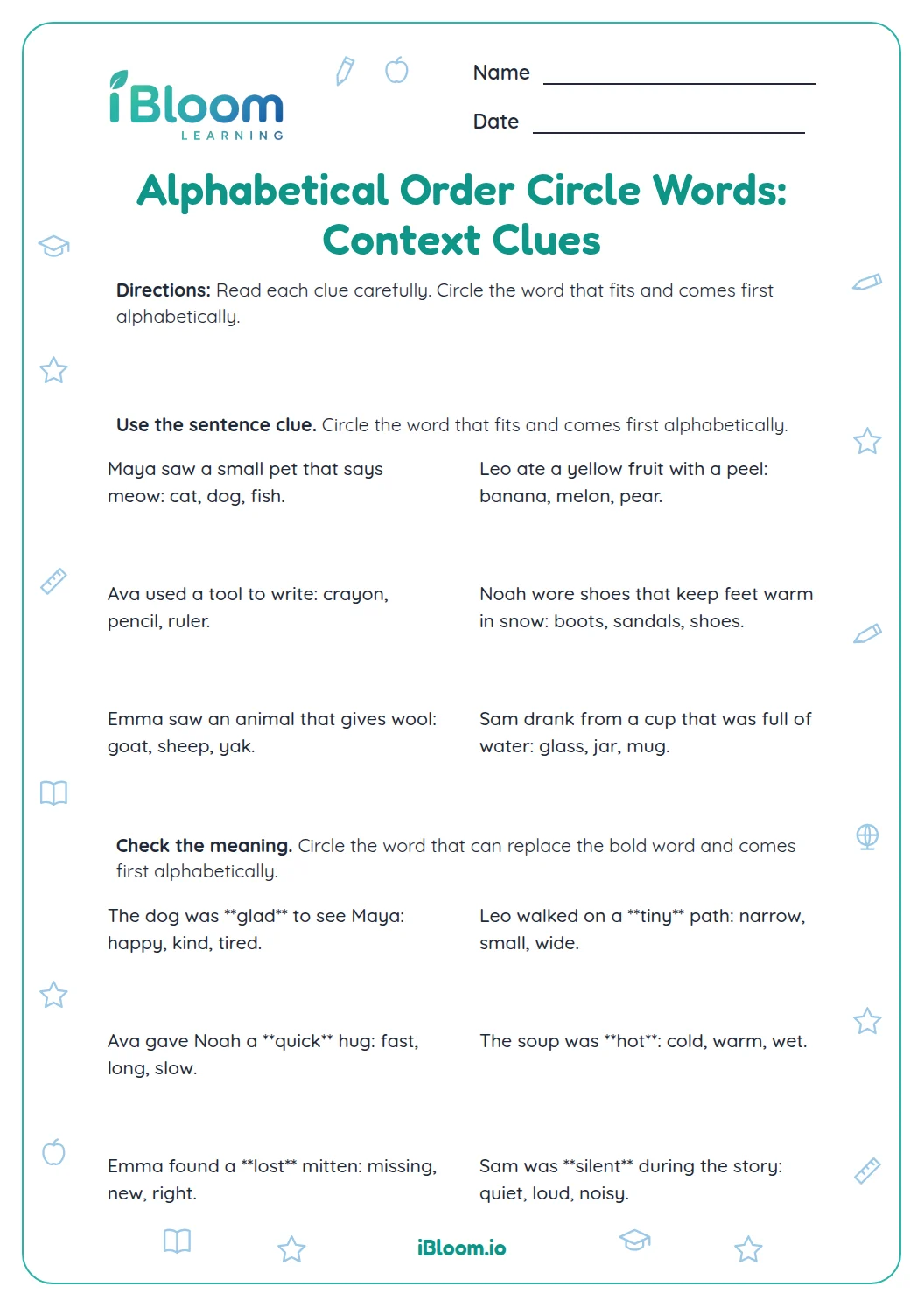
Part A asks children to write small groups of words in ABC order. The word sets use familiar, short words so the focus stays on comparing letters. Some groups begin with different letters; others begin with the same letter and require looking farther into each word. Part B asks which word comes first or last, and Part C asks children to write one sentence for each target word.
The sheet has 15 questions: 10 word-order tasks, 2 ABC-order choices, and 3 sentence prompts. The answer key lists the word order and gives one possible sentence for each open response.
How to use this worksheet
- 1Say the alphabet together, pointing to each letter as you say it.
- 2Model one set by finding the word whose first letter comes earliest.
- 3For a tie at the first letter, compare the next letter in each word.
- 4Let the child write each word in order; reread the sequence from left to right.
- 5For the sentence prompts, check that the target word is used in a complete idea.
Common mistakes and quick fixes
The mistake
Looking only at the first letter when two words start alike.
The fix
Point to the next letter in both words and compare those letters.
The mistake
Writing the words in the order they were listed.
The fix
Say each first letter aloud and move the earliest letter to the beginning.
The mistake
Using a target word in a sentence fragment.
The fix
Ask who or what the sentence is about and what it does.
What to practice next
Make more practice
Questions parents and teachers ask
How should children start putting words in ABC order?
Start by saying the first letter of each word and finding which letter comes earliest in the alphabet. If two words begin with the same letter, compare their next letters. Keep moving from left to right until the letters differ, then put the earlier letter first.
Why do some word groups have the same first letter?
Those groups give children practice looking beyond the first letter. Words that all begin with c need a comparison of their next letters, and sometimes a third letter too. This is a useful next step after sorting words with different first letters.
What does the sentence part practice?
The final questions ask children to use a target word in a complete sentence. A good response includes the given word and expresses a complete idea. The answer key offers one possible sentence, but other clear and sensible sentences that use the word are also correct.
Can an adult help a child who is still learning the alphabet?
Yes. Say the alphabet together, then help the child find the first letter in each word. Invite the child to point to the two letters being compared and decide which comes first. Gradually reduce the help as the child becomes comfortable sorting independently.
How do children order words that start with the same letter?
Compare the next letter in each word. If those letters also match, move one letter farther to the right. Questions 11 and 12 use words with matching first letters, so children must keep comparing until the words differ.