






About this worksheet
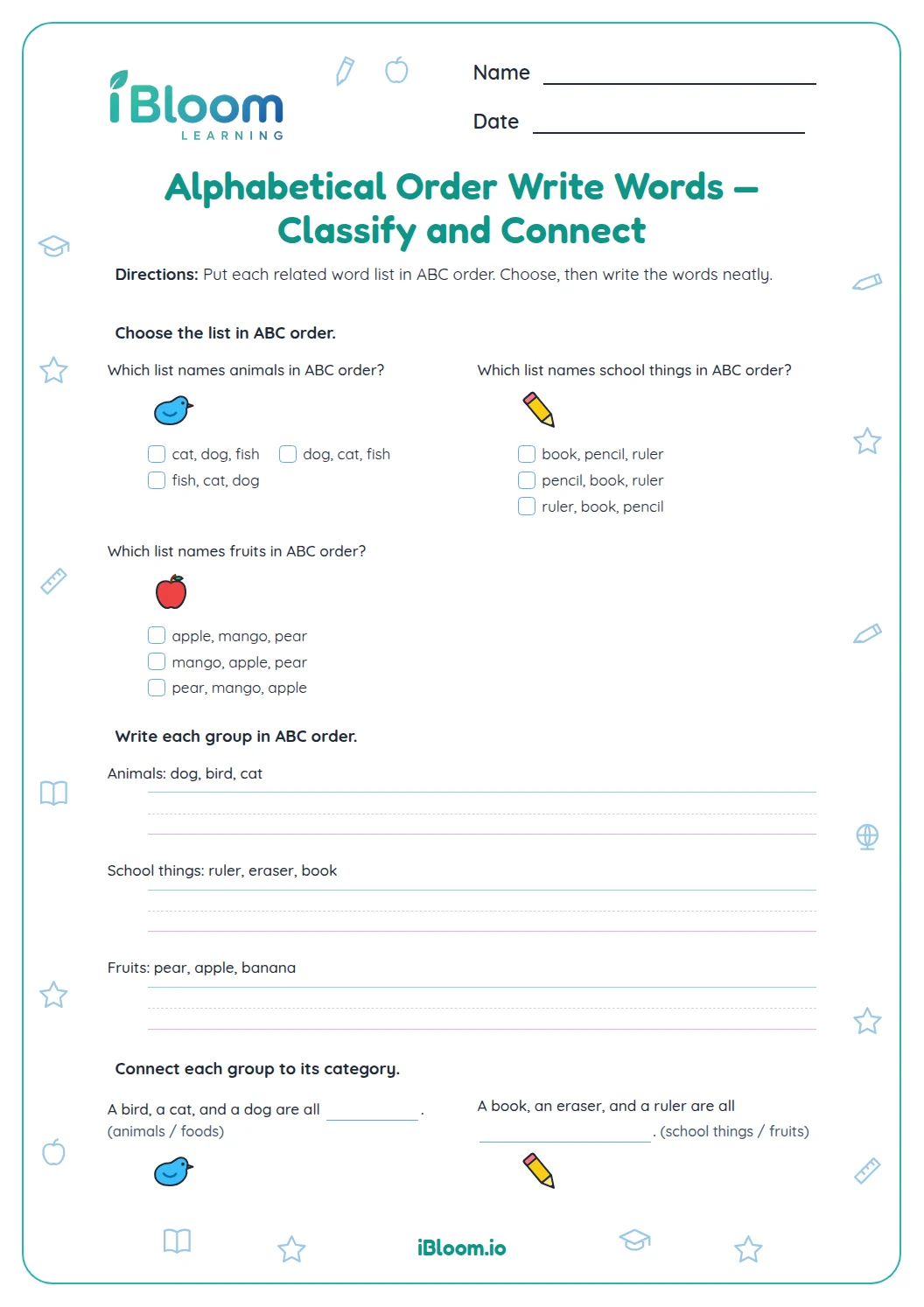
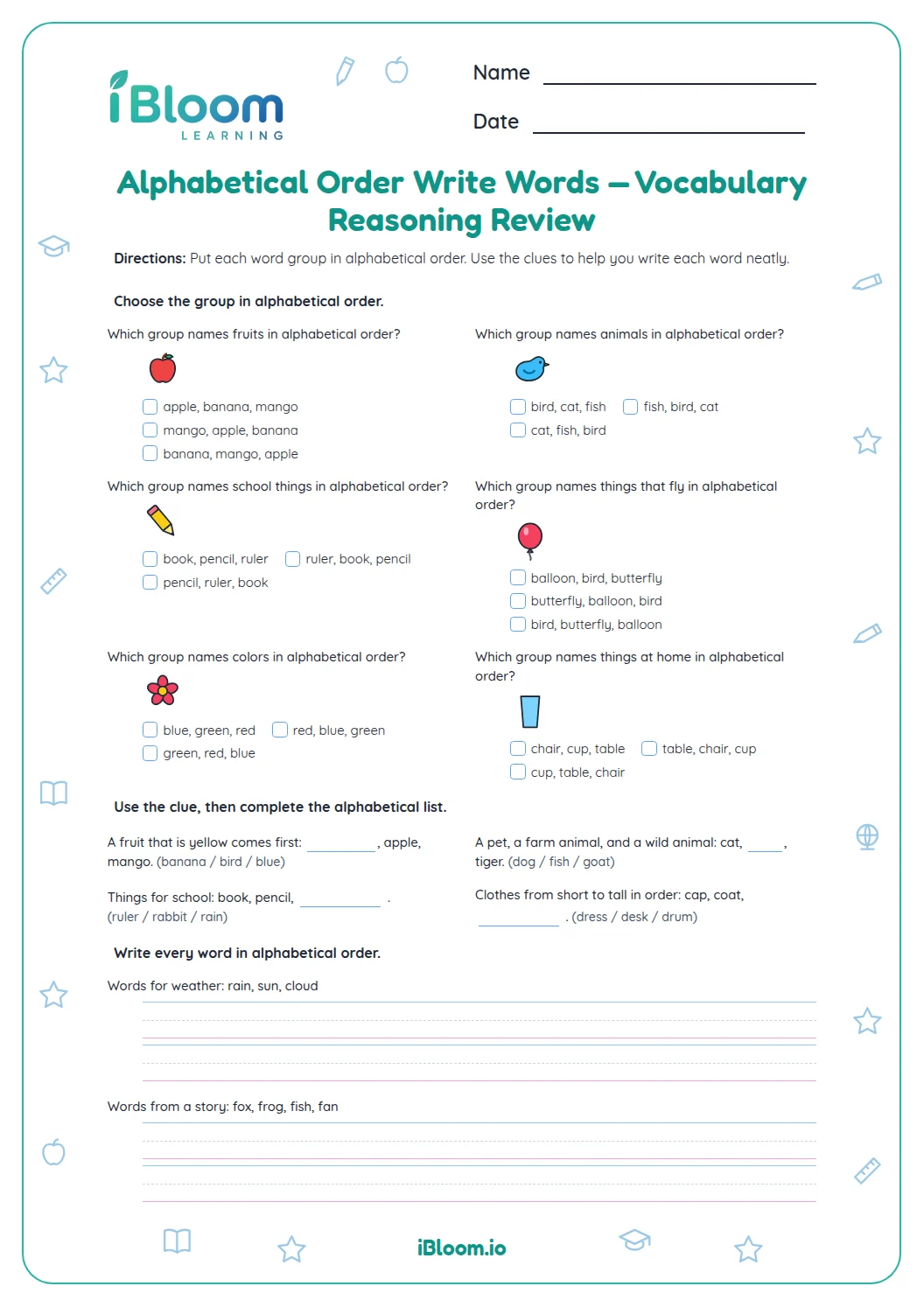
This free Grade 1 worksheet combines writing words in alphabetical order with using words meaningfully. In Part A, children rewrite twelve sets of three familiar words in ABC order, comparing the first letters. Part B uses eight short sentences to help them find and write the meaning of a word in capital letters. That sentence-clue work practices CCSS L.1.4a. Each ordering set has different starting letters, so children can use an alphabet strip without comparing later letters. The answer key shows the complete ordered lists and the eight meanings.
Aligned to L.1.4a
How do children order these word lists?
Read the three words, then say their first letters. Start at a on an alphabet strip and move across until you find one of those letters. Write that word first, then continue across for the remaining two.
All twelve lists use different first letters within each set. Children write the whole words, keeping every letter in its original order.
- 1Words: dog, ant, cat
- 2First letters: d, a, c
- 3Alphabet order: a, c, d
- 4Write: ant, cat, dog
How do sentence clues help with word meaning?
Part B gives a word in capital letters and two possible meanings. Children read the sentence, use its clues, and write the meaning that fits. In question 13, “in the sky” helps show that SOAR means fly.
Ask children to explain one choice aloud. They can point to “need a coat” for CHILLY or “lift the box easily” for LIGHT. The sentence supplies evidence for the meaning.
What help keeps the practice focused?
Place a separate alphabet strip nearby and read unfamiliar words aloud if needed. Let children do the ordering and writing themselves. When checking a list, compare its first letters with the alphabet before checking spelling.
For each meaning question, replace the capitalized word with the chosen meaning and reread the sentence. For example, “I feel cold. I need a coat” makes sense. This connects the new word to a familiar meaning.
How to use this worksheet
- 1Put an alphabet strip where your child can see it.
- 2Read dog, ant, cat and name each first letter.
- 3Write the words in ABC order, then complete the other eleven lists.
- 4Read each Part B sentence and use its clues to choose the meaning of the capitalized word.
- 5Use the key to check the word order and ask for one sentence-clue explanation.
Mistakes to notice and fix
The mistake
Copying dog, ant, cat in the printed order.
The fix
Name d, a, c, then find a first on the alphabet strip.
The mistake
Rearranging letters inside a word.
The fix
Keep each word whole. Only the positions of the words change.
The mistake
Choosing dig as the meaning of SOAR.
The fix
Point to “in the sky.” A bird flies through the air, so soar means fly.
Common Core alignment
Use clues in a sentence to find the meaning of a word.
On this sheet: Part B asks children to infer eight word meanings using clues in short sentences.
Show the official wordingHide the official wording
Use sentence-level context as a clue to the meaning of a word or phrase.
What to practice next
Make more practice
Further reading
Questions parents and teachers ask
Do any words start with the same letter?
No, the three words in each ABC set begin with different letters. Children can solve every list by looking at first letters and following the alphabet. This keeps the task manageable while they practice copying whole words in a new order on the answer line.
May my child use an alphabet strip?
Yes, an alphabet strip is useful for all twelve ordering questions. Have your child name each first letter, then track across the strip to decide which comes first. The goal is to use alphabetical order accurately; the strip can stay nearby throughout the written practice.
How does the sheet practice word meanings?
The final eight questions ask children to find the meaning of a word in capital letters. Each sentence gives clues, such as “in the sky” for SOAR and “need a coat” for CHILLY. Children write the matching meaning, then explain which clue helped them.
Should children copy words or just write letters?
Children write all three words in each ABC list. For dog, ant, cat, the answer is ant, cat, dog. Writing whole words makes the ordering visible and provides copying practice. In Part B, they write the chosen meaning, which may be a word or a short phrase.
Can I read the vocabulary aloud?
Yes, you can read the lists and sentences aloud while your child does the thinking and writing. Keep the printed words visible so first letters remain available for ABC ordering. In Part B, ask which sentence clue helped them work out the capitalized word’s meaning.