







About this worksheet
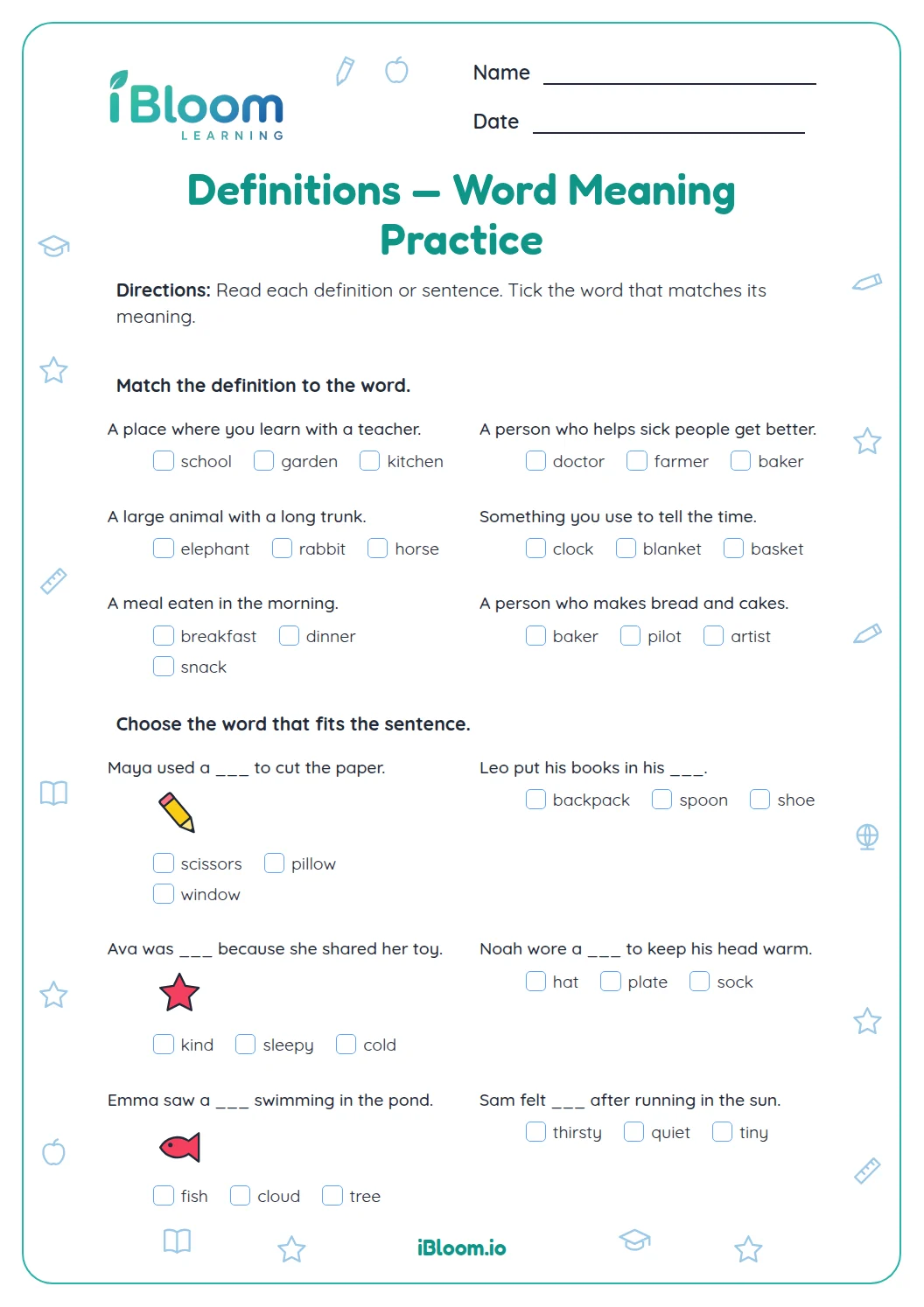
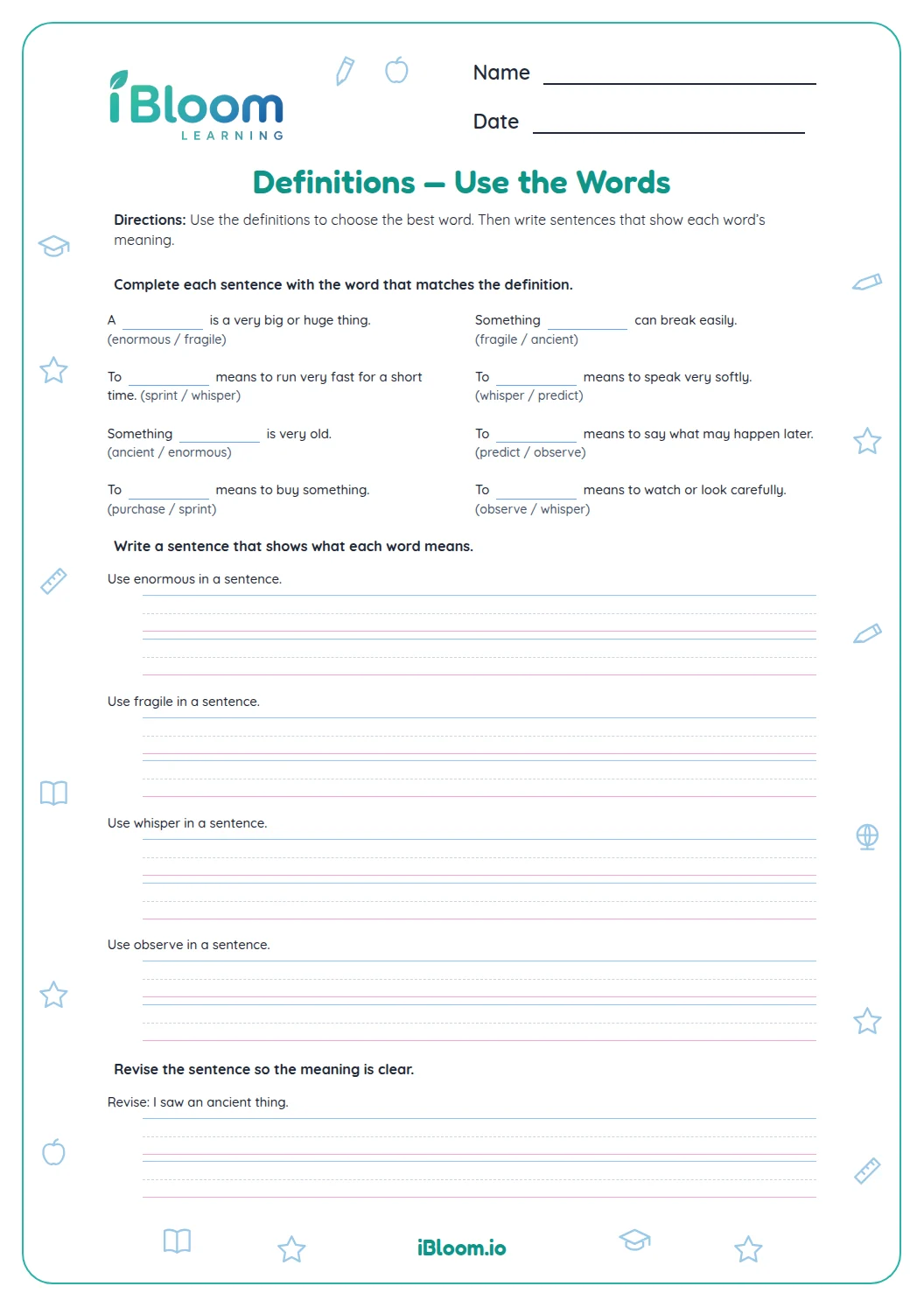
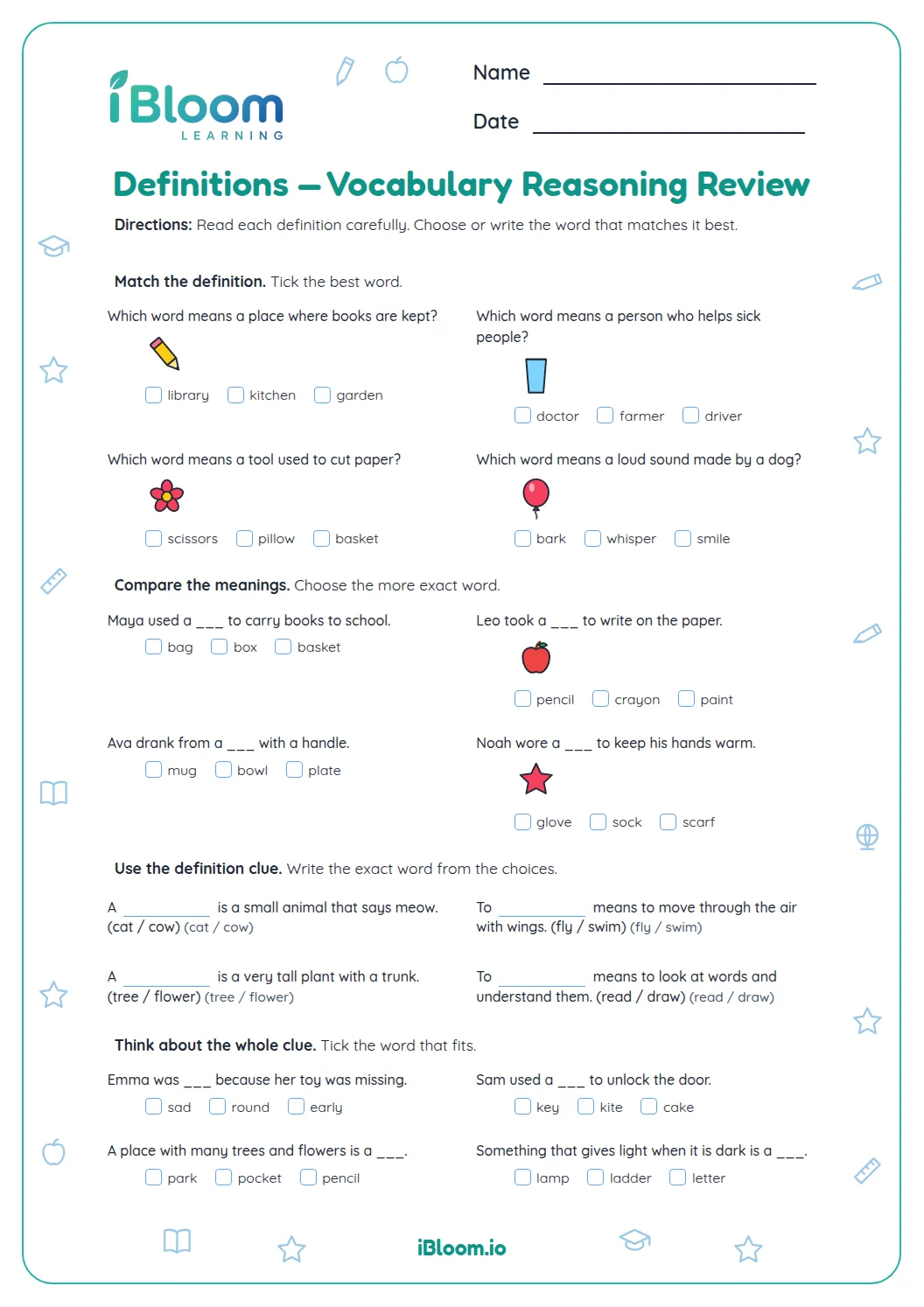
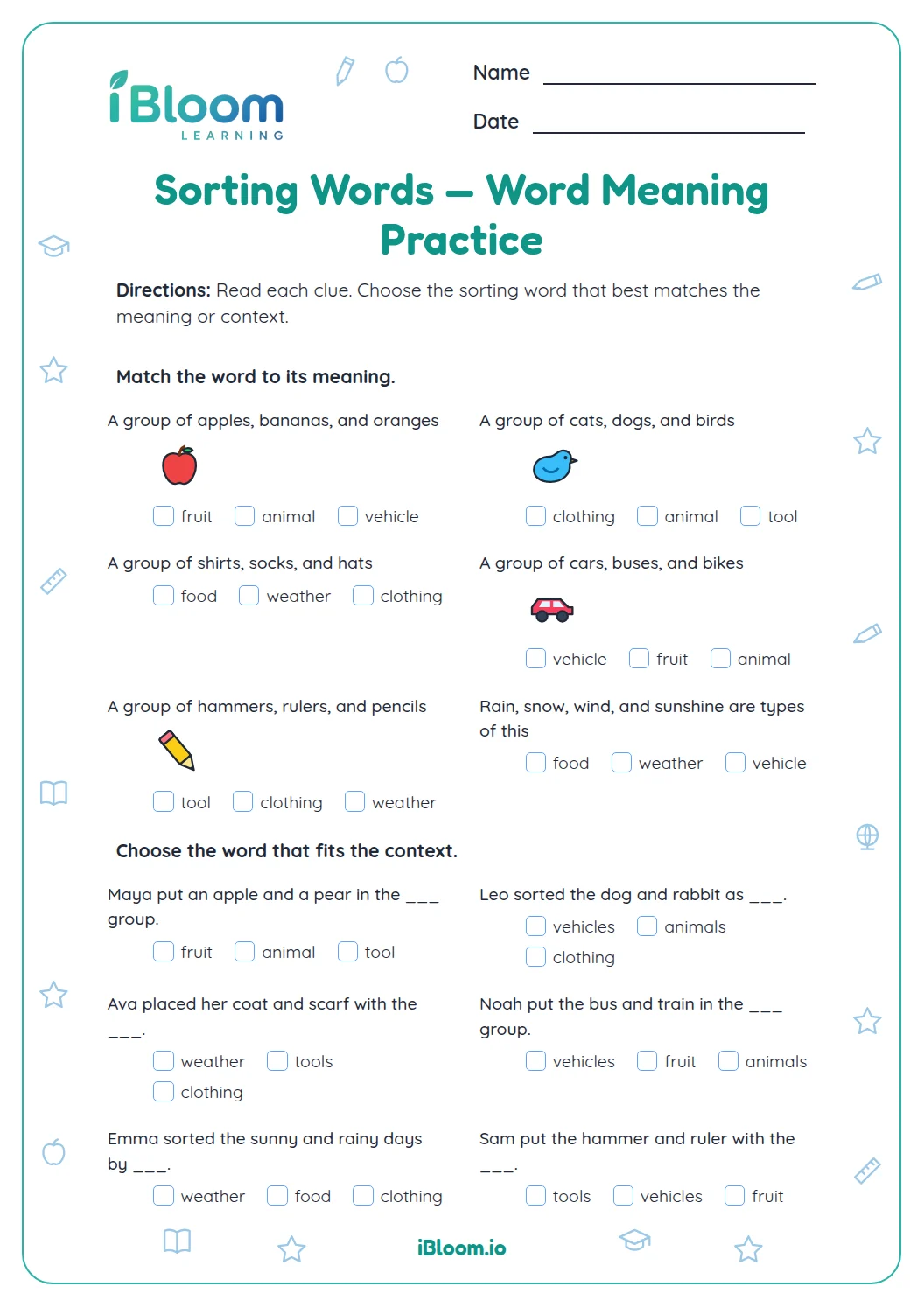
This free Grade 1 vocabulary worksheet helps children connect a word with both its group and a useful defining feature. Part A has six meaning questions, such as finding the tool used to cut paper. Part B asks children to classify four familiar words as animals, clothes, foods, or tools. Part C gives a four-word bank for completing definitions. The 14 questions practice Common Core L.1.5a and L.1.5b with adult guidance as needed. The separate answer key lets families check both the selected words and the category choices.
Aligned to L.1.5a and L.1.5b
What makes a useful first-grade definition?
A useful definition says what kind of thing a word names and gives a feature that helps identify it. “A tool” is a start for scissors; “a tool used to cut paper” gives enough information to choose scissors from the three options.
Ask children to say the group and feature aloud. They can point to a familiar object or mime its use before choosing a written answer.
Two more clues ask children to identify a rabbit by its ears and hopping, and a broom by its use for sweeping.
How do children classify the words?
Part B repeats four categories: animals, clothes, foods, and tools. Each target word has a picture to support its meaning. Socks are clothing, a rabbit is an animal, bread is food, and a hammer is a tool.
Use the target word’s meaning rather than its first letter. A category groups words by a shared idea, not by how they look or sound.
How does the word bank help complete definitions?
Part C supplies bird, fish, spoon, and coat. Each clue gives a category and a distinguishing feature or use. Children can try each word in a blank and read the complete definition to check that it makes sense.
- 1A ___ is a tool with a small bowl used to eat soup.
- 2Word bank: bird, fish, spoon, coat
- 3The group is tools. The use is eating soup.
- 4Answer: spoon
How to use this worksheet
- 1Read the first definition aloud and ask which words tell the group and the feature.
- 2Let the child choose the answers for the remaining Part A questions.
- 3Say each Part B target word and name its category before marking a choice.
- 4Read the four Part C bank words together, then fill each blank.
- 5Check the key and ask the child to explain one answer using both the group and a feature.
Mistakes to notice and fix
The mistake
Choosing an object that shares only one feature.
The fix
Check the whole definition; a ball is round, but the fruit in question 4 is an orange.
The mistake
Treating all things in the kitchen as foods.
The fix
Ask what the item is used for: a spoon is a tool for eating food.
The mistake
Filling a blank without rereading the sentence.
The fix
Read the finished definition aloud and check both its category and its feature.
Common Core alignment
Group familiar words by what they name.
On this sheet: Part B asks children to classify words as animals, clothes, foods, or tools.
Show the official wordingHide the official wording
Sort words into categories (e.g., colors, clothing) to gain a sense of the concepts the categories represent.
Connect a word with its group and a feature that helps define it.
On this sheet: Parts A and C combine categories with features such as feathers, fins, and uses.
Show the official wordingHide the official wording
Define words by category and by one or more key attributes (e.g., a duck is a bird that swims; a tiger is a large cat with stripes).
What to practice next
Make more practice
Further reading
Questions parents and teachers ask
Can I read the questions aloud to my first grader?
Yes, reading aloud is a useful way to keep the focus on word meanings. Read all of the choices in the same tone, then let the child decide. Ask them to explain the category or feature that helped, rather than pointing to the correct choice for them.
What categories appear in Part B?
Part B uses animals, clothes, foods, and tools. Children classify socks, rabbit, bread, and hammer by selecting one category for each word. You can name another familiar example of each group after checking, then invite the child to add an example of their own orally.
Why does a definition need more than a category?
A category names a broad group, while a feature helps identify the particular thing. “A tool” could describe many objects. “A tool used to cut paper” points to scissors among the choices on this sheet. Have the child check both pieces of information before choosing.
How should we use the four-word bank?
Read bird, fish, spoon, and coat before starting Part C. Each word is used once to complete a definition. Encourage children to read the whole sentence after filling its blank; the word should match both the broad category and the specific feature or use named there.
Which vocabulary standards does this practice?
The worksheet practices CCSS L.1.5a by sorting words into familiar categories and L.1.5b by connecting words to categories and key attributes. Offer guidance when needed by discussing the words aloud. The answer key lists the correct choices and bank words for all fourteen questions.