







About this worksheet
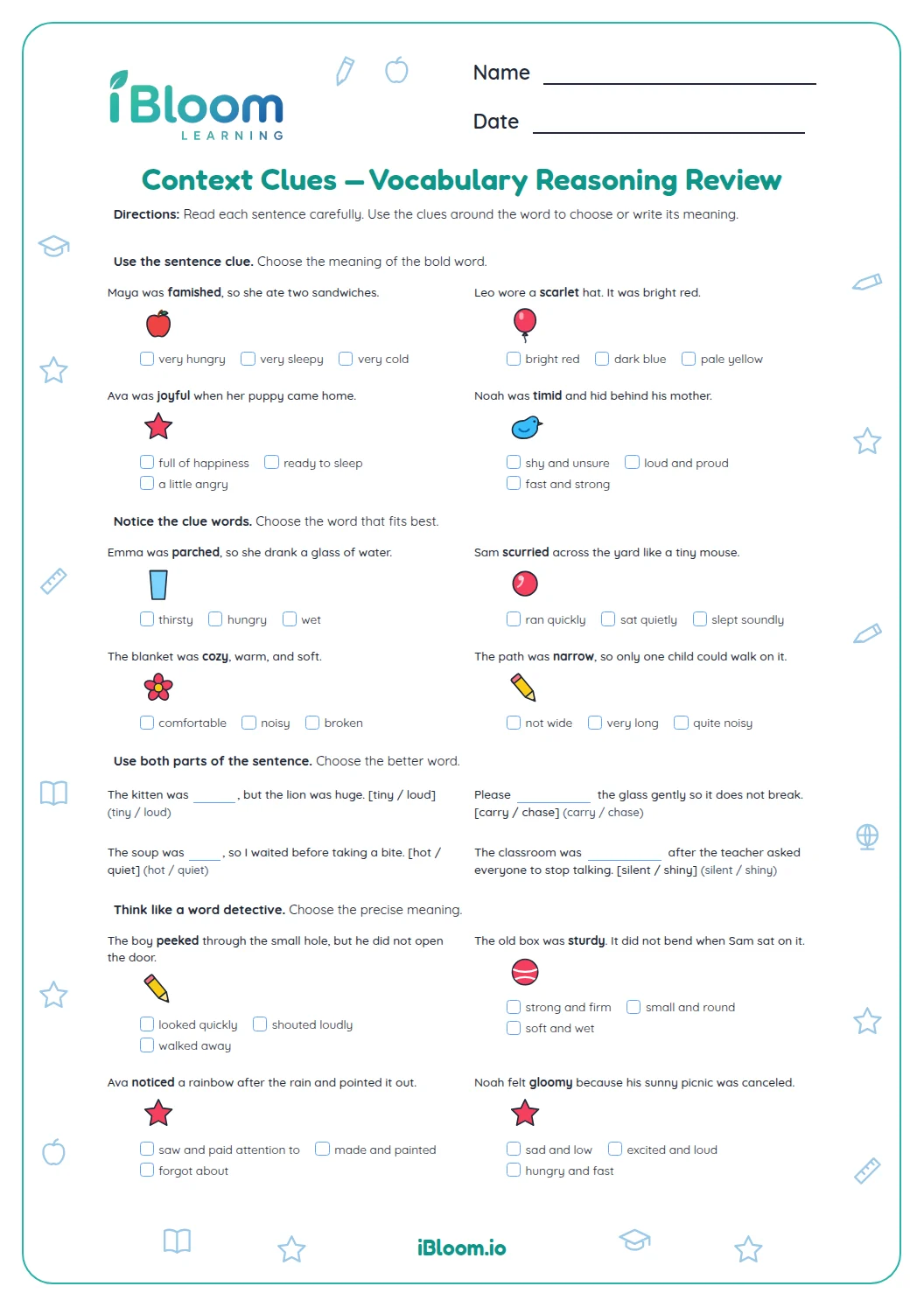
This free printable Grade 1 worksheet teaches children to use the clues in a sentence to figure out what a new word means. In Part A they read a sentence with a clue, such as "The ant is tiny. It is hard to see," and color the meaning of the word. In Part B they pick the word that fits a blank, and in Part C they pick the picture that fits the clue. It practices Common Core L.1.4.a, using sentence-level context to find a word's meaning. A separate answer key marks every answer.
Aligned to L.1.4.a
What are context clues?
Context clues are hints in the words around a new word. A child who does not know chilly can still work out its meaning from "The snow felt chilly. Mia put on her coat." Snow and coat both point to cold.
For Grade 1, the clue is usually in the same sentence or in the short sentence right after it. The habit to build is simple: stop at the new word, look at the words around it, and ask what they tell you.
- 1The drum was noisy. We covered our ears.
- 2Clue: we covered our ears
- 3Ask: when do we cover our ears? When it is loud.
- 4Answer: noisy means making a lot of sound
How does this worksheet teach the skill?
Part A gives the clue and asks for the meaning. Four words are used: tiny, chilly, noisy and cheerful. Each has a picture to support what the sentence says. Part B turns the question around. Children read the clue and pick the word that fits the blank, and the same words come back along with brave and empty.
Part C asks children to read a clue and pick the picture. This shows whether they understood the word, not only the answer choices. A child who knows noisy can tell the drum from the book.
What is on this worksheet?
Eleven questions in three parts. Every sentence is short, and every word being learned is one that Grade 1 children can picture.
- Part A, What does it mean?: 4 questions with a picture and a clue sentence
- Part B, Which word fits?: 4 fill-in choices, including empty and brave
- Part C, Clue to picture: 3 questions where the choices are pictures
- Words used: tiny, chilly, noisy, cheerful, empty, brave
How to use this worksheet at home or in class
- 1Warm up by whispering and then shouting a word. Ask: "Which one was loud? How do you know?"
- 2Read the first sentence in Part A aloud, then point to the clue words together, "hard to see."
- 3Let your child choose a meaning, then read the sentence again with that meaning in place of the word.
- 4In Part B, ask your child to read the whole sentence before looking at the three choices.
- 5For Part C, ask your child to explain why the other picture does not fit the clue.
- 6Check with the answer key. For any miss, ask, "What clue did you use?"
Common mistakes and quick fixes
The mistake
Choosing from the picture alone, without reading the clue sentence.
The fix
The picture shows the thing, not the meaning. A drum can be quiet or loud; only the clue "We covered our ears" tells you noisy means making a lot of sound.
The mistake
Reading only the sentence with the new word and skipping the sentence that follows it.
The fix
Point out that the clue is often in the next sentence, as in "We covered our ears." Read both sentences before choosing.
The mistake
Choosing a word that could describe the thing but does not match the clue, such as silent for the puppy that wagged its tail and jumped.
The fix
Check the choice against the clue words. Wagging and jumping show a happy puppy, so cheerful is the word that fits.
Common Core alignment
Most US states use the Common Core Language standards or a close state version. This sheet practices the standard below.
Use the rest of the sentence as a clue to what a word means.
On this sheet: Every question gives a clue sentence and asks children to work out what the word means from it.
Show the official wordingHide the official wording
Use sentence-level context as a clue to the meaning of a word or phrase.
What to practice next
Make more practice
Further reading
Questions parents and teachers ask
What are context clues for first graders?
Context clues are hints in the words around a new word that help you figure out what it means. In "The ant is tiny. It is hard to see," the words hard to see are the clue that tiny means very small. Children learn to look for those hints before they guess.
Why are there pictures on the worksheet?
First graders are still building their reading skills, and a picture of an ant, a drum or a balloon helps them picture the sentence. The picture supports the clue but does not give the answer. Children still have to use the words to choose between very small, very loud or very cold.
What are the answers to Part B?
The answers are empty, cheerful, brave and tiny. Each sentence has a clue: no juice points to empty, wagged its tail and jumped to cheerful, scared but still jumped in to brave, and fit in my hand to tiny. The answer key shows all eleven answers, including the three picture choices.
My child cannot read all the sentences yet. What can I do?
Read each sentence aloud and let your child choose the answer. The skill is understanding how clues work, not reading speed. Point to the clue words as you read, then ask your child which meaning fits. Try the next worksheet by yourself when they feel ready.
What should I do if my child picks the wrong answer?
Ask what clue they used, then read the sentence again with their chosen meaning. If it does not make sense, look for the clue words together. Children often pick the answer they know best. Putting the meaning back into the sentence shows whether it fits.
Is there an answer key, and how long does the sheet take?
Yes. The answer key has the correct choice colored in for every question and uses the same pictures as the worksheet. Most first graders finish in about 15 minutes, a little longer if an adult reads each sentence aloud and talks about the clue words with them.