


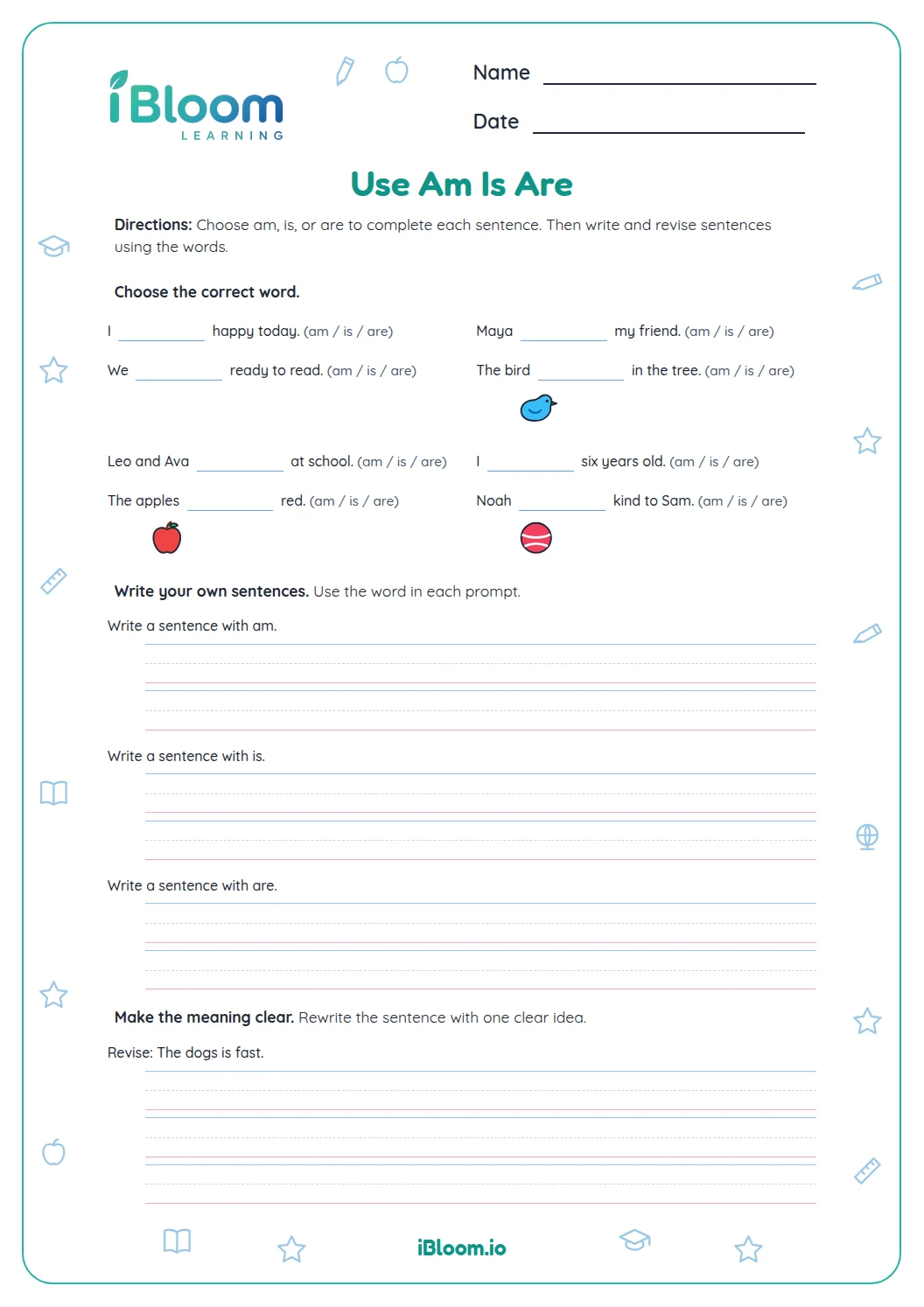
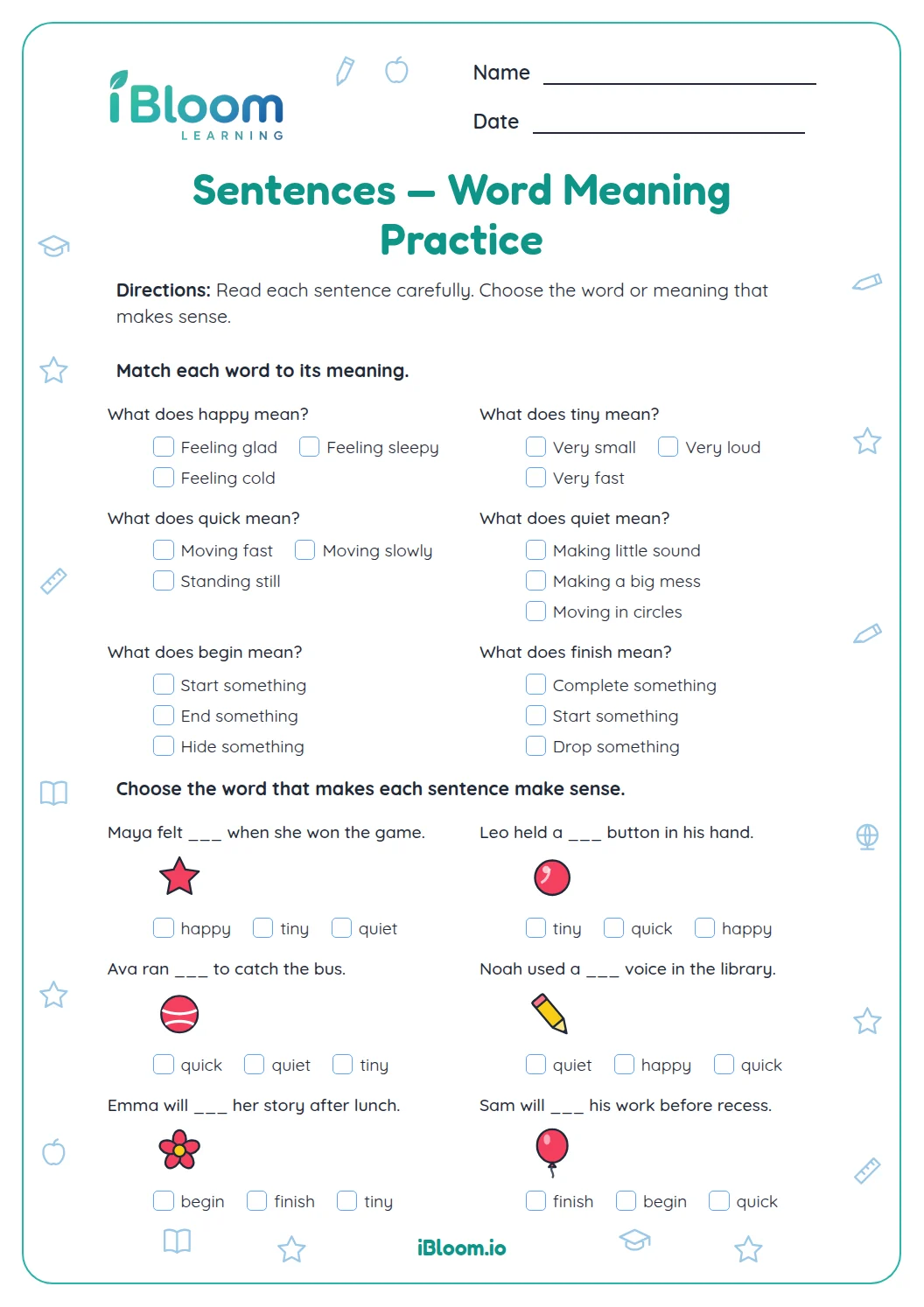

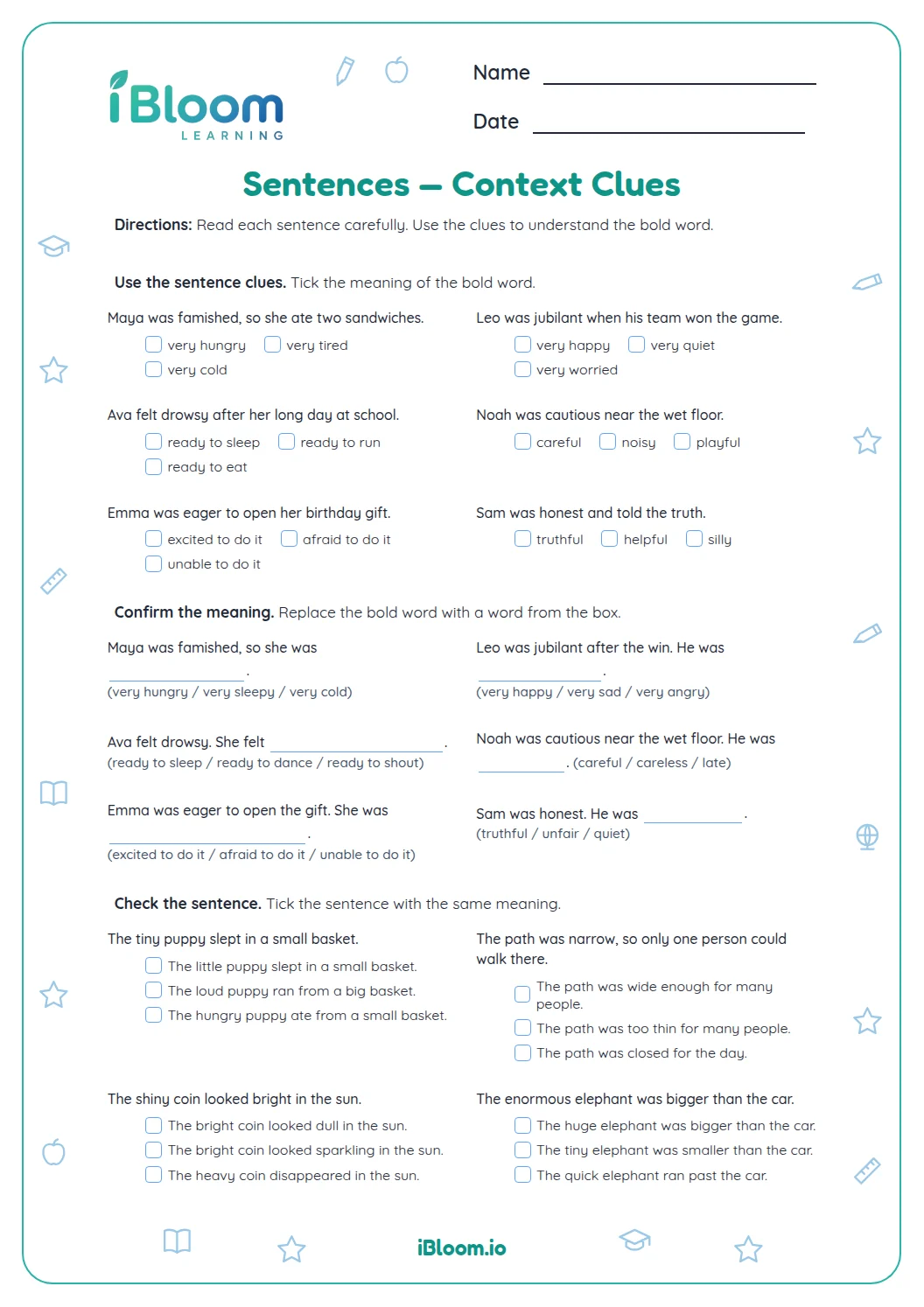
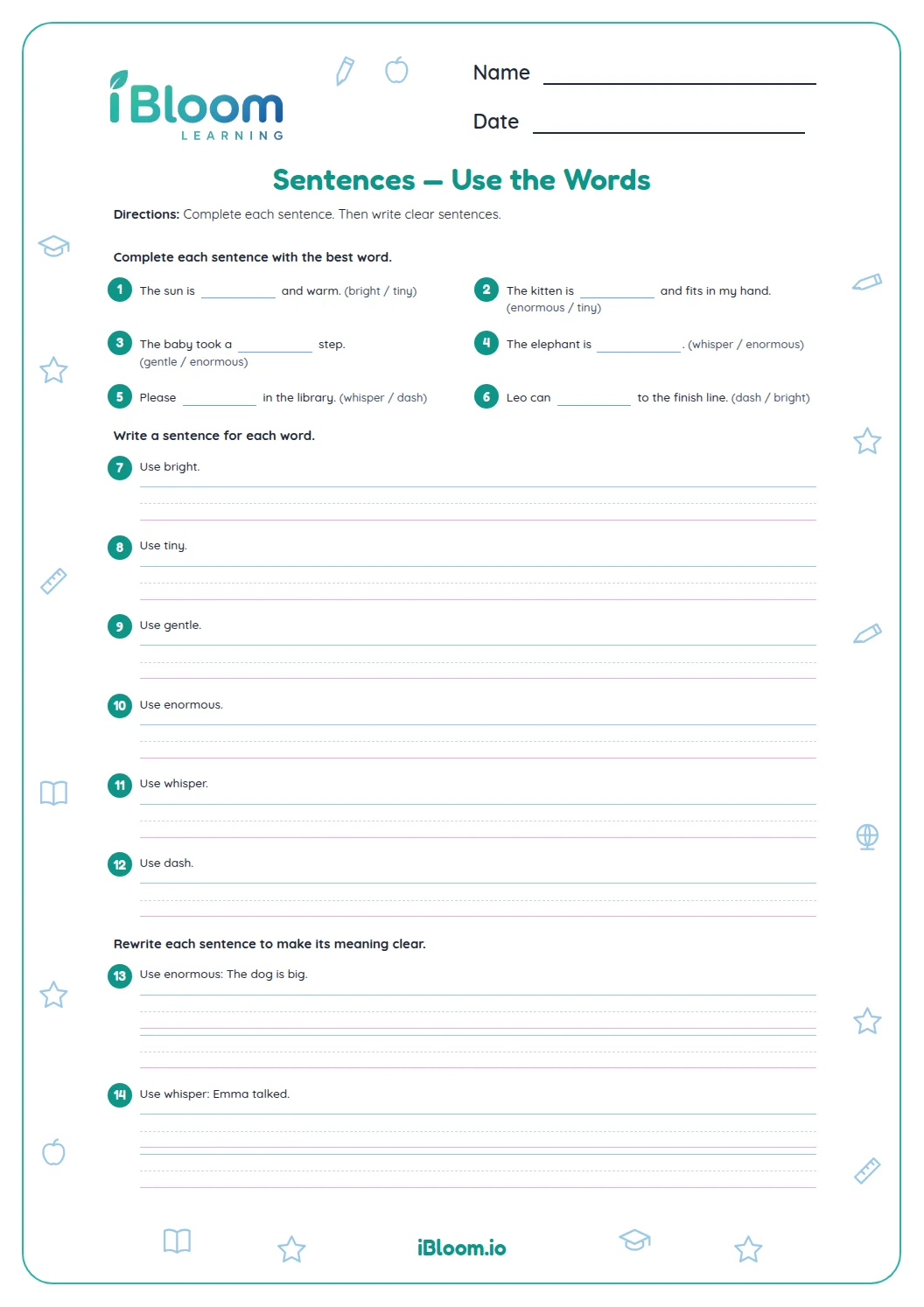


About this worksheet
This review helps first graders match am, is, and are to the person or thing named in a sentence. Part A completes sentences, Part B checks whole-sentence agreement, and Part C asks students to correct and explain examples. The answer key includes sample responses for open-ended items.
Aligned to L.1.1
How to use this worksheet
- 1Find the person or thing the sentence is about.
- 2Say the subject with each choice: “I am,” “he is,” “they are.”
- 3Read the finished sentence aloud to check that it sounds right.
Common mistakes and quick fixes
The mistake
Using is with a plural subject, as in “The cats is.”
The fix
Replace the plural subject with they: “They are,” then use are.
The mistake
Writing “I is” or “I are.”
The fix
Practice the fixed pairing “I am.”
Curriculum alignment
The work supports first-grade standard English grammar and usage during speaking and writing.
Use common, proper, and possessive nouns; pronouns; verbs; adjectives; and other Grade 1 language conventions.
On this sheet: Students use the present forms am, is, and are to make sentences agree with their subjects.
Show the official wordingHide the official wording
Demonstrate command of the conventions of standard English grammar and usage when writing or speaking.
What to practice next
Make more practice
Further reading
Questions parents and teachers ask
When should a student use am?
Use am with the subject I. For example, “I am ready” and “I am in Grade 1” match the subject and verb. Reading the sentence aloud can help children remember this special pairing. The subject and verb should sound right together.
How do I choose between is and are?
Use is with one person or thing, such as “The bird is small.” Use are with you or with more than one person or thing, such as “You are kind” or “The cats are asleep.” Find the subject before choosing.
What should students check in a sentence?
Students should check that the verb matches the person or thing named by the subject. Underline the subject, choose am, is, or are, then read the whole sentence aloud. For “The bird are small,” the singular subject bird takes is: “The bird is small.”
How can an adult support this practice?
Ask the child to say a sentence with I, then one with a single person, and one with a group. Listen for “I am,” “she is,” and “they are.” The worksheet answer key includes the choices and sample open responses.