





About this worksheet
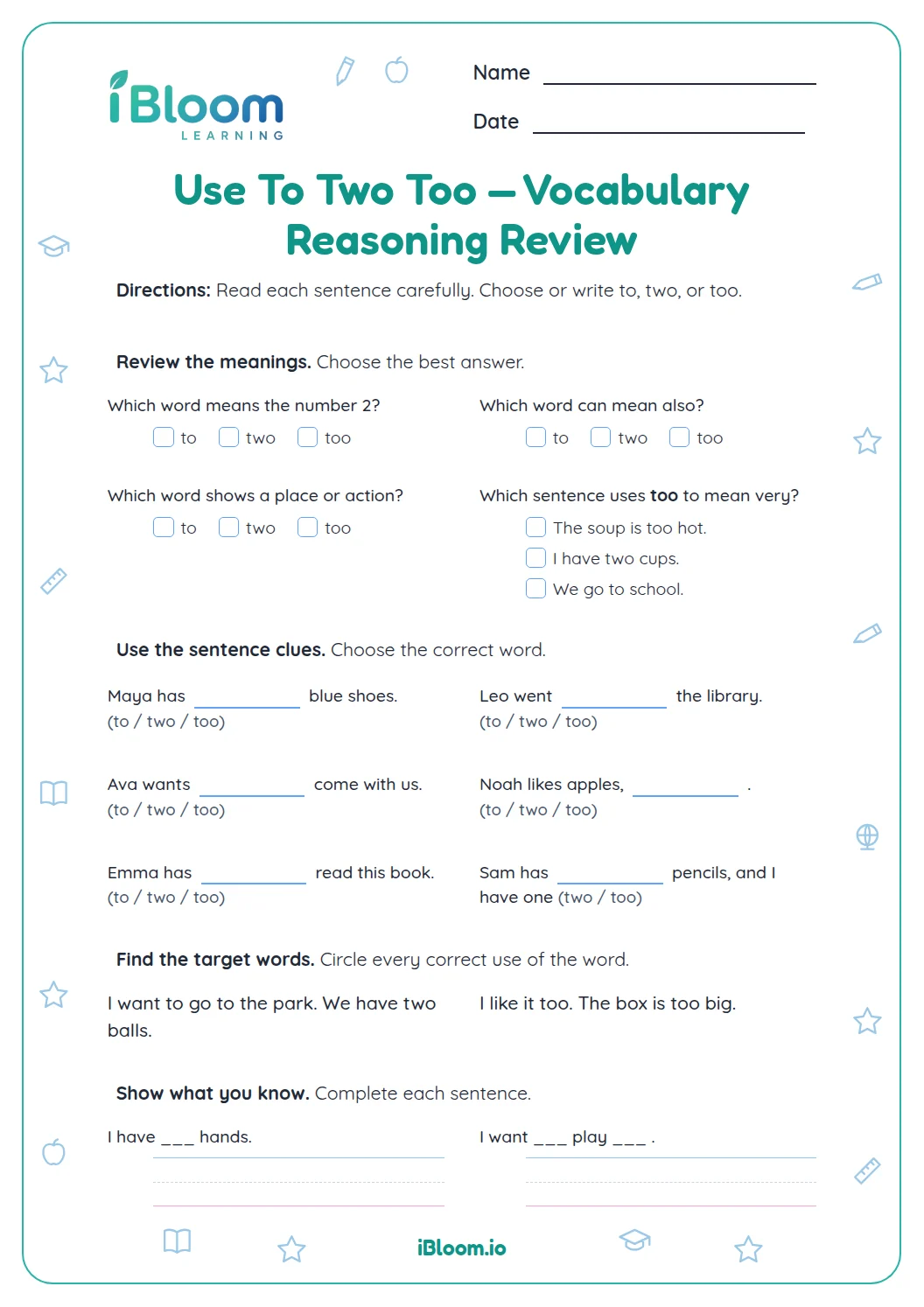
This free printable worksheet helps Grade 1 students tell the words to, two and too apart. In Part A, children match words to their meanings: toward a place, the number 2, also and more than enough. In Part B, they read nine short sentences and choose the word that fits, with a picture of two pencils and two birds to help. In Part C, they draw two kites. The practice supports Common Core L.1.4.a: using the sentence around a word as a clue to its meaning. An answer key lists every word.
Aligned to L.1.4.a
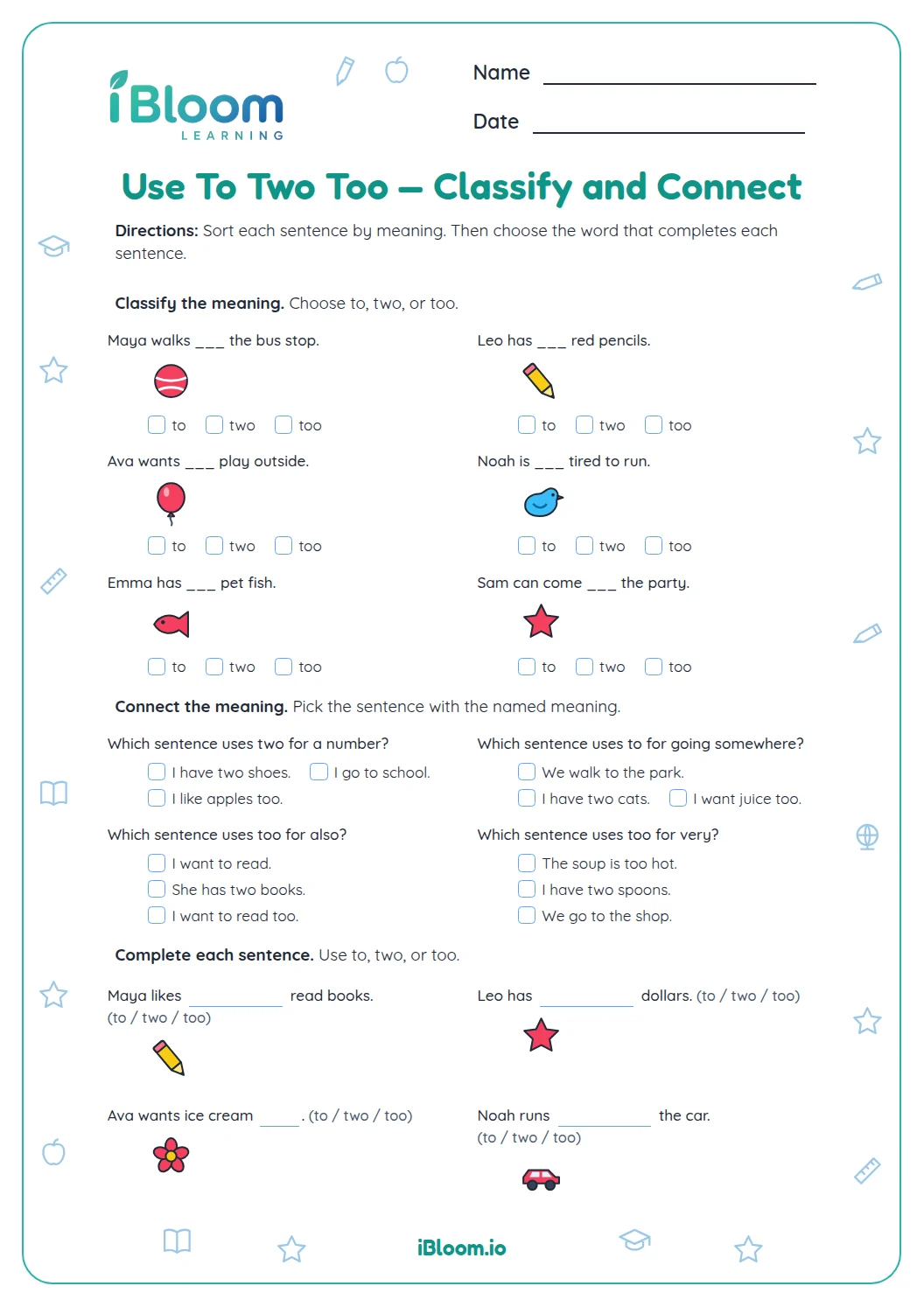
What is on this to, two, too worksheet?
Every question uses the same three choices, to, two and too. That means children cannot find the answer by scanning the choices. They have to read the sentence and think about what it says.
Part A names each meaning in words. Part B puts the words into sentences about school, pencils, birds and soup. Two of the sentences have pictures that show two things, which helps children link the word two to the number. Part C asks children to draw two kites.
- Part A: match the word to its meaning (questions 1 to 4)
- Part B: choose the word that fits the sentence (questions 5 to 13)
- Part C: draw two kites (question 14)
- Every answer is one of to, two or too
How can you tell to, two and too apart?
Each word does a different job. To points toward a place, as in to school, or comes before an action word, as in to play. Two is a number word. Too means also, as in “Emma likes apples, too,” and it can also mean more than enough, as in too hot.
A trick for too: it has an extra o, and it is the word you use when there is an extra, more, or more than enough. Two has a w, like twin and twice, and both are about the number 2.
- 17) Ava wants ___ play outside. → play is an action word → to
- 29) Emma likes apples, ___. → you can say also → too
- 36) Leo has ___ blue pencils. → the picture shows 2 pencils → two
What clues in a sentence show which word to use?
The words around the blank give the clues. If a place or an action word comes next, the answer is to. If a number of things is being counted, the answer is two. If the sentence ends with the blank, as in question 13, or the sentence says something is more than enough, the answer is too.
Reading the sentence aloud with each choice also helps. “I want a turn, to” sounds unfinished, while “I want a turn, too” sounds right.
- 110) The soup is ___ hot to eat. → more than enough hot → too
- 213) I want a turn, ___. → the blank is at the end and means also → too
Why draw two kites?
Drawing turns the number word into something children can see. A child who draws two kites and then counts them has connected the word two to the quantity.
After drawing, ask your child to say a sentence that uses all three words, such as “I drew two kites, too.” The answer key shows what a good drawing includes.
How to use this worksheet at home or in class
- 1Read the three words aloud together and ask what is the same about them. They sound the same.
- 2Do Part A together and say each meaning with the word, such as “two is the number 2.”
- 3Read question 5 aloud with each choice and ask which one sounds right.
- 4Let your child finish Part B alone, filling in one bubble for each sentence.
- 5For the pencils and birds, have your child count the pictures first, then choose the word.
- 6Have your child draw the kites, then count them aloud, and check Parts A and B with the answer key.
Common mistakes and quick fixes
The mistake
Choosing too in “Ava wants ___ play outside” because it sounds right.
The fix
Remind your child that all three words sound the same, so sound cannot help. Ask what comes next. Play is an action word, and to goes before action words.
The mistake
Choosing to in “I want a turn, ___.” because to is the spelling children see most often.
The fix
Try the word also in the blank. “I want a turn, also” makes sense, so the word is too. To always needs a place or an action word after it, and here nothing comes after the blank.
The mistake
Choosing to in “The soup is ___ hot to eat” because to comes before hot.
The fix
Ask whether the soup is hot, or more than enough hot. Too means more than enough, and the extra o is a reminder that there is extra heat.
Common Core alignment
Most US states teach vocabulary with the Common Core standards or a close state version. This Grade 1 standard names the skill the whole page practices.
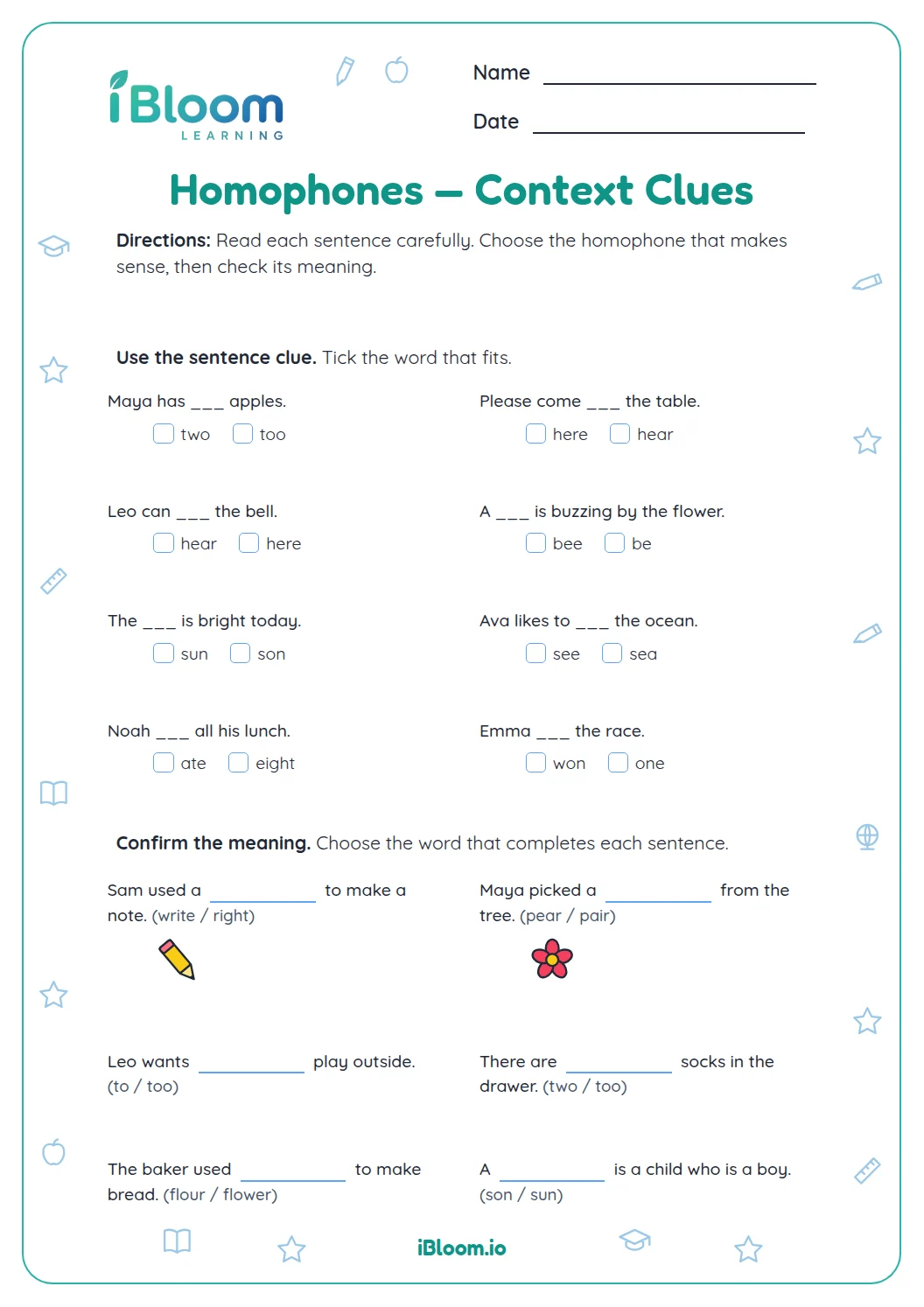
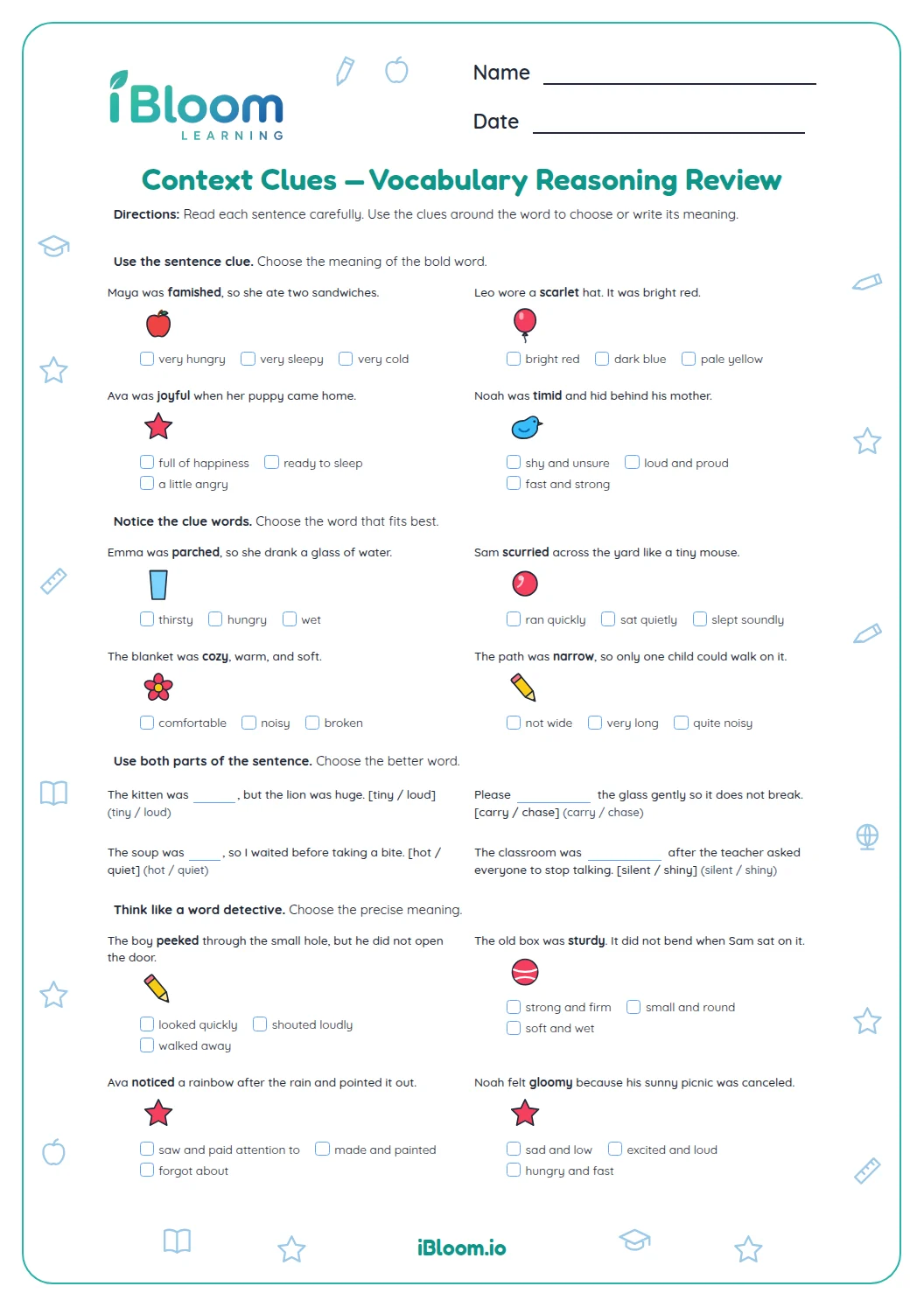
Use the rest of the sentence to work out which word fits.
On this sheet: Children read each sentence and use its clues to choose to, two or too.
Show the official wordingHide the official wording
Use sentence-level context as a clue to the meaning of a word or phrase.
What to practice next
Make more practice
Further reading
Questions parents and teachers ask
Why are to, two and too so confusing for Grade 1?
They sound exactly the same, so children cannot use their ears to tell them apart. Each one is spelled differently and does a different job. That is why every question on this worksheet uses the same three choices: children have to read the sentence and think about what it means.
What does too mean?
Too has two meanings. It can mean also, as in “Emma likes apples, too,” or more than enough, as in “The soup is too hot to eat.” Part A asks for both meanings, and questions 9, 10 and 13 use too in a sentence. Reading each aloud helps.
How do I explain when to use to?
Use to before a place, such as to school, or before an action word, such as to play. Question 5 is the first kind, and question 7 is the second. A quick check is to look at the next word: if it names where someone goes or something they do, to is the word.
Does my child need to spell the words?
No. All three words are printed beside each question, and children fill in the bubble for the one that fits, so nothing is written from memory. The drawing in Part C links the word two to the number. Children who want more can write a sentence with each word on the back.
Why are some sentences paired with pictures?
Questions 6 and 12 show two pencils and two birds. A child can count the pictures, see that there are two, and then choose the word two. The pictures give a beginning reader an extra clue, and they tie the number word to a real amount.
What should my child do after this worksheet?
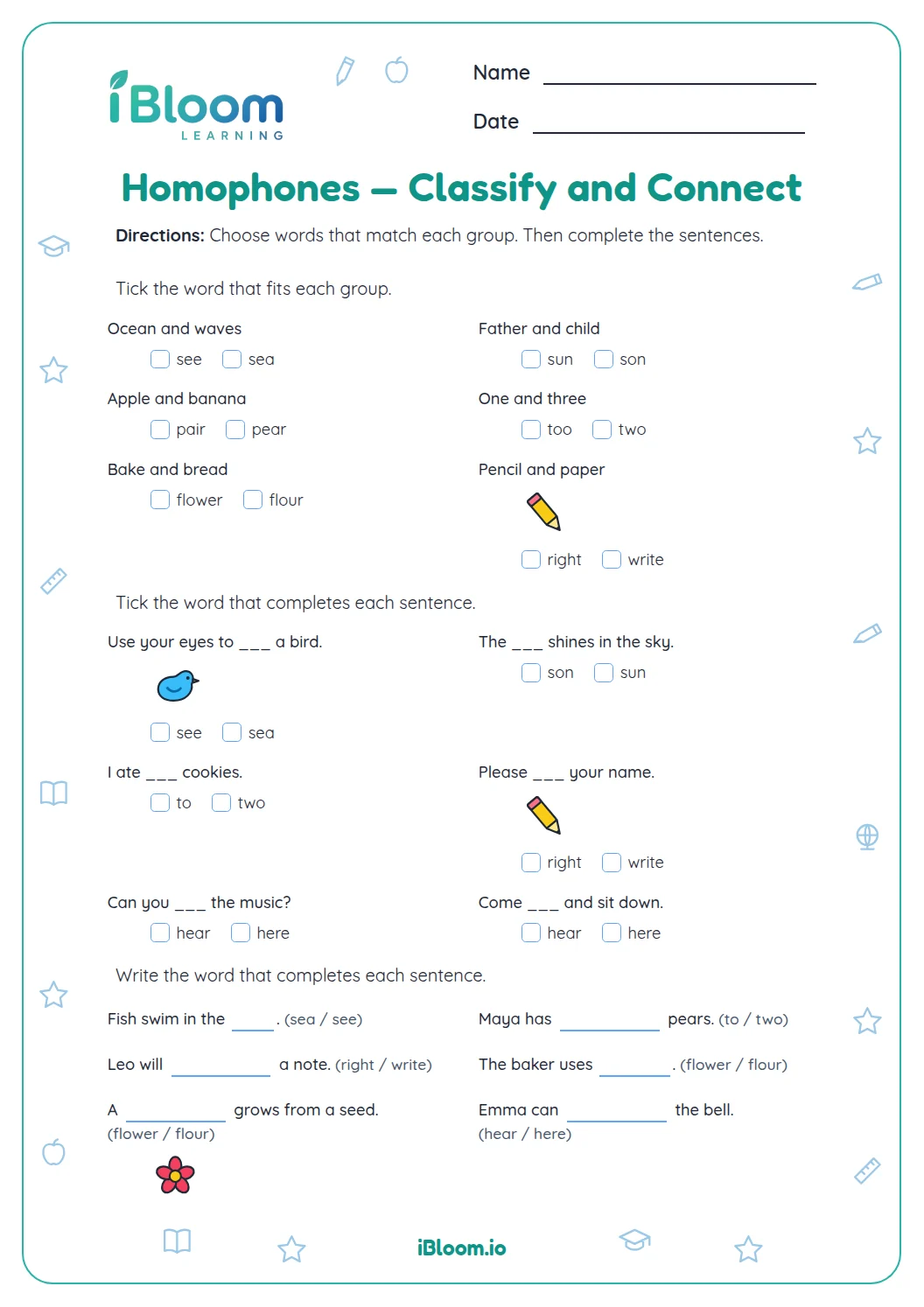
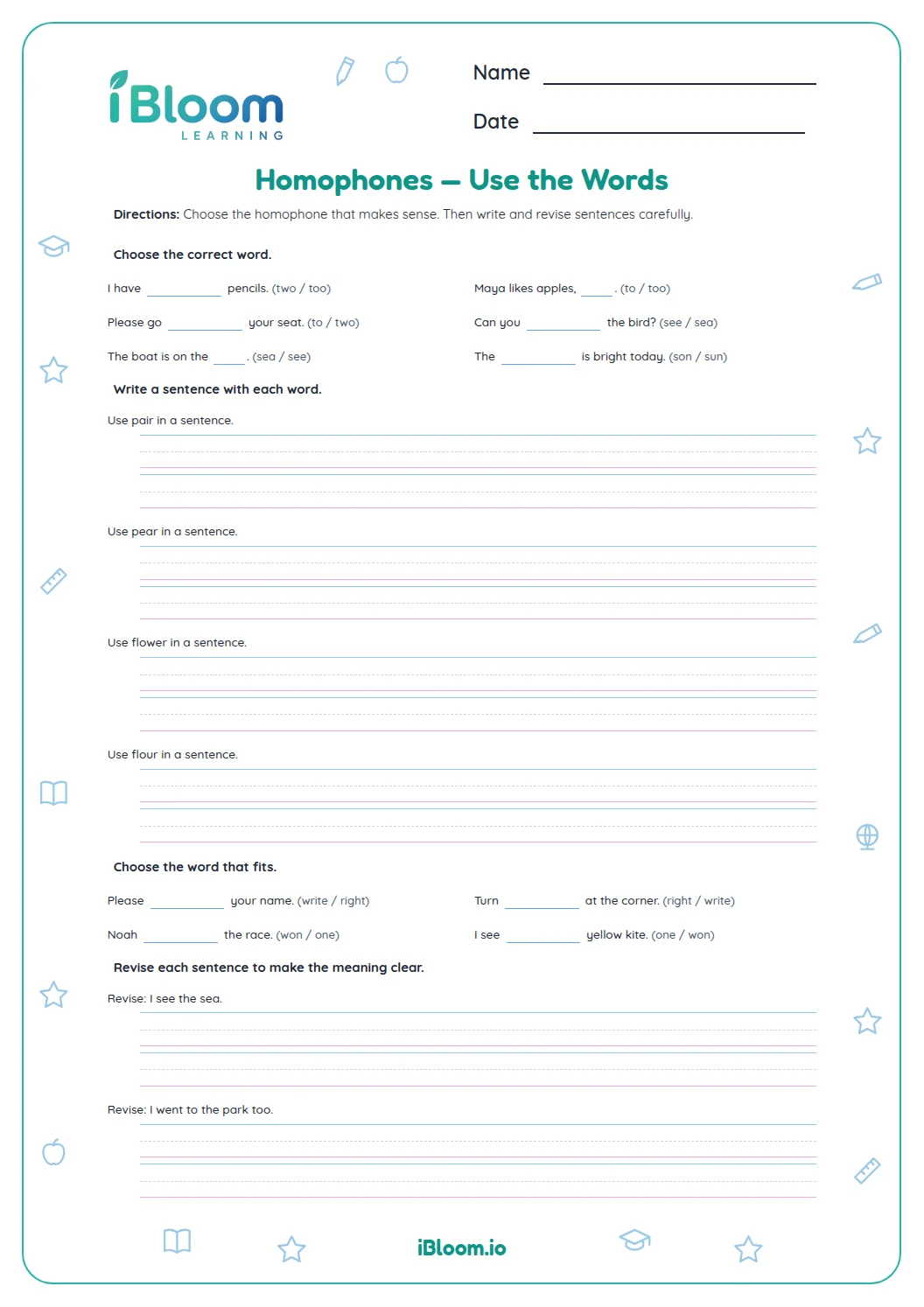
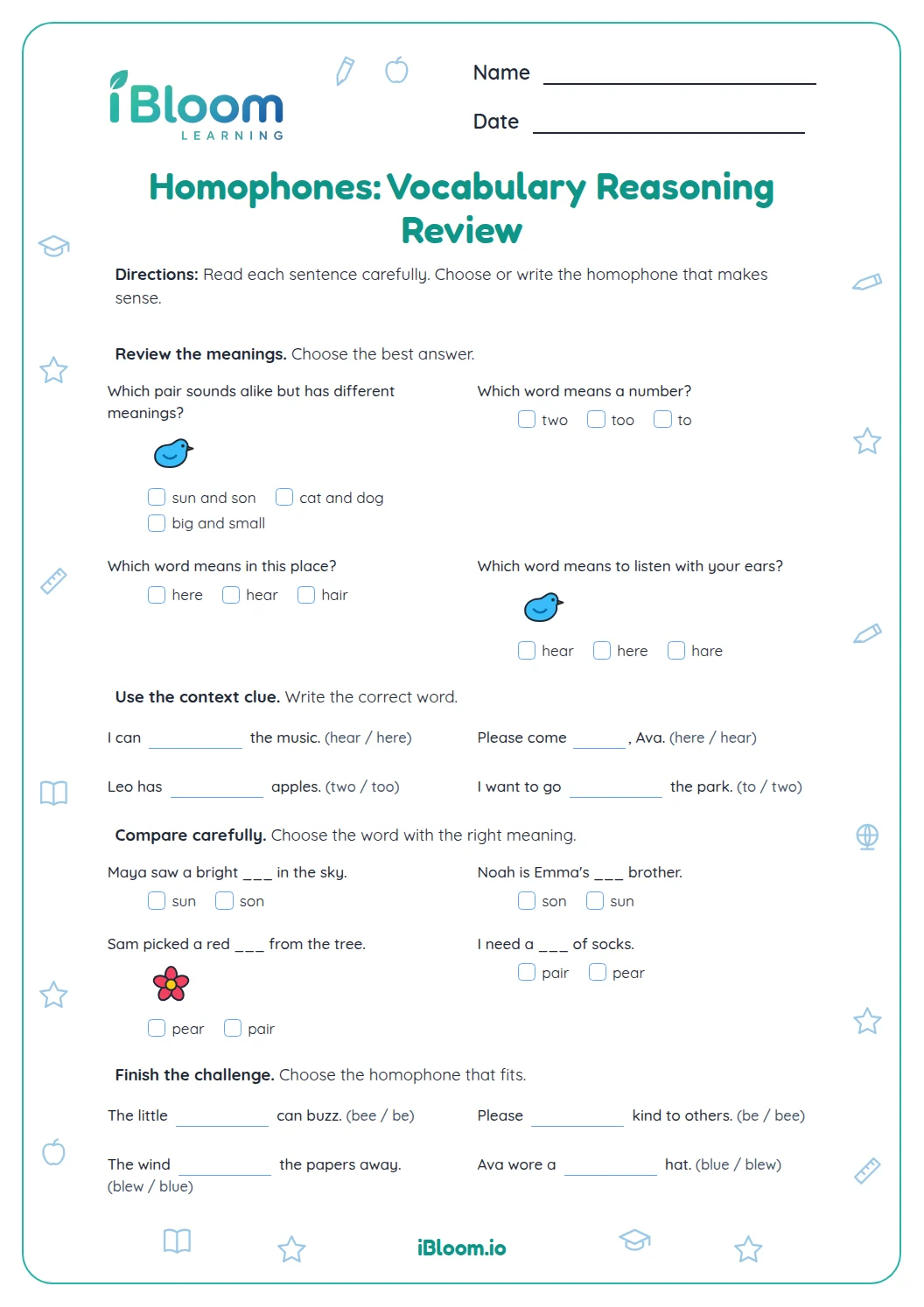
Ask your child to say or write three sentences, one each with to, two and too, and check each other’s sentences. The Homophones worksheet adds more pairs that sound alike, and the Context Clues worksheet helps children use the rest of a sentence to figure out a word.