



About this worksheet
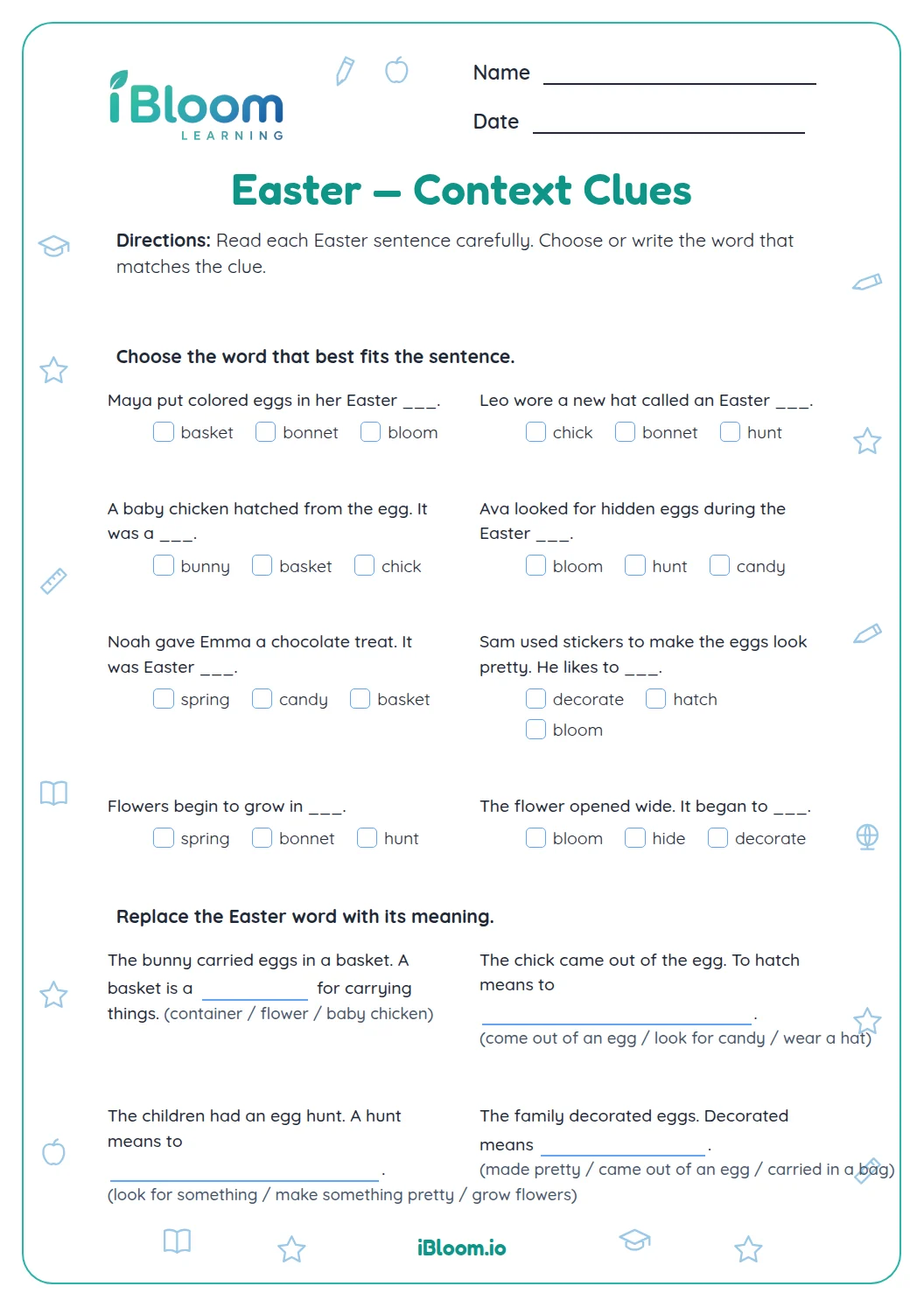
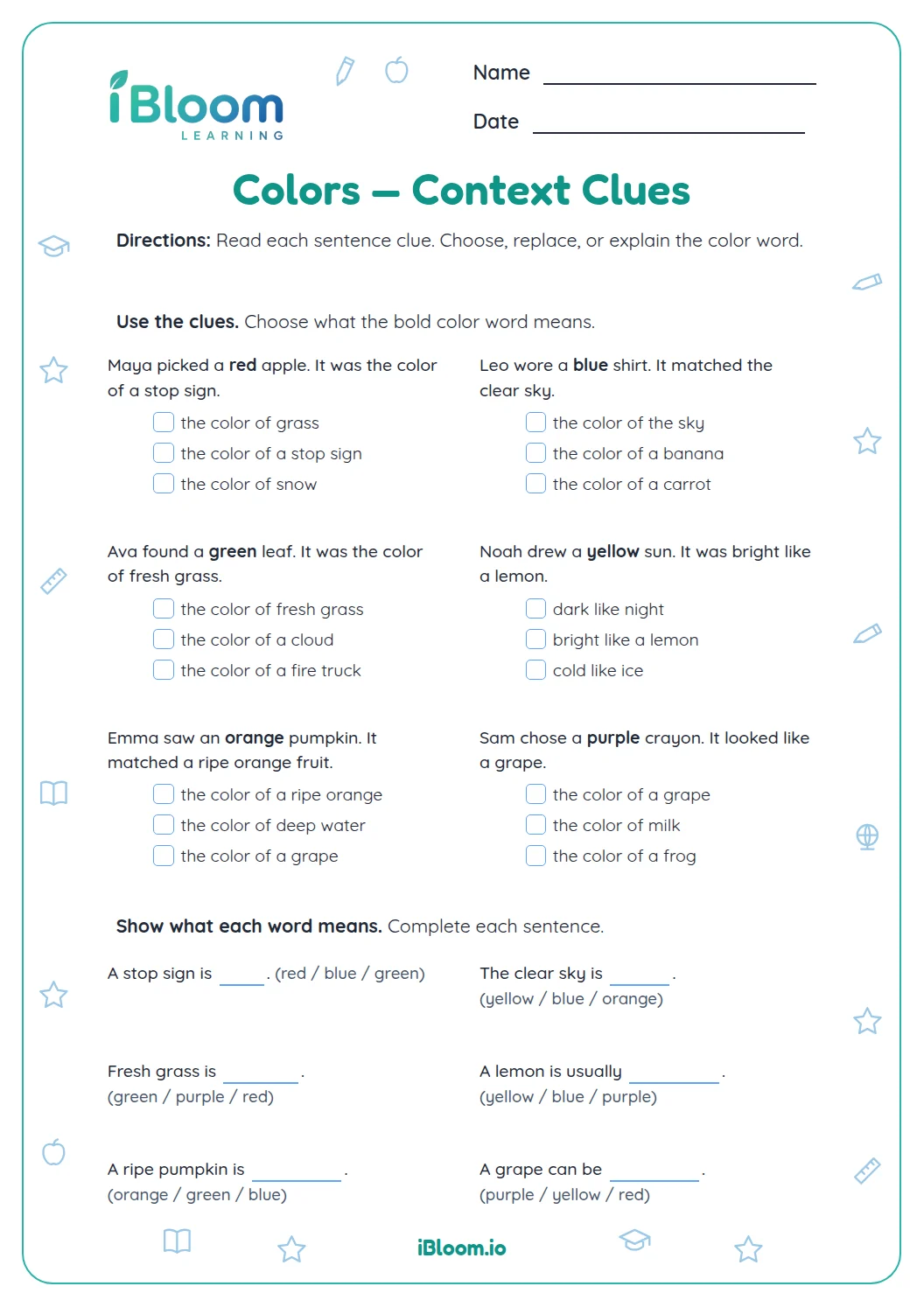
This free printable Grade 1 worksheet helps children connect Easter and spring words with their meanings. Across 14 multiple-choice questions, children read short clues, use details in a sentence, and choose words such as chick, nest, tulip, and basket. The practice aligns with Common Core L.1.5b: defining familiar words by category and key attributes. The worksheet is two pages, with a separate two-page answer key.
Aligned to L.1.5b
How do children connect Easter words with meaning?
Children read a short clue, then compare its details with the answer choices. The clue “A bird lays its eggs in a ___” points to nest because a nest is where a bird lays eggs. A child can say the clue aloud and try each choice in the sentence.
How does context help choose a word?
Part B uses short situations such as putting colored eggs in a container or spotting a small animal in a garden. Children use the surrounding words to choose a fitting Easter word. The answer key gives one answer for each of the 14 questions.
What does this worksheet include?
The two parts contain seven meaning clues and seven context or word-pair questions. All items use familiar Easter and spring vocabulary, including chick, nest, tulip, basket, and bunny. The compact multiple-choice format keeps the practice on two worksheet pages, followed by two key pages.
How to use this worksheet
- 1Scan the grid for a word from the list.
- 2Circle each word you find.
- 3Read the clue before choosing a vocabulary word.
- 4Complete the sentences with a word that makes sense.
- 5Check answers and reread each sentence.
Common mistakes and quick fixes
The mistake
Finding a word but not thinking about its meaning
The fix
After circling it, explain the word aloud.
The mistake
Choosing a word that matches only one part of a clue
The fix
Check that the choice fits the whole clue.
The mistake
Using a word that does not make sense in the sentence
The fix
Reread the sentence with the word inserted.
Common Core alignment
Identify familiar words by category and key attributes.
On this sheet: Children use familiar attributes and contexts to identify Easter and spring vocabulary.
Show the official wordingHide the official wording
Define words by category and by one or more key attributes (e.g., a duck is a bird that swims; a tiger is a large cat with stripes).
What to practice next
Make more practice
Further reading
Questions parents and teachers ask
What words does this Easter worksheet practice?
It practices familiar Easter and spring words such as chick, nest, tulip, bunny, basket, and hunt. Children use short clues and situations to choose the word that fits. The separate answer key lists one response for each of the 14 questions.
How do children use a clue?
Children read the whole clue and look for a detail that matches one choice. In “A bird lays its eggs in a ___,” the detail about eggs helps identify a nest. An adult can invite the child to try each option in the sentence and explain the choice.
Is the answer key included?
Yes. A separate answer key gives the intended answer to all 14 multiple-choice questions. Children can try a whole part before checking, then reread any clue where their choice differed and explain which detail helped them decide. This makes checking part of the vocabulary practice.
How many pages are included?
The printable has two worksheet pages and two answer-key pages. Its 14 questions use compact choice items, so children can work through Easter word meanings and context clues without extended writing. The key follows the worksheet on separate pages for easy checking.
Can an adult read the questions aloud?
Yes. Reading a clue aloud can help a child focus on the meaning rather than decoding every word. Pause before the choices, ask what detail matters, and let the child select the word that fits the clue. Then ask the child to say why it fits.