







About this worksheet
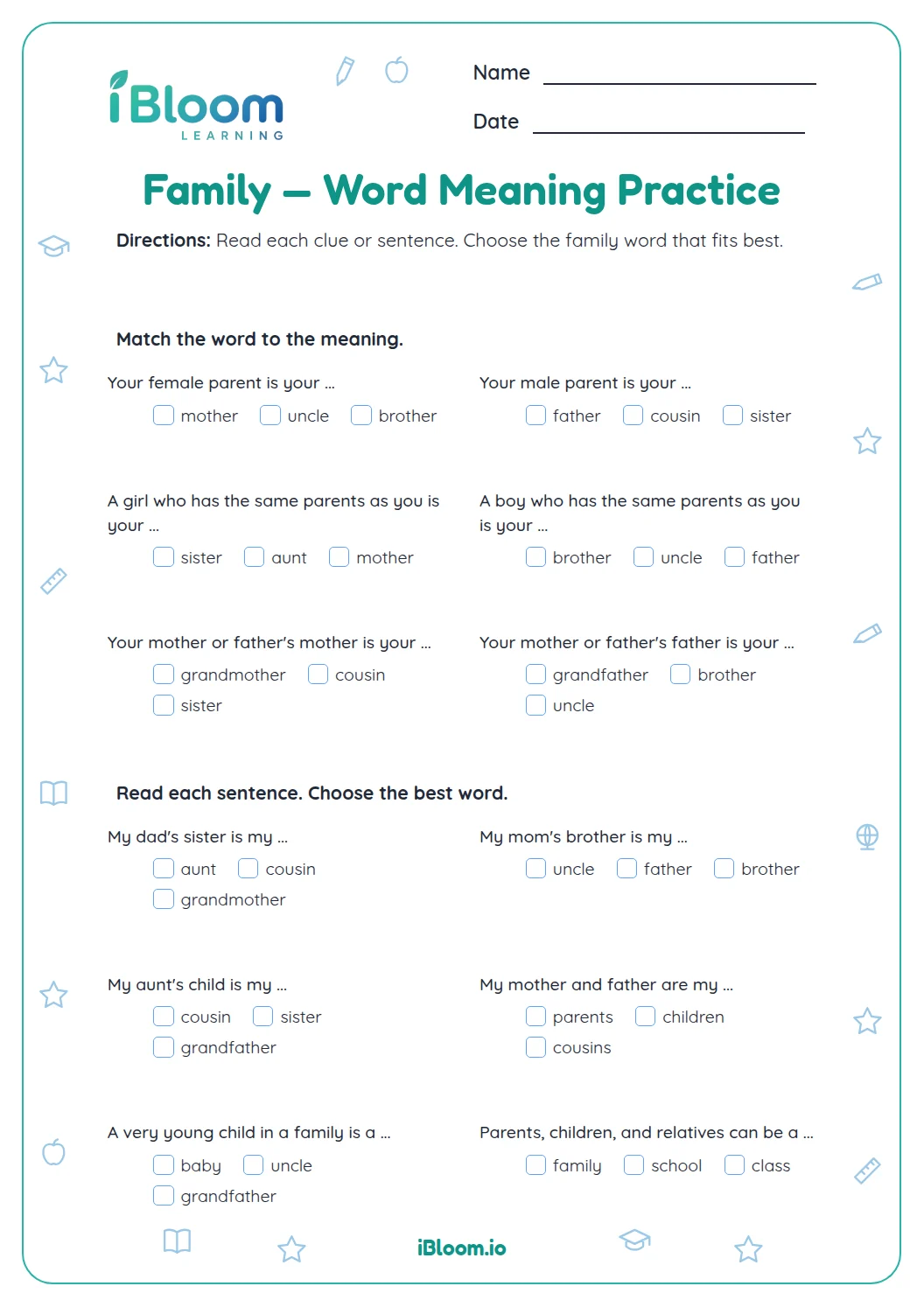
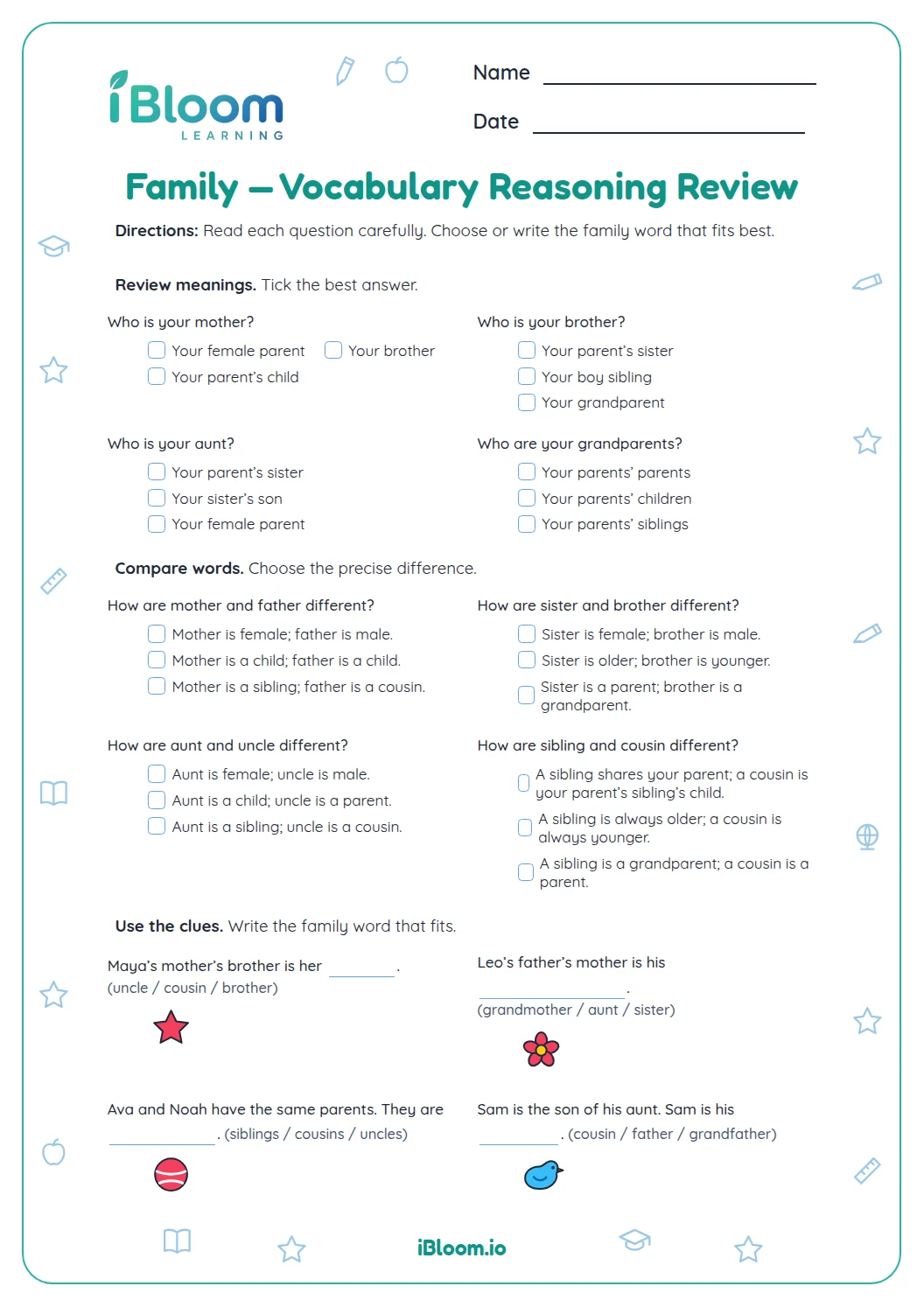
This Grade 1 printable helps children use family words in context. First, students choose a word that completes each relationship clue, such as identifying a mother’s sister as an aunt. Next, they write complete sentences using family words, then finish more short clues about relatives. It aligns with CCSS L.1.4a: using sentence-level context as a clue to word meaning. A separate answer key includes the choices and sample sentences.
Aligned to L.1.4a
Which family words does this sheet use?
The page starts with eight short relationship clues and two word choices. Children choose terms for parents, siblings, grandparents, aunts, uncles, and cousins. The later questions let them use familiar family vocabulary in complete sentences.
How do the sentences help choose a word?
Read the whole clue and name the relationship before choosing a word. “My mother’s sister” points to aunt; “my aunt’s child” points to cousin. In the writing section, use the target word in a sentence that makes its meaning clear.
- 1My mother’s sister is my ___.
- 2A mother’s sister is an aunt.
- 3Answer: aunt
Can an adult read the prompts aloud?
Four prompts ask children to write a sentence with mother, brother, family, or cousin. Six final clues ask for a family word. An adult may read a clue aloud, then ask the child to explain the relationship or read the new sentence back.
How to use this worksheet
- 1Read the entire clue before choosing a word.
- 2Notice which family relationship the clue names.
- 3Write one word that completes the sentence.
- 4Read the sentence again with the answer in place.
- 5For a question, answer with the family word that fits the relationship.
- 6Check answers with the separate key.
Common vocabulary mix-ups and fixes
The mistake
Mixing up aunt and uncle.
The fix
An aunt is a woman in the family; an uncle is a man in the family.
The mistake
Choosing cousin for every relative around the same age.
The fix
A cousin is the child of an aunt or uncle; check the relationship clue.
The mistake
Reading only the blank and skipping the clue.
The fix
Read the whole sentence and name the relationship before writing.
Common Core alignment
Children use sentence context to understand family vocabulary.
Use sentence-level context to understand a word or phrase.
On this sheet: The sentence questions use relationship clues to select the family word that makes sense.
Show the official wordingHide the official wording
Use sentence-level context as a clue to the meaning of a word or phrase.
What to practice next
Make more practice
Further reading
Questions parents and teachers ask
What family words does the worksheet practice?
The worksheet uses mother, father, sister, brother, parents, children, grandparents, grandma, grandpa, aunt, uncle, and cousin. Children choose among family words for relationship clues, write two original sentences, finish two sentence starters, and complete two more clues. The answer key gives selected words and sample responses.
How many questions are included?
There are 14 questions: eight choose-a-word clues, two sentence-writing prompts, two sentence starters, and two more family clues. Sample answers appear in the key for the open responses, since children may write different correct sentences. Read each answer aloud to check it makes sense.
Can an adult read the questions aloud?
Yes. An adult can read the relationship clue aloud and ask the child to explain who is being described before choosing a word. For sentence writing, the adult can help the child say a complete sentence first, then write it down. This keeps attention on word meaning and relationships.
What is the difference between an aunt and a cousin?
An aunt is the sister of a parent, and a cousin is the child of an aunt or uncle. The worksheet uses both words in short clues so students can notice how the relationships differ. A quick family tree sketch can make the connection easier to remember.
Does the page include an answer key?
Yes. The separate answer key lists the best word for each clue and gives sample sentences for the writing prompts. Since children can write different sentences, compare their meaning with the target family word instead of expecting the sample sentence exactly.