





About this worksheet
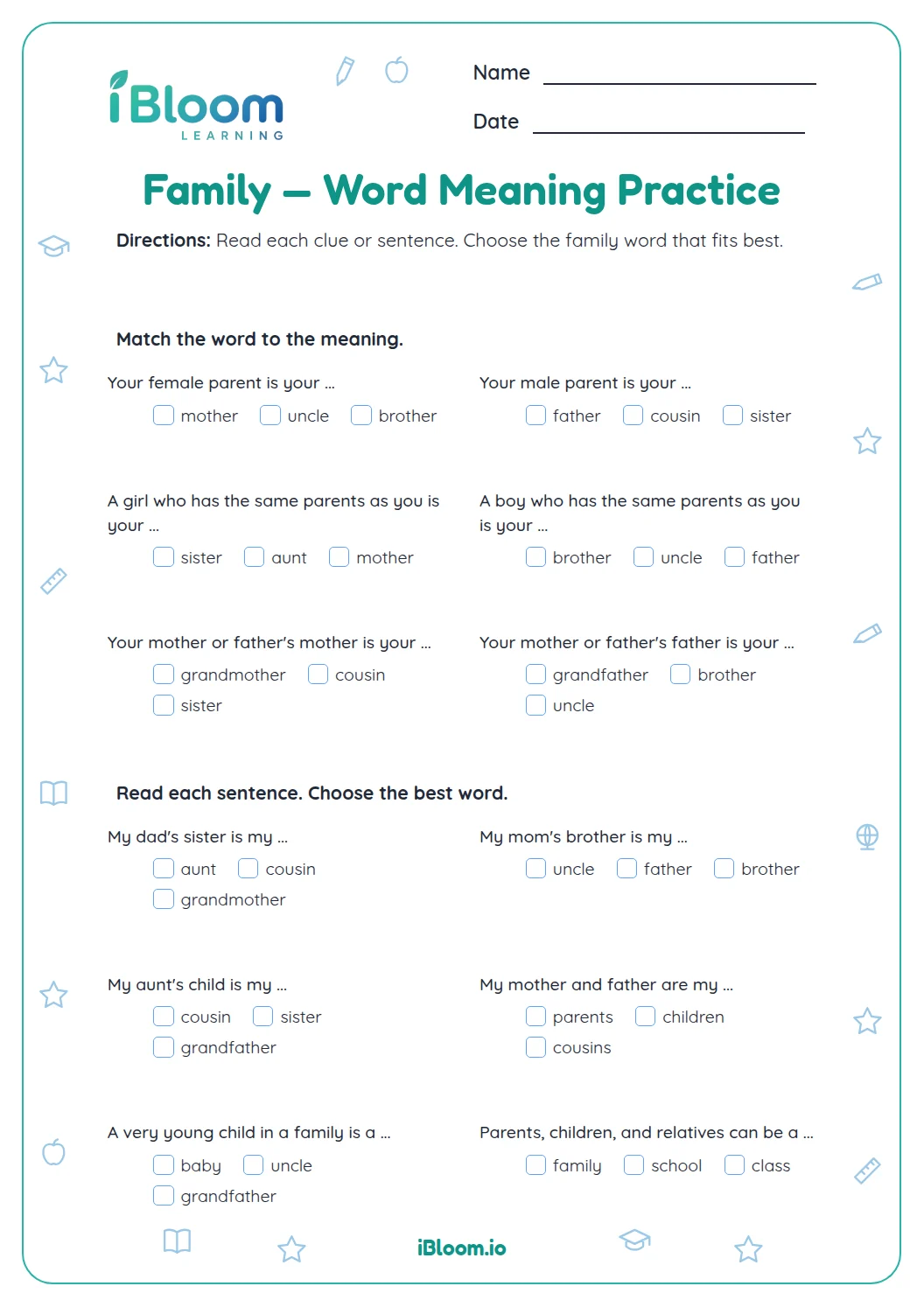
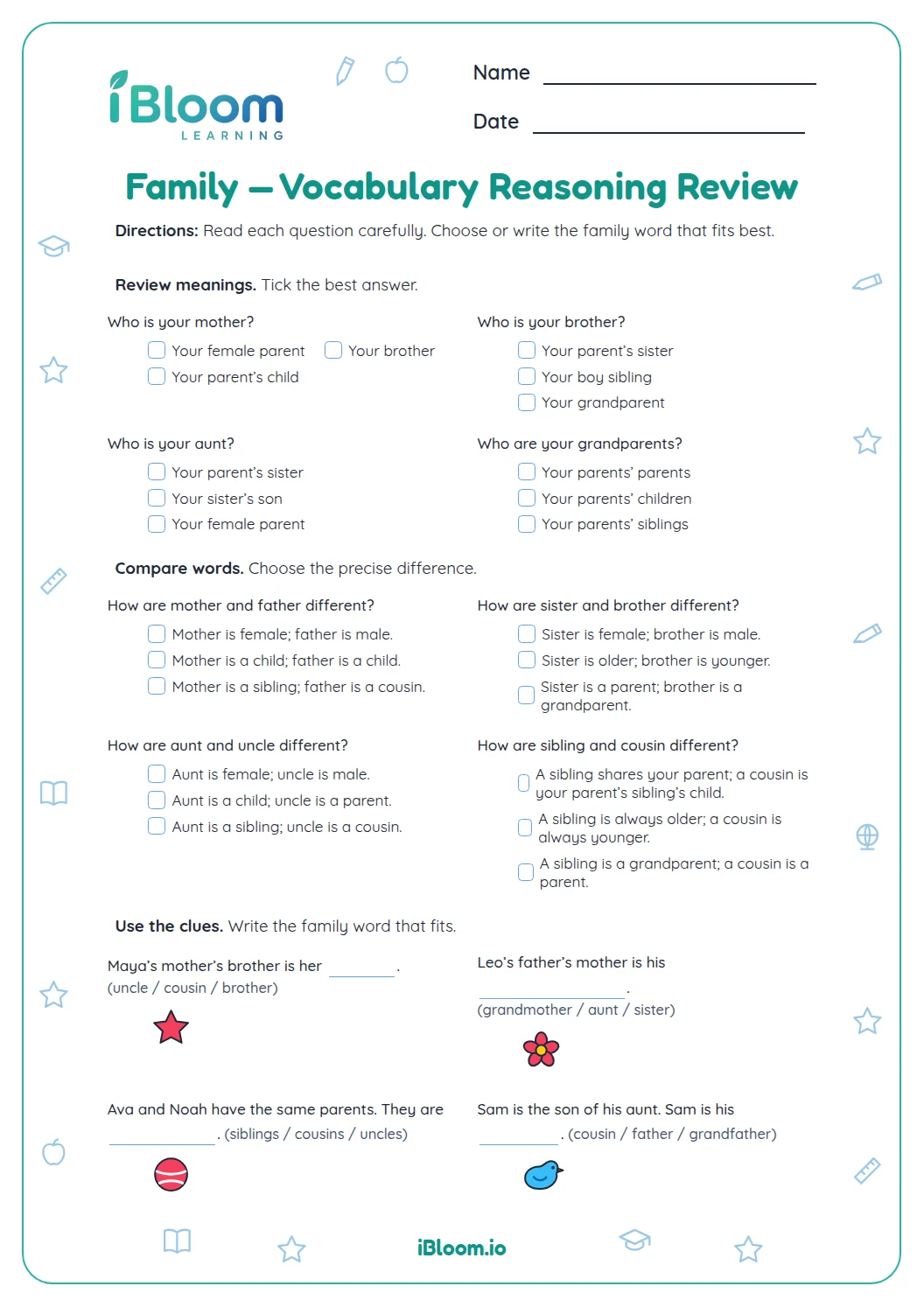
This Grade 1 printable uses family vocabulary to practice classification and word relationships. Learners answer 16 multiple-choice clues about parents, siblings, grandparents, aunts, uncles, and cousins. They sort words into meaningful groups and connect familiar relationships. The answer key supports quick checking and follow-up conversation about how relatives are connected.
Aligned to L.1.5a
How are family words grouped?
A category puts words with a shared idea together. Family words can name parents, siblings, grandparents, or other relatives. Some families use different names, so children can focus on the relationships described in the question.
- 1Which word names a parent?
- 2mother · cousin · aunt
- 3Mother names a parent.
How can children identify family relationships?
Part A asks learners to match a relationship clue with a family word or pair. A parent’s sister is an aunt, and a parent’s brother is an uncle. Read the entire clue and check that each chosen word fits.
How does the sheet connect the words?
Part B completes short statements about family relationships. For example, a mother’s mother is a grandmother, and a sister or brother is a sibling.
How to use this worksheet
- 1Review the family words in the questions: parent, sibling, grandparent, aunt, uncle, and cousin.
- 2Read each clue all the way through.
- 3Name the relationship before looking at the choices.
- 4For a pair or group question, check that every word fits.
- 5Use the answer key to review any tricky relationships.
Common mistakes and quick fixes
The mistake
Mixing up aunt and cousin.
The fix
An aunt is a parent’s sister; a cousin is another relative’s child.
The mistake
Calling every relative a sibling.
The fix
Sibling means a brother or sister, while aunt, uncle, and cousin describe other relationships.
The mistake
Choosing an answer from only one clue word.
The fix
Read the full question and test the choice against the whole relationship.
Common Core alignment
The questions ask learners to sort family words into meaningful relationship categories.
Sort family words into groups such as parents, siblings, and relatives.
On this sheet: Learners classify family words by relationship and identify how the words connect.
Show the official wordingHide the official wording
Sort words into categories (e.g., colors, clothing) to gain a sense of the concepts the categories represent.
What to practice next
Make more practice
Further reading
Questions parents and teachers ask
Which family words does this worksheet practice?
The 16 questions use parent, mother, father, sister, brother, sibling, grandparent, grandmother, grandfather, aunt, uncle, cousin, and relative. Learners identify individual words, sort pairs into categories, and complete short statements about how relatives are connected. The full set revisits these terms in several different clues.
What does sibling mean?
A sibling is a brother or sister. Question 13 asks learners to complete a sentence with that relationship word. The term groups two family words under one category, so children can say which people it describes and use it in the sentence.
Is a cousin the same as an aunt or uncle?
No. An aunt or uncle is a parent’s sibling. A cousin is another relative, often the child of an aunt or uncle. The questions use these words to help learners tell family relationships apart; children can also discuss the terms used in their own families.
Can we discuss a different family structure?
Yes. Use the vocabulary in ways that fit the child and family. The worksheet practices category words such as parent, sibling, grandparent, and relative. A learner can explain how the word fits the clue without needing to describe personal family details.
What does the answer key include?
The separate answer key gives responses for all 16 family vocabulary questions. Use it to check a selected pair or a completed relationship word, then ask the learner to explain which clue helped. That conversation reinforces how the words fit their categories.
How long should Grade 1 learners spend?
About fifteen minutes is a reasonable estimate for reading and answering 16 short questions. Reading the clues aloud together can keep attention on the relationship words. Pause when needed to talk through how one family term connects to another.