



About this worksheet
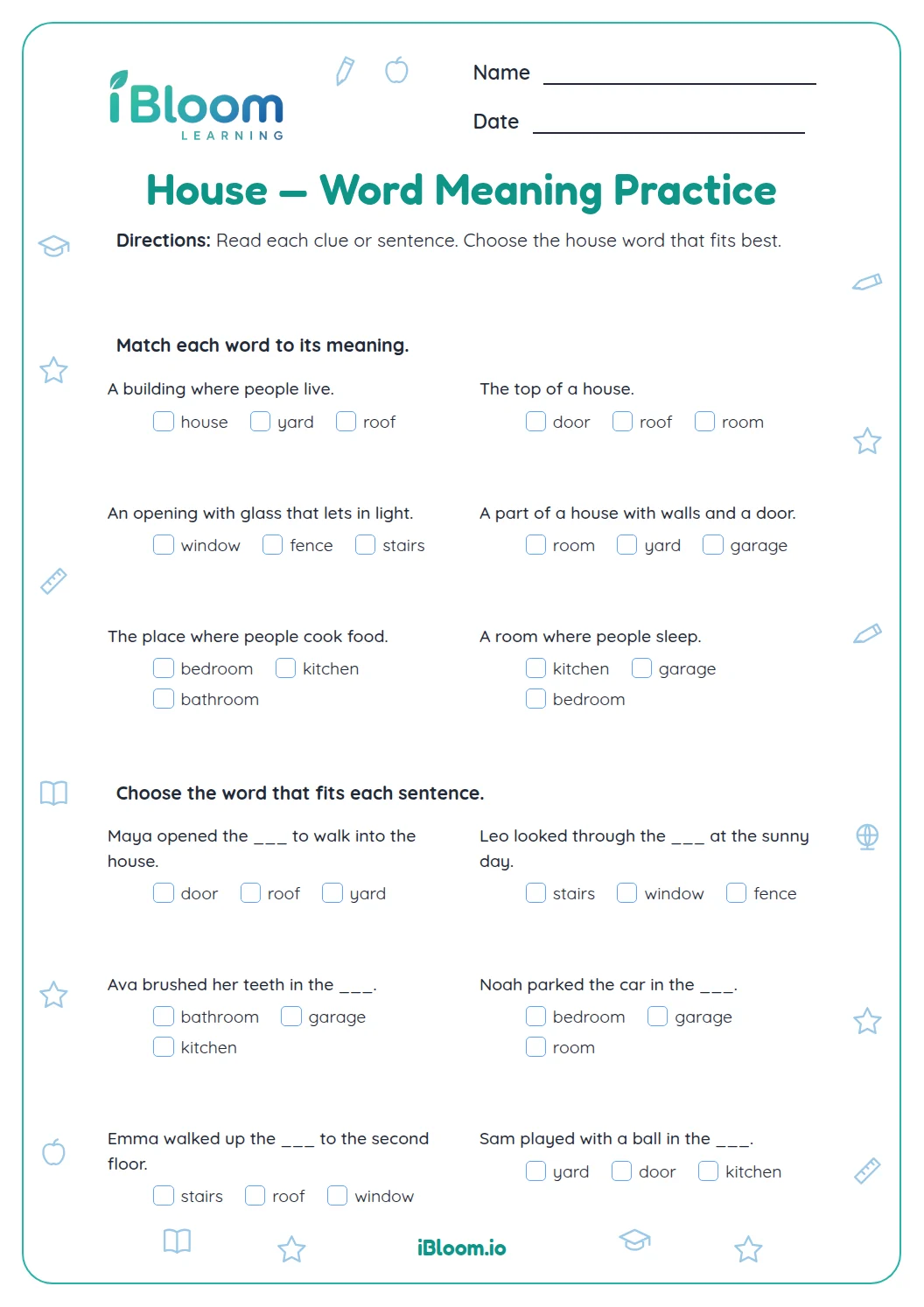
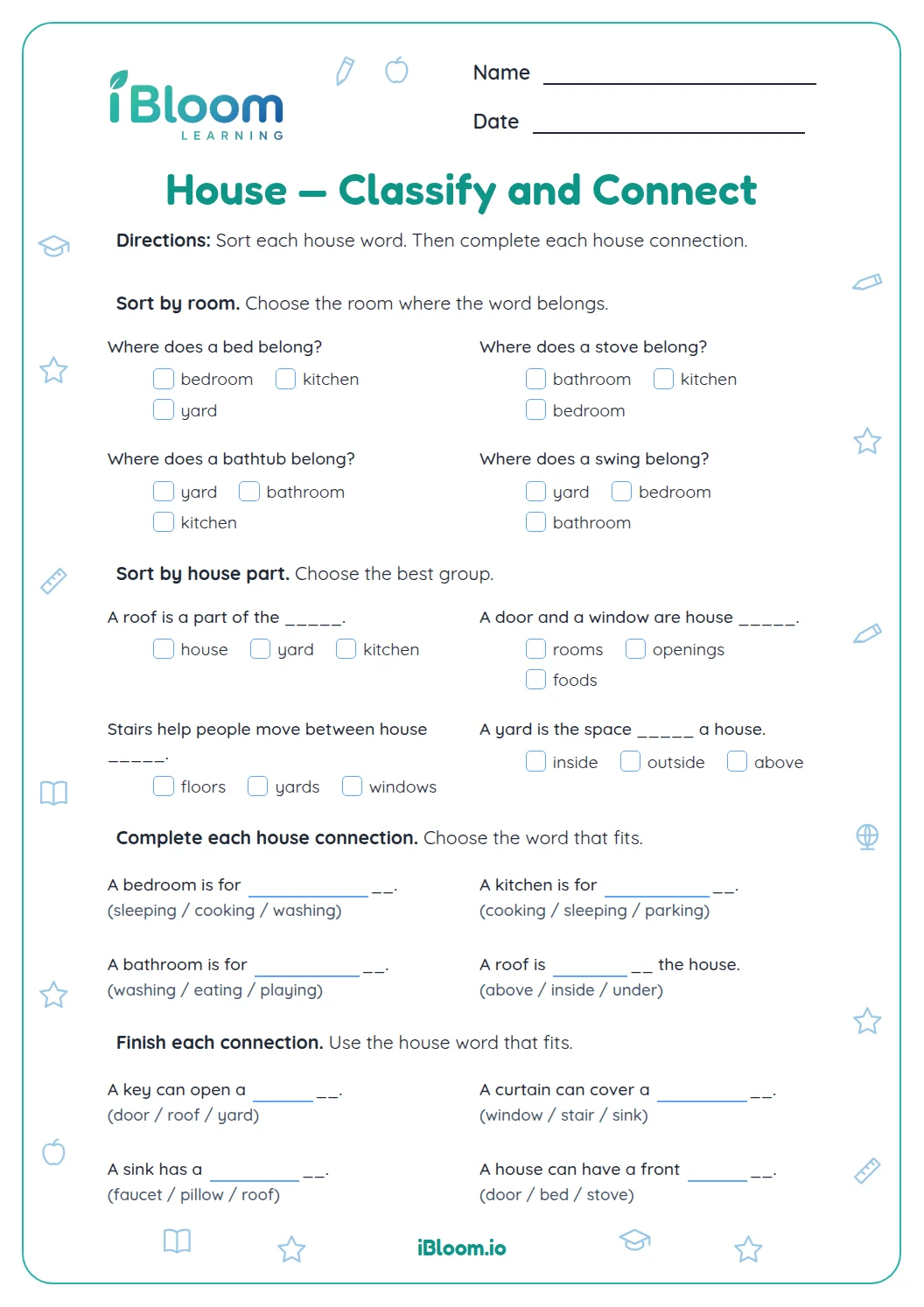
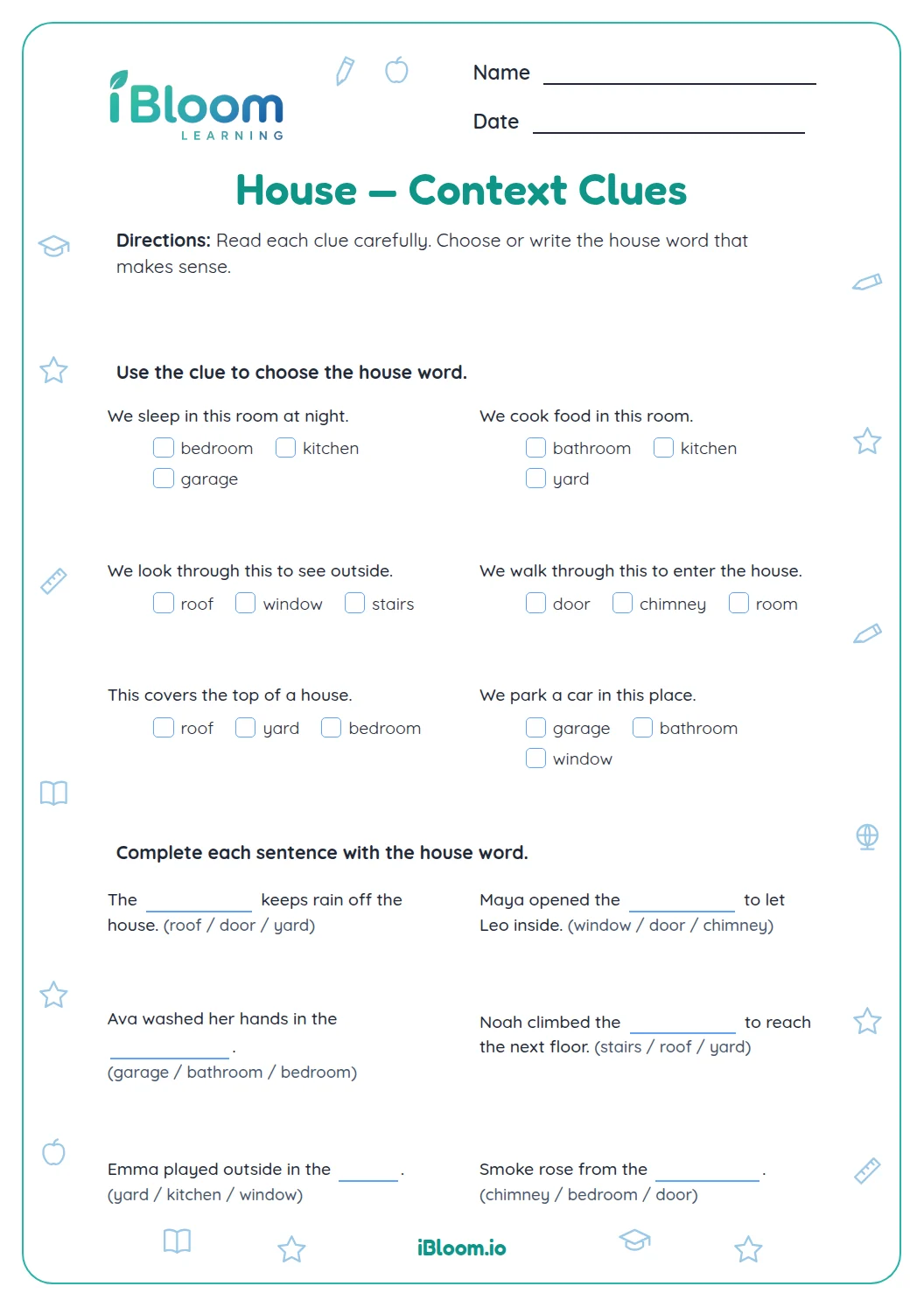
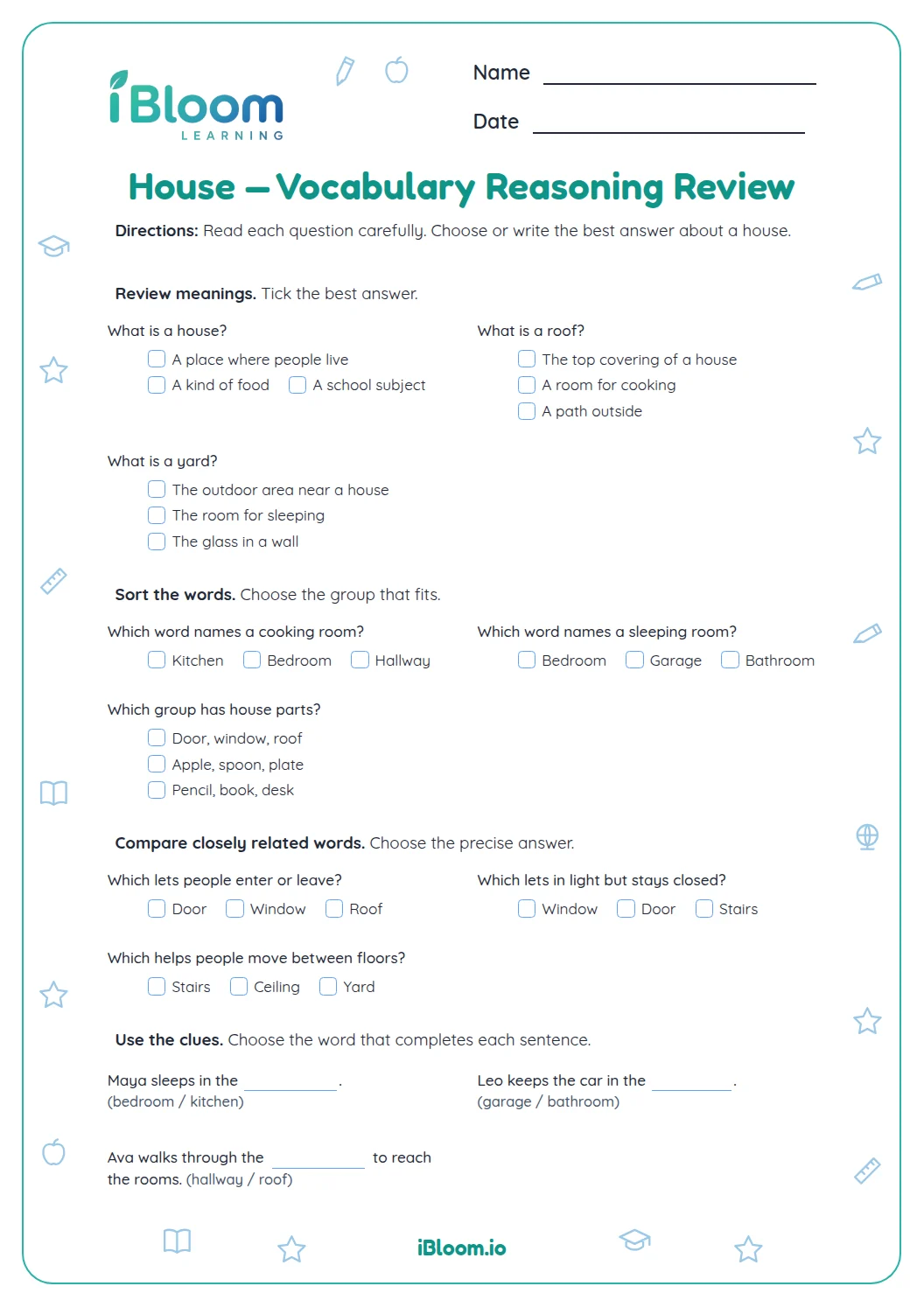
This Grade 1 house-word worksheet uses sentence clues to help children choose the meanings of familiar household words and rooms. Children answer thirteen short multiple-choice clues, then find 12 house words in a word search. The sentence details guide children toward a meaning, such as a rug being a floor covering or a kitchen being a room for cooking. The page aligns with Common Core L.1.4a. A separate answer key marks the target words and correct choices.
Aligned to L.1.4a
How do sentence clues help?
A sentence gives a detail that points to a word’s meaning. “A rug is soft under your feet” helps children choose a floor covering, while “A roof keeps rain out of a house” points to the house’s top cover.
What rooms and spaces appear?
The clues include kitchen, stairs, window, bathroom, and garage. In “Mia cooks soup in the kitchen,” the sentence detail points to a room for cooking.
Which words are in the search?
The final grid contains bed, rug, lamp, door, roof, sink, tub, wall, stairs, kitchen, window, and bathroom. Children can circle the listed words across or down after working through the sentence clues.
How to use this worksheet at home or in class
- 1Read each clue sentence all the way through.
- 2Point to the detail that helps explain the house word.
- 3Read every choice and choose the meaning that fits.
- 4After the clues, look for all 12 listed words in the grid.
- 5Use the answer key to check the choices and word search.
Common mistakes and quick fixes
The mistake
Choosing a meaning that fits the word but not its sentence.
The fix
Read the full sentence again and use its detail as a clue.
The mistake
Mixing up similar house spaces, such as a kitchen and a bathroom.
The fix
Look for the action in the clue: cooking points to a kitchen, washing to a bathroom.
The mistake
Skipping a word in the word-search list.
The fix
Cross off each target word after finding it, then check the full list.
Common Core alignment
This page connects familiar vocabulary with real-life home uses.
Use sentence clues to work out the meaning of familiar house words.
On this sheet: Each clue sentence gives context that helps children choose what the house word means.
Show the official wordingHide the official wording
Use sentence-level context as a clue to the meaning of a word or phrase.
What to practice next
Make more practice
Further reading
Questions parents and teachers ask
What words are in the house word search?
The grid includes bed, rug, lamp, door, roof, sink, tub, wall, stairs, kitchen, window, and bathroom. Children circle each word as they find it, then connect the words with the sentence clues about familiar household objects and rooms. The answer key repeats the target list for checking.
How many questions are on this printable?
There are 14 questions: thirteen multiple-choice clues and one word-search activity. The clues connect household objects and rooms with their meanings, and the final grid contains 12 house words. The answer key shows the correct choices and target words for checking.
What does the answer key show?
The key marks the 12 target words in the grid and identifies the correct choice for each sentence clue. For example, a rug is a floor covering, and a kitchen is a room for cooking. Children can use the clue sentence to explain why their answer fits.
Can an adult read the clues aloud?
Yes. An adult can read the clue and choices aloud while the child listens for the home detail that matters. That keeps the task focused on connecting context with word meaning. Children can still search for the printed words and point to each answer.
What does this worksheet practice?
It practices using sentence-level context to work out word meaning. Children locate 12 house words, read clue sentences, and choose a meaning that fits each one. The page aligns with Common Core L.1.4a, which addresses context as a clue to meaning.