



About this worksheet
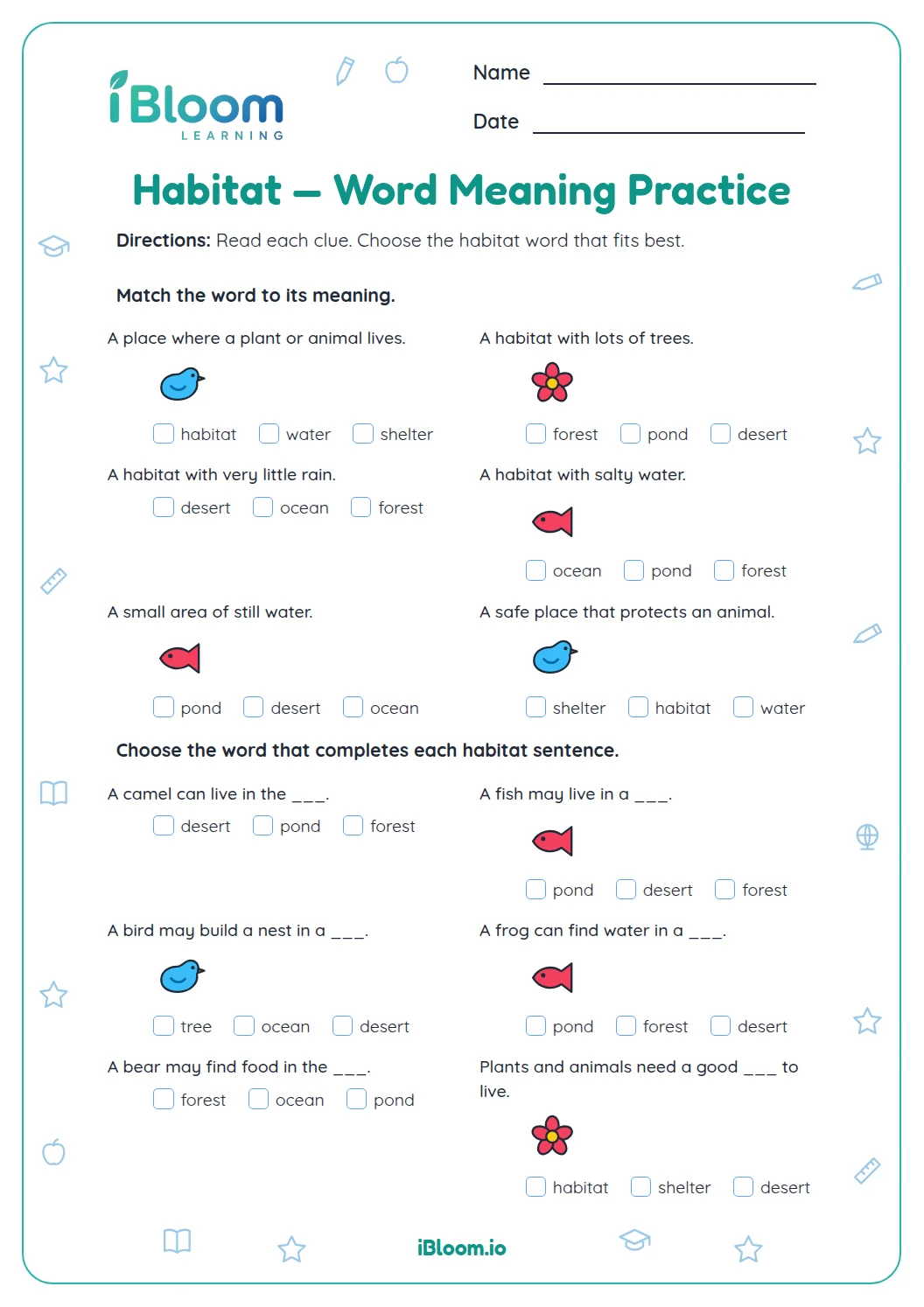
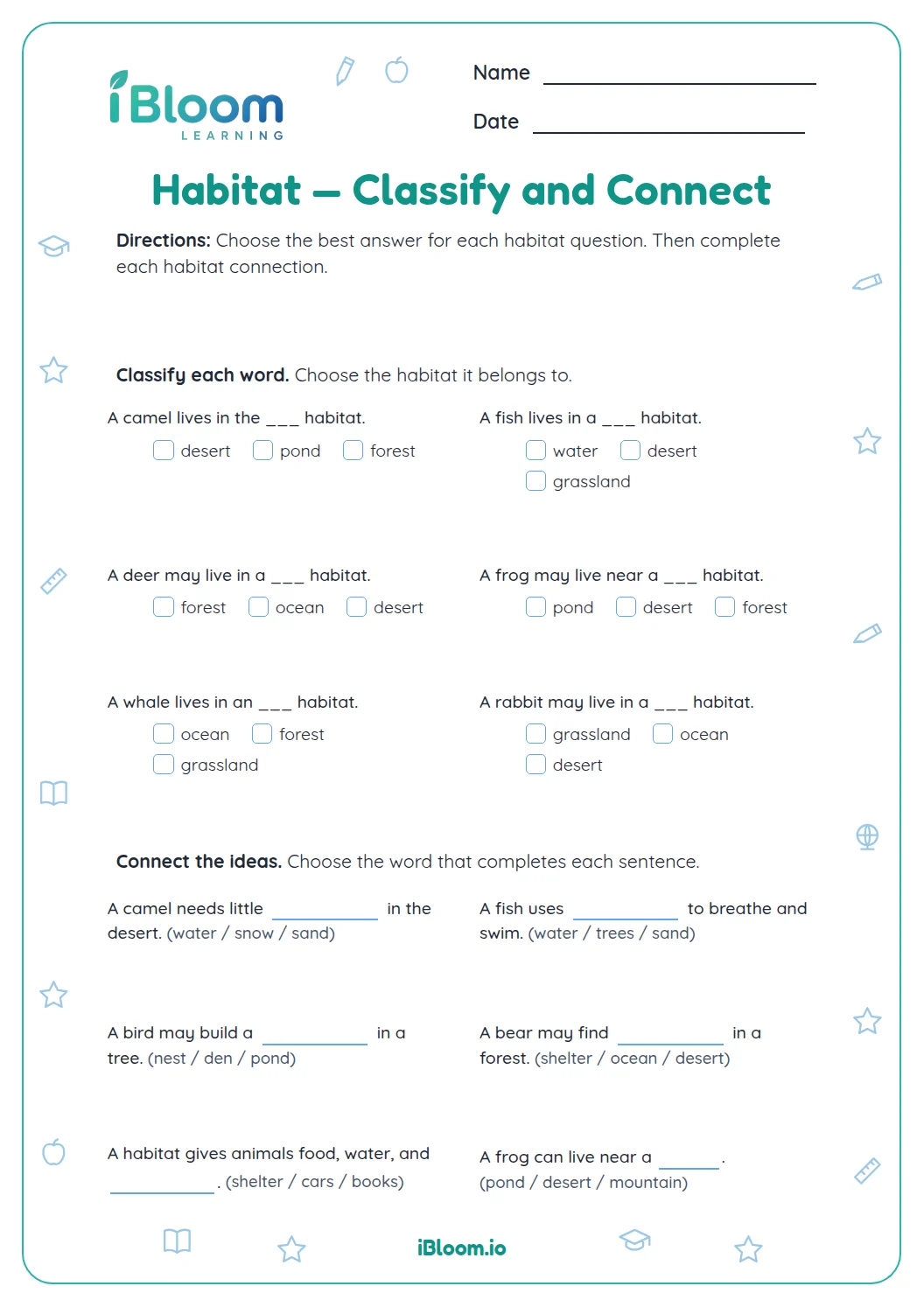
This free Grade 1 printable combines habitat vocabulary with simple sentence clues. Students complete 19 questions in four parts: choose habitat words that fit, find eight habitat terms in a word search, use sentence details to identify meanings, and complete four clue sentences. The work practices L.1.4.a by using sentence-level context to understand words. An answer key is included.
Aligned to L.1.4.a
What do the four parts practice?
The first five sentences connect an animal or plant to a habitat word. Part B asks students to find eight of those words in the grid. Part C uses a nearby clue to choose a meaning, and Part D completes four short sentences.
- Part A: Choose a habitat word
- Part B: Find eight words in the grid
- Part C: Use sentence clues
- Part D: Complete the clue
How does a sentence clue help?
A clue tells what a word means without simply repeating it. In question 9, “has little rain” points to the meaning of “dry”: it has little water. Look at the whole sentence before choosing.
- 1The dry desert has little rain. What does dry mean?
- 2Answer: has little water
What should students look for in the word search?
The grid contains forest, pond, desert, ocean, nest, den, burrow, and river. Words read across the rows. After finding each one, students can connect it to the habitat clue sentences in the other parts.
How can children check a habitat meaning?
Reread the sentence and ask what the clue says about the place. “A rabbit hides underground in a burrow” tells where the rabbit is; “land beside water” explains shore. The last part asks for a word that fits both the clue and the sentence.
How to use this worksheet
- 1Read each animal or plant clue and choose the matching habitat word.
- 2Find and circle all eight listed habitat words in the grid.
- 3For each choice, underline the nearby words that give a meaning clue.
- 4Complete each final sentence with a word that fits its clue.
- 5Use the key to check the word and the meaning it gives in context.
Common context-clue mix-ups
The mistake
Picking a habitat from memory without reading the sentence.
The fix
Use the specific clue in the sentence to narrow the choices.
The mistake
Confusing the animal with its habitat.
The fix
Ask whether the blank needs an animal, a place, or a meaning.
The mistake
Choosing a word that fits the topic but not the clue.
The fix
Reread the entire sentence with the choice in the blank.
Common Core alignment
Students use the words around a habitat term to work out its meaning.
Use sentence-level context as a clue to a word’s meaning.
On this sheet: The sentence questions ask students to infer word meanings from nearby clues.
Show the official wordingHide the official wording
Use sentence-level context as a clue to the meaning of a word or phrase.
What to practice next
Make more practice
Further reading
Questions parents and teachers ask
How many questions are included?
There are 19 numbered questions in four parts. The page includes five habitat clues, an eight-word search, nine sentence-based choices, and four sentence completions. The answer key lists the intended word or meaning for every item, including the word-search list.
Which words are hidden in the grid?
Students search for forest, pond, desert, ocean, nest, den, burrow, and river. Each word appears across a row. Finding them reviews the habitat vocabulary before students use the same terms in the sentence clues and meanings in the other parts of the page.
How does this page practice context clues?
Several questions include a clue near the target word. “Has little rain” helps explain “dry,” and “land beside water” explains “shore.” Other sentences describe how an animal uses a place. Encourage the student to use those words instead of guessing from the animal alone.
What does the answer key show?
The key gives the intended answer for each question and names all eight words in the grid. For a sentence completion, accept another word only if it fits the clue and keeps the sentence accurate. The listed answer is a consistent model for checking.
How long does this worksheet take?
Plan for about 15 minutes. The word search and multiple-choice section may go quickly, while reading every clue carefully takes longer. Students can complete one part at a time, underline clue words in the sentences, and check their answers after finishing the full page.