



About this worksheet
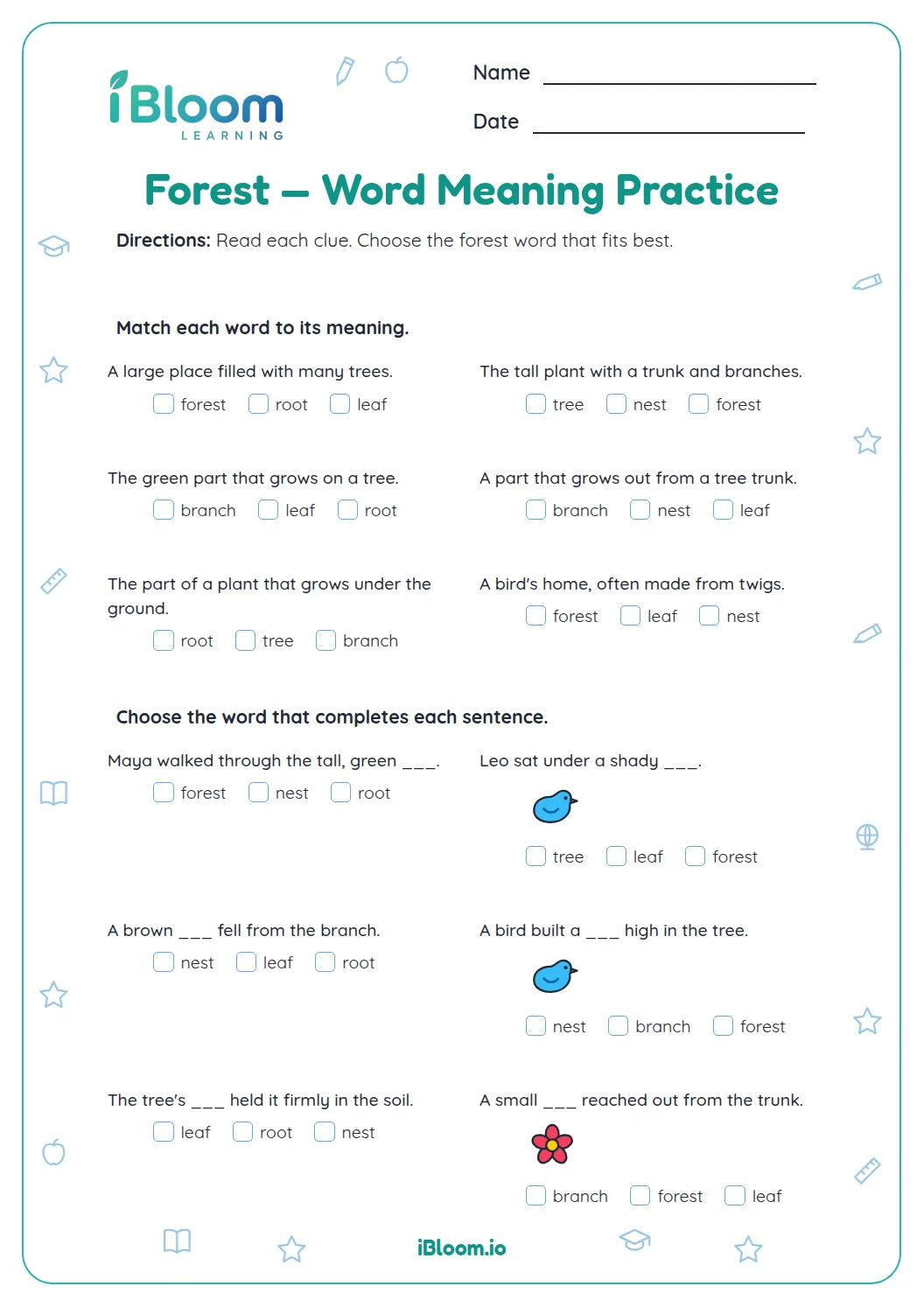
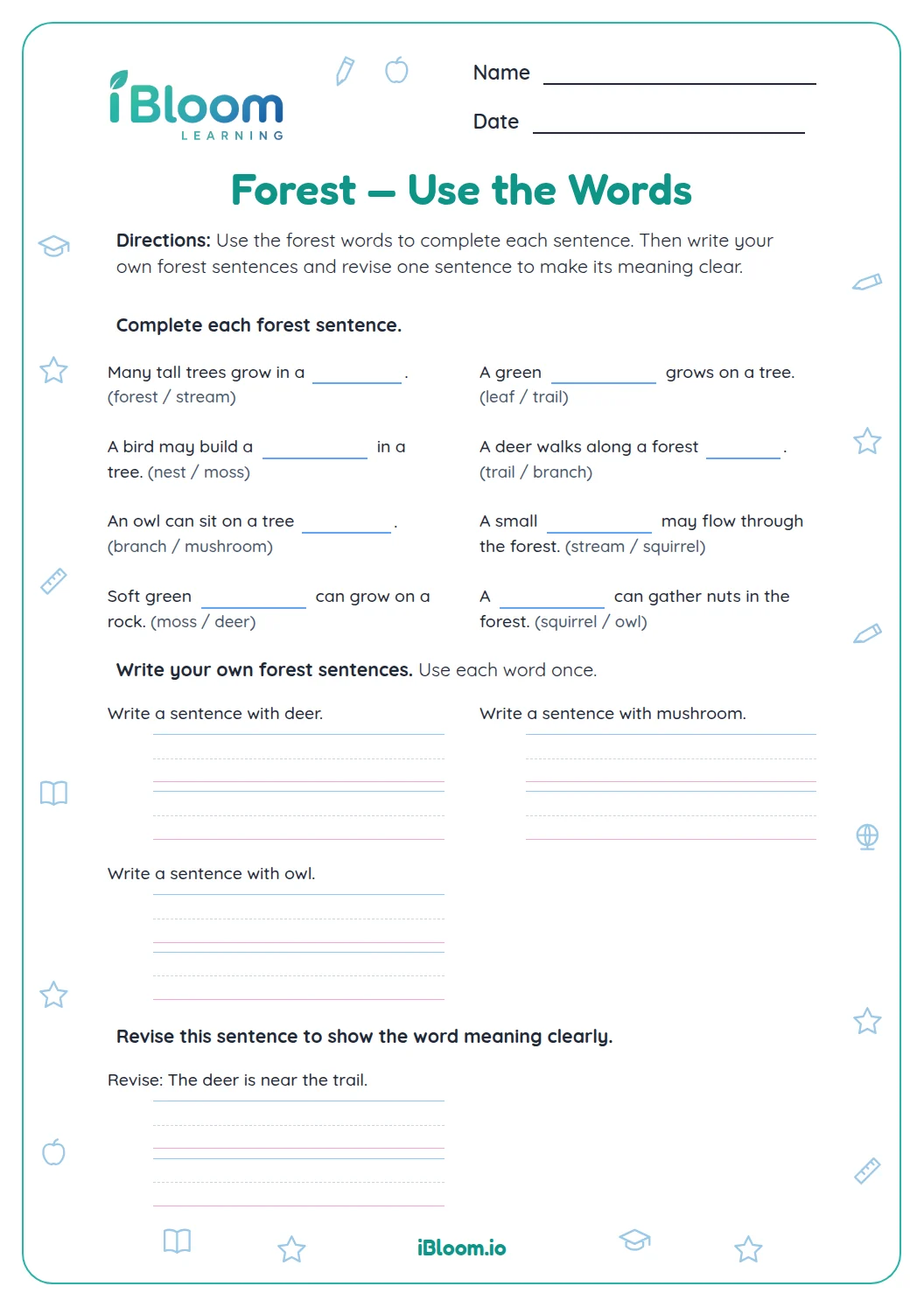
This Grade 1 printable uses short forest sentences to help children work out word meanings. Part A has eight multiple-choice items with direct clues. Part B has six sentence completions that connect a word to its meaning. Children work with words such as sturdy, hollow, and glisten. It aligns with CCSS L.1.4a, using sentence-level context to clarify a word. The answer key is included.
Aligned to L.1.4a
How do nearby words reveal meaning?
A context clue is a word or phrase around a new word that helps explain it. In question 5, the phrase “of the tree” helps show that a limb is a tree branch.
- 1An owl sat on a limb of the tree.
- 2Clue: “of the tree”
- 3A limb of a tree is a branch.
Why read the whole sentence?
One clue may be a familiar word, an action, or a short explanation after a comma. Read the complete sentence before looking at the choices, then try the likely meaning in place of the new word.
What is the word search for?
Part A uses eight short clues to choose a word meaning. Part B asks children to complete six sentences with a forest word that fits the definition. Read the whole clue before choosing or writing the word.
How to use this worksheet
- 1Read the entire sentence before looking at the choices.
- 2Read every Part B sentence all the way through.
- 3Look for a nearby phrase that explains or demonstrates the target word.
- 4Try the answer choice in place of the target word.
- 5Check the choices against the answer key.
Common mistakes and quick fixes
The mistake
Choosing a meaning from memory without checking the sentence.
The fix
Point to the clue words and explain how they support the choice.
The mistake
Using just one nearby word when the clue is a full phrase.
The fix
Reread the whole sentence, especially after a comma.
The mistake
Choosing an answer that fits the topic but not the sentence.
The fix
Swap the choice into the sentence and see whether it makes sense.
Common Core alignment
The meaning questions use short, explicit sentence clues.
Use a sentence clue to work out a word’s meaning.
On this sheet: Part B asks learners to use nearby words to choose the meaning of forest vocabulary.
Show the official wordingHide the official wording
Use sentence-level context as a clue to the meaning of a word or phrase.
What to practice next
Make more practice
Further reading
Questions parents and teachers ask
What is a context clue?
A context clue is a word or phrase that helps explain another word in a sentence. In “a sturdy branch, so it held the bird,” the phrase about holding the bird hints that sturdy means strong. Learners can replace the target word with the choice to test whether it fits.
What is included in the forest worksheet?
The printable has 14 forest vocabulary questions in two formats. Part A offers eight multiple-choice items, and Part B has six sentence completions. Learners use sentence clues to choose or write words such as sturdy, hollow, owl, branch, leaf, and bark.
Should a learner read the whole sentence first?
Yes. Each item gives a sentence with a clue, such as “The path was narrow, with room for one walker.” The first eight questions ask learners to choose a meaning, while the final six ask them to write a forest word that completes its definition.
Can I read the questions aloud?
Yes. An adult can read a sentence and its choices aloud while the learner listens for the clue and chooses a meaning. Pause after the clue phrase and ask what it suggests about the target word. That keeps the task focused on meaning while supporting a developing reader.
Does the page include a word search puzzle?
The printable practices forest vocabulary through context-clue sentences. Learners choose a meaning that fits or complete a sentence with the right forest word. Although the page is grouped with word-search worksheets, its activity focuses on vocabulary meaning rather than finding words in a letter grid.