


About this worksheet
This free printable Grade 1 jobs worksheet pairs a short word search with picture-supported job clues, context sentences, and reasoning questions. Children locate familiar job names, connect each role with its work, and use the clues to choose words that fit. It includes 16 questions and a separate answer key. The vocabulary practice connects job words with the groups and ideas they represent.
How does the word search help?
Children first locate ten job names in the grid, all placed left to right. Finding each word gives them a chance to read the job vocabulary before matching roles with clues.
- 1Find CHEF in its row.
- 2Then read the job clues and match chef with preparing meals.
How can a clue point to a job?
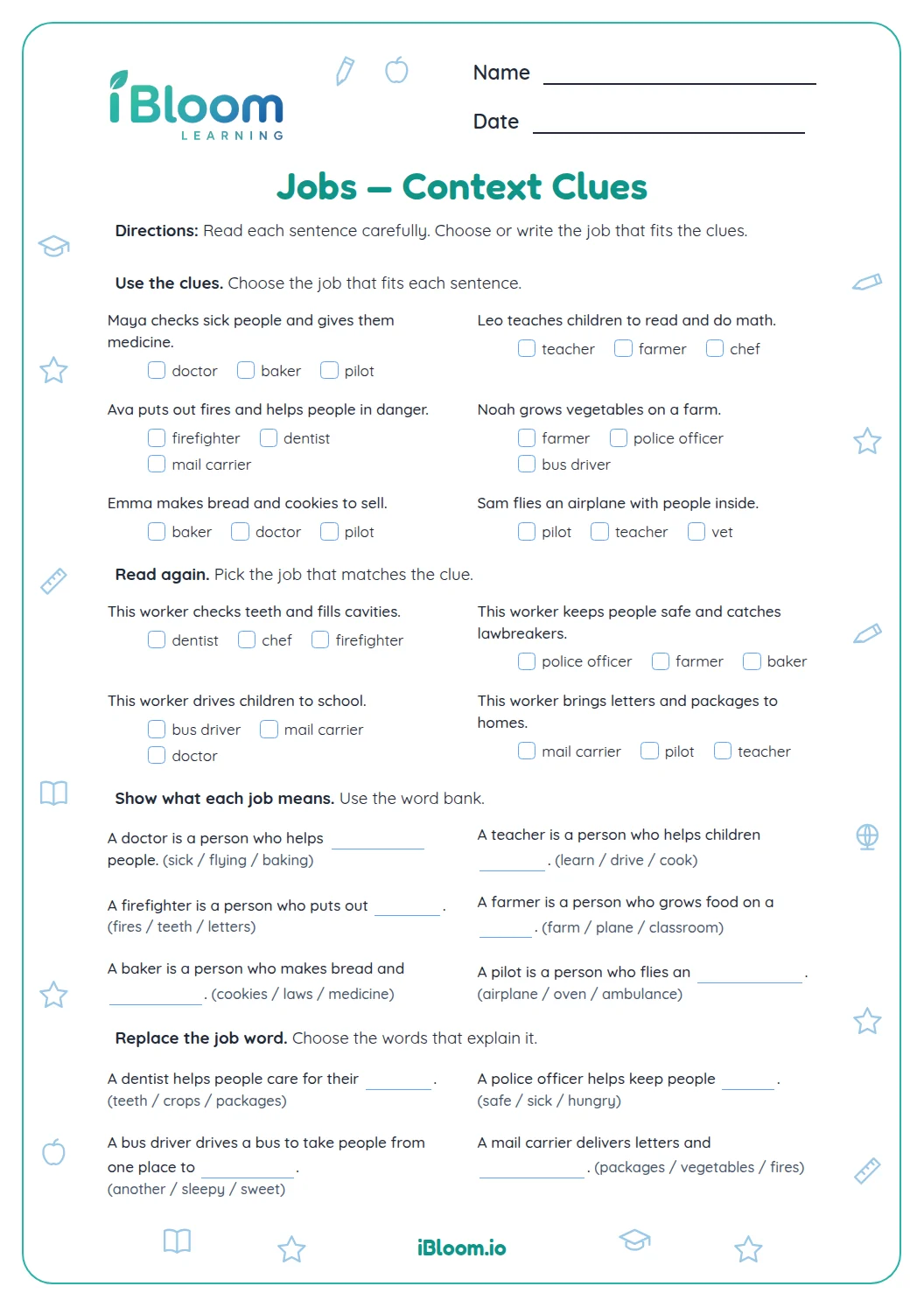
Look for the action, workplace, or tool in the clue. A person who bakes bread may be a baker; a person who helps sick animals may be a vet.
How can children explain their choices?
Ask which word names the person who does the work. Linking a job to its task, tool, or setting helps make the vocabulary meaningful.
How to use this worksheet
- 1Read each part’s direction before starting.
- 2Solve the facts or clues in order and show work where space is provided.
- 3Use the operation or text detail that fits the question.
- 4Check the answer key after completing the practice.
Common mistakes and quick fixes
The mistake
Answering quickly without checking the clue or operation.
The fix
Point to the exact word, detail, number or mark that supports the response.
The mistake
Skipping a question that feels unfamiliar.
The fix
Try the next part, then return and use its directions as a reminder.
The mistake
Changing a correct answer after a quick glance.
The fix
Explain the evidence or calculation aloud before making a change.
What to practice next
Questions parents and teachers ask
Which words are hidden in the word search?
The grid includes chef, nurse, farmer, pilot, baker, doctor, teacher, artist, vet, and mail carrier. Each word runs left to right in its own row. Children can cross off a word after finding and reading it. Each word appears across a row, so remind children to scan from left to right and compare the letters in.
What vocabulary does the worksheet review?
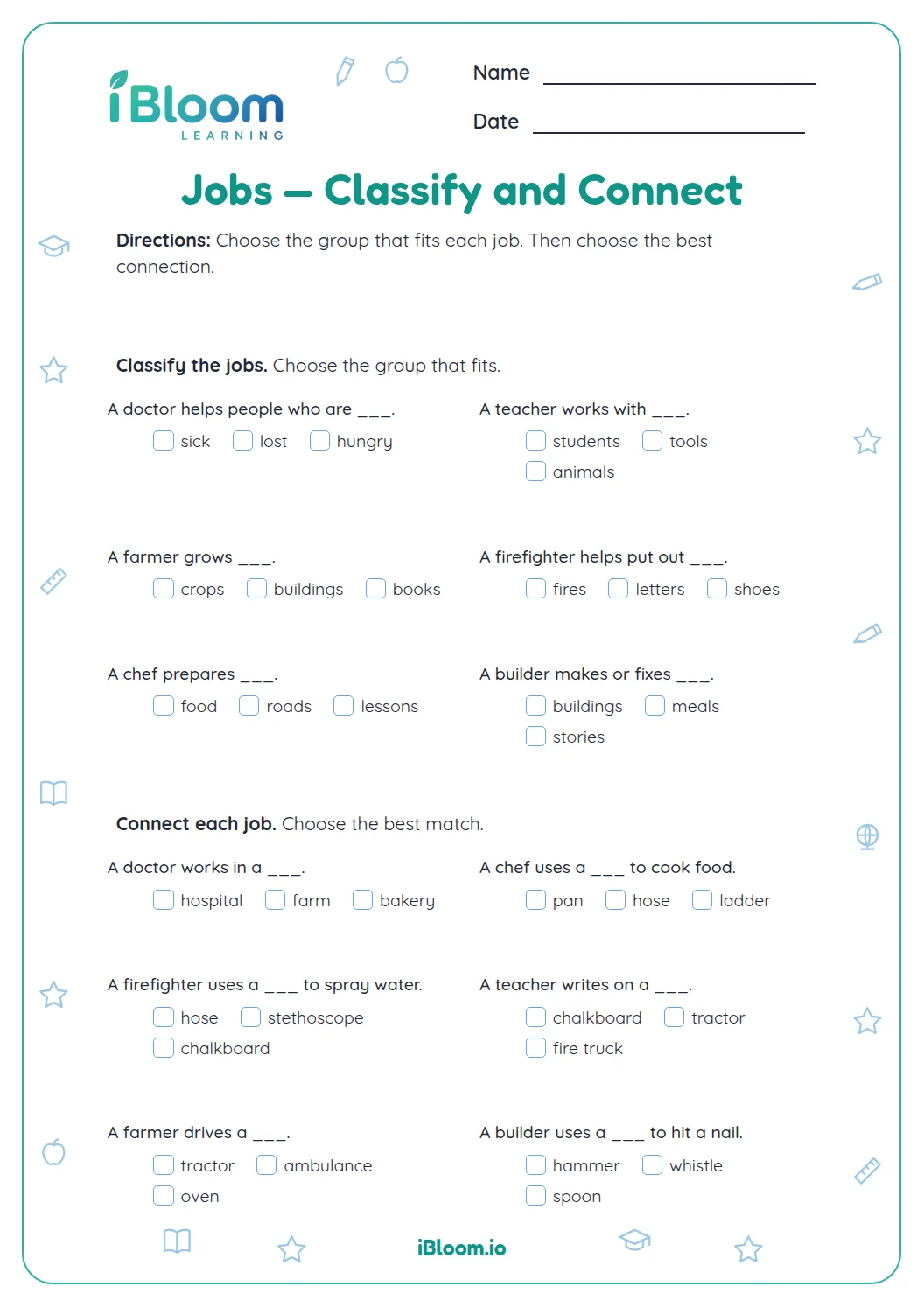
It reviews community job names and the tasks connected with them. Children match teachers with lessons, bakers with bread, and veterinarians with animal care, then use work clues to reason about other job words. Children see job names such as teacher, farmer, doctor, and pilot, then match them with familiar work. The final clues ask them.
How many questions are included?
There are 16 questions across four parts: a word search, job clues, context sentences, and additional reasoning. The mix gives children practice recognizing job names and connecting each word with a task, tool, or setting. The set includes a word search, multiple-choice clues, context sentences, and reasoning prompts. This gives children several ways to read and.
How should I help if a clue is difficult?
Reread the whole clue and focus on its action or object. Ask which job would do that work, then compare the choice with the answer key. For example, a person who measures flour and bakes bread is a baker. The printed directions and answer key make it easy to review the response after the activity is complete.
How can children use the job clues?
Look for the action, tool, or place named in each clue, then choose a job that fits. A baker works with bread and flour, while a doctor may use a stethoscope. The answer key helps confirm each match after children finish.