


About this worksheet
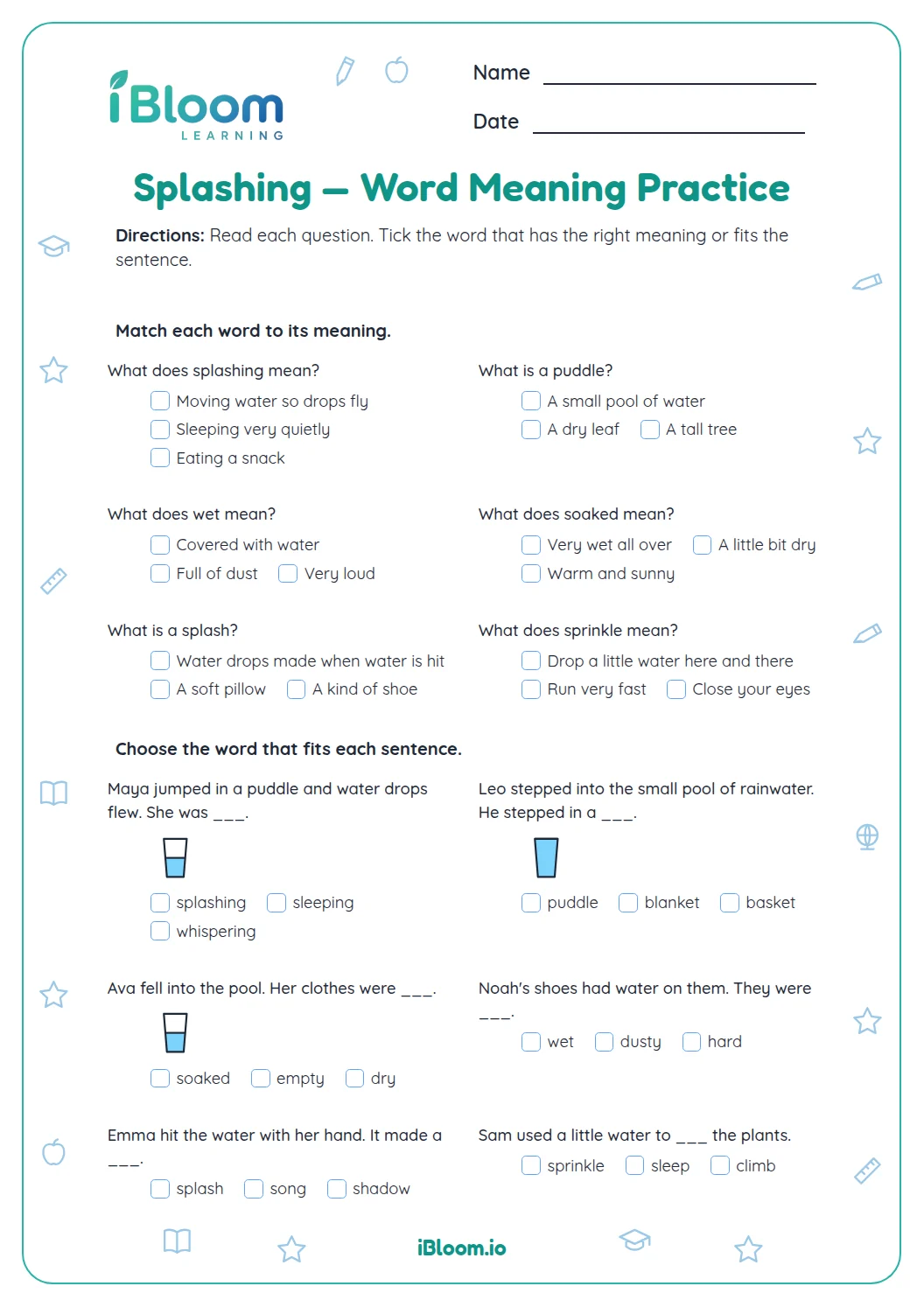
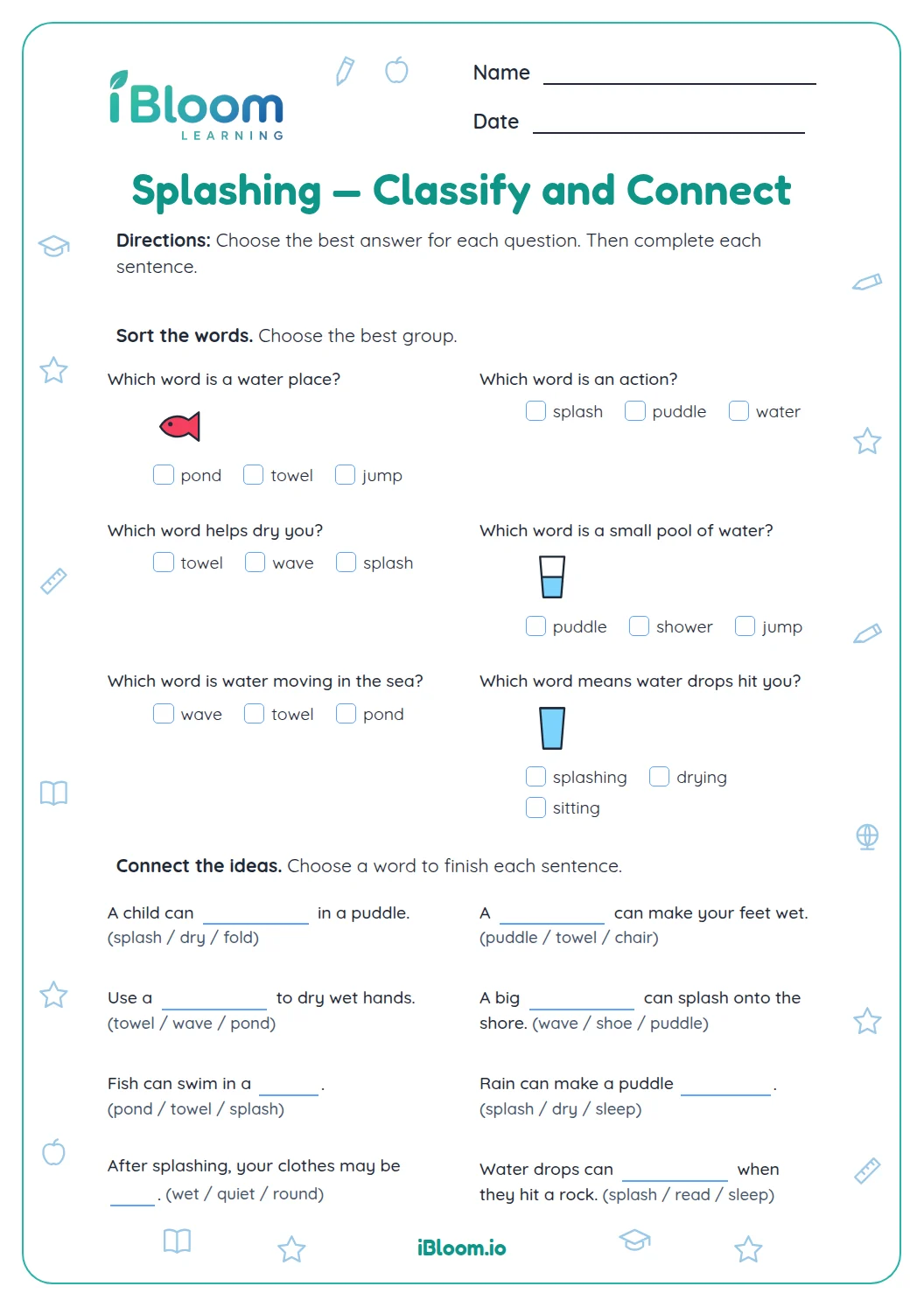
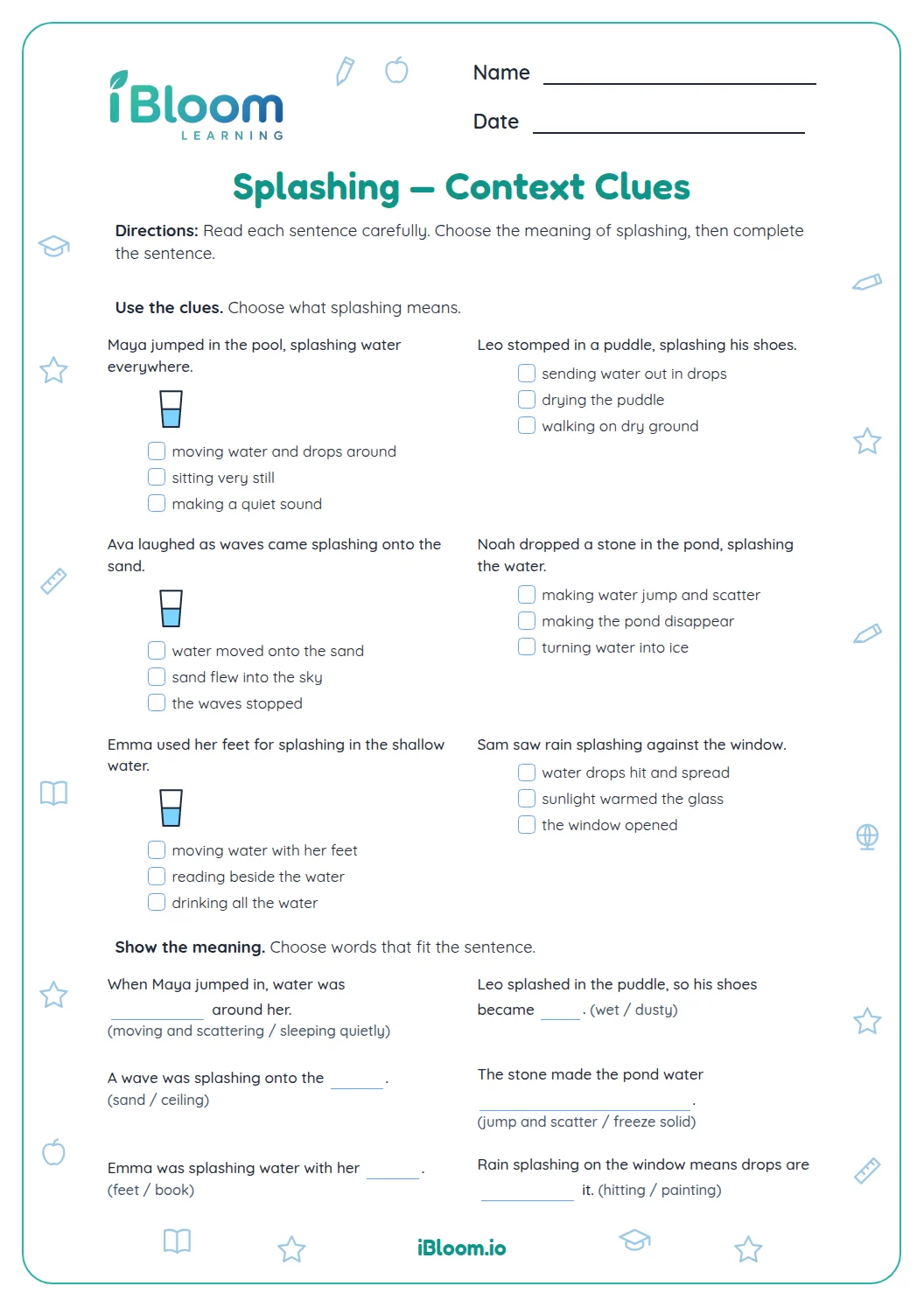
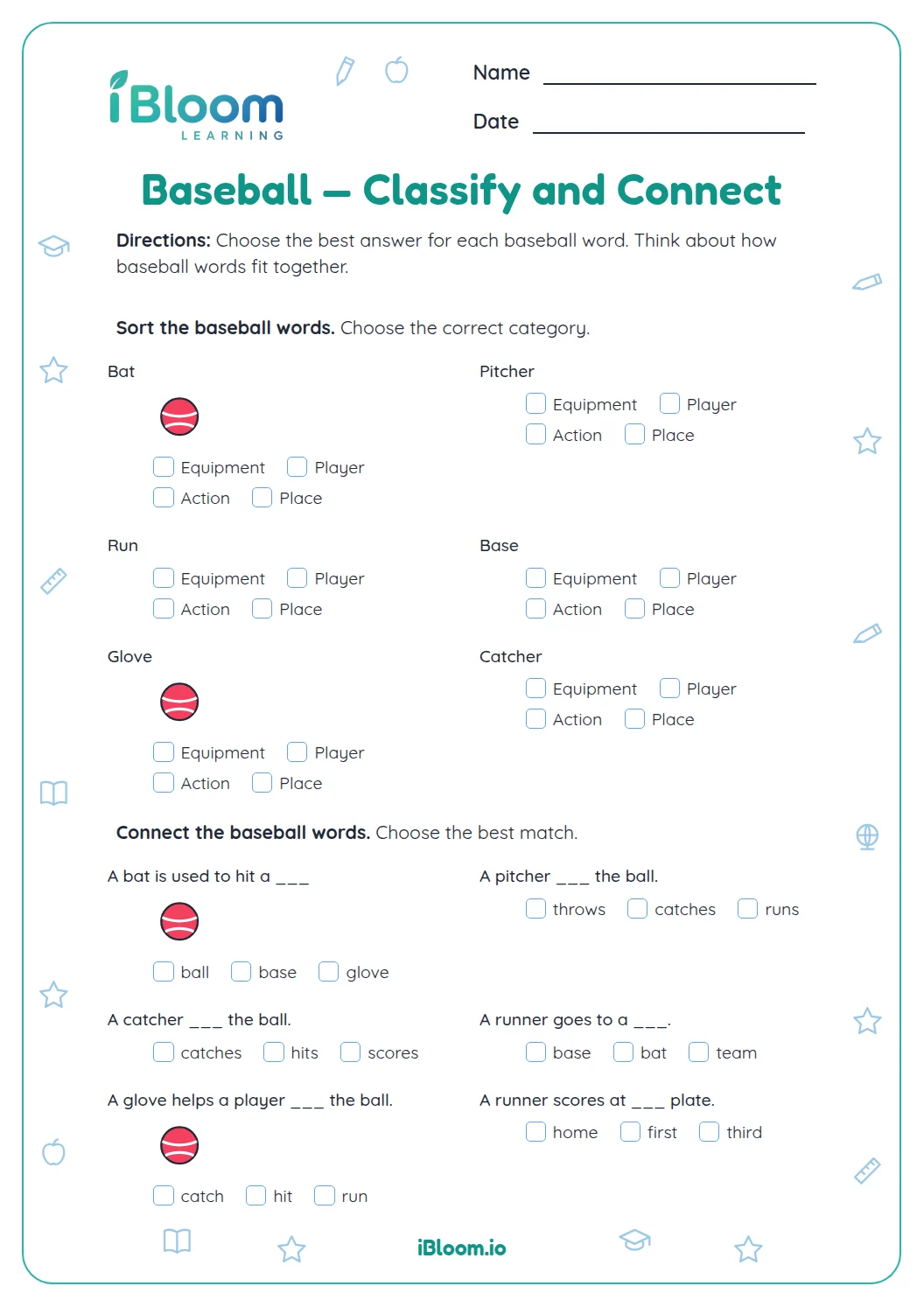
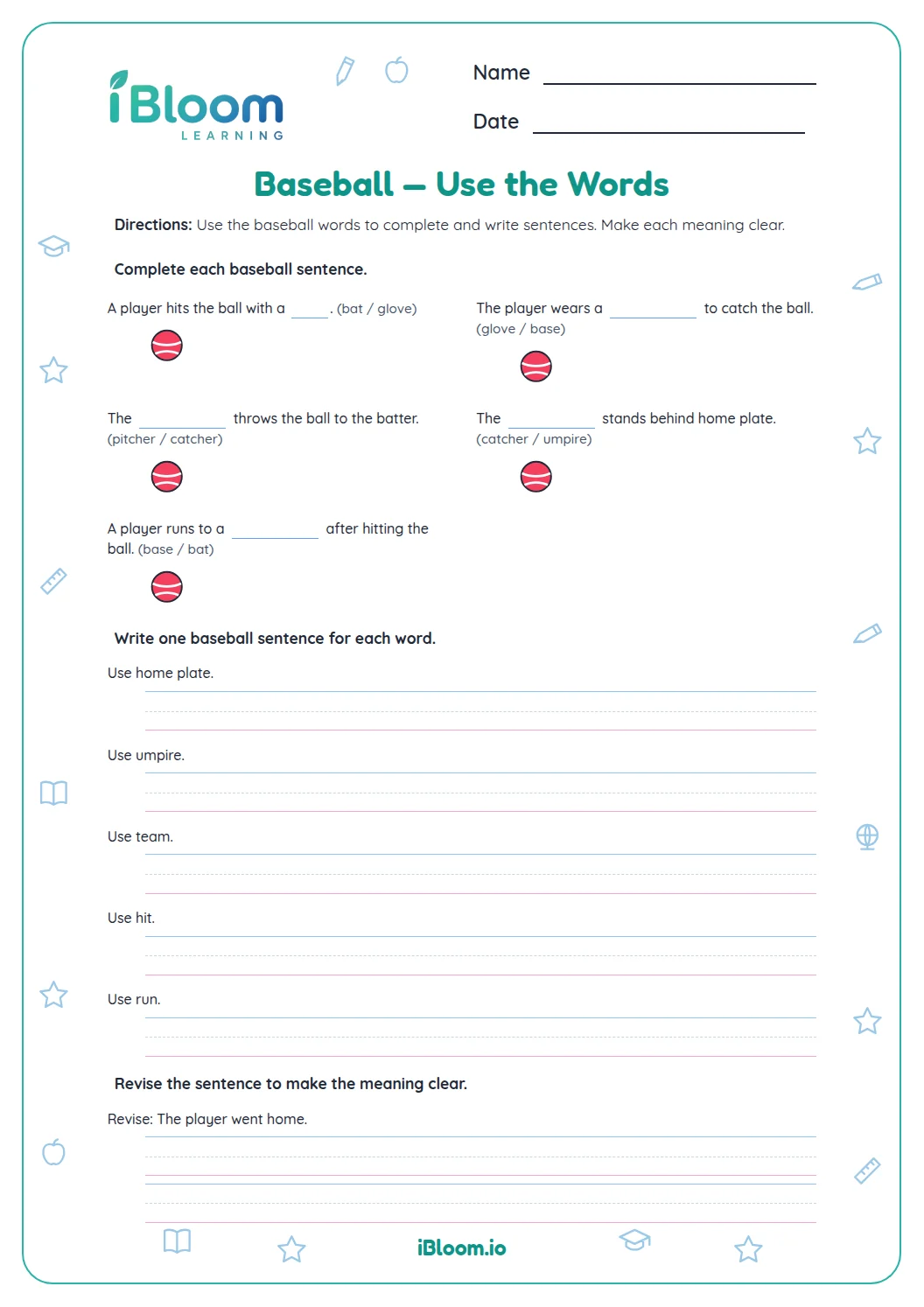
This two-page Grade 1 worksheet practices four forms of splash: splash, splashes, splashed, and splashing. Children use sentence clues such as “yesterday,” “right now,” and “every time” to choose the form that fits, then write their own sentences with each form and revise one sentence with more detail. The answer key gives model sentences for the open writing prompts. The page supports CCSS L.1.4.c by connecting a root word with its inflectional forms.
Aligned to L.1.4.c
What does the splash worksheet include?
The 16 questions begin with choosing a form of splash for a sentence. Students then write one sentence with each of the four forms and revise a short sentence to make its meaning clearer.
Time clues and sentence grammar help identify the needed form. “Yesterday” points to splashed, while “I am” is followed by splashing. The writing section lets children use those forms in their own ideas.
- Part A: choose a splash form in 12 sentences
- Part B: write sentences using splash, splashes, splashed, and splashing
- Part B also asks students to add detail to one sentence
How do you choose the right form of splash?
Look for time clues and for the words before the blank. A sentence about yesterday calls for splashed; a sentence with “I am” calls for splashing. With one person or thing doing something regularly, splashes may fit.
- 1Yesterday, we ___ near the shore.
- 2“Yesterday” tells when the action happened.
- 3Answer: splashed
What makes a sentence with splash clear?
A complete sentence tells who or what is splashing and what happens. The worksheet provides a line for each word form, then asks students to revise “The child was splashing” with more detail, such as where or how the child splashed.
How to work through the worksheet
- 1Read the complete sentence and notice its time clue.
- 2Check who is doing the action.
- 3Choose the form that fits both the time and the sentence.
- 4Write a complete sentence for each listed form.
- 5Add a detail when revising the final sentence.
Common mistakes and quick fixes
The mistake
Using splashes with “we.”
The fix
Match the subject: “We splash,” but “The duck splashes.”
The mistake
Using splashing without a helping verb in a sentence like “I am ___.“
The fix
Keep the helping verb and use splashing: “I am splashing.”
The mistake
Using splashed with a present-time clue.
The fix
Look for words such as yesterday or last night; those clues signal past time.
Common Core alignment
This worksheet practices skills described in these grade-level language or reading standards.
Identify root words and their inflectional forms.
On this sheet: Students connect the root word splash with its inflectional forms.
Show the official wordingHide the official wording
Identify frequently occurring root words (e.g., look) and their inflectional forms (e.g., looks, looked, looking).
What to practice next
Make more practice
Questions parents and teachers ask
Which word forms appear on the page?
Children practice splash, splashes, splashed, and splashing. The first part asks them to choose the form that fits each sentence. The writing prompts then give each form its own sentence, followed by one revision prompt. The answer key includes sample responses.
When should a child use splashes?
Use splashes when one person or thing does the action in the present, as in “The duck splashes in the pond.” With I, you, we, or they, use splash: “We splash near the shore.” Match the verb to its subject.
How is splashed different from splashing?
Splashed tells that the action happened in the past, as in “Yesterday, we splashed.” Splashing names an ongoing action when paired with a helping verb: “I am splashing.” Time words and helping verbs make useful clues for choosing the right form.
What does the writing section ask students to do?
Students write a sentence with each of the four forms—splash, splashes, splashed, and splashing—then add detail to “The child was splashing.” The key offers sample responses, while other clear sentences can also be correct if they use the word appropriately.
How many questions are there?
There are 16 questions across two worksheet pages: 12 sentence choices and four writing prompts. The answer key marks the correct form in each choice and offers sample writing so an adult can review responses that vary. Ask the child to explain which time clue helped with each choice.