



About this worksheet
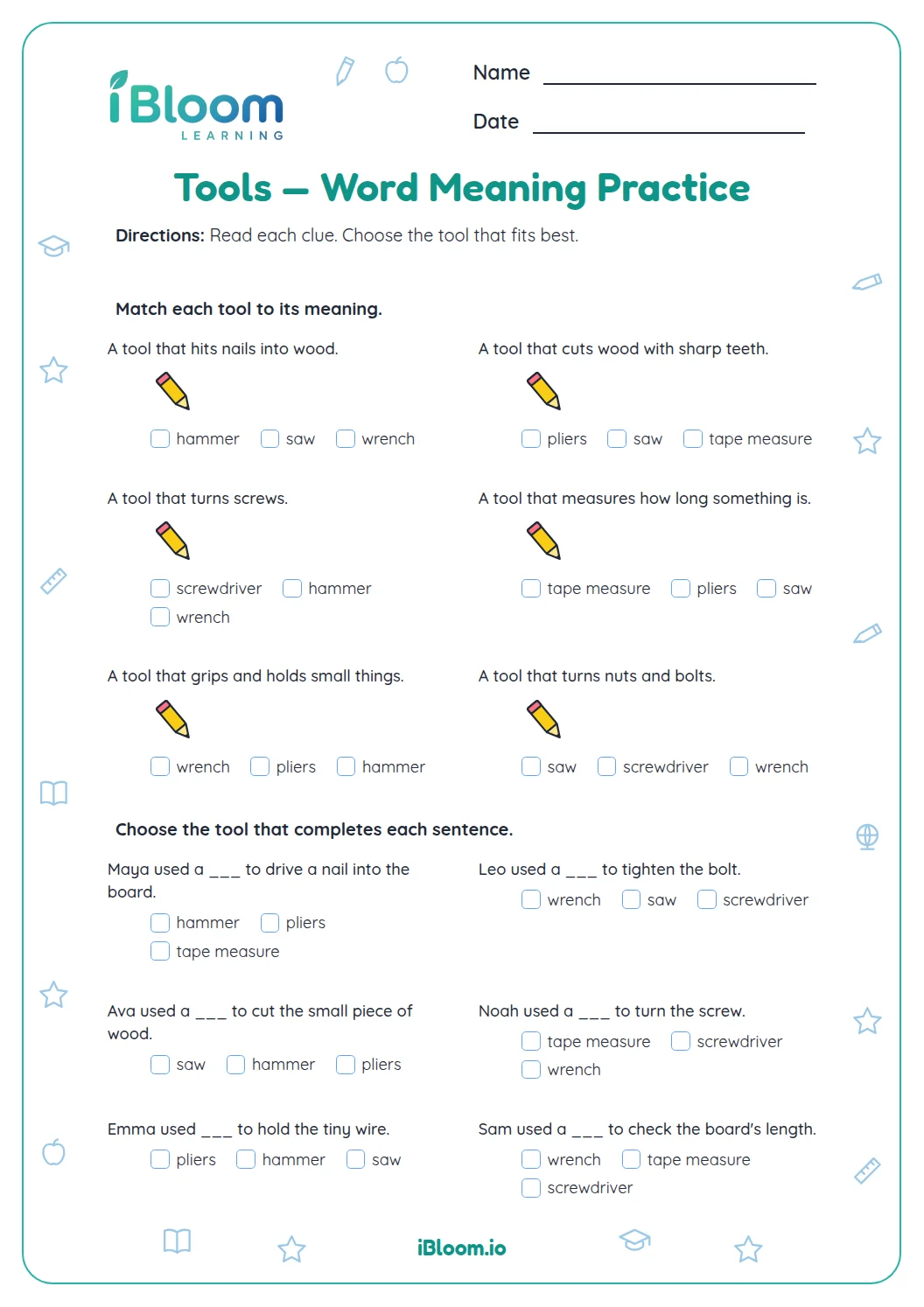
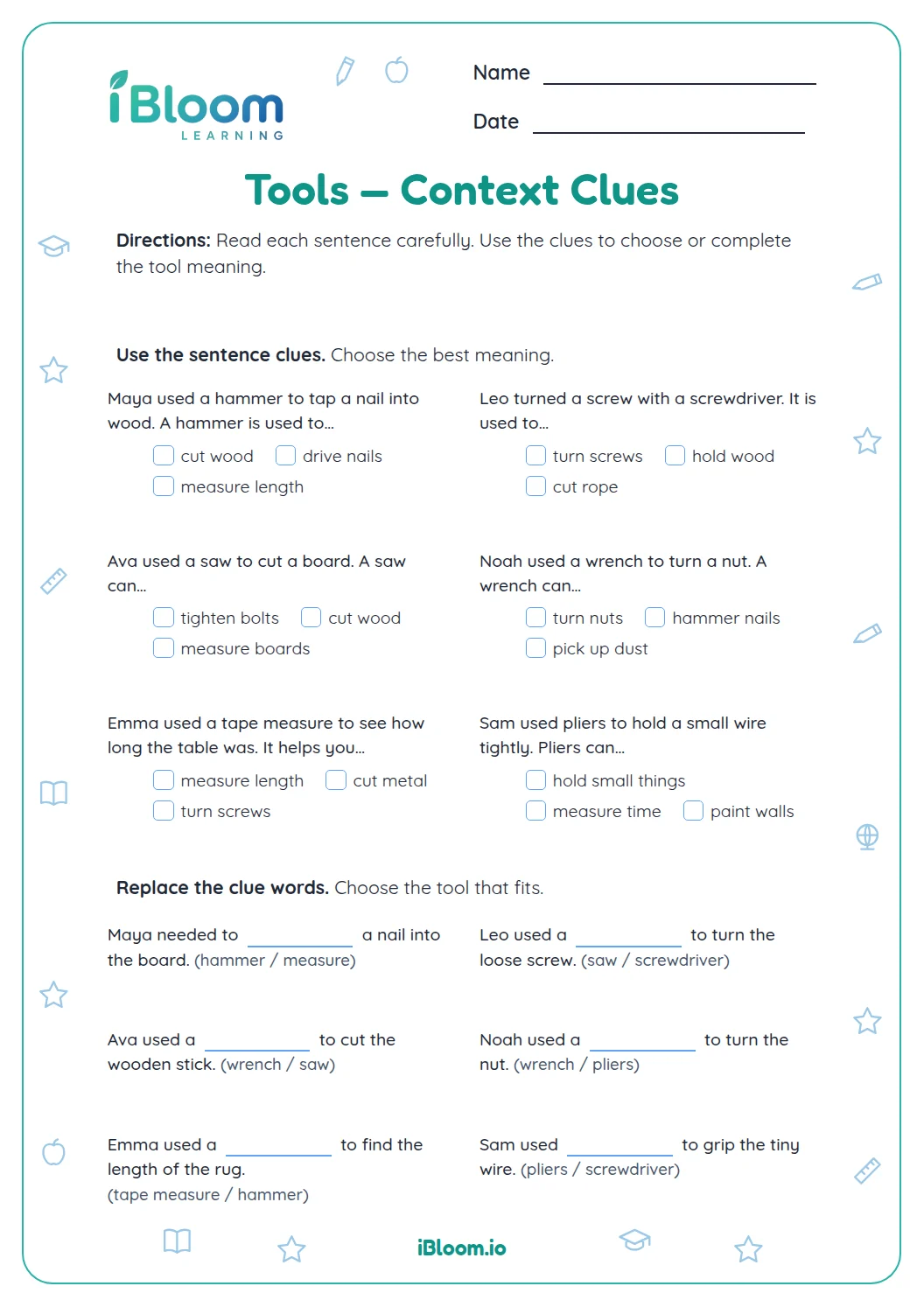
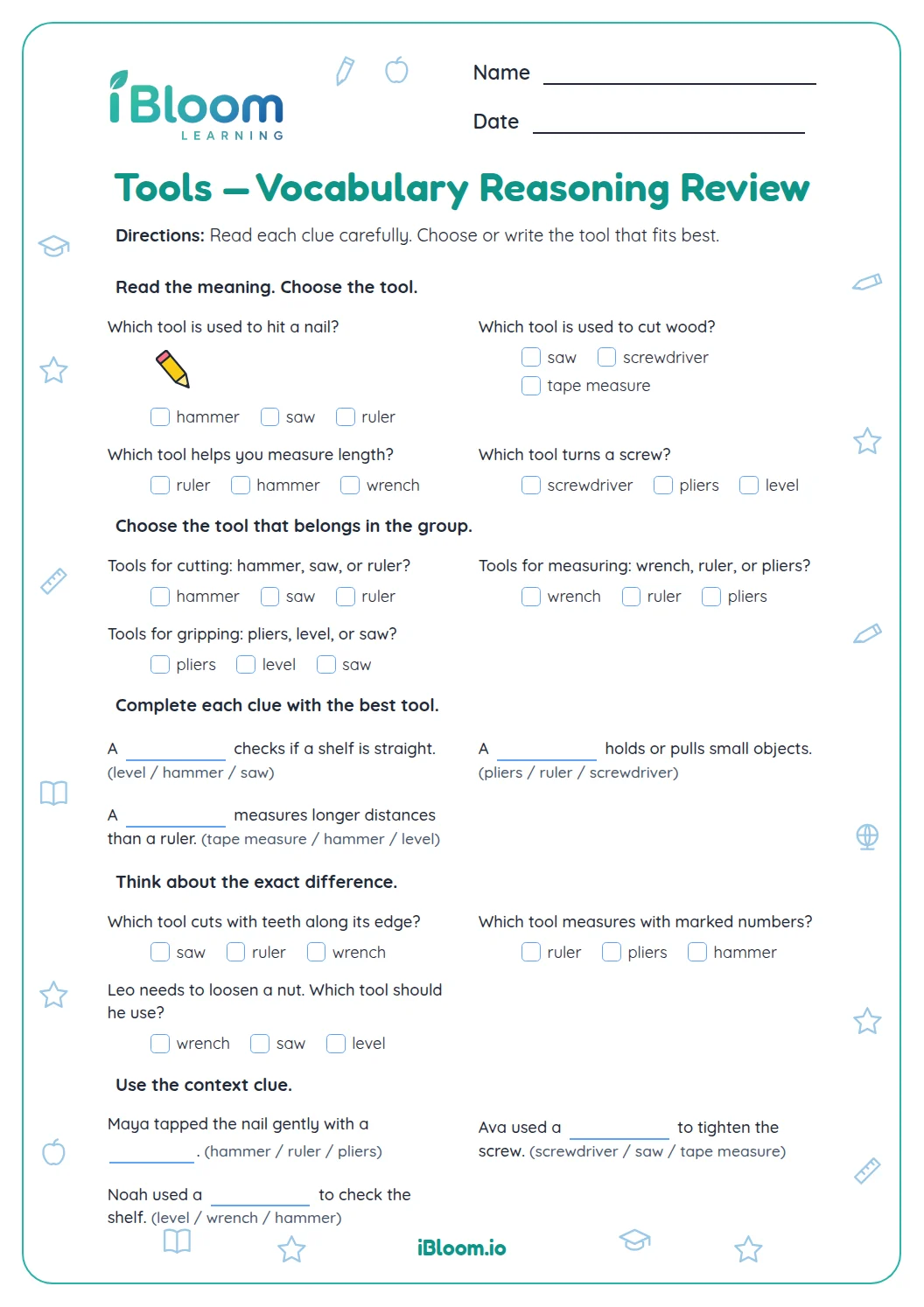
This free printable Grade 1 vocabulary worksheet helps children use six tool words: hammer, saw, rake, shovel, ruler and scissors. In Part A, they choose a tool that fits a short sentence about its job. In Part B, they complete four sentences with tool names. Part C asks them to write two sentences that explain how tools are used. The 14 questions practice Common Core L.1.4a and L.1.6 by connecting sentence clues with word meanings and using learned words in writing. The separate answer key includes sample sentences for the two open responses.
Aligned to L.1.4a and L.1.6
Which tool words will children use?
The six words are hammer, saw, rake, shovel, ruler and scissors. Each appears in Part A with a job clue: driving a nail, cutting wood, gathering leaves, digging a hole, measuring a length or cutting paper.
Say the words together before starting if any are unfamiliar. The activity is about vocabulary, so a child can describe a tool even if they have never used one.
How do the job clues help children choose?
Read the whole sentence and identify the action. In question 5, the words “measure a line” tell children to choose ruler. The other choices are tools too, so they must think about the job rather than simply recognize a tool name.
- 1I measure a line with a ___.
- 2Choices: shovel, ruler, rake
- 3The job is measuring a length.
- 4Answer: ruler
What makes a useful sentence in Part C?
A useful answer includes the named tool and explains a job it does. “A hammer drives a nail” gives more information than “I see a hammer.” Children may choose different wording as long as the tool use makes sense.
The answer key provides one sample for hammer and one for ruler. Accept a different accurate sentence; ask the child to read it aloud and point to the tool word.
How to use this worksheet
- 1Say all six tool words and talk briefly about each job.
- 2Read the first clue and ask which action helps identify the tool.
- 3Let the child complete Part A, reading the clues aloud if needed.
- 4For Part B, say the missing tool name before writing it in the sentence.
- 5In Part C, check that each sentence names the tool and explains a job.
Mistakes to check and ways to help
The mistake
Choosing scissors for the clue about cutting a board.
The fix
Point to “board” and compare a saw cutting wood with scissors cutting paper.
The mistake
Choosing shovel for the sentence about pulling leaves together with teeth.
The fix
Point to “teeth” in the clue. A rake has a row of teeth that pull leaves into a pile.
The mistake
Writing “I like my ruler” when asked to explain a ruler’s job.
The fix
Ask what the ruler helps measure, then add that action to the sentence.
Common Core alignment
Use clues about a job to choose the tool word that fits.
On this sheet: Parts A and B use actions such as measuring, digging and cutting as clues to tool names.
Show the official wordingHide the official wording
Use sentence-level context as a clue to the meaning of a word or phrase.
Use learned tool words to write sentences about what tools do.
On this sheet: Part C asks children to use hammer and ruler in original sentences about their jobs.
Show the official wordingHide the official wording
Use words and phrases acquired through conversations, reading and being read to, and responding to texts, including using frequently occurring conjunctions to signal simple relationships (e.g., because).
What to practice next
Make more practice
Further reading
Questions parents and teachers ask
Which six tool words are practiced?
The worksheet practices hammer, saw, rake, shovel, ruler and scissors. Part A gives one job clue for each word. Part B reuses hammer, shovel, rake and scissors in new sentences, and Part C asks children to write about the jobs of a hammer and a ruler.
Can I read the clues to my child?
Yes, you can read the clues and answer choices aloud. Keep the focus on connecting the tool word to its job. Ask the child to repeat the useful clue, such as “measure a line,” before choosing a tool and explaining why that choice makes sense.
What should the two written sentences include?
Each sentence should include the requested tool word and an accurate job. A hammer sentence might say that a hammer drives a nail, while a ruler sentence might describe measuring a book. The key gives sample responses, but children can write different sentences with the same clear meaning.
Does my child need to handle real tools?
No, the vocabulary questions can be answered by reading and discussing the sentences. Children connect names with jobs such as digging a hole or cutting paper. If a word is unfamiliar, describe the tool and its action before returning to the clue on the sheet.
How can I check a sentence that differs from the key?
Check the meaning rather than matching every word. If the child writes “Dad uses a hammer to put a nail in wood,” it answers the hammer prompt accurately. Ask whether the tool is named, its job is clear and the sentence makes sense when read aloud.