




About this worksheet
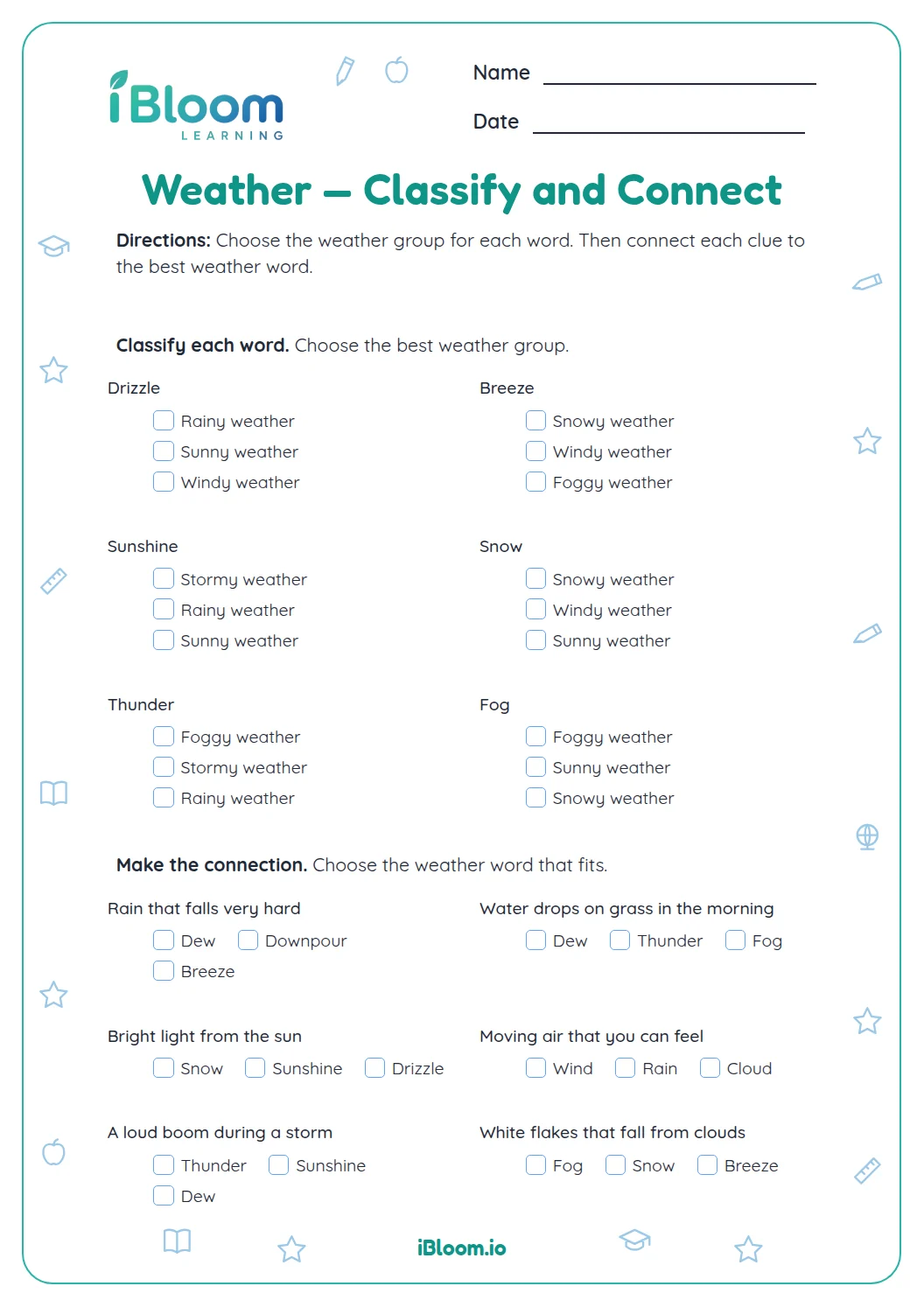
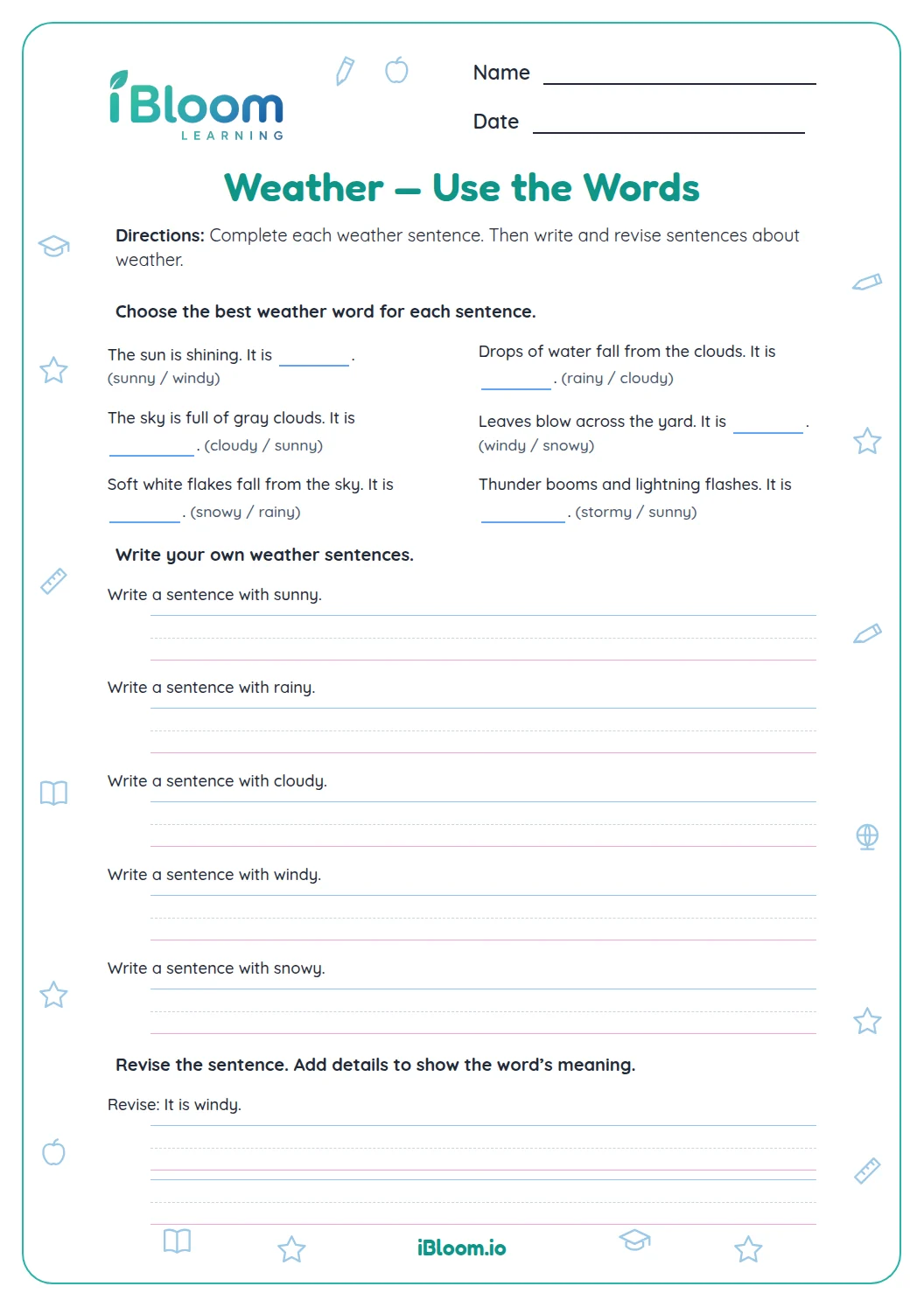
This Grade 1 weather vocabulary worksheet gives children 14 sentence clues and an eight-word search to solve. They answer seven multiple-choice questions, then complete seven sentences with a weather word. Details about clouds, drops, wind, flakes, and sunshine help children connect familiar conditions with precise words. The page practices CCSS L.1.4a, using sentence-level context to clarify a word’s meaning. Children also find eight weather words in a grid. A separate answer key is included.
Aligned to L.1.4a
How do context clues help name the weather?
A context clue is a detail near a word or question that helps show meaning. Clouds, drops on a roof, and leaves blowing can point to stormy, rainy, or windy weather. Read the whole sentence before choosing a word.
How can readers tell similar weather words apart?
Some details fit more than one condition, so look for all the clues together. Dark clouds and rain may signal a storm, while a low cloud that hides faraway objects suggests fog. The answer should match the complete sentence.
How can a child explain a weather answer?
Name the weather word and point to the clue. Drops tapping on the roof suggest rain; blowing leaves suggest wind. After the sentence clues, the word search gives children another way to recognize the same weather vocabulary.
- 1Clue: dark clouds cover the sky; rain may fall soon.
- 2Think about both dark clouds and coming rain.
- 3Choose the word that matches: stormy.
How to use this worksheet
- 1Read the whole sentence before choosing a weather word.
- 2Look for details about clouds, drops, wind, flakes, or sunshine.
- 3Complete each sentence with the word that fits its clue.
- 4Find all eight listed weather words in the grid, marking each one.
- 5Explain the final answer by naming the detail that helped.
Common mistakes and quick fixes
The mistake
Choosing a word because it shares one detail, such as clouds.
The fix
Check all the clues in the sentence before deciding.
The mistake
Mixing up weather and a single weather object.
The fix
Ask what the sky or air is like: rainy describes a condition; rain is the water falling.
The mistake
Finding only the first few grid words and stopping.
The fix
Cross off each word as it is found, then scan every row again.
Common Core alignment
This page asks readers to use sentence context to identify weather vocabulary.
Use each sentence’s weather details as a clue to word meaning.
On this sheet: The 14 sentence items pair weather clues with the word that describes the condition.
Show the official wordingHide the official wording
Use sentence-level context as a clue to the meaning of a word or phrase.
What to practice next
Make more practice
Further reading
Questions parents and teachers ask
Which weather words are in the word search?
The grid contains sunny, rainy, windy, snowy, cloudy, foggy, stormy, and rain. The page also has 14 sentence clues where children choose or write a weather word. The answer key lists the clue answers and the words to find.
How do context clues help with weather words?
Details in a sentence point toward a word’s meaning. Drops on the roof suggest rain, while leaves blowing in moving air suggest windy. Reading the full sentence helps children use more than one clue. Encourage the child to say the clue aloud before choosing a word.
How many activities are on the page?
There are 15 activities: seven multiple-choice sentence clues, seven fill-in sentences, and one word search with eight weather words. Children use sentence details to name weather conditions, then find the same vocabulary in the grid. The separate answer key lists all answers.
Can an adult read the clues aloud?
Yes. An adult can read each sentence and ask the child which details describe the sky or air. The child can then choose a word and point to the clue that helped. Invite the child to repeat the clue and match it to the weather word.
What answer fits the last sentence clue?
The final fill-in sentence describes a wet sidewalk and drops tapping on the roof, so rainy fits. The falling drops are the detail that supports the word. The key provides the same answer, and the child can underline the clue before writing.