


About this worksheet
This Grade 1 printable pairs a weather word search with vocabulary practice. Children find eight words in the grid, then answer thirteen short questions about weather words and their meanings. The word search provides a visual way to scan for familiar words; the follow-up asks children to connect each word to a simple clue or sentence. The source record includes old-sheet URLs, but the original image could not be reviewed in this workspace.
How does the word search help?
The grid includes sun, rain, wind, cloud, snow, fog, hot, and cold. After circling each word, read the clue questions and think about what each word means.
How can a clue point to a weather word?
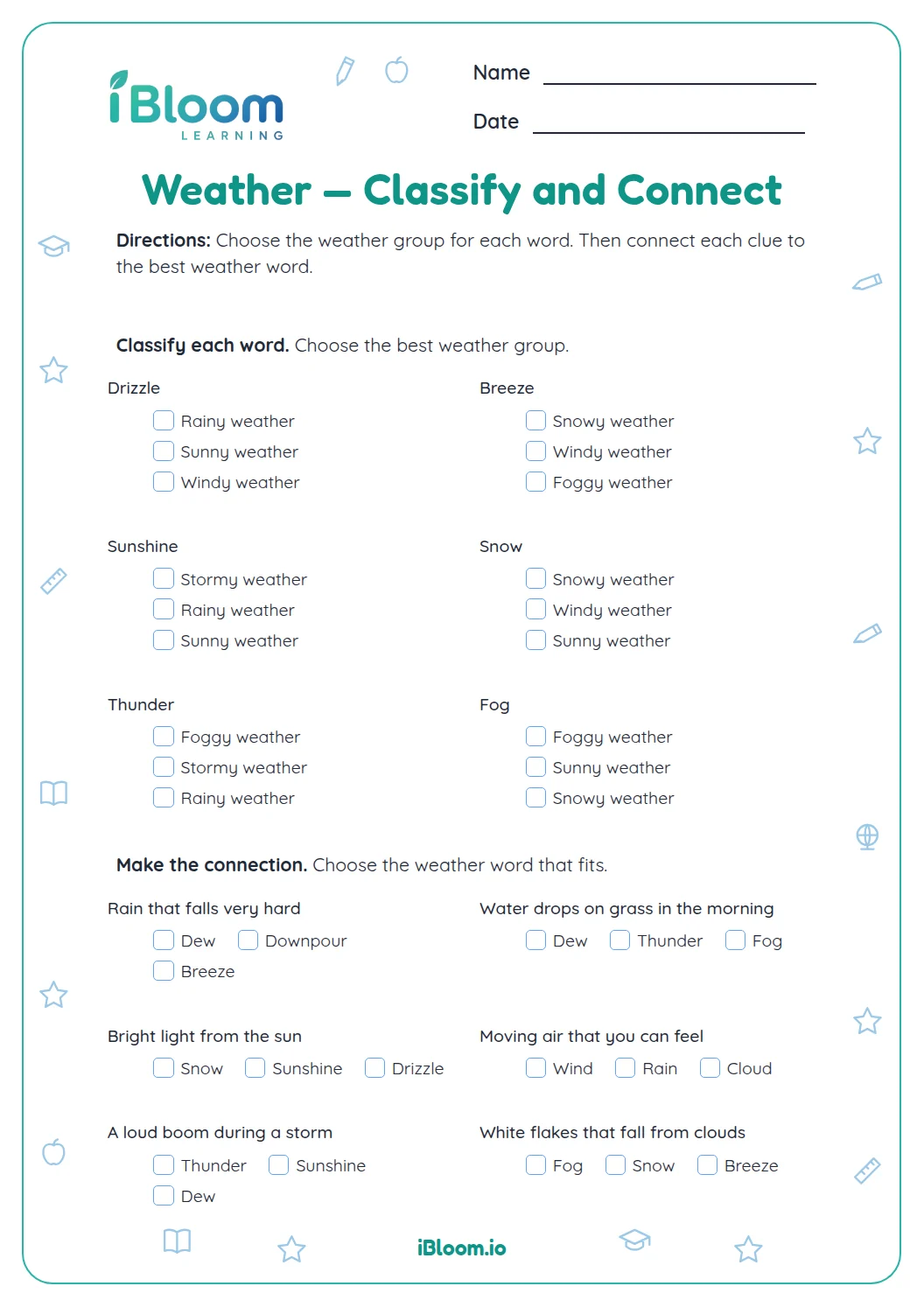
In “What moves the leaves on a tree?” moving air is the clue. The matching weather word is wind.
- 1What moves the leaves on a tree?
- 2Answer: wind
How to use this worksheet
- 1Scan one row at a time for the first letter of a listed word.
- 2Circle a complete word from left to right.
- 3Read each clue question slowly.
- 4Choose the weather word that fits the clue.
- 5Check each answer with the key.
Common mistakes and quick fixes
The mistake
Stopping after finding the first letter.
The fix
Check the letters that follow before circling.
The mistake
Mixing up hot and cold.
The fix
Ask whether the clue describes warmth or a lack of warmth.
The mistake
Choosing a word that is weather-related but does not fit the clue.
The fix
Reread the whole clue and test the word in it.
What to practice next
Make more practice
Questions parents and teachers ask
Which words are hidden in the puzzle?
The puzzle hides sun, rain, wind, cloud, snow, fog, hot, and cold. Each word runs from left to right. Children can cross off each word on the printed list after they find and circle it. Invite the child to point to a clue word, say it aloud, and explain why it fits before checking the key.
What should a child do after the word search?
After circling the eight words, answer the clue questions on the sheet. The questions ask children to match simple descriptions with weather words, such as moving leaves with wind. Invite the child to point to a clue word, say it aloud, and explain why it fits before checking the key.
Does the worksheet include an answer key?
Yes. The answer key gives the eight words in the grid and the answer to each vocabulary clue. Use it after the child has tried the puzzle and questions independently. Invite the child to point to a clue word, say it aloud, and explain why it fits before checking the key.
How can I help without giving away an answer?
Ask the child to reread the clue and say what it describes. For the moving leaves clue, for example, ask what makes leaves move. Let the child choose the matching word and then check the sentence aloud. Invite the child to point to a clue word, say it aloud, and explain why it fits before checking the key.
How long does the activity take?
Plan for about 15 minutes, depending on how quickly the child finds words and reads the clues. A child who is new to word searches may benefit from completing the grid first and taking a short pause before the questions.