




About this worksheet
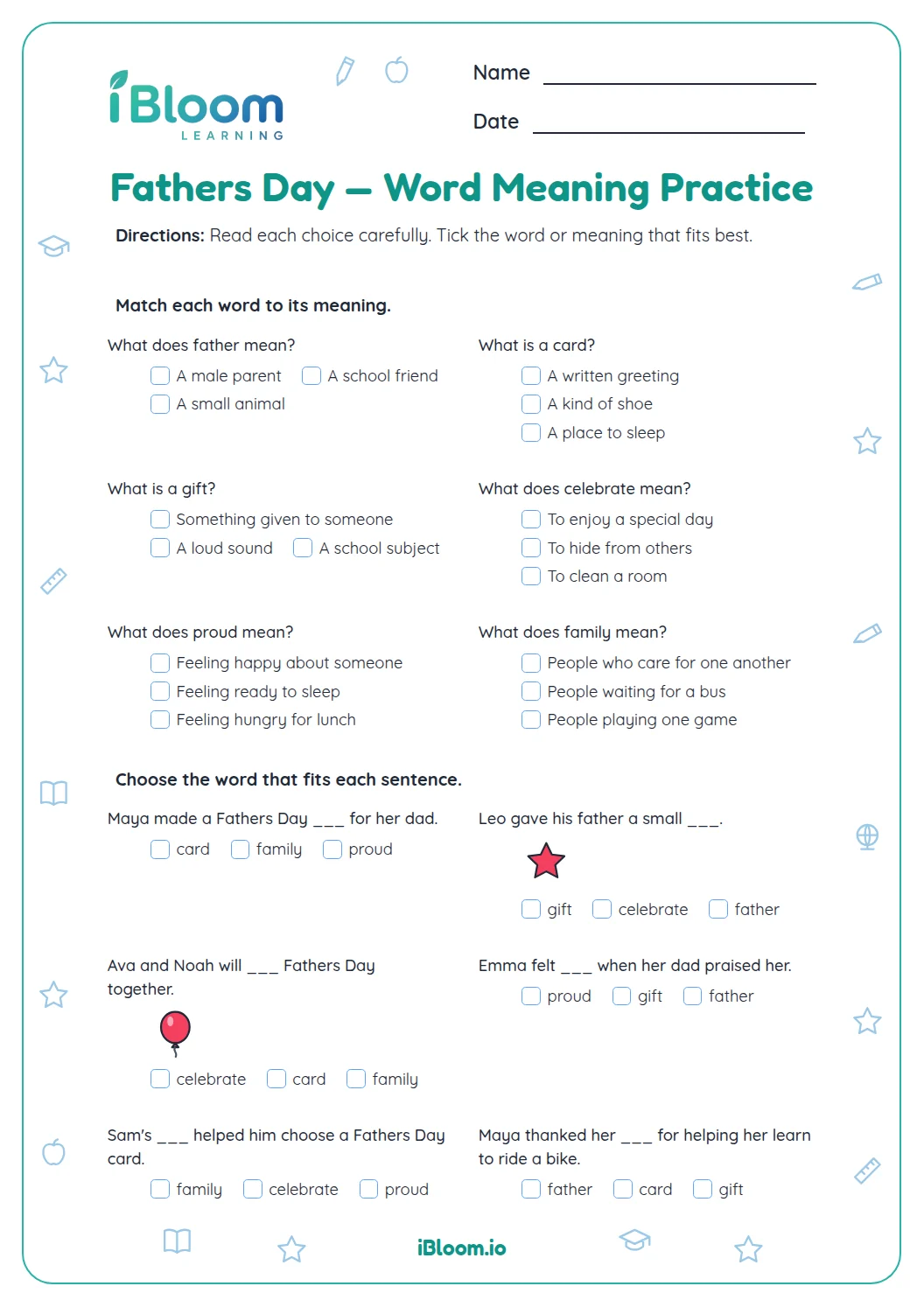
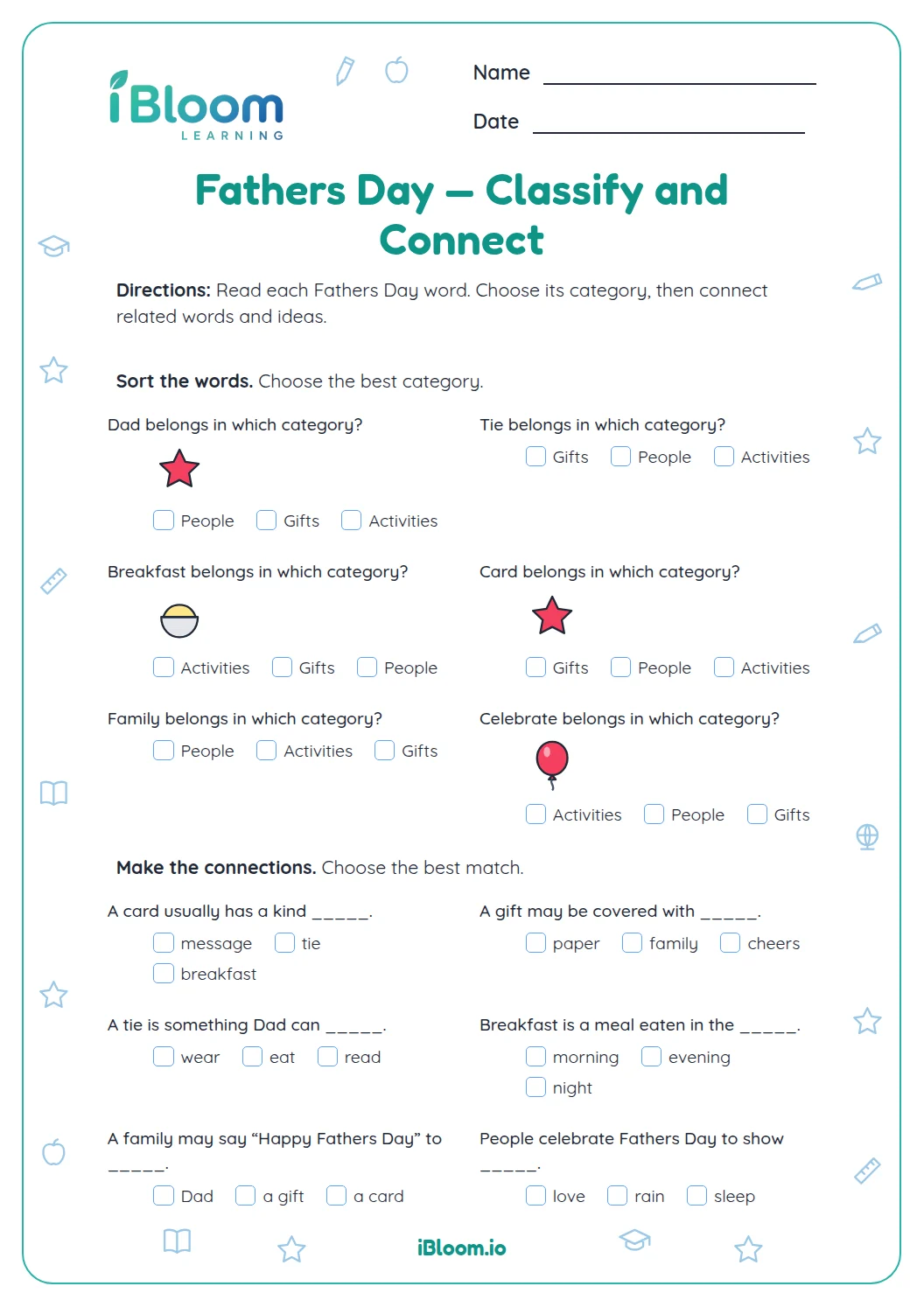
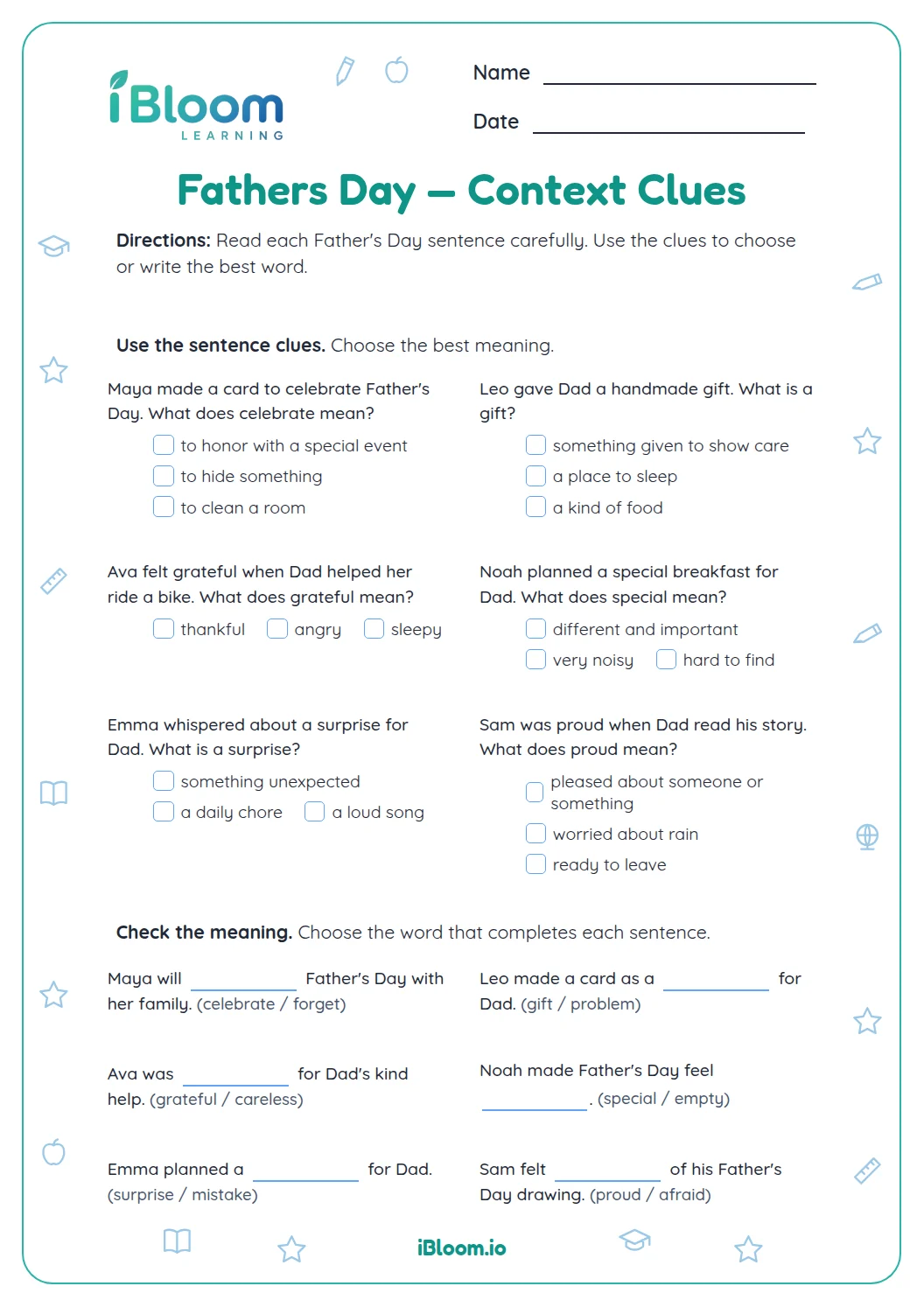
This free Grade 2 Father’s Day worksheet reviews words for giving, remembering and showing thanks. Children answer six meaning questions, compare four ideas, complete four sentences and finish with two questions about appreciation and shared activities. The vocabulary includes gift, card, celebration, memory, dad, grateful, personal and surprise. Children connect these words to familiar actions, such as writing a note or making breakfast together. This practices Common Core L.2.5a, linking words with their use in real life. A separate answer key covers all sixteen questions.
Aligned to L.2.5a
Which words does this sheet review?
Part A introduces gift, card, celebration, memory, dad and grateful. Each question asks children to choose a meaning or connect a word with a short situation. A wrapped-gift picture helps with the gift sentence in Part C.
Part B adds personal and surprise, compares thankful with grateful, and asks which action shows appreciation. Part C uses card, grateful, memory and gift in sentences. Part D checks appreciation and shared activities.
How do children compare meanings and ideas?
Ask what the word tells about the situation. A card with a note written just for Dad is personal. A surprise is something he did not expect. Thankful and grateful have similar meanings, so either can describe feeling glad about someone’s help.
How do sentence clues help children choose a word?
Read the whole sentence and try each word in the pair. In question 13, Ava remembers fishing with Dad. A memory fits because it is something remembered; a receipt is a record of a purchase.
- 1Ava has a happy ___ of fishing with Dad. (memory / receipt)
- 2Clue: she remembers something they did together.
- 3A memory is something remembered from the past.
- 4Answer: memory.
How can children explain appreciation?
Appreciation means recognizing and valuing what someone does for you. Saying thank you is one way to show it. Question 15 asks children to connect Emma’s words with appreciation. Question 16 checks shared: Sam and Dad make breakfast together, so both take part.
Connect each word to its meaning
- 1Read each Part A question aloud if needed, then compare the choices.
- 2In Part B, ask what detail makes the chosen word or action fit.
- 3Try both choices in each Part C sentence before writing the missing word.
- 4For Part D, explain how thank you and together help identify the answers.
- 5Check the key, then ask for one new example of being grateful or sharing an activity.
Mistakes to notice and how to fix them
The mistake
Choosing gift as the meaning of memory.
The fix
A gift is given to someone. A memory is something you remember, such as fishing with Dad.
The mistake
Thinking a surprise must be a large gift.
The fix
The important clue is whether the person expects it. Size does not make something a surprise.
The mistake
Choosing an activity done alone as shared.
The fix
Shared means people take part together, as Sam and Dad do when they make breakfast.
Common Core alignment
Connect words such as grateful, personal and shared with everyday actions and experiences.
On this sheet: Children connect giving, remembering, thanking and doing activities together with the words that describe them.
Show the official wordingHide the official wording
Identify real-life connections between words and their use (e.g., describe foods that are spicy or juicy).
What to practice next
Make more practice
Further reading
Questions parents and teachers ask
Which Father’s Day words are practiced?
The questions use gift, card, celebration, memory, dad, grateful, personal, thankful, surprise, appreciation and shared. Children choose meanings and compare examples before completing four sentences. The final two questions ask them to connect saying thank you with appreciation and making breakfast together with a shared activity.
What is the difference between grateful and appreciation?
Grateful describes how someone feels when thankful for help or kindness. Appreciation names the feeling or recognition of that kindness. On this sheet, Leo feels grateful when Dad helps him, and Emma shows appreciation by saying thank you. Ask children to explain each situation in their own words.
How do children complete the four sentences?
Children choose one word from the pair beside each sentence and write it in the blank. The answers are card, grateful, memory and gift. Encourage them to read the completed sentence aloud and point to the clue that makes that word fit the situation.
Can children talk about another caring adult?
Yes, children can discuss the vocabulary using examples involving another caring adult. The printed questions use Dad and Father’s Day, while words such as grateful, memory and appreciation apply to many relationships. Keep the printed answers tied to the questions, then invite personal examples during discussion.
What is included in the answer key?
The separate answer key gives the correct choice for twelve questions and the missing word for four sentences. It covers all sixteen tasks. After checking, ask children to explain one choice using its meaning, such as why making breakfast together counts as a shared activity.