





About this worksheet
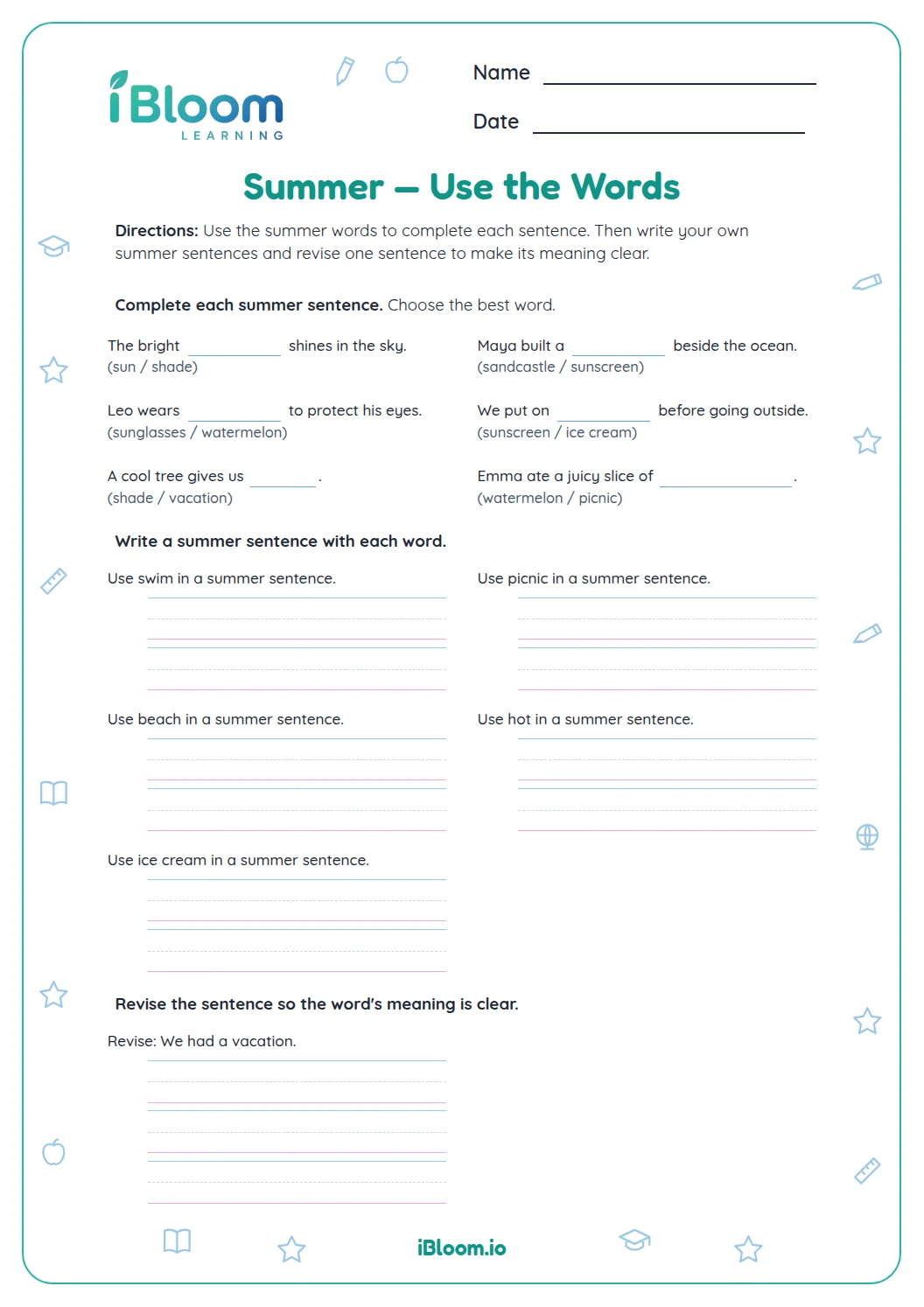
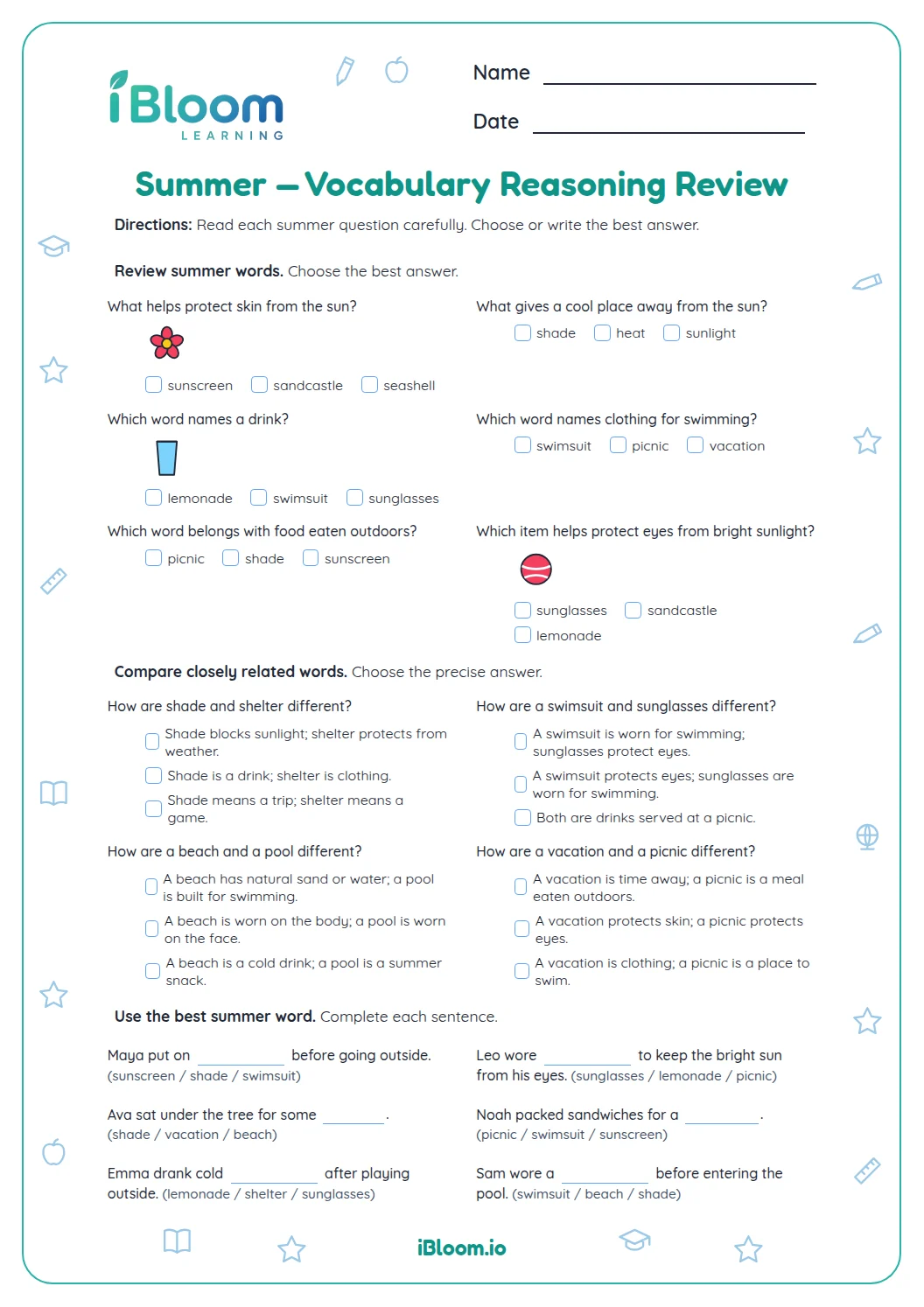
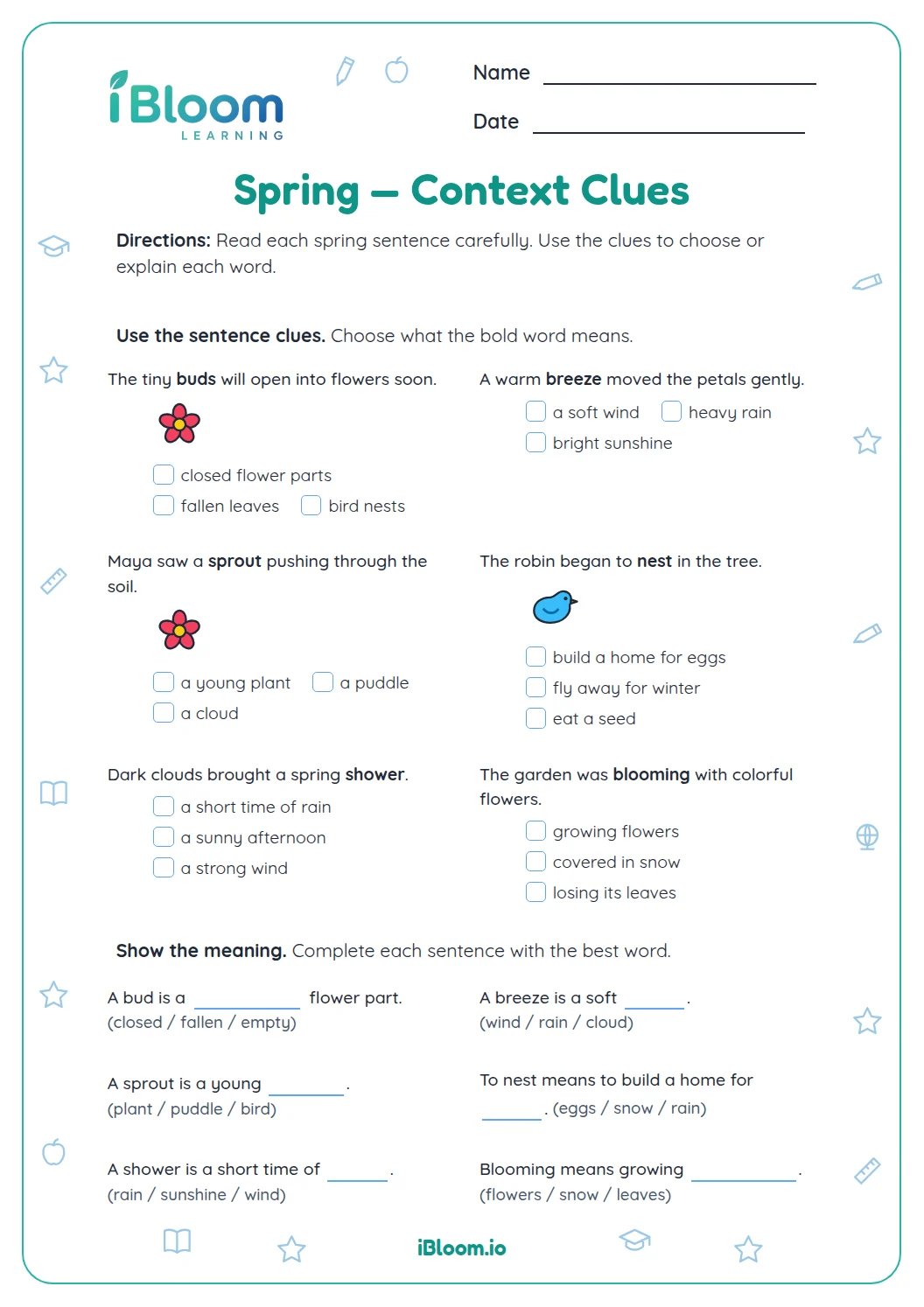
This Grade 2 summer vocabulary worksheet gives sentence-level context-clue practice. Students choose the meaning that fits each sentence, using nearby details about shade, a breeze, a picnic, and other summer situations. Each item asks about a different word, so students use the full sentence to work out meaning rather than repeat a definition. An answer key lists the best-fitting choice for all 14 questions.
Aligned to L.2.4.a
How can nearby words point to a meaning?
Read the complete sentence and notice details around the target word. In “Sam felt a cool breeze near the lake,” cool and felt help show that a breeze is a light wind. The 14 questions use different summer words and situations.
- 1“Sam felt a cool breeze near the lake.”
- 2Cool and felt point to a light wind.
How can a clue rule out other meanings?
Ask whether each choice fits the whole sentence. In “The ice cream melted in the hot sun,” a change from solid to liquid fits; getting colder does not. This check helps students use sentence evidence instead of choosing from the topic alone.
Why use the meaning in a new sentence?
The final six questions use fresh words, including damp, packed, exhausted, lifeguard, scorching, and dusk. Their surrounding details help students infer what each word means. The key gives the intended choice for every sentence.
How to use this worksheet
- 1Read the full sentence before choosing a meaning.
- 2Notice details about the setting, action, or result.
- 3Try each choice in the sentence and see which one fits.
- 4Choose the meaning supported by the nearby clues.
- 5Use the key to review the clue that helped most.
Common mistakes and quick fixes
The mistake
Choosing a meaning from the topic alone.
The fix
Read all the words around the target; “under a tree” and “hot sun” help define shade.
The mistake
Confusing breeze with a storm.
The fix
A breeze is a light wind; the clue “cool” supports that meaning.
The mistake
Treating melting as getting colder.
The fix
Connect hot sun and ice cream with a change from solid to liquid.
Curriculum alignment
This practice connects the page activities with the listed learning standard.
Use sentence clues to work out the meaning of a summer word.
On this sheet: Each vocabulary choice uses sentence context to identify a word meaning or fitting replacement.
Show the official wordingHide the official wording
Use sentence-level context as a clue to the meaning of a word or phrase.
What to practice next
Make more practice
Further reading
Questions parents and teachers ask
How do context clues help with a new word?
The surrounding words give hints about an unfamiliar word. In “Sam felt a cool breeze near the lake,” cool and felt point to a light wind. On this worksheet, students read each whole sentence and select the meaning that fits its details.
What does shade mean in this worksheet?
Shade is a cooler place away from direct sunlight. The tree gives Leo a place to rest out of the bright sun. Question 3 asks students to select the meaning that fits those clues. Ask your child to name the clue words that helped narrow the meaning.
How does this worksheet practice summer vocabulary?
The worksheet uses summer situations to give clues for different word meanings. A tree blocks the hot sun, a towel is damp after a swim, and a lifeguard watches swimmers. Students choose the meaning supported by each sentence, then check all 14 answers with the key.
How many questions are on the worksheet?
There are 14 multiple-choice questions, one for each target word. The first items use words such as sunny, shade, thirsty, and breeze; the later items add damp, packed, exhausted, lifeguard, scorching, and dusk. The answer key lists the intended meaning for each sentence.
Can students use a different meaning than the choices?
The page asks students to choose from printed meanings, and the key shows the intended choice. In conversation, a child may explain the idea in different words if it still fits the sentence; for example, a breeze is a light or gentle wind. Ask which words gave the clue.
What does melting mean in the ice-cream sentence?
Melting means changing from a solid to a liquid. The ice cream sentence places it in the hot sun, which helps students infer the change. The question asks them to choose that meaning from three options, and the key lists “Solid changes to liquid.”